The Je Ne Sais Quoi to it All

By Mark E. Smith

There’s an ultimate je ne sais quoi to it all. It’s the tipping point where your skin fits – perfectly. It’s that inexplicable eloquence as you glide through life defying any preconceived notions of who you should be, all because you just are who you are, not a facade or a mirage, but true from the inside, out. Your core, anchored stronger than concrete, even an 8.0 on the Richter scale can’t shake you. As Nina Simone put it, “I’ll tell you what freedom is to me – no fear.” And, I’ll add that in everything you do, you don’t need to worry about any of it. Man, Woman, brothers and sisters – the je ne sais quoi of us all – just be. You.

Video:

Foul Mouth Kids

foul

By Mark E. Smith

In my neighborhood, none of us kids took anything from anyone. It was where the two sides of the tracks intersected – upper- and lower-class kids intertwined. Neither had much parental guidance. You just never knew where anyone’s parents were. Some were drinking in dark bars in the afternoon, others working in the city in high-rises till all hours, and some straddling both lives. Because of this, in my neighborhood, most kids had free reign from parents, and when out wondering our suburban streets, you didn’t take gruff from anyone.

Being the kid who used a wheelchair didn’t make me exempt from any of it – the dysfunctional home, taking jabs from the other kids or dishing it back. Mostly, though, I kept to myself after school. At 14, I had a lot going on teaching myself to be independent with cerebral palsy. I was three or four years into my mission of being as independent as possible and I saw a lot of progress. My main self-therapy was pushing my manual wheelchair for two hours or so after school every day. The repetitive motion of pushing my manual wheelchair was a sound exercise in strength and coordination. But, I was dismal at it. I’d started a few years earlier barely able to propel across our living room, and by this point, I could make it around our neighborhood. Yet, there was no grace in it.

I pushed painfully slowly. Really, it wasn’t even pushing – pushing implies consistent movement. For me, it was push, roll feet or inches, regather my flailing, spastic limbs and then push again. All that mattered, though, was that I was seeing progress.

As I went out each day, I purposely stayed on quiet streets. I needed to do what I had to do and didn’t want to be bothered. Besides, I never knew if anyone would understand why I was doing what I was doing, and I didn’t want to have to answer any questions. When I was eight, I was in a grocery store trying to buy a pack of gum and an elderly woman made a huge scene that crippled people like me shouldn’t be out alone in public. That experience shook me a bit, and I suppose it made me want to avoid such a scene while out pushing my manual wheelchair, self-aware of how awkward I looked. So, the side streets were my sanctuary, where I could push and progress at my own pace, in solitude.

There was a hill leading to our driveway. It wasn’t the steepest of hill, but long – maybe two blocks – lined by vacant land on each side. It took me a good year to get to where I could push up that hill myself, but I got to where I could do it, although it was forever a challenge, inch by inch.

One afternoon while halfway up the hill, a group of neighborhood kids came up from behind me.

“Need help?” one of them asked as they all surrounded me.

“Do I look like it?” I asked with an attitude, pushing toward a boy standing in my path.

“Yeah,” they all replied at once, laughing.

“Screw you!” I shouted, giving my chair another push, wanting to be left alone.

“Screw you!” they shouted back as they walked in front of me.

“You’ll never make it up the hill, retard,” one kid yelled.

I pushed even harder.

“And I’m going to kick your ass in school tomorrow!” I yelled.

Of course I made it up the hill, and I didn’t kick the kid’s ass in school the next day. I guess achieving one of my two goals wasn’t bad considering the circumstances.

The Stories We Share

OUR_STORIES

By Mark E. Smith

When I entered San Francisco State University’s creative writing program some two decades ago, I did so with one goal in mind – to be a better writer. After all, writing is a technical craft – not unlike painting or music – and if you want to get better at the craft, you expand your skill set. And, I wanted to possess the largest skill set possible so that, as a writer, I could write about virtually any topic, in any form. If writing was carpentry, I wanted the skills to build anything.

Upon my first week in the program, I realized it wasn’t what I expected. The fact was, I quickly learned that the true craft of writing wasn’t about technical skills at all. Yes, as students, we’d long learned the formalities of writing, with more to come. However, what we were there to really learn was the power and universal impact of stories. We learned what it was like to be impoverished and black in the south under Jim Crow laws through Alice Walker. We learned what it was like being a disenfranchised white, middle-aged male through Charles Bukowski. And, we learned what it was like to be a teenage heroin addict through Jim Carol. The stories went on and on, and we learned that every one has a story – ones of universal impact. We learned that writing wasn’t just about a skill set, but more so a deep acknowledgment of the human condition we all share.

As students, we were required to write with courage and vulnerability, to share our stories. Writing workshops, where you critique each others’ pieces, were cathartic, safe places where we could write and share the stories in our lives. The beautiful twenty-something who seemed to have it all wrote about her struggles with self harm, cutting her thighs with razor blades. The silent guy in the army surplus jacket wrote about being raped in his high school locker room by three jocks. And the happy-go-lucky, surfer dude wrote about living on friends’ couches because he was disowned by his parents when he came out as gay. What it taught us was that everyone had a story – including ourselves – and the true craft of writing isn’t just about telling stories, but honoring them.

During that time, my twenties, I was struggling with a lot. I was trying to understand my identity as one with severe cerebral palsy, and struggling with the guilt of separating myself farther and farther from my dysfunctional family. When we go through these periods of our lives – deep emotional struggles – it’s impossible to not feel alone. It’s unfortunately intrinsic to the process. Yet, our individual struggles – read that, stories – are universal to the human condition, and whatever we’re feeling or have experienced, we’re not alone.

What I gained from attending the two-year creative writing program – and writing of my struggles in the process – was recognizing the importance and vulnerability in sharing our stories, as well as embracing those of others. While there’s a time and a place for light conversation, it’s in sharing our stories that truly connects us.

Since that time, not the writer in me, but the person in me, has lived a life of connecting with others – through stories. Of course, I’ve shared mine countless times, as cerebral palsy can’t be hidden and understandably can become a topic. However, what’s shaped my life are the stories that others – with trust, courage and vulnerability – have shared with me. See, I’ve learned that no one’s story is more or less significant than another, just different. And, we intrinsically relate to them all. Pain, joy, sadness, fear, courage, failure, success, heartache, love, guilt, pride, resentment, elation, self-doubt, confidence and on and are all emotions that we universally share. They unite us.

However, sharing our stories does more than unites us. The process has far more power. Sharing our stories can heal, uplift, inspire, empower, and most of all the process shows us we’re not alone.

I don’t know what your story is. Maybe it’s one you’re struggling with alone. Or, maybe it’s a story that can help another person in your situation. Share your story. Let it out to someone, somewhere, in a safe place, where I promise it will change both your lives. None of us need to be writers to be courageous and vulnerable in sharing our stories. We just need to be ourselves.


Full-Court Throw

Mark_9695

By Mark E. Smith

Imagine your basketball team is tied at the ending of a game, seconds from the final buzzer. You’re standing at the opposite end of the court, and the ball comes to you. What do you do with it?

Most players dribble, hold or pass the ball as the buzzer times out. After all, what can be accomplished at the buzzer, an entire court away from the basket?

My answer every time in life is to take a leap of faith in our talent, luck and what’s meant to be, and throw the ball as high and hard as we can across the entire court, toward the basket – because there’s a chance it will go in. When we have nothing to lose and everything to gain, go for the longshot every time.

I was writing an article a few years ago on pediatric wheelchair use, and I called the mother of a little girl in Southern California for an interview. We’d met a year or so earlier at an event I attended in L.A. on business, and we were linked through Facebook.

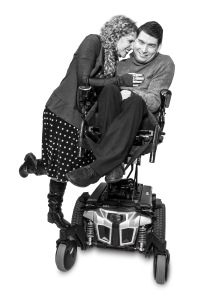
When I called her for the interview, I only had one thing on my mind – the interview. However, she was so engaging and wonderful to talk with. We ended up speaking the next eve, then the next, then the next. I quickly realized this woman was amazing, having it all: outer beauty, humor, intellect, compassion, you name it.

But, by all accounts, she was out of my league, though. If anyone objectively looked at the reality of the situation, I was at the wrong end of the basketball court to have any chance of making a basket. I was a single dad with cerebral palsy living in rural Pennsylvania. Why would a gorgeous high-end optician and artist living in San Diego even entertain me as a potential love interest?

However, as I fell for her, I turned to the one trait that’s always got me to new heights in my life: I went for the seemingly impossible longshot. I put my heart out there with nothing to lose and everything to gain. You might say I threw the longest basket in history – from Pennsylvania to California – and it miraculously swooshed the net. Yet, while making a full-court basket only lasts for one game, my now wife and our marriage is for a lifetime.

Life is going to put us at the end of the court from time to time. When we’re blessed, a ball comes our way. And, when the ball comes to us, we can pass or we can trust in ourselves and fate, throwing the ball as high and hard as we can toward the basket. No, it won’t go in every time – it hasn’t for me. But, when it does, it changes our lives forever.

The Life and Death of Humor

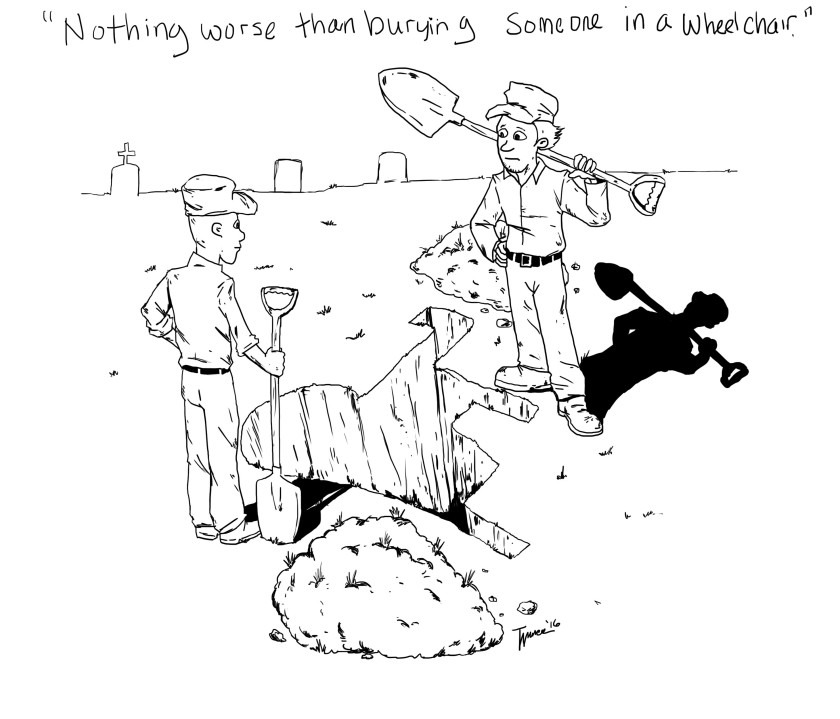
To John: After writing the essay, I had to have an illustrator colleague bring my image to life - or death!  -Mark
To John: After writing the essay, I had to have an illustrator colleague bring my image to life – or death! -Mark

By Mark E. Smith

Among my all-time favorite people is Callahan – John Callahan. He’s been dead now for going on 6 years, and I’m sure there’s still a hilarious punchline to that waiting to be told… maybe a cartoon of two grave diggers with shovels standing over a grave dug in the silhouette of a wheelchair?

See, Callahan was abused as a child, an alcoholic by his teens, and a high-level quadriplegic by 21 from a drunk-driving accident. There’s nothing funny about any of that – except to Callahan and his millions of readers who understood through his twisted but totally candid cartoons that humor can be among the truest healing forces. I mean, his most famous cartoon was where cowboys on horses in the desert surrounded an empty wheelchair, noting, “Don’t worry, he won’t get far on foot,” exemplifies where tragedy evolved into humor in Callahan’s life. Many were mortified by the tasteless cartoon; but for those of us who live with disability, it was hilarious.

I’ve seen it so many times, where our pain, when addressed with humor, can become joy. And, making that transition is life-changing. If you can genuinely laugh at something, you’ve survived it. You’d be hard pressed to find a successful comedian who hasn’t experienced trauma, but through that has somehow found humor.

For me, humor has always kept me from the dark sides of life. If you ask me about cigarette smoking, I’ll tell you to go for it. After all, my mother smoked throughout her pregnancy with me, and I was born just fine, right? …The whole cerebral palsy thing was just an uncanny coincidence.

I likewise grew up with alcoholic parents, and they died from it at young ages. Along the way, I spent time accompanying my drunk mom to Alcoholics Anonymous meetings as a teenager – because when you’re 16, with cerebral palsy, it’s the one place your slurred speech and uncoordinated body gestures fit in. At times, I wanted to truly participate: “I’m Mark, and I’m not an alcoholic, but I sound like one and sometimes I pee my pants – where’s my AA coin!”

No, there was nothing funny about being born with cerebral palsy or having drunks for parents – it was all tough stuff. Yet, I survived it all, and I can’t help but see humor in most of it now. Humor, in so many ways, is the power to rise above pain, to take back our joy, our spirit.

As they say, that which does not kill us – or does! – only makes for a hilarious punchline. And, as Callahan taught us all so well with his work, if you’re not at the point yet where you can laugh at your own pain, you don’t need to worry – there are plenty of us who will do it for you!

The Most Sacred Trust

trust

By Mark E. Smith

Every week, I take a leap of faith on this blog and write essays that are often very personal and expose vulnerabilities about myself that I know can range from liberating to uncomfortable for readers. Yet, there’s a deep meaning and purpose to it all. Firstly, as a formally-trained writer, I was taught that if you’re truly going to write, you owe it to yourself and your reader to write with unflinching courage, to expose that which others may not dare, all in the name of integrity – the best writing is fearless and scary all at once. Secondly, there’s such power in universal experience, where if through sharing my own vulnerabilities I can help someone else embrace his or hers, realizing that none of us are alone in life’s challenges, that’s a tremendous privilege. I write to connect, and that demands unflinching honesty, candor and authenticity.

However, here’s what might surprise you: I don’t believe that this unyielding, wide-open form of trust should be practiced in our personal lives. The fact is, whether a child or a so-called hardened criminal, there’s a fragility within all of us – our inner-most vulnerabilities. And, they aren’t to be trusted with just anyone. We’re too valuable to risk handing over our emotions to those who may not honor, respect or deserve them.

Many of us know a lot of people, many of whom we call family and friends. For me, I can’t even count how many people I know. All are wonderful people. Yet, if you think about your own friends and family – as I do mine – how many have truly earned your trust to possess the capacity to treat your deepest vulnerabilities with the safety and security you deserve?

Chances are, not many. Unfortunately, we’ve often learned this in the most painful ways. We’ve shared our most vulnerable selves with someone, only to have that person attempt to hurt us with it later in scorn or judgement at the most opportune – make that, malicious – of times. True family and friends don’t use our vulnerabilities against us. Rather, true family and friends treat our vulnerabilities as sacred, those which are to be addressed with compassion, empathy and support.

So, how do we know with whom our deepest vulnerabilities are safe? For most of us, it’s a tiny fraction of those who we know, maybe only one or two people. And, the litmus test can take time, often years. See, true trust isn’t assumed; it’s earned, piece by piece. You share a little, see how that’s handled by someone over time, and if it’s honored, you share a little more, until ultimate trust is earned. Along the way, let us not be guarded, but aware, as if we witness the slightest violation of trust, it’s a sign to put on the emotional brakes and realize that person may be a loved family member or great friend, but not one who we can trust in our most sacred places – again, that’s reserved for those who’ve earned it.

By far the toughest practices of setting boundaries of who’s earned the privilege of being trusted with our deepest vulnerabilities is in romantic relationships because the emotions are so intense and the stakes are so high. In our desire to love and be loved, it’s far too easy to dismiss violations of our vulnerabilities. He only said it out of anger during our argument…. No, there’s never a reason or excuse to use someone’s vulnerabilities against him or her. That’s not love, its betrayal – and that never makes for a relationship you deserve. I married my wife for a lot of wonderful reasons, but the big one was our mutually-earned trust. Sure, we get mad and frustrated with each other, but we know that each other’s vulnerabilities are the sacred boundary line that we respect above all else. I’m also blessed that this ultimate sacred trust holds true with both my oldest daughter and my lifelong best friend.

When it comes to our vulnerabilities, let us seek comfort in others – it’s healing for the soul. However, let us likewise know that our vulnerabilities shouldn’t be entrusted to anyone except those worthy of respecting and cherishing such a gift. See, when it comes to ultimate trust, it’s quality, not quantity, that serves our heart.

The True Meaning of Weakness

biggest-weakness

By Mark E. Smith

I love working out because it’s such a humbling experience. See, people often trick themselves into believing that working out is about strength; however, it’s literally an exercise in embracing weakness. After all, if you’re putting your all into your workout routine, you do so till failure, finding your ultimate weakness every time. If you’re doing it right, you never leave a workout accomplished but defeated.

Yet, what’s fascinating about working out is that by consistently acknowledging your weakness, it ultimately makes you stronger. This goes for all of life, where our greatest strengths originate from our truest weaknesses. If we wish to live to our best, we can’t focus only on our strengths, but we have to be wise enough to embrace and pursue our weaknesses.

I come from a lineage of addiction, and I’ve never thought myself stronger than it. I was born into it, science says it’s in my DNA as a genetic component, and was further solidified by the environment I was raised in. By all accounts, I statistically should be – and could be, as it’s never too late – an addict. It would be easy for me to say that I’m too level-headed or strong-spirited to be an addict. But, the fact is, it’s knowing my weaknesses toward addiction that have kept me off of that path. I’ve known my risk factors, and knowing my predisposed weaknesses within me keep me in check. I’m not inherently stronger than addiction, just wisely aware of my weaknesses. If you know you can’t out-wrestle a bear, stay away from bears!

Having a disability, my physical weaknesses are always front and center – at least as society recognizes them. After all, we live in a culture of hyper portrayals of masculinity and femininity. Men should be strong and independent, and women should be sexy and elegant. But, physical disability can make living up to those standards not just impossible, but excruciating. As a result, it’s so easy to push disability weaknesses – read that, vulnerabilities – down in denial or shame, especially when it comes to how the so-called weaknesses and our romantic partners interrelate. However, if you’re willing to expose and embrace your seeming weaknesses, it will take your life and relationships to a far deeper, rewarding level.

I’ve always had a whatever-it-takes attitude, and it’s served me well – that is, except when I’ve used it to mask disability-related weaknesses. I’ve spent decades struggling to use the toilet, where poor balance and poor coordination made the transfers a constant nightmare. I could never use the bathroom in the morning because I lacked the balance and coordination, and then in the evenings, falls from transfers weren’t uncommon. In my mind, my thought process was, no matter how hard it all was didn’t matter – I’d rather die trying than accept help. In my skewed, macho mind, what was less manly than having my wife help me transfer onto the toilet?

However, it was tough for my wife to see and hear me struggle. And, one eve, she just came up, tucked her arms under mine, and together we slid me onto the toilet, then off. It took a lot for me to accept that help, but it immediately made my life one thousand times easier. Yes, I had to admit a weakness to myself, that independently transferring onto the toilet was a huge problem. However, as a result, I summoned far more inner-strength and confidence by being secure enough in who I am to embrace such help from my wife – and it’s enhanced my life and our marriage.

From what I’ve learned in my own life, I don’t know why “weaknesses” in our culture are seen in such a poor light. After all, when weaknesses are embraced and addressed, they can be the ultimate form of strength.

The Iris Effect

12196161_10207777888755456_2604424288050660940_n

By Mark E. Smith

Ninety-four year old fashion icon, Iris Apfel, once said, “I’m not going to be a rebel and offend anybody, but I’m not going to live in somebody else’s image.”

Being somewhat of a public figure, I recently was engaged in a several-day online banter with an individual being very critical of me, to the point of irrational. Still, I felt the need to respond to his criticisms. For one, I didn’t want false statements about me left unaddressed in a public forum, and secondly, I was trying to be respectful and not ignore the individual. I didn’t take it too personally, but I also didn’t just let it emotionally go – and logistically it consumed a lot of time. However, I finally realized I didn’t deserve to be treated that way, and I didn’t care what else was said of me – and I simply ceased the unhealthy dialogue. I know who I am, I know what I do, and I’m proud of it all, so there’s no need to waste time with concern over others’ opinion of me – good or bad.

Most of us have been in this type of predicament, sometimes more serious than others, right down to abusive. I mean, maybe you know what it’s like to be inappropriately criticized, judged or condemned by others. And, it’s most painful when it’s by those who claim to love us. Something as small as a comment like, “You’re not going to wear that, are you?” after we’ve gotten dressed up can sting. Of course, situations like when parents stop talking to a child because he or she came out as gay can crush. From tiny comments to huge judgments, it all just hurts, doesn’t it?

But, there’s a way to stop it all, to take away the pain – and, more importantly, remove the power of others from effecting us. We need to realize that, if we’re good people, living good lives, no one has the right to criticize, condemn or judge us, period.

As I grew up with a severe disability, it was always in the back of my head whether others would accept me? This insecurity extended well into my adulthood. Granted, I was really good at concealing it, where self-confidence was a mask I wore. However, in my 30s – and it’s unfortunate that it took me that long to come to such a simple truth – I realized that I was to be accepted as I was, and I didn’t need anyone’s approval toward my having a disability. It’s really a brilliantly childish life strategy: I don’t need anyone to accept me because I don’t accept anyone who doesn’t accept me. It’s my ball, and if you don’t like the way I play, then I’m taking my ball and going home!

See, the prize is in you and me, not those who criticize, condemn or judge. I’ve run into several circumstances where friends have come out as gay to their parents, only to be shunned. Again, imagine how painful it is to have your parents shun you. However, who should shun who in such a circumstance? It’s painful and hard, but a child needs to say to his or her parents, I’m your child and I deserve to be loved as-is, and guess what, folks, until you love me as I deserve, you’re going to have an empty chair at the dining room table.

Life and relationships are full of compromises, but our intrinsic value isn’t. We shouldn’t live to others’ criticism, condemnation and judgment. I know, it can be hard to break free of investing in what others think of us, especially when it’s gotten to a toxic level in family dynamics and relationships. Yet, we owe it to ourselves to be our own cheerleaders, champions of the self, where the only opinion that counts is our own, based strictly on the positive, meaningful lives we lead.

Our Truest Voice

speaking

By Mark E. Smith

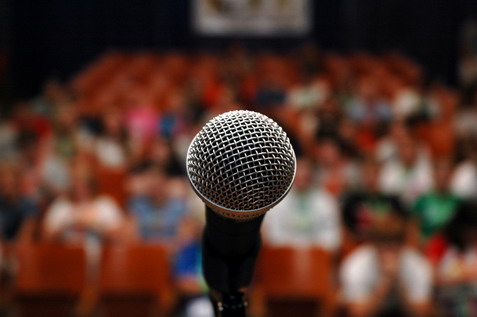
I recently watched a Ted Talk by a public speaking coach who gave the secrets to being a great speaker. She spoke of relaxed posture. She spoke of soft breathing. She spoke of using your diaphragm. She spoke of controlled speech patterns. And, she spoke of overall body composure. Really, based on all she covered, I should never roll on a stage or speak in front of a group ever again because my cerebral palsy prevents every technique she noted. According to her, I’m the antithesis of a speaker, her worst nightmare.

Yet, over the past 25 years, I’ve spoken to more groups than I can count; I’ve made a remarkable number of TV appearances; and, I speak formally within my company in many capacities every day – all with tremendous efficacy. So, how do I – as one with severe cerebral palsy – defy the rules of the experts and achieve success in my career with so much speaking?

The answer is, I am just me and I always speak from the heart. I don’t need to be a polished robot, nor do I need to try to be someone I can never be. When you hear me speak – sometimes labored, sometimes slurred, sometimes spastic – you’re getting the real me. What greater gift can we give others than the real us, perfectly imperfect, speaking from the heart?

Among the reason why I address groups within our company is because I’m so passionate about what we do and I’m so inspired by the profound difference each employee makes in the lives of our customers. And, so one of my greatest privileges is speaking to groups of our employees, both weekly with new hires, and monthly at our birthday lunch, where we celebrate employees’ birthdays.

It’s my pleasure to share with you one of my talks with our employees. What I want you to note is that I’m clearly not what that speech coach envisioned. Rather, I’m real and imperfect – the two traits that we should all embrace to make a true impact in the lives of others. There’s no one more captivating than who we truly are.

Crank up the volume and enjoy this 12-minute talk:

First Drafts

hemingway

By Mark E. Smith

When my daughter told me that her first reading assignment in her college freshman English class was Ann Lamott’s “Shitty First Drafts,” I was thrilled. Now there’s a professor who knows how to teach!

“Shitty First Drafts” was never a stand-alone essay, but an excerpt from Bird by Bird, Lamott’s 1994 book on writing, aimed at writers living the writing life, and goes back to Hemingway who coined the subject of shitty first drafts. Yet, Lamott, who you might recognize as a very pop-culture and, interestingly, irreverent Christian writer, infused Bird by Bird with life lessons, where I, for one, have always viewed “shitty first drafts” as another one of Lamott’s ultimate metaphors for life.

Lamott’s assertion is that, as writers, the only way we ultimately get to clarity and success is by having the courage to embark on shitty first drafts:

…All good writers write them. This is how they end up with good second drafts and terrific third drafts…. Very few writers really know what they are doing until they’ve done it. Nor do they go about their business feeling dewy and thrilled. They do not type a few stiff warm-up sentences and then find themselves bounding along like huskies across the snow. One writer I know tells me that he sits down every morning and says to himself nicely, “It’s not like you don’t have a choice, because you do – you can either type, or kill yourself.” We all often feel like we are pulling teeth, even those writers whose prose ends up being the most natural and fluid. The right words and sentences just do not come pouring out like ticker tape most of the time.

Chances are, you’re not a writer. But, if your life is like mine, it’s certainly checkered with shitty first drafts. As Lamott puts it, we typically have no idea what we’re doing until we do it. And, I don’t know about you, but I can’t think of hardly any success in my life that didn’t begin as a shitty first draft – from living with my disability to school to career to finances to relationships to working out, and yes, writing. In fact, I have shitty first drafts every day, where based on my disability, two or three tries at any daily living task is the norm. However, I’m always thinking, learning, getting wiser as I do a task, so rather than getting frustrated, I hone in on getting better, improving with each “draft.”

When it comes to our lives, it’s vital to give ourselves permission – and have the courage! – to have shitty first drafts, namely because, as Lamott puts it, they lead to good second drafts and terrific third drafts. Do you know how I learned about finances and relationships, two cornerstones of life? Shitty first drafts! In my 20s, I got into debt up to my ears, by my 30s I paid everything off, and today I haven’t used credit in over a decade, living totally debt free. Relationships have had a similar path, having to learn about love through a lot of painful trial and error, but I think I’m a better partner today than I was 20 years ago. There are so many aspects of life that generally start with shitty first drafts; but, if we’re cognizant, self-aware and dedicated to growth, those shitty first drafts aren’t shitty at all – they’re assured paths to ultimate success.

So, as my 18-year-old daughter moves through her first semester of college, she’s not just reading about shitty first drafts, she’s undoubtedly living them at times, as we all have and do. Yes, it’s hard as a father not to jump in and correct my daughter’s “shitty first drafts,” but I know that by allowing her to learn and grow from them, her second and third drafts – read that, her accomplishments – will be amazing.