Failing Greatly

By Mark E. Smith

Anyone who saw the movie, Apollo 13 – or never saw the film! – knows the iconic phrase, Failure isn’t an option.

Indeed, the phrase is inspirational and catchy, now part of our motivational lexicon. However, here’s what few know: Not only was the phrase a fictional creation for the film and book, but it was derived from the NASA Control Room philosophy that really meant that quitting was never an option.

See, the catch phrase was skewed from an interview where Apollo 13 flight controller, Jerry Bostick, said, “…When bad things happened, we just calmly laid out all the options, and failure was not one of them. We never panicked, and we never gave up on finding a solution.”

Truly, what Bostick expressed was that failures – or, in his words, “bad things” – occurred all of the time, but what the flight control team did was never quit, they never gave up on finding solutions. They wouldn’t accept a failure as an end-all.

That’s such a vital distinction: Failures are bound to occur in virtually all that we do. However, quitting in the face of them is not an option. In fact, among the greatest people and accomplishments have always been born from huge failures. Babe Ruth struck-out 1,330 times. Henry Ford went broke five times. Jack Canfield’s Chicken Soup for the Soul manuscript was rejected by 140 publishers. James Dyson’s vacuum had 5,127 failed prototypes.

Of course, these catastrophic failures lead to among the greatest success stories in history. Babe Ruth, is arguably the greatest baseball player of all time. Henry Ford revolutionized manufacturing and the automobile. Chicken Soup for the Soul has sold 130 million copies. And, the Dyson vacuum became a market leader, changing its industry.

As Confucius put it, “Our greatest glory is not in never failing but in rising every time we fail.” As Samuel Beckett put it, “Ever tried. Ever failed. No matter. Try again. Fail again. Fail better.” And, as President John F. Kennedy put it, “Only those who dare to fail greatly can achieve greatly.”

All of these great men – as well as all wise individuals – know that failure is part of the path to success. Learning always involves failure – it’s why students study, athletes practice, and businessmen develop. Failure is “practice making perfect.”

Now, I’ve outlined a few extraordinary examples of huge failures leading to astounding successes. However, failure – and how we address it – plays an even more important role in our personal, everyday lives. If we fail, and quit as a result, we lose everything, it’s game over. Yet, if like the greats that I’ve previously noted, if we fail, but keep striving, finding new approaches and solutions, learning and growing, we will ultimately succeed. No matter if it’s my two year-old niece who was frustrated by a baby gate, so she used her toy box as a ladder to climb over it, or my friend who went on over 30 job interviews before landing his dream job, both experienced failure after failure, but followed through with a tenacity to success.

As for me, my life remains one big failure. From my daily living skills, to my career, to my relationships, to my parenting, truly, there’s nothing that I haven’t failed at. Heck, I’m failing at this very writing as I create the first draft (by the time you read this essay, I will have failed with four or five drafts). But, I don’t give up, ever. There’s nothing too physically tough, too intellectually challenging, to financially burdensome, too emotionally harrowing for me to ultimately succeed at. Sure, again, I will – and have! – fail at many aspects of life, unquestionably many more times to come. But, failure doesn’t scare or deter me; rather, failure drives me to push harder. Through failures, I learn, I grow, I adapt, I change my approach, and eventually I succeed. I’m going to fail, but in that process, I know that I’m moving closer to success.

I don’t know what challenges – read that, failures – you’re facing in your life right now. However, try shifting your perspective to a mode where you see failures as direct paths toward success. Does it take perseverance? Yes. Does it take determination? Of course. Does it take patience? Sure. But, does it ultimately lead to success? Absolutely. After all, without failures, there is no success.

Chased By It

By Mark E. Smith

Among the incidents in my life that has haunted me most is the suicide of singer and quadriplegic, Vic Chestnut. Some things just hit too close to home for comfort.

As I’ve written and spoken extensively about – although Vic’s suicide was a combination of factors – arguably the largest factor was an overwhelming sense of isolation and loneliness. And, as I’ve processed Vic’s final act over several years now – an act made as much out of heightened self-awareness as depression – I’ve never been able to answer the question of, did Vic simply kill himself, or did the world around him indirectly take his life?

In the realm of psychology, there’s a term, “parentified-child,” which applies to children who, based on extremely dysfunctional parents – addicts, mentally ill, physically ill, emotionally inept – must assume adult-like roles, literally parenting their parents. At a time when a child should be nurtured, he or she is thrust into the role of nurturer. As a result, the child learns that his or her feelings and needs are second – or, non-existent, really – to everyone else’s, and identity and self-worth are sacrificed. Such children grow up being drawn toward very unhealthy, unbalanced relationships and lifestyles, rarely capable of truly looking out for their own interests. And, the internal isolation that ultimately exists – where he or she struggles to let people in, to be nurtured – often leads to self-destructive behavior. You might say that such individuals implode rather than explode from emotions.

As adults, we can find ourselves in similar situations due to any number of circumstances, where we’re always the nurturer, never to be nurtured – and, again, it implodes the soul. Vic lived this, where he absorbed too much of the pain from others and the world around him, with little space to express his own, that it literally killed him. Going from “fame” on stage where you give yourself to others so completely, then being alone in a hotel room with not a single person in the world with you – or who you feel emotionally safe enough to call – is a harrowing experience. It helped kill Vic, and it’s chased me a few nights.

I was born a “parentified-child.” I learned early in life that loving someone meant saving him or her at your own expense – but that’s not how love should work, does work, or can work. My mother was as dysfunctional as one can be – substance abuse, mental illness, divorces – and from as young as I can recall, I just wanted to make her feel better, where her emotions were far more important to me than my own. And, it’s not a bad trait as a son or a person to want to save someone who you dearly love. However, there has to be a line we draw between being forced into that role as a child, versus choosing that role as an adult in relationships. And, I’ve chosen that role for too long, where loving has always been easy for me, but being loved, not so much. And, so my comfort zone has always been giving as much as I can to others, and using it as a smoke screen to avoid my own feelings of vulnerability. And, it works really well.

Until it doesn’t. And, ultimately, like Vic, I’m alone in a hotel room, staring at a cell phone, unable to call anyone. But, it’s not that there’s no one to call. I just can’t. They have spouses and children and jobs – and who am I to interrupt their lives with my desperate moment of all-consuming isolation and loneliness, where I’ve gone from the soaring affirmation of a public event, to an emotional crash landing, alone.

But, I’m cognizant of it all. On a recent trip, my friends bought me a rock-star-size bottle of Southern Comfort, all in good spirits. And, with it sitting on the restaurant table, not only did I know that I couldn’t drink out of fear of drinking heavily, period, but that if I took the bottle back to my hotel room, all of Hell could break loose for me. Isolated and ungrounded, with my past still not allowing me to reach out in such moments, I could easily unscrew the cap from the bottle over the bathroom sink, chug it one-fisted, toasting to Vic, the whole bottle – gone.

So, I left the bottle on the restaurant table, and split – sober and safe. And, I made it through the night, alone in my hotel room. “Mark takes care of Mark,” I said to myself while shaving in the mirror the next morning. And, I was back at it with the new day, there for everyone – and I meant it.

Then, as the day turned to eve, then to night, the bottle showed up again with my friends. “You left this at the restaurant last night,” they said.

I went along with the well-intended amusement, but, again, with Mark looking out for Mark, never to drink with Vic because I know where it could lead, I ditched the bottle somewhere – so much in a panic that I don’t recall where – and I made it through another night, isolated, lonely, but safe.

However, like the isolation and loneliness that’s come and gone much of my life, the bottle mysteriously showed up again – in my van. And, so with a friend leaving town, too, I tucked the bottle in his truck, and sent it on its way, far from me.

I got in my van, and headed a few hours home, where I couldn’t wait to see my daughter, our two dogs, and ultimately get back to the stability of my office routine. And, so just as the bottle of Southern Comfort went away, soon would the isolation and loneliness – at least for now.

No Farther Than Ourselves

By Mark E. Smith

There were many reasons why Kurt Cobain of the band, Nirvana, killed himself on April 5, 1994. Suicide, you see, is often a very complex process, rarely attributed to a sole cause, but most often a culmination of unbearable emotions. However, as fellow musician, Henry Rollins, put it, much of Cobain’s issues leading to his suicide could be traced to “the brutality of the public” – that is, the challenges of being in the public eye, where strangers can be astoundingly cruel, where Cobain, himself, discussed being too sensitive to endure criticism by the public, robbing him of his sense of identity.

When I started WheelchairJunkie.com 15 years ago, two aspects surprised me. Firstly, I was surprised by its success. After all, I created the site simply as a small place for my fellow wheelchair users and me to connect. However, its readership didn’t just grow rapidly in the beginning, but has continued growing ever since, where I’ve been forever amazed that such a personal project could reach so many – and I’ve been blessed that others have allowed me the privilege of being part of such a terrific community for much of my adult life.

Secondly, following the launch of the site, I was surprised by, as Rollins put it, “the brutality of the public,” which grew proportionately as the site’s popularity grew. I don’t recall exactly when my readership grew large enough to tip into the realm of my being somehow recognizable enough to become a target of “the brutality of the public,” but at some point relatively early on, a complete stranger emailed me in hatred of who he thought I was or represented. Now, in my 15th year of running the site, based on the vast readership, not a day passes where I don’t awake to an email or message board post where a total stranger – sometimes several – wants to argue with me, condemn me, or literally wish me dead.

However, rather than being distraught over strangers wishing me ill over my public persona – although my public persona isn’t a persona at all – I’ve been intrigued by the phenomenon as it’s occurred for well over a decade in my life. What’s intriguing is the question of why anyone in the public would hate me to the point of wishing my death, or at the very least stating, “I disagree with Mark on almost everything….” If we look objectively at my “public profile,” it’s about as mundane and noncontroversial as it gets. Read my weekly web and print articles and essays, read my message board posts, follow my Twitter and Facebook, and you’ll see that there’s no controversy (most of it is so feel-good or sincerely striving to be helpful that it borders on boring). Still, you’ll see comments directed at me that are antagonistic at best, shockingly graphic in wishing me dead at worst. But, why?

In a parallel, strangers hating me reminds me of what I know about Jennifer Aniston. Year after year, Jennifer Aniston receives among the most death threats of any celebrity. What has Jennifer Aniston ever publicly done that could possibly upset anyone? So, I suppose that if someone as noncontroversial as Jennifer Aniston is among the most hated celebrities, I, as a guy simply striving to help others in a similar situation to mine as one with a disability, shouldn’t be exempt from unexplainable hate from strangers, as well – after all, there’s no rationale to the brutality of the public, strangers merely inappropriately projecting their angst upon us. If you have a large enough audience, regardless of who you are or what you do, the brutality of the public emerges.

Nevertheless, when it comes to enduring the brutality of the public, I have a tool on my side – and you may, too – that most others in the public eye don’t have: Disability experience. See, if you’ve lived with disability for many years or a lifetime like I have, you likely know how brutal the public can be. From time to time, strangers will make assumptions about us based solely on our disabilities, projecting stereotypes and stigmas upon us that are completely irrational. It can be offensive and distressing. Yet, when it occurs, if we’re rational and self-accepting, we’re not offended by someone treating us arbitrarily different based on disability, but we instead recognize that a stranger’s ignorance toward disability is of no ultimate consequence as long as we know who we are. Therefore, there’s a fascinating overlap between disability experience and public experience, where void of rational explanation, strangers make completely inappropriate projections upon us – and it’s our job to not be offended by it, but to just recognize that it goes with the territory of public exposure.

Yet, there’s an even larger picture to all of this, life truths that apply to everyone. If we’re going to find ultimate fulfillment in life, we must be so resolute in our core values – in following our hearts of hearts, our passions of passions – that we’re simply not swayed by outside forces. Praise shouldn’t matter. Criticism shouldn’t matter. Peer acceptance, the support of our families, money, fame, a risk of failure – none of it should matter. If we are to be ourselves to the most true, sincere levels, we can’t be swayed by others – all we can be is who we are, where the brutality of the public is voided by our own unwavering integrity.

Unfortunately, as Kurt Cobain ultimately failed to realize, true singers sing solely for the sake of one’s own soul, not for the praise or criticism of an audience. For, when it comes to seeking acceptance, we should look no farther than ourselves.

Alien on a Leash

By Mark E. Smith

The dog sits on the stainless-steel examination table.

“Maybe we should muzzle her, so no one gets bit,” the veterinary assistant says.

“She’s deaf, it won’t help,” the vet says.

And, I’m astounded that veterinary medical professionals are acting as if my 22 lb., 4-year-old French Bulldog is a viscous alien – just because she’s deaf.

“She’s totally normal,” my sister chimes in.”You can examine her like a normal dog.”

“I don’t know?” the veterinary assistant says to the vet. “Maybe I can hold her for the exam?”

And, Lola, my little white fluff-ball with a black ring around her eye like the dog from Our Gang, just sits there, looking at the vet staff like they’re all insane. And, she’s right – these medical professionals are acting like idiots, as if they’ve never seen a dog before, as if a deaf dog completely throws out every rule of veterinary medicine, as if my sister and I entered the clinic with an unknown creature on a purple dog leash. It’s a freakin’ dog who hasn’t been eating normally and has been vomiting – this isn’t a paleontological mystery!, I want to scream.

“Just examine her – she’s a normal dog,” I say.

Of course, Lola is a normal dog physically, but being deaf-from-birth, she has developed extraordinary skills. As cliché as it sounds, she runs circles around my English Bulldog when it comes to using her senses (which might not be that impressive since all my English Bulldog wants to do is sleep on the couch or bark at the clothes drier). Lola is astoundingly visual, reading facial expressions, if not lips. We speak commands to her, and as long as she’s looking at us, she responds. And, she has an uncanny sense for vibrations. She knows before the rest of us that a car has pulled in the driveway, and when she’s sleeping on the floor and my wheelchair or footsteps pass by, she awakes. In fact, if you didn’t know Lola was deaf, you’d never have a clue – she’s just an alert, happy, hyper little dog buzzing around the house.

But, the vet knows that Lola is deaf, and it clearly freaks out her and her staff. Lola looks and acts like any other dog at the vet clinic, but the fact that it lists her as deaf on her medical chart changes everything, making her “disability” more perception than reality.

Finally, the vet examines her and notes, “It’s tough to tell what’s really going on because she’s deaf.”

If she wasn’t deaf, would you ask her a litany of questions, expecting a verbal response from her? I wanted to say but refrained. Really, because a dog is deaf, it’s tough to tell why it’s vomiting? What kind of asinine correlation is that? Clearly, a Critical Thinking course isn’t part of the curriculum for veterinary medicine.

With my sister and I advocating for Lola, she’s finally X-rayed, gladly finding no internal blockages – no rubber balls or cotton socks in her digestive tract – and she’s ultimately diagnosed as having a stomach virus, prescribed a diet of boiled hamburger and rice. In short, the dog’s vomiting got it prescribed a personal chef – ingenious!

And, as I pay the $258.14 bill at the check-out counter, with Lola standing beside me, her panting, pug-nosed face pointing toward the door, wanting to go home, I’m again reminded of how shockingly ignorant the medical field can be toward those of us with disabilities – dogs or humans, no matter.

Call Me Shallow, But….

By Mark E. Smith

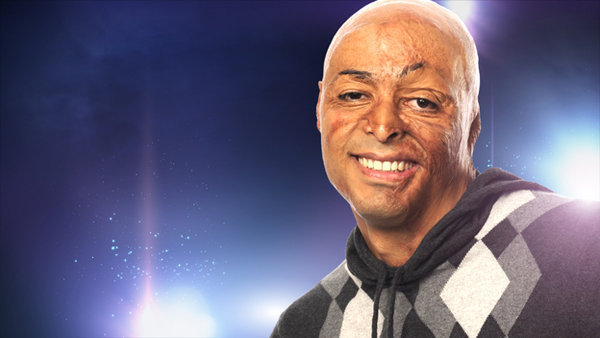
When J.R. Martinez, known from his roles on “All My Children” and “Dancing With the Stars,” was in the hospital recovering from burns over 40 percent of his body, including life-changing facial disfigurement, his mother had a very straight talk with him, one that would guide him to the true depths of his character.

See, J.R. was an American soldier in Iraq, having enlisted at just 19, when his Humvee ran over a landmine, catapulting him to a path of 33 surgeries in 34 months, resulting in the loss of an ear, and permanent facial disfigurement. J.R. describes lying in the hospital, glancing in the mirror, seeing a monster looking back where he once saw a handsome young man – all sending him into a deep, dark depression.

But, J.R.’s mother, older and wiser, saw something else in the situation: The truest essence of her son. “People aren’t going to love you for how you look,” she told J.R. “They’re going to love you for who you are. And, that is a true blessing.”

J.R.’s mom was so right – and J.R.’s success proves that. I mean, the grace and humility with which he presents himself doesn’t make his disfigurement go away; rather, it makes his character shine brighter, where his facial attributes are part of him, but not the sum of him. J.R. is living proof that our exterior facades are just that – facades – and it’s our true character that matters beyond all else.

Yet, not everyone understands this concept. Surely, there are many superficial people in our culture who dwell on appearance alone – their appearance, everyone else’s appearance – and there’s a personal tragedy to it. Literally, when one dwells on appearance, not only can they never be seemingly good enough – after all, there’s always someone better looking by such shallow standards – but they never see others beyond an exterior facade, resulting in never developing deeply sincere relationships.

An acquaintance told me the story of her being a smoking-hot 26-year-old, living life in the fast lane in a Southern California beach community, where her friends and boyfriends were all from wealthy families. She drove nothing but Mercedes since the age of 16; she went shopping virtually every day to keep up with the latest trends; she had breast augmentation, a nose job, and routine Botox treatments; her girlfriends were the hottest of the hot, and they could cut the line at any club; and, she refused to date a guy who didn’t have a buffed body and a Porsche, no exceptions. And, all was moving along perfectly in her world of self-described perfection – that is, until she reached down to grab a CD off of the floor of her newest Mercedes, crossed the lane on a twisting road, and slammed head-on into a guard rail, the impact leaving her a quadriplegic.

But, the accident and paralysis were just the beginning of what she saw as the biggest tragedy of the time. Upon the accident, friends initially rushed to her bedside, and then slowly they stopped coming or calling. While she was in rehab, her friends hit the clubs as usual, and her buffed boyfriend who she thought was Mr. Right (after all, he had a Porsche!), promptly began sleeping with her soon-former best friend. Indeed, she learned that her relationships were as much a facade as her glued-on fingernails and sprayed-on tan. “When we place so much emphasis on our exteriors that we overlook the importance of who people really are on the inside, we take a huge risk,” she shared with me. “Trust me, when your identity and view of others is simply a house of cards, it crumbles fast.”

Going back to J.R.’s mother, she was absolutely right in the scope of her advice: Disability does allow us to have often times deeper relationships, a sort of interpersonal mechanism that protects us from the shallow people among us. Disability is a sort of barometer that gauges the character of of others, only letting the best of the best get close to us – and that’s a great opportunity.

Yet, like all opportunities, we must welcome others accepting us, as-is. J.R. could have used his unique appearance and initial self-consciousness to hide from the world, a way of judging himself and becoming bitter toward others, a presumed lack of acceptance. But, instead, J.R. chose to see the depths of his own character, not just the scars on his face, and he put himself in the world, trusting that he would witness the best in others, as well. Of course, as we now know, his self-acceptance has created universal acceptance by millions of adoring fans, all based on his demonstrating the depths of his character, not an external facade.

As for me, I strive to dress nice and present myself well, but the reality is, I’m a visibly flawed guy with cerebral palsy when viewed on the surface – and I’m OK with that, as the depth of my character hopefully shines through to some. However, when some don’t have the capacity to see beyond my lack of physical perfection, I’m fine with that, too, where I’m glad not to have those “emotionally blind” people in my life. Call me shallow, but if someone is more concerned about the imperfection of my physical appearance than the quality of my character, I don’t want that person around me – and I’m glad that my disability serves as a smoke screen to keep such people away.

What’s really wonderful, though, is that when we recognize the interpersonal value of being embraced for our true character, not our superficial facades, we instinctively return the gesture, being much more open toward others. And, we end up with an amazing exchange – where we’re both seeing each other on the most genuine levels – and that’s how the sincerest relationships are formed. If I accept you for you, and you accept me for me, now we’re truly connecting – and that’s where we all should be in our interactions with those around us.

Someone recently asked me what true acceptance of others really means? And my answer was coy but fitting: True acceptance is the sincerest gift that we can share with another person.

Staring at the Drapes

By Mark E. Smith

I lay in this hotel room bed – alone – thinking of Vic, who committed suicide almost 22 months ago to the day.

This evening, I spoke to a group of around 170 people, half-way across the country from my home – and I knocked ’em dead, as they say in show business. It was my kind of event – dinner and cocktails – where I have the liberty of really working a festive crowd. And, I hit it home with a theme of following the ramps in our lives – bridges of opportunity that take us to places we never dreamed – by interweaving stories from the humorous to the poignant. And, the gracious crowd was with me all along – an exchange of amazing energy – and then I rolled off stage to their flattering standing ovation.

At the time of Vic Chesnutt’s suicide, many chalked it up as the quadriplegic musician who was tired of living with the daily trails of disability, that the physicality of it all caused him to take a fist full of muscle relaxers, mix a dangerous cocktail, and check out for good – his fourth and final suicide attempt. But, as I wrote at the the time, there was more to the story than that:

…From what I knew of Vic, from what I’ve since learned of Vic, and from what I’ve witnessed and experienced in my own life, I believe that the unique pressures of living ultra-successfully with disability caught up with him, where he wasn’t able to cope with the extreme fluctuations in his life. See, when you have an exceptional level of success like Vic did while living with a disability, it can become a tale of two cities. On the one hand, publicly, everyone’s telling you that you’re a huge success and inspiration, putting you atop the world. Yet, on the other hand, you’re a real person, with real-life issues toward health, relationships, and finances. And, when all isn’t kept in balance, you can go from extreme highs to extreme lows in literally a matter of moments – in the time it takes to go from on-stage in front of a cheering crowd to a lonely hotel room where you’re left to face the realities of your everyday life. Truly, when you have such extremes in life – and you’re emotionally unable to center yourself – it’s just as easy to get consumed by the lowest of the lows as the highest of the highs, where the healthy middle-ground needed to survive doesn’t exist. And, that’s where the tragedy in Vic Chesnutt’s life occurred – not in his literal disability, but in his inability to find that middle ground of understanding and comfort in life as a whole, where, by all accounts, he lived a tormenting oscillation between the highest heights of elation in his work, and the deepest plunges of despair in his personal life, with no middle ground to just be at peace.

My colleague and I leave the banquet after the program’s finished. I thank our host for the engagement, and I convince my colleague to go across the street with me to an eatery for a late night snack. Again, going from a stage to an empty hotel room can be torturous – there has to be a bridge in-between to help one transition from the energy of a packed house to being totally alone. And, by getting something to eat, I’m stalling – buying my time, avoiding the empty hotel room in which I will inevitably find myself. But, I can get through it – alone, the hardest part of it all that Vic knew too well.

Eventually, I make it to my room like countless other nights on the road. I lay in this hotel room bed – alone – thinking of Vic, who committed suicide almost 22 months to the day. And, I realize that everyone’s assumptions of Vic’s suicide truly were wrong. See, as I stare at the shadow of the drapes in the dark, I know that the challenge for guys like Vic and me isn’t being alone in our disabilities; rather, the challenge is being alone in ourselves.

The Glory of Vulnerability

By Mark E. Smith

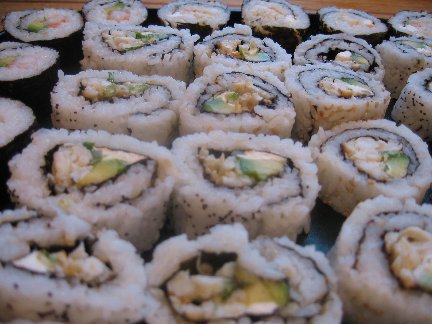
I wasn’t the least bit uncomfortable about it, nor was she. See, there I was, all dressed up to give a talk in front of a corporate group, but I was presented with a pre-talk lunch served by our gracious host, consisting of sushi rolls. I knew from the very sight of the rice-covered sushi rolls that, due to my poor coordination, there was no way that I could get them from the table to my mouth without rice and who knows what else ending up on my neatly-pressed pants….

So, I had two choices: One, I could simply not eat; or, two, I could have the courage to ask for help.

With little hesitation, I asked for help because it’s just as important to me to acknowledge my vulnerabilities as it is my strengths – that is, I want those around me to know my entirety, not just selected parts. I wouldn’t be true to myself or those around me if I only showed my strengths, and didn’t admit any limitations of my disability, my vulnerabilities.

Fortunately, my asking for help was easy in that instance based on the fact that a dear colleague of mine was with me, who’s traveled with me quite a bit, so asking her for a helping hand was natural. What’s interesting, though, is that getting to that comfort level – where I could turn to my colleague and say, “Would you mind feeding me my sushi, so I don’t get it on my clothes?” – took time and candor to evolve. On her part, my colleague’s sincere, genuine nature has been touching, and she’s proved truly intuitive in getting to know me as a person, disability and beyond – all of which speaks to the exceptional qualities of her character. However, I’ve likewise have had the openness not to hide any of my vulnerabilities – the realities of my disability – from her. She knows that I drink through a straw, I squirm in airplane seats to shift weight off of my rear, and can be a bit messy when I eat, and on and on. I am who I am, and I trust that my comfort in living with my vulnerabilities – where I don’t display only the so-called best of me, but the true me, flaws, spasms, and all! – has likewise made her more comfortable. None of us are perfect; we all need help at some point in our lives. And, allowing others to see our vulnerabilities is a positive trait, one that unifies, where asking for help and helping others is an inspiring exchange. We don’t get through life alone, and sharing our vulnerabilities is a key that we all need in living a life that allows us to truly connect with others in the most genuine ways.

Interestingly, researchers scoured the globe for the one aspect that most connects us with others – that is, what forms the deepest, most meaningful relationships on all levels? – and allowing ourselves to express our vulnerabilities topped the list. Vulnerabilities, it proves, are only weaknesses when we won’t admit them. However, when we admit our vulnerabilities, they become strengths because we’re showing ourselves to others in the most genuine ways – and that forms the most open connections with others, the sincerest relationships.

Of course, it’s easy to know why many people hide their vulnerabilities: They’re scared that others won’t accept them in their entirety, that others will judge them. But, this rarely proves the case. The basis of sharing vulnerabilities is formed within honesty and results in our fully opening ourselves up to others – and those are the foundations of healthy relationships. When we live freely with our vulnerabilities, we allow others to accept us wholly, and we accept others wholly, as well (if I expect you to accept my vulnerabilities, I likewise must accept yours, and we’re two perfectly imperfect people connecting on the sincerest level). But, here’s what’s really important: When we express vulnerabilities with others, we’re acknowledging our vulnerabilities within ourselves, and it’s the self-acknowledgment of our vulnerabilities – not denial! – that allows us to live healthier lives.

Addiction and recovery proves an enlightening study in how vulnerability can kill us or liberate us – sometimes literally – all based on whether we admit vulnerabilities. For example, an addict in the clinches of use, will never admit vulnerabilities. An addict won’t admit to causation, won’t express genuine feelings, will try to justify even the worst decisions, and will lie about everything under the sun, including lying to his or herself. That is, addicts run and hide from vulnerabilities via substance abuse – and, at best, it disconnects them from meaningful relationships, and, at worst, it literally kills them.

However, recovering addicts do just the opposite – they admit and address vulnerabilities. Think about the first words spoken by everyone at an Alcoholics Anonymous meeting: I’m Joe, and I’m an alcoholic. Admitting the vulnerability of addiction – that is, being honest and candid – liberates and connects. There’s remarkable empowerment in it. And, when getting into deep models of recovery, acknowledging the vulnerabilities that lead to the addiction – past traumas and such – is yet another way of profound recovery. That is, the only way addicts stop using is by acknowledging and addressing the underlying vulnerabilities that cause the addictive behavior in the first place.

In our personal lives, hiding behind our vulnerabilities – or, denying them through self-justification – is extremely dangerous, defeating so many potentials in our life: I’ve been hurt in a past relationship, so I’m not going to trust anyone again…. I don’t want to be seen as weak, so I’m not going to apologize…. I’m not going to show all of me because others will judge me…. Really, what such a closed emotional state says is, Overall, I’m going to self-sabotage meaningful relationships because I’m so scared to reveal my vulnerabilities – my complete self – to others.

It is astounding how painful and self-defeating it can be in not allowing ourselves to be vulnerable. At the very least, most of us can relate with the inner-conflict that occurs when we want to reach out to someone, but don’t out of the fear of feeling vulnerable – maybe it’s asking someone on a date, maybe it’s calling an estranged family member or loved-one to try to patch things up, or maybe it’s sharing one’s true feelings with a good friend. I’ve struggled with all of these – and continue to at times! – but what I’ve learned is that while there’s always the risk of the other person not being receptive, there’s also the more likely possibility that the other person will be receptive. And, the real reward in this process of overcoming our fears of vulnerability is that we’ve at least had the integrity to act on our true feelings, with sincere intent, living openly in every way – and that’s liberating, regardless of the final outcome.

The fact is, there’s a universal bond in the truth that none of us are perfect, that we all have vulnerabilities – and some are scary to admit to ourselves and others. Yet, when we live freely with our vulnerabilities, acknowledged by ourselves and shared with those close to us, we not only allow others to know us completely, but we’re far more open and accepting of others – and that builds connections of lasting trust and meaning. I have vulnerabilities, you have vulnerabilities, and it’s all OK. Let us live fully as perfectly imperfect people – with our glorious vulnerabilities exposed! – and our self-acceptance and relationships will flourish.

The Best Kinds of Crazy

By Mark E. Smith

One of my college buddies was the private pilot on comedian, Howie Mandel’s, national comedy tours in the early 1990s. My buddy’s observation was that Mandel was genuinely crazy, that he never saw Mandel waiver from his on-stage persona, that on the jet, Mandel would simply waffle between being hysterically funny and clinically irrational. In fact, Mandel billed himself as “a wild and crazy borderline psychotic.”

Of course, we now know that Mandel publicly discusses one of his diagnosed mental illnesses, mysophobia, an irrational fear of germs. Yet, based on my buddy’s stories and Mandel’s over-the-top persona, it’s reasonable to wonder if Mandel has other conditions, as well?

Interestingly, the psychology community has been studying a link between mental illness and very successful people for two decades, and their findings are fascinating. “Hypomania” is a persistent mood that causes an exaggeration of thoughts that’s most often linked to bipolar disorder, where one can be energized, euphoric, overflowing with ideas, extra social, and a risk-taker. These traits may not only be seen in those suffering profound mental illness, but are also seen in extraordinarily successful people. After all, from show business to entrepreneurial business, being energized, euphoric, overflowing with ideas, extra social, and a risk-taker are all traits that allow one to succeed where others would fail. Therefore, there is a debate in the psychology community that certain kinds of diagnosed mental illness may not be “crazy” at all, but actually an evolutionary advantage.

I’ve witnessed this similar phenomena in physical disability terms, where physical disability isn’t debilitating for some, but actually elevating, where their lives aren’t restricted by it, but empowered.

What’s extraordinary about physical disability is that if we’re to succeed, it requires us to more intently focus on abilities, where our lives aren’t about what we can’t do, but what we can do. The average person without disability goes through life with a fairly fixed outlook toward what’s possible, rarely questioning it, rarely recognizing the chances that present choices.

However, when it comes to physical disability, we’re forced to question at points in our lives, Can I do that? – and, what’s remarkable is that the question most often leads to, How do I do it? which leads to accomplishing what was once thought impossible. So, this progression of constantly questioning what’s possible leads to never-ending expansions of our lives, where the possibilities eventually become endless, where we forget about the initial question of, Can I do it?, and begin only asking, How do I do it? And, it’s at that point that we see nothing but potentials. Put simply, while other people stop at what’s practical or seemingly rational, we intrinsically push ours live much further, toward what’s truly achievable on a scale that others don’t fully grasp. In ways, we may seem crazy.

And, because we can live on such a larger scale, where …well …anything seems possible, it can perplex those without disabilities who live strikingly limited lives. When someone questions how you do something, or sees your goals as unrealistic, it’s not reflective of you as one with a disability – again, you think and live on a larger scale than most! – but it merely reflects the closed mindsets of those who haven’t had the opportunity to become so visionary.

Indeed, physical disability intrinsically opens us to possibilities, proving not a limiting factor in our lives, but truly an unlimited factor, where what some inaccurately define as debilitating is ultimately liberating. And, surely there’s enormous value, reward, and blessing to living in a counter-intuitive realm, where crazy can prove a higher level of sanity, and physical disability can prove a higher level of ability.

Will It Kill Me?

By Mark E. Smith

Is it literally going to kill me – and, if not, then I’m going through with it for my own betterment and growth. This is the code I strive to live by.

I’ve most recently been tested on this mindset, where I’ve admittedly become obsessed with riding my 6-wheel-drive, amphibious ATV on the 110 acres adjacent to my home. After my obligations for the day are done, I go out to my garage, put on full moto gear, fire up the ATV, and roar up the “Mountain Trail,” as I’ve nicknamed it. I’ve been getting faster and faster on the wooded trail sections, seeing how quickly I can slalom around the oaks without nailing a tree; and, I climb and descend hills too steep and tall to walk up or down.

At times, maybe I’m pushing myself and my vehicle to the very limits, where I drive up to the edge of embankments so high and steep that I can’t see the Earth past my ATV’s hood – just the sky straight ahead – and I summon the courage to simply drive off, where I trust that my driving skills, my vehicle, and the terrain will allow me to make it down unscathed. And, no matter how risky or uncertain a circumstance has seemed, overcoming my fear and tackling terrain I never imagined that I could, has never let me down, proving enormously liberating, where I’m pushing my mind and body far past previous barriers, to great personal growth, where if I can overcome fear and obstacles in my ATV, it carries over into my everyday life. If it’s literally not going to kill me – flying cross country alone for business, giving a talk in front of hundreds of people, being as open and honest as possible with those around me, tackling a seemingly impossible independent living skill, driving my ATV off of a several-hundred-foot-tall embankment, or any other anxiety-filled life experience – I’m going to do it, period. After all, if it won’t literally kill me, then there’s no valid excuse not to push myself forward.

Interestingly, I’ve observed that the process of moving forward once in motion is easy – it’s summonsing the courage to make the decision to initiate momentum in life that’s hard. Trust me, I’ve sat atop embankments – both in my ATV and in life, wanting to twist the throttle and just go for it – where fear had a grip on me, daring me to overcome it. Yet, once I’ve said to heck with fear, and just gunned it, my life in any circumstance has flourished. So, it’s the “saying to heck with fear” aspect that really proves the hardest part of change and growth. Life is really just one, big twelve-step program, where committing to the process of change is the hardest – and most crucial – part.

A lot of times we know what we should do – or must do – but committing to doing it, where we know there’s no turning back, can prove the hardest moves we ever make. It’s among the scariest questions in life – that is, should I or shouldn’t I? – in committing to decisions. I recently had the amazing opportunity to participate as a volunteer at an adaptive water sports clinic by Champions Made From Adversity in Georgia – a fantastic organization. Our crew was one of around six boats pulling those of all types of disabilities on tubes and sit-skis. What astounded me was that, as a seasoned boater myself, I know lots of “able-bodied” people who won’t tube or water ski out of fear. Yet, there I was in Georgia, with peers of all ages and disabilities, who were overcoming all fear to simply tackle what in many cases they never imagined doing – that is, with limited use over one’s body, putting one’s trust in a situation that was literally dragging them into the unknown: Heading out into a gigantic, deep lake at speed, bucking and bouncing, not knowing if they would drown (lifeguards on jetskis did parallel every run, so when someone fell out, rescue was immediate).

What I witnessed was that not only wasn’t anyone harmed – even when they fell out! – but the participants were actually empowered by the experience of overcoming their fear. Make no mistake, some were terrified getting in the tube – it was the hardest part of the process for them – but they still did it. And, we had the privilege of watching their lives change at 20 mph behind a boat, where they realized the liberation of, If it won’t kill me, I’m going to attempt it in an effort to better myself, even if I’m initially terrified.

Just like those with great trepidation to get into the tube at the adaptive water sports clinic, I’ve sat atop harrowing embankments in my ATV, hand on throttle, for minutes at a time, where it’s taken all of my courage to simply gun it, dropping into the unknown – but, I’ve always done it, landing tougher and more confident at the bottom. Yet, what I’ve grown to know is that overcoming short-term fear and stress is the catalyst for long-term growth and success, that getting past fear leads to liberation, no matter in the physical, emotional, or interpersonal. Much like I’ve learned that I can survive descending and climbing through the steepest ravines in my ATV, I can do the same in life, where overcoming initial fear will bring me to amazing vistas.

I wonder, what are you not tackling in your own life simply out of fear of the unknown? If you attempt it, will it literally kill you? If not, then there’s truly nothing stopping you from pursuing what you’ve thought too impractical, scary, or impossible – you, too, can summons the courage, no matter what you’re facing, to not just tackle the unknown, but to actually thrive in the attempt. Once we push beyond anxiety toward change – albeit, physical, emotional, interpersonal, or all in one – and propel ourselves forward in positive directions, the personal rewards are astounding: Vistas in our life appear that we never knew existed.