The True Origin of Civil Rights

civil rights

By Mark E. Smith

At this writing, it’s the 25th anniversary of the Americans with Disabilities Act (ADA) – and if you’re among my readers who thinks it doesn’t pertain to you because you don’t have a disability, then you should especially keep reading.

See, the ADA isn’t merely about ramps and access to public transportation, but it’s literally civil right legislation. Its intent is to protect those with disabilities from all forms of discrimination. In so many ways, it’s an add-on to the Civil Rights Act of 1964.

The most sweeping civil rights legislation since Reconstruction, the Civil Rights Act prohibits discrimination of all kinds based on race, color, religion, or national origin – but it doesn’t include disability. Hence, in part, the ADA.

In this spirit, on the 25th anniversary of the ADA, I don’t see it merely as a milestone toward social inclusion of those with disabilities, but an opportunity for larger questions: Can we legislate acceptance, and what’s the ultimate solution to civil rights for all?

I’ve spent about half of my life both pre- and post ADA. Yes, I’ve seen vast societal shifts in inclusion and infrastructure toward the positive over the past quarter century via the ADA, just as I’ve seen greater acceptance of all so-called minority classes. The United States is a far better place post the Civil Rights Act and ADA.

However, I personally still encounter those who stereotype me and, yes, the occasional instances of discrimination based on my disability. And, I’m not alone. From in our personal lives to watching the nightly news, who among us doesn’t still witness racism, sexism, antisemitism and every other labeled form of discrimination we’ve ever had?

What I’ve learned in the second half of my life, as a member of a “protected class,” is that while you can legislate socially-inclusive processes and infrastructure, you can’t legislate tolerance or acceptance, you can’t legislate what’s in someone’s mind and heart. Prejudice can’t be legislated out of someone.

I hear rumblings from the local diner to Capitol Hill that the remaining solution to prejudice and discrimination is additional legislation. However, there’s really only one ultimate solution.

As much as we see civil rights as a societal issue, it’s not. Rather, civil rights is a personal issue, and it’s ultimate solution is found within each and every one of us. Yes, we can legislate public policy, and rightfully so. However, we, more importantly, must engage our minds and open our hearts, to where civil rights isn’t just an ethical societal concern, but more so a personal moral standing, where we simply see all others as equal as ourselves.

Rounding Third Base

dreamfield

By Mark E Smith

There’s a counter-intuitive nature to adversity that you can’t understand or appreciate unless you’ve experienced or witnessed it. It’s a realm where, as a complete contradiction, weakness becomes strength, heartbreak becomes joy, tragedy becomes fortune. It’s where life sends you a devastating blow, only to usher in unexpected triumphs of the soul.

Two weeks ago, at this writing, I was involved in the still-unfolding story of a 10-year-old boy. On March 9, 2015, his family was involved in a devastating car accident, the jaws of life employed to remove the 10-year-old. While the parents, fortunately, quickly healed, the 10-year-old was left a C-4 quadriplegic.

Many people casually describe such a spinal cord injury as chest, down paralysis, it’s not. It’s truly chin, down paralysis. See, The fourth cervical vertebra is the level where nerves run to the diaphragm, the main muscle that allows us to breathe. It separates the chest from the abdomen, and when it contracts, air is sucked into the lungs like a bellows. No contraction, no sucking, no breathing. People who survive spinal cord injuries at or above this level need ventilators or machines to breathe.

And, so in a scene unfathomable to most, this 10-year-old boy lay in a hospital bed on a ventilator, his body motionless since March. As the boys of summer ramped up for little league, he wasn’t among them. Then, in the most tangible moment to date of how permanent his disability is, two weeks ago, his new power wheelchair was delivered to his bedside.

No, this wasn’t a typical power wheelchair. It was small, built for his childhood stature. It had a ventilator on the back. And, rather than a hand control, a small joystick was mounted aligned to match his chin and mouth.

It took a lot to get him in the power wheelchair – everything takes a lot at that injury level. Tubes had to be routed, his body positioned and strapped in. And, all the while his parents watched with fear and sorrow in their eyes, not knowing what the outcome would be – what it will ever be. It was a scene no parent can even process.

But, then, amidst all of the logistical and emotional chaos, all became still, quiet. And, with a touch of his lower lip on the joystick, the power chair moved – he moved for the first time in months. A world of tragedy and confinement was transforming before everyone’s eyes into hope and liberation. Soon, he was independently driving up and down the hospital halls, a special version of seeing your son rounding third base.

And, as the clinicians and his parents transferred him back into bed, it finally happened. For the first time since his accident, he screamed and cried. No, not because of the extent of his injury or the realization of all that has been seemingly lost. No, he cried because he wanted his power wheelchair back – it was his freedom – and he wanted to be racing up and down the halls, not back in bed.

Indeed, there is a counter-intuitive nature to adversity, where that 10-year-old boy teaches us that weakness can become strength, heartbreak can become joy, tragedy can become fortune. It’s where life sends you a devastating blow, and you ultimately can experience triumphs of the soul.

Now That’s Sexy

The-Wedding-Singer

By Mark E. Smith

Let’s talk about sexy! This conversation started for me about a year ago when I asked my lifelong best friend – both of us wheelchair users – about whether he was observing what I was: there seemed a sudden shift where many of our peers with disabilities were now in amazing relationships. “When did disability become the new sexy?” I asked.

There have always been cultural stigmas around disability and sexuality – the most historic and inaccurate being that those with disabilities are asexual, that sexuality doesn’t exist within the disability realm. Further adding to this is the totally inaccurate message in society at large that physical perfection directly correlates with sex appeal – that is, the better looking you are, the more sexually desirable you are.  Now, we know in our progressive culture that neither of these are true. However, here’s the question: if we know that imperfect physicality doesn’t deter sex appeal, what then actually drives sex appeal?

The science is in, and the results are encouraging for the 99% of us who aren’t supermodels. While most might say a big bosom or bulging biceps are what people find sexy, the true factors are far more complex and equalizing according to researchers.

Firstly, people find integrity sexually appealing – which makes sense because healthy people aren’t attracted to those who aren’t forthright. The deeper the trust, the purer the attraction.

Secondly, people find a smile and eye contact totally sexually appealing. Admit it, when you’re checking out at the grocery store and the checker glances up at you with eye contact and a smile as he or she runs your V8 juice across the scanner, you’re like, “Was that a flirt?” and it feels awesome. So, imagine when someone at a cocktail party smiles and makes eye contact from across the room – that’s hot! And, if you’re the one doing it, you’re hot! And, if two of you are doing it with each other, it might be time to find a closet – the coat closet, that is, where you can exit the party and go have great conversation over coffee (what did you think I was implying?)

Thirdly, wit and humor are huge turn-ons. Wit and humor make us fun, engaging, grounded, disarming, comfortable and charming. Seriousness is like rain: it’s great as needed, but you don’t want to live with it every day. Wit and humor is the warmth and sunshine that draws others to us.

Fourthly, intelligence is seen as very sexually appealing. Intelligent people both make us feel more secure and stimulate us mentally and emotionally – and that’s sexy. People who demonstrate poor judgement aren’t those who attract others. Act with intelligence; be sexy!

Fifthly, compassion is exceptionally sexually appealing – it ties into deep biological reproductive drivers, where we’re compelled toward people who nurture. It’s a huge turn-on when your partner recognizes and addresses your needs, and you, his or hers.

Last, but not least, people find confidence ultra sexy – bring in the alpha! Now, arrogance shouldn’t be confused with confidence. There’s nothing sexy about a narcissist. However, confident people are cool, calm, collected, in control, comfortable in their skin – and who isn’t attracted to someone with such composure? Just be you; that’s confident and that’s sexy.

Now, the fact is, I haven’t shared anything that you don’t know – and researchers on this subject aren’t rocket scientists. Yet, it proves a powerful point for all of us: sex appeal ultimately doesn’t stem from the body, but the brain. And, if your brain demonstrates integrity, knows how to flash a smile, can make someone laugh, demonstrates intelligence and compassion, and is absolutely comfortable in who you are, well then you are exuding sex appeal wherever you go, a love magnet!

Did I just catch you smiling at me?

Changing Channels

tvBy Mark E. Smith

Happiness amidst adversity has always fascinated me. Yet, so has misery among fortune. Both are totally counterintuitive – that is, people facing life’s toughest adversities logically shouldn’t be genuinely happy, just as among the most fortunate shouldn’t be miserable. But, we constantly see this occur with such frequency that it’s almost a norm rather than an isolated phenomenon. We see individuals facing challenges that, logically, should defeat the soul, but instead there’s a contentment and joy. Then, we see individuals with every advantage in life who are miserable. How is it that a 23-year-old with muscular dystrophy from which he or she will eventually die by age 30 is intrinsically happier than a 40-something multi-millionaire, recreational triathlete? I witness this all of the time among people I know and acquaintances – and, as one with a severe physical disability, I’ve experienced it myself.

Psychologists, sociologists and philosophers have been studying this exact subject, trying to crack this code of human nature: how does suffering allow for happiness while good fortune allows for misery? The recent consensus is intriguing.

See, what’s been discovered is that while happiness should logically come from good fortune, good fortune unto itself doesn’t evoke happiness. You can have all of the success in the world, and it doesn’t inherently induce happiness. Of course, many of us have known this, but, here’s the intriguing part. What does inherently induce happiness is gratitude. In fact, it turns out that they’re inseparable. If you have gratitude, you inherently possess happiness. But, that leads to yet another question in this equation: where does gratitude originate?

It turns out that opportunity is the root of gratitude – both in recognizing it and in appreciating it. I know where researchers are coming from because I live it. My independent living skills, such as bathing, are extremely difficult for me, sometimes having to endure a level of literal pain, if not suffering, in the process. When you lack coordination and balance, aspects like showering aren’t just difficult but often borderline dangerous, where falls and rebounds are just part of the nightly ritual. Yet, even in the midst of tremendous struggles, I’m genuinely happy. Heck, I even catch myself singing in the shower among the controlled chaos. How can I remain truly happy during such seemingly difficult times? Well, I know a lot of individuals who aren’t able to bathe themselves, and so I’m grateful for the opportunity simply to be able to do so, no matter how trying it can be. Opportunity creates gratitude, and gratitude creates happiness.

A childhood friend of mine, John, has had a slowly-progressing form of muscular dystrophy. He’s always used a power chair, but has slowly lost more and more muscle tone to where, now in his 40s, he doesn’t have the strength to use a television remote. But, John, as a super successful guy who knows the power of opportunity, gratitude and happiness, shared a story that made me smile. He found out that by getting a different cable box, he could use his smartphone’s touch screen to change channels. And, here’s what he said in his exuberance: “I’m quite overjoyed, and delighted even, to discover the new X1 system comes with an app on which I can completely operate the cable box from my iPhone. Losing strength and losing that ability killed me (metaphorically)… But now, I again have full control of my cable box!”

No, operating a cable box doesn’t in itself make John happy; however, the gratitude that he recognizes from the opportunity does.

Of course, this isn’t to say that we don’t all experience real human emotions like sadness and frustration, nor can gratitude overcome mental health conditions like clinical depression or chemical imbalances. However, when we’re emotionally and mentally healthy, gratitude can help us move toward positive states amidst difficult times. I recently lost Rosie the English Bulldog, my companion of 10 years – a very sad loss. But, amidst my understandable sadness, I found tremendous gratitude in her companionship, where reflecting on her hilarious absurdities – her tongue always protruding from her mouth, making her constant comic relief – filled my heart with joy despite the sad loss. In this way, finding gratitude in the toughest of situations can elevate our spirits. I’m not happy that Rosie the English Bulldog passed, but I’m grateful and happy for the 10 comical, adoring years we shared.

When the everyday aspects of life aren’t seen as doom or gloom, but as amazing opportunities, it creates gratitude, and with that we’re intrinsically filled with happiness. One doesn’t need to struggle or face challenges to find gratitude in one’s life – everyone can embrace it because where there’s life, there’s opportunity and gratitude. However, one does need to have gratitude to truly have happiness. Maybe we all need to take a lesson from John and recognize that the surest path to happiness is found in simply switching the channel – to gratitude.

Let Dreams Go

Dreams-Quote

By Mark E. Smith

Walt Disney said, “All of our dreams can come true if we have the courage to pursue them.”

He was right, but only partially. See, his understanding of how dreams truly become reality was incomplete – that is, there’s an addition to his eloquent words that must be added to shift them from inspirational to achievable: “All of our dreams can come true if we have the courage to pursue them, and as long as we are flexible, willing to adapt our vision as circumstances dictate.”

I know a lot of people – me included – who’ve lived their dreams, but none have achieved them by adhering to a single, fixed, idealistic vision. Life and success simply doesn’t allow for an easy Point A to Point Z dream-come-true path – there are a lot of twist and turns along the way. And, dreamers who succeed know the importance of remaining flexible and adapting along the way.

A dream begins as a wish, a want, a desire or a need, and always has a specific outcome – very specific. A high-school student dreams of being a professional football player in the NFL. Newlyweds dream of buying the perfect house. A CEO dreams of having the top company in his industry. A woman in her 30s dreams of meeting Mr. Right.

Now, by nature, such dreams are rigid. That high-school student’s only foreseeable result is playing in the NFL. The newlyweds know exactly what their dream house looks like. That CEO has an exact dollar figure in his head. That woman in her 30s has a list of all of the characteristics that her Mr. Right possesses. They’re all linear, inflexible, singular outcomes. However, again, although we cement such rigid dreams in our minds, it’s a contradiction to how life plays out for even the most focused, fortunate people.

Therefore, if dreams set in stone are unrealistic to begin with, why have them, and isn’t any dream then a set-up for failure?

Not at all. In fact, with flexibility and adaptations, the core aspects of our dreams are always achievable, ultimately resulting in at least some form of what we wished – and sometimes even more. I personally know each person in the examples I’ve given and they exemplify how flexibility and adaptation has allowed them to live the core values of their dreams – and achieve them.

The star high-school football player was paralyzed from the chest, down, six years ago. The injury, of course, could have destroyed his dream of playing in the NFL. Yet, it didn’t. No, he won’t be suited up on the field, but he’s now in law school becoming a sports agent.

The newlyweds couldn’t afford the new custom home they wished, but bought a fixer-upper. With a little paint, handywork and sweat, they’ve created a home they absolutely love.

The CEO’s industry went through a 5-year downturn, but he reorganized and refocused, and he’s arguably now at the top of his competition.

And, the 30-something woman is madly in love and engaged to a man who’s three inches shorter than her – a trait that her tall, handsome Mr. Right was never supposed to have.

When it comes to my friends’ original, rigidly envisioned dreams, you could argue that, per Walt Disney’s outlook, they failed, never achieving the exact dream. Yet, their plights prove that with flexibility and adaptation, the core values of their dreams were totally achieved.

Let us not be boxed in by our dreams but inspired by them. If you hold on to a single vision too strongly, your dream will be destroyed by the first twist life introduces. Instead, let a dream be the inspiration to seek what you wish, and loosen its reigns to shift as needed. Dreams are like seeds planted – as they germinate and grow, follow them with flexibility and adaptation, where the ultimate dream realized is almost never quite what you envisioned, but often proves more successful than you ever …well …dreamed.

Bus Stop at Purpose Ave.

Jayne__Kenya_1

By Mark E. Smith

Think about the most genuinely happy, joyful person you know. I have no way of knowing that person, but I certainly can tell you all about him or her. His or her smile lights up a room. He or she is totally comfortable in his or her own skin. He or she doesn’t worry about trivial aspects in life. He or she is one of great comfort to others in an especially unique way. And, he or she is slowly but surely changing the world for the better. Who is this individual?

The answer is, it’s a person living to his or her purpose. See, when we live with purpose, it’s impossible not to be happy and successful. After all, in living with purpose, you know the value of your life, the positive ways you impact others – directly or indirectly – and how you change their lives for the better. Most importantly, you recognize the value of others, and strive to meet their needs with your unique abilities.

For some, their purpose seems obvious. A police officer protects citizens. A comedian makes people laugh. An emergency room nurse saves lives. However, for the rest of us, finding or recognizing our purpose can be less obvious.

I recently had this talk with my 18-year-old daughter: how do we know our purpose? An even more challenging question is – and it’s one of the toughest in humanity, an age-old inner-struggle – do I even have a purpose?

As one who feels tremendous purpose in my life, I thought a lot about what core questions does my daughter – or any of us! – need to find and understand our purpose?

And, so I gave my daughter some questions to ask of herself:

Who am I?
What am I passionate about?
How do I effect other people?
What do others need from me?
How can my everyday actions better other’s lives?

For me, the answer is easy. I have cerebral palsy and in understanding the liberation of mobility and independence, my purpose is in helping others achieve those vital aspects in their own lives. As a result, at the end of each day, I feel the privilege of having a tangible sense of purpose in my life.

Based in New York, Rick Guidotti is among the top fashion photographers in the world. In the 1990s, he photographed those who were deemed the most beautiful women on Earth. Then, in 1998, at a bus stop, he encountered a teenage girl with albinism. In a world that can see such conditions as strange, Rick saw beauty, and as he embarked from there to taking photos of those who weren’t known as conventionally beautiful like the models he shot for Vogue and such, he found a turning point in his life: his purpose. See, through Rick’s photos, he not only raises the esteem of his photographed subjects – many seeing their own beauty for the first time, the camera serving as the ultimate mirror of truth – but his photos have also captured the attention of the top magazines and galleries, dramatically improving society’s perception of not just those with disabilities, but also the truth that we’re all beautiful.

Rick knows who he is, what he’s passionate about, what others need from him, and how his actions change their lives. He’s a man living with purpose.

I don’t know where you are in your life, but I l know that you, too, have great purpose. Maybe you know your purpose and know the joy that comes with it. Or, maybe you’re trying to discover your purpose. Think about who you are, what you’re passionate about, what others need from you, and how your actions can change their lives. And, live it with everything you have.

When We’re De-Elevated

1422565061579

Ny Mark E. Smith

It happened in an instant. In fact, as one who doesn’t experience anxiety and is pretty calm in virtually any situation, I began to panic. There’s a horrifyingly surreal quality to suddenly becoming invisible.

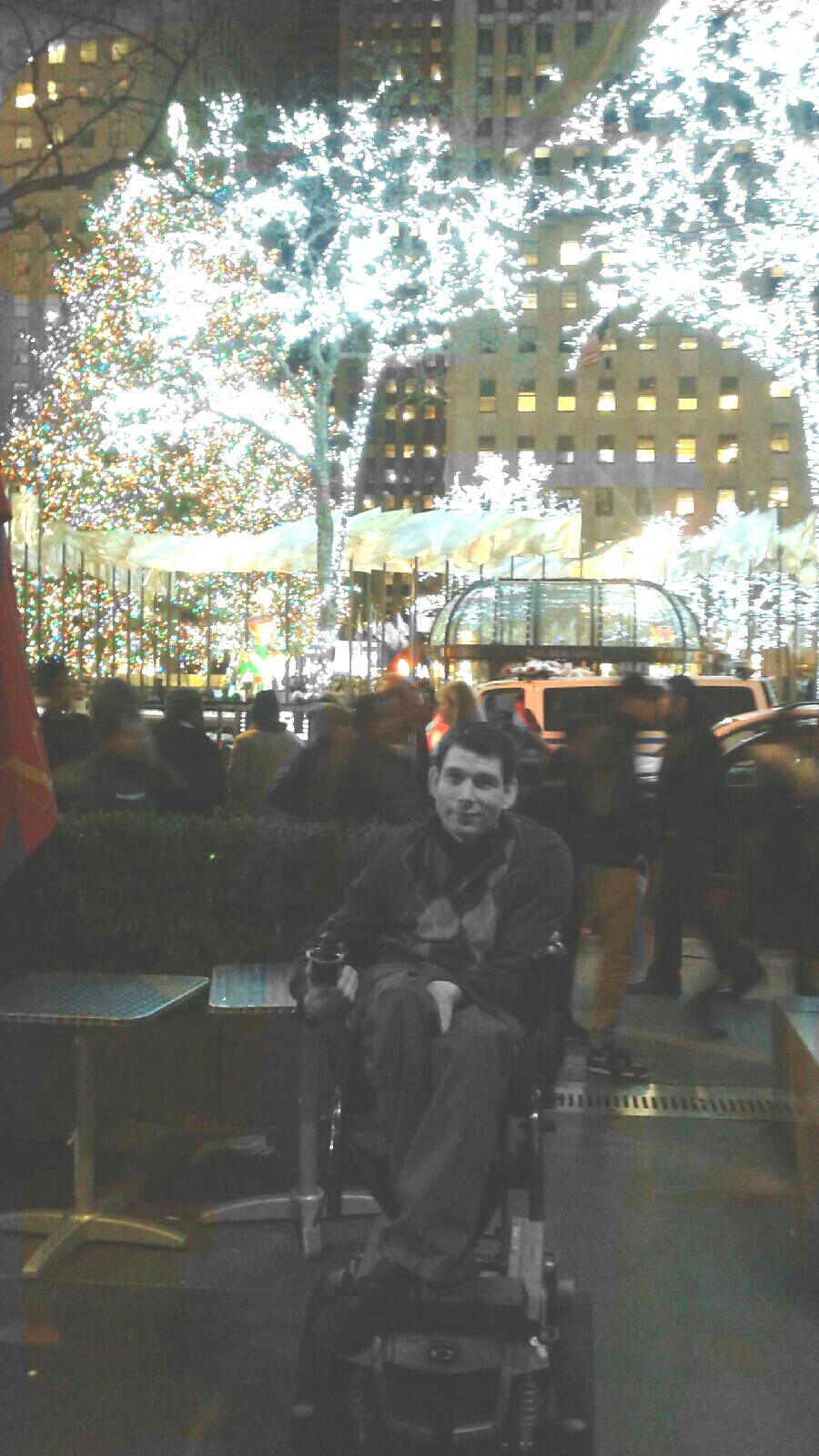
My family and I went to see the famed Rockefeller Christmas tree, and it was more crowded than anywhere I’ve ever been. However, because my power wheelchair has an elevating seat that places me at 5’7” tall, I worked my way through the crowd slowly but surely, eye-to-eye with those moving about, where people smiled at me, gingerly moving aside as needed for my 24”-wide power wheelchair to pass.

As we got closer to the tree, the crowd became so dense that I couldn’t see the ground, merely following the heads in front of me. Then, suddenly, my power wheelchair dropped down a medium-height curb leading to the tree. Although the unexpected curb startled me, all was fine and we continued to the tree, shoulder-to-shoulder in the crowd, finishing with a classic family photo of the tree behind us.

We worked our way back through the crowd, and I watched carefully for the curb, knowing that while I couldn’t climb it while elevated, I could lower my seat to standard wheelchair height and safely drive up it. As I reached the curb, the crowd continued flowing around me – that is, until I lowered my seat. Suddenly, at typical wheelchair height, my world changed. It was literally darker, more confined and, most shocking to me, I became invisible. While the crowd was moments earlier around me at standing height, now people were slamming into me, falling on me, oblivious to the fact that I was “down there.” I’d gone from a person in the crowd to suddenly invisible and of no stature simply by lowering my seat.

I yelled to my fiancee for some sort of help and in a panic, I charged the curb, clipping people along the way. For me, in among the rarest moments I’ve experienced, it felt like it was life or death – I was both fighting and fleeing.

Once up the curb, I quickly elevated my seat, and as people immediately began safely flowing back around me, I took a deep breath, composed myself, and realized a universal truth: Being invisible to society is terrifying.

For me, that was an experience I’ve culturally known in other ways as a man with a disability. Beyond the change in physical stature I described with my elevating seat, I’ve more readily been de-elevated in social stature at times. However, the de-elevation of who we are – where we become invisible in an instant based on ignorance, stereotyping and discrimination – is a disturbingly universal one.

Imagine how it feels as an African-American trying to hail a cab in a big city, and empty cabs pass you by. Imagine being gay at a dinner party where rhetoric arises, condemning homosexuality. Imagine being a woman shopping for a car, and the salesman only speaks to your husband. Imagine walking into a clothing store as one of a plus size, and the sales people ignore you. Imagine being in bed with your spouse, and he or she turns his or her back to you as you’re trying to communicate. Or, imagine being homeless on a Los Angeles sidewalk, and no one even looks at you as they pass. So many of us can relate with being de-elevated to invisible.

Yes, I was fortunate amidst the crowd at Rockefeller Center that eve because, at the touch of a button, I elevated back to being seen. However, life for many – including me as one with a disability – often isn’t so easily resolved. When we’re dismissed by others and made to feel invisible, there is no button to push. Rather, the experience of being made invisible based not on our character, but based on the ignorance, stereotyping and discrimination of others… well… just hurts.

Barbershop

BARBERSHOP

By Mark E. Smith

No, I wasn’t surprised, but it hasn’t happened to me in so long. Over my 44 years, I’ve seen so much progress toward social acceptance of all, that I simply don’t encounter such situations often anymore.

However, while society at large has changed – where diversity on all levels continues becoming the norm to the point that even using the word is becoming less relevant – some individuals don’t change. And, where I see this lack of change the most is as a generation gap.

So, when the 70-ish woman at the salon refused to cut my hair this past week due to my wheelchair and cerebral palsy, I wasn’t surprised. After all, she was raised in a time when those with disabilities were “cripples,” African-Americans were “negros,” and being openly gay didn’t exist. Yes, we hope that most evolve with the times, but we also know that limited life experiences can keep us from growing, it can keep prejudices ingrained in us. And, for this woman, I understood that disability – not me as an individual – was too much for her to process. In fact, I felt for her because she was beyond flustered while I was fine with the situation. I just wanted a haircut, not to judge her beliefs.

Of course, the salon manager, Andy, jumped in, cutting my hair – because that’s how we accept each other in society today, open, embracing, with grace and dignity, no matter who you are.

I left the salon with a haircut and a reminder that the beauty of practicing acceptance sometimes means likewise embracing those who don’t accept us at all.

Pitch 15

elcapitan

By Mark E. Smith

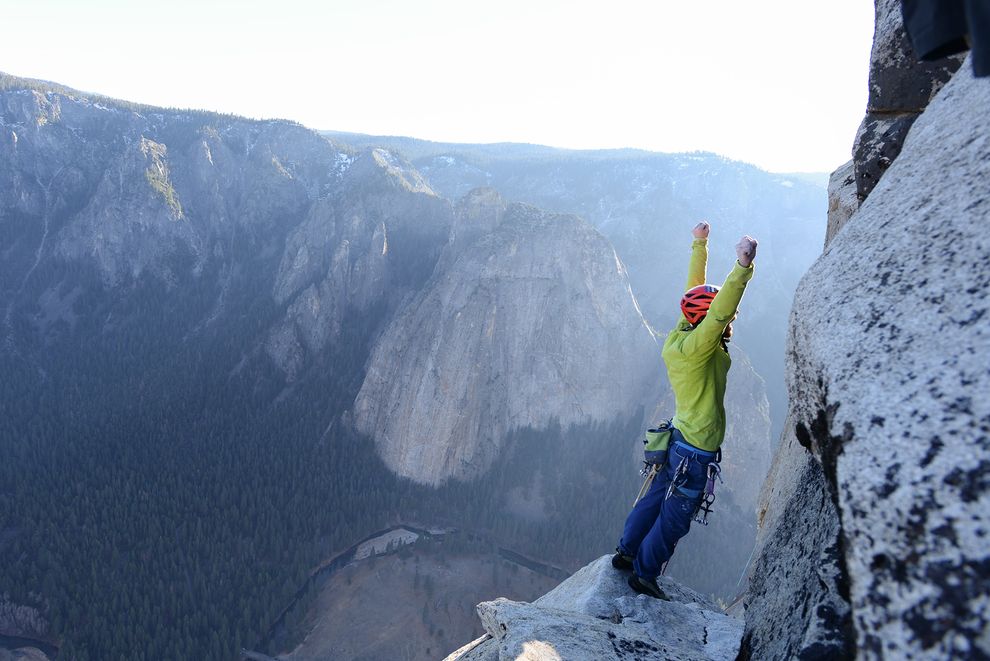
Kevin Jorgeson and Tommy Caldwell recently became the first rock climbers to “free climb” Yosemite’s mammoth 3,000-foot granite face, El Capitan. For the climbing community and public, what made the climb a record was the fact that the duo didn’t use any climbing aids – just bare hands griping crevices and climbing shoes pressed on the rock face.

However, the free climb wasn’t what impressed me. Rather, it was a story within the successful climb.

See, on day 8, on Pitch 15, one of the toughest stages, Caldwell zipped right up it. But, Jorgeson failed. In fact, he failed over a dozen more times, adding 7 days to the climb. Imagine the scene. Caldwell perched slightly above the pitch, watching his partner fail over and over, day after day. And, Jorgeson consistently failing to the point where he should have thrown in the towel. It looked to both men and the world watching that it was an impossible feat for Jorgeson.

Yet, despite exhaustion and escalating self doubt, Jorgeson finally conquered Pitch 15 after 7 days of trying. When asked what pulled him through, he replied, “Resolve. I didn’t see any other outcome but to make it….”

We all encounter Pitch 15s in our own lives, those times when we don’t think we can go on, those times where success seems impossible, adversity too looming. I’ve been there regarding living with disability many times. And, what I’ve learned, much like Jorgeson, is this: we can either concede and quit, or we can muster resolve and determination, where ultimate failure isn’t an option. We know the outcome of conceding and quitting – dreams dashed, an important part of our potential never realized. Yet, when we persevere through the seeming impossible, the results are astounding – we succeed.

Jorgeson’s dilemma on Pitch 15 was a unique one in physicality. After all, he’s among the first to free climb El Capitan. However, emotionally and mentally, his plight was universal – keep trying, against all odds, until you make it. Maybe you’re currently struggling in a college class or with sobriety or in a relationship or in your career. Again, you can always just quit tackling any adversity at any time – and if it’s obviously tough, no one will fault you.

Yet, here’s the universal truth when you have the courage not to quit: if you’re brave enough to tackle adversity, you’re brave enough to overcome it and succeed.

From Cerebral Palsy to Quaaludes

Matt Fraser
Matt Fraser

By Mark E. Smith

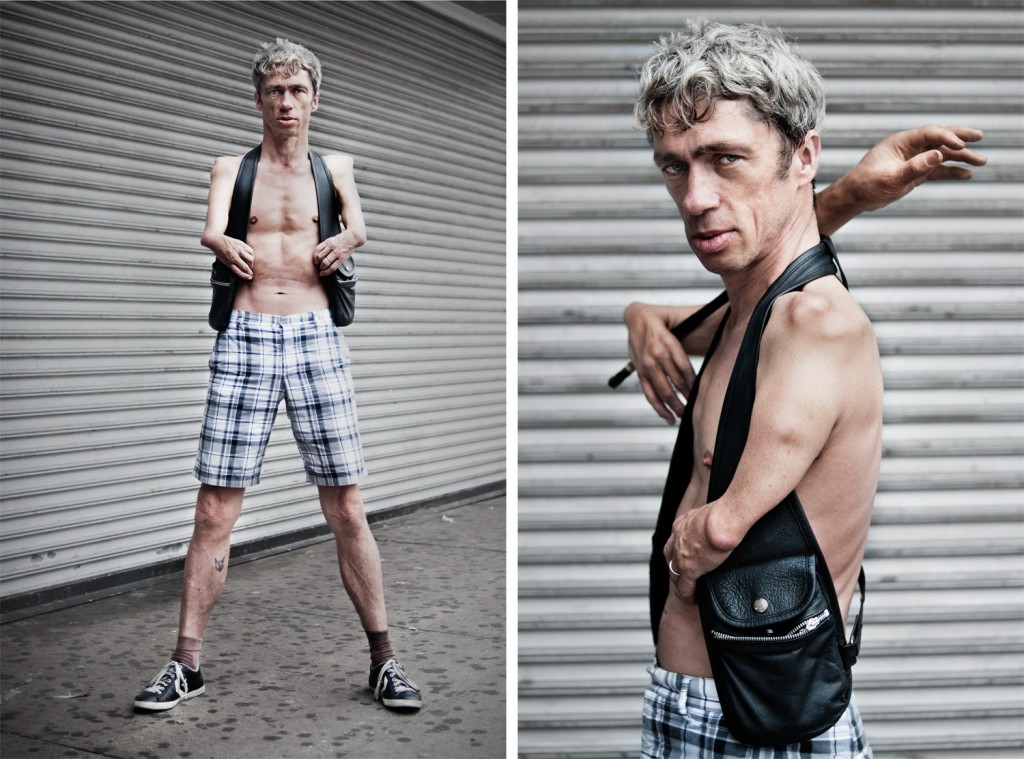
Matt Fraser isn’t afraid to be nude. He also isn’t afraid to appear on stage at venues ranging from off-Broadway plays to movies to television shows, including this season’s smash hit, American Horror Story: Freak Show. And, his fearlessness doesn’t end there. Matt is a Black Belt, a forever-charming ladies man and even a BBC radio show host.

However, here’s the single most important aspect to the success in Matt’s life: Matt Fraser isn’t afraid to be Matt Fraser. He presents himself with authenticity and doesn’t give us any other choice. We either accept Matt for who he is – disability and all – or move on.

How many of us struggle or have struggled with being who we are? Maybe as children we behaved a certain way to please our parents that wasn’t authentic to our identity. Maybe in high school, we caved to peer pressure, not feeling safe to truly express ourselves. Maybe in our careers, we squelch our personalities to fit a corporate norm. And, how many of us have curbed our behaviors, feelings and wishes to please a partner? Indeed, we’ve all been there. Yet, here’s my question for you: Have any of these scenarios worked for you in the long term?

Of course not. It’s never worked for you or me because whenever we’re not 100% authentic, parts of us feel inadequate, denied, undesired, squelched – and that’s painful. However, if you want to avoid such a terrible fate, just be yourself! It will feel risky and scary at first, but soon it will feel liberating, the freest you’ve ever felt. Now, some in your life won’t be able to handle the real you because they’re used to a watered-down, squelched version. But, your world as a whole will feel anew, fresh air filling your lungs as never before.

I remember being in my 20s and very self-aware. I watched carefully what I said to whom, and although I often had zany, witty thoughts pop into my head, I rarely uttered them, fearing I’d sound uncouth. My brother, on the other hand, who shared my wit, said anything to anyone, and I observed how charmed others were by his authenticity. With my brother as an inspiration, I slowly let my authentic voice come out – I’d say exactly what I wished on stage and in witting – and that’s when my career took off in every direction. It was time for me to be… well… me.

Some two decades later, being Mark E. Smith is a blast. I mean, if you’re an adult and ask me, “What happened to you,” I’m not going to give you a politically-correct answer about cerebral palsy as I would have in my 20s. Rather, if you’re an adult ignorant enough to ask me that question at an airport or such, I’m going to be me and you’re getting a one word answer: Quaaludes!

Each of us were born to be who we are, and assuming we’re healthy individuals, we owe it to ourselves and those around us to simply be who we are. Society, partners, and you name it may try to squelch who you are. But, your obligation is to be a Matt Fraser and live your life beautifully, exactly who you are, never compromising your authenticity – and the world will embrace you.