At the Heart of Smiling

12141599_10208009578662115_6936364041281133666_n

Every time you smile at someone, it is an action of love, a gift to that person, a beautiful thing. ― Mother Teresa

By Mark E. Smith

My father-in-law, a retired pastor, told me a great story over dinner.

He said, “My best friend, Gary, and I were both pastoring, and I noticed that at the end of services, everyone hugged Gary, while they only shook my hand. So, I asked Gary why that was? Gary replied, ‘You stick out your hand, while I open my arms….’”

What the two pastors were really discussing was that we receive what we offer. If you want a hand shake, put out your hand and you’ll get one. If you want a hug, open your arms and you’ll get one!

For me, I’ve always smiled. From as young as anyone can recall of me, I was always smiling. Part of it is my innate disposition, but the other part of it, as I’ve come to understand, is an appreciation for life. I’ve been through my share of adversities – and will forever struggle with some – and it’s gratitude toward all of it that keeps a joyful smile on my face.

However, smiling is more than only about my disposition or gratitude. It goes back to the conversation the pastors had. Truly, if you want to see the world smile, smile at it. I often share this story. I was at Walmart with my sister several years ago, and she noted how friendly and nice customers and employees were to me – the complete opposite of her experience of everyone being somber. I asked her to watch as we continued shopping. Per my usual, I smiled and made eye contact with complete strangers where that led to an exchange of a friendly how-are-you? “Just smile at people,” I said. “It changes everything.”

I’m at the point now where I smile at pretty much everyone. On my route to work, a crossing guard shared with me that she learned who I was by asking a friend in the neighborhood, “Who’s the guy in the power chair who’s always smiling?” If I’m at a stop light in my van, I’ll smile at those in cars next to me, and it’s amazing how a gruff guy’s demeanor will change or a woman will blush – a smile is a powerful exchange.

And, there’s science to this all. Firstly, smiling triggers a happiness feedback loop in our brain, so whether we smile because we’re happy or we become happy because we smile, it works. Secondly, numerous studies have shown that smiling increases our success, from home life to career. The average person smiles 20 times per day, whereas ultra-successful people smile 40 to 60 times per day. Smiles are warm, inviting and sincere – they’re a people magnet because we’re drawn to happiness.

Of course, I do run into being stereotyped sometimes based on my smiling. Well-meaning individuals noting my cerebral palsy come right out and ask, “How is it that someone in your predicament can find a reason to smile?”

I just smile and reply, “A life where you smile at the world and it smiles back at you is a fortunate predicament to be in….”
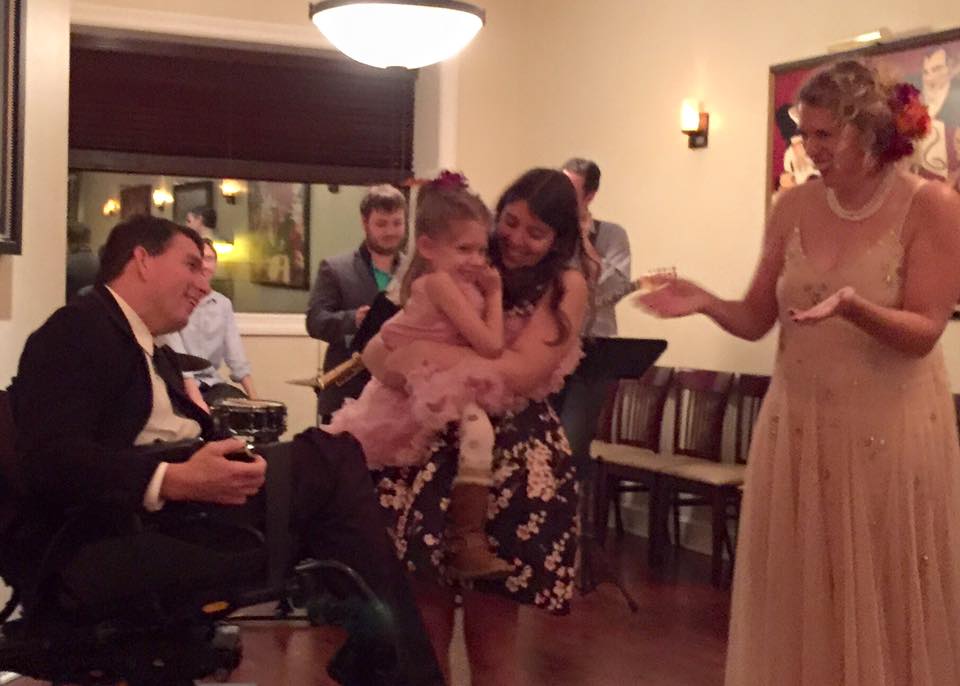

No More Second Chances

Smith Wedding Reception, October 10, 2015

By Mark E. Smith

On the surface, my life is one of second chances. In fact, from the moment of my birth, not breathing, resuscitated, then given only hours to live, my life started with a second chance.

As my life went on, second chance after second chance all but saved me from countless perils that could have stopped my life in its tracks. I went from lying on therapy mats in a special school to being mainstreamed in public school; I went from virtually no mobility to having a power chair; I went from moving into a garage to moving into my stepfather’s home; and, I ultimately went from not having a father to being among the most dedicated fathers myself. Indeed, if it wasn’t for second chances, my life would have derailed at so many points.

However, now at mid-life, my experiences and insights have allowed me to realize that second chances don’t truly exist beyond cultural mythology. Life doesn’t offer second chances. We can’t erase where we’ve been, we can’t change what’s happened, and we certainly don’t get do-overs. No, life is a journey, a linier equation, where all that we’ve experienced shapes who we are, where we are – the painful times, the prosperous times, the losses and gains, the tragedies and triumphs all serve a masterful purpose.

The notion of second chances suggests that the firsts were an error, not meant to be. Yet, without whatever came first – the tragedies, the mistakes, the failures, as commonly labeled – we could never have what came next, we could never continue on the journey that makes our lives… well… our lives. And, when we remove the notion of second chances from our beliefs, and value all aspects of our life as a linier journey, it gives meaning to all, turning even the most painful parts of our lives into purposeful, into having reason, into healing and success.

See, if we don’t look at life as second chances, but rather as what’s meant to take time to unfold and come to fruition, it’s impossible to be bitter, resentful or regretful of the past. Instead, we become intrinsically thankful not just of where we are, but likewise where we’ve been. Sometimes life’s journey is not to be questioned, but lived.

Our Truest Voice

speaking

By Mark E. Smith

I recently watched a Ted Talk by a public speaking coach who gave the secrets to being a great speaker. She spoke of relaxed posture. She spoke of soft breathing. She spoke of using your diaphragm. She spoke of controlled speech patterns. And, she spoke of overall body composure. Really, based on all she covered, I should never roll on a stage or speak in front of a group ever again because my cerebral palsy prevents every technique she noted. According to her, I’m the antithesis of a speaker, her worst nightmare.

Yet, over the past 25 years, I’ve spoken to more groups than I can count; I’ve made a remarkable number of TV appearances; and, I speak formally within my company in many capacities every day – all with tremendous efficacy. So, how do I – as one with severe cerebral palsy – defy the rules of the experts and achieve success in my career with so much speaking?

The answer is, I am just me and I always speak from the heart. I don’t need to be a polished robot, nor do I need to try to be someone I can never be. When you hear me speak – sometimes labored, sometimes slurred, sometimes spastic – you’re getting the real me. What greater gift can we give others than the real us, perfectly imperfect, speaking from the heart?

Among the reason why I address groups within our company is because I’m so passionate about what we do and I’m so inspired by the profound difference each employee makes in the lives of our customers. And, so one of my greatest privileges is speaking to groups of our employees, both weekly with new hires, and monthly at our birthday lunch, where we celebrate employees’ birthdays.

It’s my pleasure to share with you one of my talks with our employees. What I want you to note is that I’m clearly not what that speech coach envisioned. Rather, I’m real and imperfect – the two traits that we should all embrace to make a true impact in the lives of others. There’s no one more captivating than who we truly are.

Crank up the volume and enjoy this 12-minute talk:

Intersection of Purpose and Hope

hope-1

By Mark E. Smith

I was recently in Boston, working a consumer trade show for disability-related products, including my company’s power chairs. If you’ve never been to Boston, it’s a stunning city – from the architecture to the cobblestone streets to the harbor – and I found myself in Boston at an amazing spot: the intersection of Purpose and Hope.

No, the intersection of Purpose and Hope isn’t a literal street corner in Boston, but it can be found in any city, and in any of our lives. For me, in Boston, it was found in my meeting a seven-year-old boy with cerebral palsy.

He reminded me a lot of… well… me at that age. He was a little guy, squirming all over the place in a manual wheelchair due to spasms and tone, symptoms of cerebral palsy. And, the reason why his family was at the show was because he needs a power chair to keep up with his siblings and peers – read that, to just be a kid.

We had our top-of-the-line power chair there in a pediatric seat size, and as I soon realized, uncannily as if made to fit him exactly. To address his involuntary body movements, I had our reps unbolt lap belts from other units, and we got him seated, strapped in and stable. And, like he’d been in a power chair his whole life – or, more aptly, a NASCAR driver – off he went!

I looked at his parents’ faces, their eyes, knowing how bittersweet these moments can be. On the one hand, a parent wants his or her child to have all of the independence in the world. Yet, no parent wants his or her child to have a lifelong disability. A child going into an advanced mobility device can be a parent’s emotional tug-of-war.

However, his parents understood the liberation he was gaining, and their expressed emotion was joy as he roared around an empty part of the convention hall.

“He’s going to be a little terror,” his mother said with a huge grin. “…From the playground to chasing his brothers on their dirt bikes.”

For me, I was blessed in that moment in living my purpose as one who’s found so much emotional reward in my career of serving others who are on the path I, too, have traveled. And, the family expressed so much hope toward the quality of life a power chair will bring to their son. All of this is the breathtaking beauty of the intersection of Purpose and Hope.

Where’s that intersection in your life right now? Sometimes we bring our purpose to the corner, and sometimes we come needing hope. I’ve been on both sides of the corner. Regardless, when we simply have the initiative and courage to place ourselves at the intersection of Purpose and Hope, all lives involved are elevated.

Keeping Roots Planted

roots2

By Mark E. Smith

For 18 years, I’ve run an Internet message forum where consumers can exchange information, as well as ask me questions, regarding mobility technology. I started the forum, in fact, before my careers in the mobility industry and writing took off. Today, both the mobility industry and writing – often overlapping – are more than full-time jobs. Yet, I still run the message forum, routinely addressing needs 20 hours per week or so, often on Sunday mornings or at 10 o’clock on weeknights.

With my career so established and the fact that the message forum has intentionally never generated income, some have asked why I keep doing it? After all, it adds stress and absorbs much of my so-called free time, and 18 years is a noble run.

My answer is simple: I never forget where I come from. See, that message forum originated from my just wanting to use my two passions – power wheelchairs and writing – to support my peers in their mobility plights. Fortunately, my career flourished, but my sense of loyalty to the message forum members has never wavered – it’s a privilege that they’ve allowed me to remain part of their lives through almost two decades.

We often see people, companies lose their roots, and it isn’t pleasant, is it? People become too good for where they came from, companies no longer care about customers. It’s easy to be humble when you have nothing; it takes true character to be humble when you have everything. I believe the ultimate measure of success is staying true to your roots, true to what got you to where you are.

The key to this is reminding ourselves of why we started doing what we do in the first place. I was talking with my CEO the other day, and he said that when he got into the durable medical equipment industry in 1986, he knew nothing about medical goods, but he knew how to treat consumers. It struck me as fascinating because he and I have spent the last 15 years talking about how to forever better serve consumers – it’s why we’re in our business. In fact, in recent years, a key focus is to constantly remind all of our employees – and ourselves – why we do what we do within our company, where we simply strive to improve the quality of life of our consumers every day.

Beyond the boardroom, I see couples struggling and I often wonder, what brought them together in the first place? Do people and life really change that much? Surely some do, but for many couples they simply forgot along the way what made each other special to begin with. It’s a losing of roots, getting too big for each other, you might say. It’s like any success that goes to your head – you take important aspects for granted. If it’s not too late, sometimes a simple remembrance of why you fell in love can be the spark that reignites the flame.

The fact is, humility and success must go hand-in-hand or you’re ultimately a failure. From our careers to our love lives, let us never leave our roots behind; instead, let us humbly plant them deeper as we go.

Graduations

EMILY_GRADUATION

By Mark E. Smith

At this writing, my daughter graduates high school this eve. She’s the second to do so in our family’s history. I was the first. Great grandparents, grandparents, my parents, aunts, uncles, no one on any limb of my family tree graduated high school.

However, it’s not like everyone doesn’t try. You start out with all of the hope in the world as a child , but in a realm where we know that cycles of dysfunction are so complex – right down to aspects like addiction having a genetic component – it just gets a grip on you, tough to escape as you hit your teens, your adulthood. I know – I’ve been there.

My daughter’s mother came from a family history of addiction, as well, and not with bitterness or anger or resentment, but with sadness, I watched her fall into the grips of addiction. They say that if you come from a family of dysfunction, you’ll either become it or marry it. Ironically, as 27-year-olds, with our daughter born, my ex-wife and I thought that we’d broken the cycle – we didn’t drink, both went to college, and life was on track.

However, as my daughter hit her toddler years, life went off of the tracks, and my ex feel into a life of mental illness and addiction compelled by her troubled upbringing – while I don’t believe in excuses, I do have empathy for reasons. Again, you can’t fault trying.

As the vortex swirled in our family, I consciously chose to swoop my daughter out. We all were in the generational cycle of dysfunction – my ex-wife became it, I was married to it, and, most disturbing of all, my daughter was growing up in it.

Soon enough, my daughter and I were on our own, my sister a major source of support. And, as my daughter grew, thriving year after year, I was both inspired and scared to death. After all, I was the only person I knew in my family tree to stay on the track during high school, and my worst fear was that my past, her mother’s past would become my daughter’s. Yet, as she grew into a young lady, like watching a thoroughbred round the bend, she never skipped a beat. I can’t count how many of her plays, band concerts, honors clubs, and so many other functions I went to. By 2013, she was named among the top 250 youth scholars in the country, and simultaneously was awarded a scholarship to a summer performing arts program for the top youth musicians in the world – literally. And, all the while, I watched not just with a father’s pride, but awe-inspired by what a person can accomplish with dedication, ambition and passion.

Tonight, my daughter will be among the most honored graduates in her class, her gown decorated with more honors – a stole, multiple awarded cords, so many award pins that my sister had to strategically align them – than I ever knew existed. And, as she walks across the stage, she won’t be the second to change our family tree, after all. No, she will be the first.

See, what I’ve witnessed through my own plight, and now my daughter’s, is that it’s irrelevant where we come from. From a lineage of addiction, poverty, incarceration, illiteracy, and mental illness, none of that crosses the stage with my daughter tonight. My daughter, it proves, will cross that stage as each of us can, where the only legacy her life carries is that of her own – and it’s amazing.

Changing Channels

tvBy Mark E. Smith

Happiness amidst adversity has always fascinated me. Yet, so has misery among fortune. Both are totally counterintuitive – that is, people facing life’s toughest adversities logically shouldn’t be genuinely happy, just as among the most fortunate shouldn’t be miserable. But, we constantly see this occur with such frequency that it’s almost a norm rather than an isolated phenomenon. We see individuals facing challenges that, logically, should defeat the soul, but instead there’s a contentment and joy. Then, we see individuals with every advantage in life who are miserable. How is it that a 23-year-old with muscular dystrophy from which he or she will eventually die by age 30 is intrinsically happier than a 40-something multi-millionaire, recreational triathlete? I witness this all of the time among people I know and acquaintances – and, as one with a severe physical disability, I’ve experienced it myself.

Psychologists, sociologists and philosophers have been studying this exact subject, trying to crack this code of human nature: how does suffering allow for happiness while good fortune allows for misery? The recent consensus is intriguing.

See, what’s been discovered is that while happiness should logically come from good fortune, good fortune unto itself doesn’t evoke happiness. You can have all of the success in the world, and it doesn’t inherently induce happiness. Of course, many of us have known this, but, here’s the intriguing part. What does inherently induce happiness is gratitude. In fact, it turns out that they’re inseparable. If you have gratitude, you inherently possess happiness. But, that leads to yet another question in this equation: where does gratitude originate?

It turns out that opportunity is the root of gratitude – both in recognizing it and in appreciating it. I know where researchers are coming from because I live it. My independent living skills, such as bathing, are extremely difficult for me, sometimes having to endure a level of literal pain, if not suffering, in the process. When you lack coordination and balance, aspects like showering aren’t just difficult but often borderline dangerous, where falls and rebounds are just part of the nightly ritual. Yet, even in the midst of tremendous struggles, I’m genuinely happy. Heck, I even catch myself singing in the shower among the controlled chaos. How can I remain truly happy during such seemingly difficult times? Well, I know a lot of individuals who aren’t able to bathe themselves, and so I’m grateful for the opportunity simply to be able to do so, no matter how trying it can be. Opportunity creates gratitude, and gratitude creates happiness.

A childhood friend of mine, John, has had a slowly-progressing form of muscular dystrophy. He’s always used a power chair, but has slowly lost more and more muscle tone to where, now in his 40s, he doesn’t have the strength to use a television remote. But, John, as a super successful guy who knows the power of opportunity, gratitude and happiness, shared a story that made me smile. He found out that by getting a different cable box, he could use his smartphone’s touch screen to change channels. And, here’s what he said in his exuberance: “I’m quite overjoyed, and delighted even, to discover the new X1 system comes with an app on which I can completely operate the cable box from my iPhone. Losing strength and losing that ability killed me (metaphorically)… But now, I again have full control of my cable box!”

No, operating a cable box doesn’t in itself make John happy; however, the gratitude that he recognizes from the opportunity does.

Of course, this isn’t to say that we don’t all experience real human emotions like sadness and frustration, nor can gratitude overcome mental health conditions like clinical depression or chemical imbalances. However, when we’re emotionally and mentally healthy, gratitude can help us move toward positive states amidst difficult times. I recently lost Rosie the English Bulldog, my companion of 10 years – a very sad loss. But, amidst my understandable sadness, I found tremendous gratitude in her companionship, where reflecting on her hilarious absurdities – her tongue always protruding from her mouth, making her constant comic relief – filled my heart with joy despite the sad loss. In this way, finding gratitude in the toughest of situations can elevate our spirits. I’m not happy that Rosie the English Bulldog passed, but I’m grateful and happy for the 10 comical, adoring years we shared.

When the everyday aspects of life aren’t seen as doom or gloom, but as amazing opportunities, it creates gratitude, and with that we’re intrinsically filled with happiness. One doesn’t need to struggle or face challenges to find gratitude in one’s life – everyone can embrace it because where there’s life, there’s opportunity and gratitude. However, one does need to have gratitude to truly have happiness. Maybe we all need to take a lesson from John and recognize that the surest path to happiness is found in simply switching the channel – to gratitude.

The Math of Life

equation

By Mark E. Smith

I love having problems. See, what I’ve learned in my life is that problems are opportunities for solutions, and with solutions comes success. In fact, in most cases in our lives, our biggest successes begin with a big problem.

Many have the equations of life backward. Although in math we’re taught that problems are solved with absolute solutions, many never look at life that way. Instead, we often view problems as unsolvable or insurmountable. Often when we encounter a problem, we give up or dramatically change directions. And, this, of course, makes achieving success and accomplishing our dreams impossible.

However, if we look at a problem as the first step toward success – that is, if I overcome this challenge, I will achieve my goal – a problem becomes nothing but positive. I mean, losing a great job for example, is in most people’s minds one of life’s toughest problems. Yet, I’ve known countless people who have used a firing as a catalyst to land better-paying, more-satisfying jobs. In this way, the problem of losing a job can either be a devastation or an opportunity for career advancement – and we have the power to choose the path.

Now, there are also bad problems and good problems, and while the objective is the same – find a solution! – few realize the difference. My daughter is formally enrolled to begin college this fall, as are many of her friends. The number one topic I hear from my fellow parents these days is the problem we’re all facing with looming $30,000 to $40,000 annual tuition bills. I’ve been expressing to my peers that this is a fantastic problem to have because while it may seem a financial nightmare on the surface, it’s only because we have amazing kids who’ve worked really hard to get accepted to among the best schools. If our biggest problem is paying for our children’s college because they’re succeeding in life, we’re actually blessed – it’s a great problem to have.

I’ve been working through good versus bad problems in looking to buy a new home. While my fiancée and realtor have been diligent and patient, it’s been impossible so far to find a home that can be made reasonably accessible for my power wheelchair and interior adaptations, such as an accessible bathroom. We’ve found several homes that if I could walk would have been dream homes. However, due to my special needs, house after house has had to be ruled out. It’s seemingly becoming a bad problem because as a man using a wheelchair, I’m seeing firsthand the problem we have in this country with an overall lack of housing that can be made accessible, from rentals to purchases. However, as one with a disability – where based on remaining social stereotypes and societal barriers to employment, my peers have an 85% unemployment rate – I’m blessed to be able to afford home ownership. Therefore, the ability to afford a house, but not be able to find one quickly based on my access needs, is a good problem to have.

In both these situations, what may seem like problems are actually remarkable opportunities for success. Solving the problem of costly tuition means that my daughter is the second person in my family’s history to attend college and, ideally, go on to an amazing career.  Solving the problem of finding my accessible dream home will allow me to live in my own sanctuary, full of laughter and love for decades to come. Yes, such circumstances begin as problems, but eventually they are pathways to remarkable success.

We all encounter problems in our lives, and it’s so easy to be frustrated at best, devastated at worst. However, if we’re going to succeed amidst adversity, we need to look at problems not as obstacles, but as opportunities. When we face a problem, it’s rarely that life isn’t going our way. Rather, when we face a problem, it’s usually life simply asking us to look at the situation a little deeper – and there within most often resides a path to greater success than we ever imagined. We may have problems, but we also have solutions to achieve amazing success.

Bus Stop at Purpose Ave.

Jayne__Kenya_1

By Mark E. Smith

Think about the most genuinely happy, joyful person you know. I have no way of knowing that person, but I certainly can tell you all about him or her. His or her smile lights up a room. He or she is totally comfortable in his or her own skin. He or she doesn’t worry about trivial aspects in life. He or she is one of great comfort to others in an especially unique way. And, he or she is slowly but surely changing the world for the better. Who is this individual?

The answer is, it’s a person living to his or her purpose. See, when we live with purpose, it’s impossible not to be happy and successful. After all, in living with purpose, you know the value of your life, the positive ways you impact others – directly or indirectly – and how you change their lives for the better. Most importantly, you recognize the value of others, and strive to meet their needs with your unique abilities.

For some, their purpose seems obvious. A police officer protects citizens. A comedian makes people laugh. An emergency room nurse saves lives. However, for the rest of us, finding or recognizing our purpose can be less obvious.

I recently had this talk with my 18-year-old daughter: how do we know our purpose? An even more challenging question is – and it’s one of the toughest in humanity, an age-old inner-struggle – do I even have a purpose?

As one who feels tremendous purpose in my life, I thought a lot about what core questions does my daughter – or any of us! – need to find and understand our purpose?

And, so I gave my daughter some questions to ask of herself:

Who am I?
What am I passionate about?
How do I effect other people?
What do others need from me?
How can my everyday actions better other’s lives?

For me, the answer is easy. I have cerebral palsy and in understanding the liberation of mobility and independence, my purpose is in helping others achieve those vital aspects in their own lives. As a result, at the end of each day, I feel the privilege of having a tangible sense of purpose in my life.

Based in New York, Rick Guidotti is among the top fashion photographers in the world. In the 1990s, he photographed those who were deemed the most beautiful women on Earth. Then, in 1998, at a bus stop, he encountered a teenage girl with albinism. In a world that can see such conditions as strange, Rick saw beauty, and as he embarked from there to taking photos of those who weren’t known as conventionally beautiful like the models he shot for Vogue and such, he found a turning point in his life: his purpose. See, through Rick’s photos, he not only raises the esteem of his photographed subjects – many seeing their own beauty for the first time, the camera serving as the ultimate mirror of truth – but his photos have also captured the attention of the top magazines and galleries, dramatically improving society’s perception of not just those with disabilities, but also the truth that we’re all beautiful.

Rick knows who he is, what he’s passionate about, what others need from him, and how his actions change their lives. He’s a man living with purpose.

I don’t know where you are in your life, but I l know that you, too, have great purpose. Maybe you know your purpose and know the joy that comes with it. Or, maybe you’re trying to discover your purpose. Think about who you are, what you’re passionate about, what others need from you, and how your actions can change their lives. And, live it with everything you have.

Redefining Tragedy

tragedy

By Mark E. Smith

My daughter had a scholarship interview on “the challenges she’s faced.” When she asked for my advice, I suggested describing the challenges, but mainly emphasizing how she’s overcome them, what we all can learn from them. After all, a tragic story is just… well… tragic. However, when we turn tragedy into triumph, that becomes an inspiring lesson for all.

It’s really the way life, too, works, isn’t it? For example, we know that dysfunction is generational, and when we see someone – hopefully not ourselves – repeating the cycle of generational dysfunction, it’s just tragic. Imagine a Ted Talk where the thesis was, “My parents were abusive alcoholics and now so am I….” The jaw-dropped audience would leave saddened and stunned. However, if the thesis was, “My parents were abusive alcoholics and here’s how I broke the cycle,” then there’s a riveting story all can learn and grow from.

I believe all of us have the ability to not rewrite our stories, but to finish them in ways that redirect them from the tragic to the triumphant, creating a phenomenally successful narrative – read that, life. The first chapters may be already written, but we can direct new ones, dramatically changing the story at any time.

See, tragedy is rarely a finite end, but almost always a remarkable opportunity for new beginnings, redirection. Yet, it’s rarely obvious. It takes a lot of awareness, introspection, and hard work to redirect our lives from tragedy to triumph. But, when we do, it’s the most important move we ever make, where tragedy stops, and healing and success begin.

Reflection, as I shared with my daughter, is key in this process – it’s where the learning curve is. If we’re unable to reflect on the tragedies in our lives, not only can’t we gain from them, but we’re at extreme risk of continuing living them. Any time that tragedy affects us, we ultimately need to find a space of reflection and introspection to stop the suffering and start the healing, the redirecting from the negative to the positive, the end of chapters and the starting of new ones.

It can be tough to do, I know. And, it’s heartbreaking when we see anyone – from loved ones to strangers – stuck in the wake of tragedy, sometimes a whole lifetime marred by its lingering effects. There are so many situations where it’s impossible to obtain clarity of thought in the situation, where reflection or introspection can’t occur because the scars are seemingly too deep or one’s capacities seem too limited. …Or, can it?

We often hear of people “hitting rock bottom.” I did this years ago in a marriage. The common misconception is that we hit rock bottom when we’ve lost everything, our lives in shambles. However, that’s rarely the case. I define “hitting rock bottom” as a point of uncanny clarity in the wake of tragedy, the point where we can reflect so honestly upon our past and present situations that we say, “Enough! I’m learning and growing out of this situation to live a healthier and more fulfilling life.” What’s wonderful is that we don’t have to be in shambles to do this – at any point, in any aspect of our lives, we can reflect upon that which isn’t working, that which has harmed us, learn from it, and move to new levels of success.

In these ways, tragedy doesn’t have to define us, it doesn’t have to be a life-long scar or pattern, but can be a catalyst for growth and change toward living the life of our dreams. As I shared with my daughter, the ultimate triumph over tragedy isn’t the inspiring messages we convey with others, but the liberation it brings to our own lives.