
If you haven’t seen me tell tales live, you don’t know what you’re missing! But, here’s a fun video excerpt that I think you’ll enjoy. -Mark
Tag: disability
Listening, Loving – Present
By Mark E. Smith
It can be argued that there’s no song more emblematic of the late 1960’s counter culture of flower-power, psychedelic drugs, and free love than “Purple Haze” by Jimi Hendrix.
However, contrary to the logical presumption that Purple Haze is about drug use, the late Hendrix swore it is a love song, a lament about a girl. And, he pointed to the lyrics, Whatever it is, that girl put a spell on me.
Of course, the lyrics that most of us know from Purple Haze are, Excuse me while I kiss the sky. But, what really puts it all into context is the preceding verse, Actin’ funny, but I don’t know why? And, so you have an amazing, iconic song about a love-sick guy, not knowing how to get himself out of a bad place, questioning, Is it tomorrow or just the end of time?
Fast forward 40-something years, and in today’s culture, the love-sick soul in Hendrix’ masterpiece becomes seen in a vastly different context, pathologized – that is, someone who needs help, some sort of intervention. Hendrix’ lyrics could easily be, Excuse me while I fix this guy.
See, we now live in a culture where it’s not OK to sometimes not be OK – and sometimes we’re just not OK, and it’s OK! Truly, we live in a society where everyone wants to fix everyone – if you have a problem, there’s no shortage of friends, family, TV personalities, doctors, and prescription drugs ready to fix you. And, yes, sometimes we need help – clinical mental health issues and various dependencies require medical intervention.
Yet, a lot of times, when we’re seemingly not OK, it’s OK. In my roles, I hear from a lot of families who want to help their loved ones who have disabilities. And, what I’ve come to understand is that a lot of times, the best help is no help – simply listen, love, and be “present” – and let the person work through his or her emotions and problems in his or her own time and way. For the most part (again, with the exception of clinical issues), we have an innate way of finding our way through the proverbial dark spots in life, back to the sunlight, where all we really need is time, space, and someone to just listen and be present with us during trying times, without judging or preaching. As Wayne Dyer puts it, “Love is the ability and willingness to allow those that you care for to be what they choose for themselves without any insistence that they satisfy you.”
As a full-time single dad raising a teen daughter, I’ve been practicing what I’ve coined the “listen-love-present approach” – and it’s challenging! I mean, I have all kinds of advice just waiting to be blurted out, but that’s not what my daughter – or most people! – need or want. Rather, what my daughter needs and wants is for me to listen, love, and be present – not dish-out advice. Sure, there are places and times for advice – including with my daughter – but, there are far more moments where the listen-love-present approach is the most sincerest form of support that we can give others.
I have an oversized, over-stuffed chair with pillows in my master bedroom. And, some evenings, my daughter will come in when I’m in bed watching TV, and she’ll curl up in that chair, and start talking. Recently, in that comfy chair, she shared with me that she’d just been dumped by her date for the Semi-Formal school dance – that is, it wasn’t just her first real school dance and “date,” but her first time being dumped. As a father, I could have given her tons of immediate advice and opinions: You’re beautiful, and he’s an idiot. I’m sure you’ll have new date in no time. We all get dumped. You won’t remember his name in 10 years. Look at how many times I’ve been dumped, and I’m fine. Everyone gets dumped – it’s just part of life. But, I didn’t tell her any of it because it would have no effect. If I did, it would really be a dismissal, wouldn’t it? Yeah, yeah – you’re 15. Trust me, you’ll get over it! That’s no way to treat anyone in real pain, who, as Hendrix noted, is questioning in a way, Is it tomorrow or just the end of time?
Rather, I asked her some listen-love-present questions: How’s this situation make you feel? …What do you think about the guy who bailed on you? …What are you going to do about the dance? And, she found the answers within herself, not just that evening, but in the coming days. (And, she gave me permission to share this story with you, as I would never betray her confidence.)
The fact is, as her father, my role is to facilitate her growth, not dictate it – and, as a father, there’s nothing more rewarding than seeing your child overcome life’s hurdles in healthy ways on his or her own, where he or she needs love, not fixing. However, this really applies to all our relationships, where often the best way to support someone isn’t with advice, but just loving, listening, and being present.
See, the truest lessons are often learned not through advice or preaching from others, but by thinking and feeling on our own – with someone who’s listening, loving, and present along the way, when we’re fortunate. As for my daughter, of course another boy asked her to the dance. And, as one might presume from Purple Haze, being broken hearted – for any number of reasons in life! – certainly shouldn’t be equated with being broken. We all need someone to listen to us from time to time, but rarely do we need fixing.
Words for Robert
By Mark E. Smith
Words.
People too often underestimate the power of words – the absurd, the reverbs. Words really can define the direction of one’s life, changing it from dark to light, from day to night, from blind to sight.
Words.
A few words can inspire, liberate, desire to be one’s best. However, to the contrary, words can also defeat, destroy, debilitate, make one’s life a mess. I mean, what we’re told by others, we often believe – heart on a sleeve – sometimes we’re left to flourish, sometimes we’re left to bleed. And, it’s for these reasons why we must choose every word carefully, deliberately, thoughtfully, where our words positively impact, not negatively detract.
Words.
I recently read a charitable letter – words striving for the better – about someone we’ll call “Robert,” and it sang a tune straight to the heart, that wasn’t an end, but a kick-start:
Though the doctors said there was little chance that he would walk again, our family refused to accept this devastating prognosis. We began doing research, determined to move Heaven and Earth to make Robert whole again.
Words.
In those two sentences are words that made me realize something that I’d never had the courage to admit to myself before: I’m not a whole person, just a partial equip. See, the fact that I’ve never walked makes me incomplete, a lesser person, someone not whole, my existence a burden. And, after fully realizing those few words in that eloquent, poignant charity letter, I understood how worthless I am, how meaningless of life I live – I am useless, a never-do-better. And, it’s devastating to my core, a struggle to live with myself like this – a fragment of a man, deserving dismiss. I mean, can you imagine the pain that my daughter has endured, being raised by me, an incomplete father, a lesser person, someone not whole, to be abhorred? How could I let my disability do this to her? And, how much suffering have I caused my family, friends, colleagues, and community? And, as for the women in my life who have come and gone, who can blame them – they deserve better than half of a man, me.
As one who cannot walk, who’s not whole – whose incompleteness has let everyone down – I have one thing to say from the depths of my heart, to write down: I am sorry for who I am, I regret who I am, and forgive me, Father, for what I’m not, not living to what life expects. Words can never express all of my regrets.
Words.
And, yet, those words, you see, aren’t me – I am whole, complete, and worthy, regardless of disability. However, here’s the question that truly terrifies me: If Robert is hearing such words from his family – Unless you walk, you’re not whole, you are not worthy – does he believe them?
Playing With Itzhak

By Mark E. Smith
My entire life, I’ve been in awe of violinist, Itzhak Pearlman, never having known music without him. My late mother was a childhood prodigy violinist, including having been among the youngest members of the San Francisco Symphony. What made her story even more remarkable was that her father was in prison, and her mother was a heroin addict and prostitute. My mother told me how when she came home from school on days when her mom was shooting up, she’d go in her room and practice the violin for hours, making any pain from her home life float away with each note.
However, as these stories too often unfold, by the time my mother was 19, she was pregnant and living in Germany with my father who was stationed in the army there, right before he headed to fight in Viet Nam. And, through my mother’s subsequent personal demons like alcoholism, she never picked up a violin again.
Still, her entire life, my mother loved the violin, and even in her darkest days decades later, she could shut her eyes, dazed on the couch from a pint of vodka, and astoundingly recall every note of an all-Beethoven program, humming it as though, in her mind, she was 15 again, in a beautiful gown, sitting upright on stage, playing every note on her beloved violin. As I grew up, it was undeniable to me even at a young age that my mother’s destiny as a concert violinist was tragically derailed – partly by uncontrollable circumstance, partly from her own horrendous decisions.
Still, among the greatest gifts that my mother shared with me was violinist, Itzhak Pearlman. For my mother and me, Itzhak represented our two worlds combined – that is, the violin and disability. See, as most know, Itzhak isn’t just among the greatest violinists of our time, but a polio survivor, relying on leg braces, crutches, and a mobility scooter.
I remember being in my manual wheelchair – maybe I was six years old? – meeting Itzhak back stage after a concert, a meeting somehow arranged by my mother. He awkwardly walked up to me in his cage-like leg braces, stopping directly in front of me. He seemed not just larger-than-life in spirit, but in physicality – a giant of a man, as if his head touched the sky-high ceiling of the auditorium.
Itzhak looked down at me, smiling, grasping my chin with his hand. “Handsome boy,” he said with an accent.
Then, Itzhak placed his hand on my forehead, closed his eyes, and said something in a language that I didn’t recognize. Was it a prayer?
I’ll never know what Itzhak said to me that day in a langauge that I didn’t understand, and what’s even more puzzeling to me today was how my mother arranged the meeting – I never thought to ask about that extraordinary event prior to her death. Nonetheless, what I recall most about meeting Itzhak was that his presence was easily defined through my eyes as a child: Greatness. Maybe it was the connection to my mother, or maybe I was at an impressionable age, but no other person has struck me with the true sense of greatness that I recognized in Itzhak – he has charisma beyond what can be explained. And, when witnessed in-person, his spirit is all-consuming.
With Itzhak being an astounding violinist and presence, his celebrity has made him iconic, worthy of his own urban legend. And, while the urban legend is, of course, completely untrue, it’s a worthy tale retold, no less – one that hits home a great life tenet:
On November 8, 1995, an entire audience got to witness Itzhak’s divine spirit first-hand. Like any other concert, Itzhak came onto stage with his crutches, took his seat, put his violin to his chin, and began playing. But, after the first few bars – strokes of his bow – a string broke on his 1714 Soil Stradivarius violin, the pop ricocheting through Lincoln Center’s Fisher Hall. In such a circumstance, a violinist must grab another violin or re-string the instrument, as such complex compositions can’t be played on three strings – or so anyone thought.
However, rather than stopping, Itzhak continued playing – the whole symphony – never missing a note. He re-modulated and recomposed each piece in real-time, in his head, redefining the arcs of his bow to eliminate the need of the fourth string. The mesmerized crowd leaped to ovation at the end.
But, Itzhak, in his humbleness, calmed the audience, and simply noted, “You know, sometimes it’s an artist’s task to find out how much music you can still make with what you have left.”
Did Itzhak really play an entire symphony concert on three strings? No – again, it’s an urban legend. Yet, there’s absolute truth in the fact that it should be all of our tasks to find out how much we can accomplish with what we have left at any point in life. Maybe we face disability, an ended relationship, a job loss, or a tough business climate – the list goes on and on. During such circumstances, our only question should be, how much can we accomplish with what we have left? The answer, as we can each demonstrate in our daily lives, is: we can accomplish more than most can imagine.
No Farther Than Ourselves

By Mark E. Smith
There were many reasons why Kurt Cobain of the band, Nirvana, killed himself on April 5, 1994. Suicide, you see, is often a very complex process, rarely attributed to a sole cause, but most often a culmination of unbearable emotions. However, as fellow musician, Henry Rollins, put it, much of Cobain’s issues leading to his suicide could be traced to “the brutality of the public” – that is, the challenges of being in the public eye, where strangers can be astoundingly cruel, where Cobain, himself, discussed being too sensitive to endure criticism by the public, robbing him of his sense of identity.
When I started WheelchairJunkie.com 15 years ago, two aspects surprised me. Firstly, I was surprised by its success. After all, I created the site simply as a small place for my fellow wheelchair users and me to connect. However, its readership didn’t just grow rapidly in the beginning, but has continued growing ever since, where I’ve been forever amazed that such a personal project could reach so many – and I’ve been blessed that others have allowed me the privilege of being part of such a terrific community for much of my adult life.
Secondly, following the launch of the site, I was surprised by, as Rollins put it, “the brutality of the public,” which grew proportionately as the site’s popularity grew. I don’t recall exactly when my readership grew large enough to tip into the realm of my being somehow recognizable enough to become a target of “the brutality of the public,” but at some point relatively early on, a complete stranger emailed me in hatred of who he thought I was or represented. Now, in my 15th year of running the site, based on the vast readership, not a day passes where I don’t awake to an email or message board post where a total stranger – sometimes several – wants to argue with me, condemn me, or literally wish me dead.
However, rather than being distraught over strangers wishing me ill over my public persona – although my public persona isn’t a persona at all – I’ve been intrigued by the phenomenon as it’s occurred for well over a decade in my life. What’s intriguing is the question of why anyone in the public would hate me to the point of wishing my death, or at the very least stating, “I disagree with Mark on almost everything….” If we look objectively at my “public profile,” it’s about as mundane and noncontroversial as it gets. Read my weekly web and print articles and essays, read my message board posts, follow my Twitter and Facebook, and you’ll see that there’s no controversy (most of it is so feel-good or sincerely striving to be helpful that it borders on boring). Still, you’ll see comments directed at me that are antagonistic at best, shockingly graphic in wishing me dead at worst. But, why?
In a parallel, strangers hating me reminds me of what I know about Jennifer Aniston. Year after year, Jennifer Aniston receives among the most death threats of any celebrity. What has Jennifer Aniston ever publicly done that could possibly upset anyone? So, I suppose that if someone as noncontroversial as Jennifer Aniston is among the most hated celebrities, I, as a guy simply striving to help others in a similar situation to mine as one with a disability, shouldn’t be exempt from unexplainable hate from strangers, as well – after all, there’s no rationale to the brutality of the public, strangers merely inappropriately projecting their angst upon us. If you have a large enough audience, regardless of who you are or what you do, the brutality of the public emerges.
Nevertheless, when it comes to enduring the brutality of the public, I have a tool on my side – and you may, too – that most others in the public eye don’t have: Disability experience. See, if you’ve lived with disability for many years or a lifetime like I have, you likely know how brutal the public can be. From time to time, strangers will make assumptions about us based solely on our disabilities, projecting stereotypes and stigmas upon us that are completely irrational. It can be offensive and distressing. Yet, when it occurs, if we’re rational and self-accepting, we’re not offended by someone treating us arbitrarily different based on disability, but we instead recognize that a stranger’s ignorance toward disability is of no ultimate consequence as long as we know who we are. Therefore, there’s a fascinating overlap between disability experience and public experience, where void of rational explanation, strangers make completely inappropriate projections upon us – and it’s our job to not be offended by it, but to just recognize that it goes with the territory of public exposure.
Yet, there’s an even larger picture to all of this, life truths that apply to everyone. If we’re going to find ultimate fulfillment in life, we must be so resolute in our core values – in following our hearts of hearts, our passions of passions – that we’re simply not swayed by outside forces. Praise shouldn’t matter. Criticism shouldn’t matter. Peer acceptance, the support of our families, money, fame, a risk of failure – none of it should matter. If we are to be ourselves to the most true, sincere levels, we can’t be swayed by others – all we can be is who we are, where the brutality of the public is voided by our own unwavering integrity.
Unfortunately, as Kurt Cobain ultimately failed to realize, true singers sing solely for the sake of one’s own soul, not for the praise or criticism of an audience. For, when it comes to seeking acceptance, we should look no farther than ourselves.
What the Weights Teach

By Mark E. Smith
If you’re going to be somebody, you can’t be just anybody. To be an individual is the art of introspection. You must only be yourself, from within, outward – entirely.
I first began working out with weights in middle school. My school didn’t have an adaptive physical education class, so I was sent across the street to the high school, to its adaptive P.E. class every day for an hour. However, its adaptive P.E. class wasn’t for those with disabilities, but injured jocks. So, there I was, a scrawny, spastic kid with cerebral palsy who used a power wheelchair, in a class with a bunch of football players and wrestlers. And, as kind as everyone was, I never felt so out of place.
Mr. Thompson, a 50-something wrestling coach who stood no more than 5’5”, with bulging biceps and a barrel chest, was our teacher. And, he made no exceptions for me in his class based on my disability – that is, regardless of my cerebral palsy, I was to work as hard as everyone else. To me, that meant I was sure to fail. After all, how could I ever compete in the weight room with able-bodied jocks who were three times my size and years older? But, as Mr. Thompson explained to me, he thought differently. My effort wasn’t based on who everyone else was or what they were capable of doing; rather, my effort was to be based solely on who I was and what I was doing. See, whether I bicep-curled three pounds or thirty pounds didn’t matter to Mr. Thompson. He just wanted me pushing my limits as an individual – entirely.
But, it all mattered to me. I wanted to compete with the big boys in the weight room, to live to their standards. So, unbeknownst to Mr. Thompson, I got a dumbbell set and started working out in my bedroom every evening. And, I was quickly humbled – humiliated, really – realizing that when it came to weights, I was a world away from everyone else. I had eight-pound dumbbells that took all of my strength and coordination to manipulate, and as the days, weeks, and school year passed, I never came anywhere near the weight-lifting prowess of the high school guys – I would clearly never be in the same league as the jocks, forever a weakling compared to them.
However, as that school year ended, I didn’t give up on lifting weights. Instead, I dedicated more time to it during the summer, realizing what Mr. Thompson knew all along: I wasn’t competing against anyone; rather, I was competing against myself to live up to my individual potential, whatever that may be.
I kept working out well into my twenties, truly living up to my own physical potentials, when I then let graduate school, career, and having a family all get in the way of my obligation to pursue my physical best, ceasing working out. What I now know is that the only way we fail at working out is to quit working out – and I failed miserably, tossing away over a decade of discipline because I got distracted by the externalities of life, neglecting my core self.
Nevertheless, by my late thirties, realizing a hole in my life – realizing that if quitting working out meant failure years prior, then starting again meant success – I got back into working out, making not a New Year’s resolution, but a life resolution. I vowed that I wasn’t going to get in shape for any reason except to live up to the potential that Mr. Thompson first taught me decades earlier, that I was ready to not just start anew, but to start anew within myself, where accomplishment wasn’t based on vanity – how strong I was, or how big I was – but simply effort.
Upon restarting working out, I initially felt like I was in middle school again, where the weights that I could handle were low and the progress slow, but I knew that it wasn’t an overnight process, that I had to be prepared for years of grueling work. I committed myself to the lifestyle by putting in an accessible home gym that originally far exceeded my fitness level, knowing that it wouldn’t go to waste, that I was going to work my way up the weights, not over weeks or months, but over years, where I would eventually reach the upper numbers on my gym equipment.
I’ve stayed true to my life resolution – read that, I’ve stayed true to my core self – where hitting the gym didn’t become a passing resolution, but a lasting lifestyle. I both work my schedule around training, as well as work my training around my schedule, and I’ve maintained working out as a life priority for several years now – and it’s become my center, a sort of meditative time, even. What I’ve learned is, if you’re truly dedicated to working out as a life quest – not for vanity or a New Year’s resolution, but for personal growth and introspection – you realize how humbling and grounding it is, where it’s about acknowledging your weaknesses not demonstrating your strengths. Weights don’t lie, and they don’t let you lie to them – and if you try to cheat them, they always win, showing you as a fool. However, if you stick with working out – honestly, introspectively, for years, driven not by living to anyone’s standards, but to simply live up to your own potential – weights truly show you who you are, instilling an unyielding work ethic, teaching goal-achieving patience, building life-inspiring perseverance, and shaping character-based humility. Most importantly, lifting weights teaches you that strength literally comes from knowing weakness and enduring pain – and you can’t maximize the first without embracing the latter. If we wish to grow, we must be prepared to reach deep, where mental, emotional, and physical pain aren’t avoided, but welcomed – in the gym and, more importantly, in life.
I don’t know where any of the jocks from that high school class are today, now in their mid-forties, or whether they have beer bellies or washboard abs. However, as Mr. Thompson taught me, I don’t care where they are today or what shape they’re in. What matters to me is that I know where I’m at: In my gym, door shut, alone, pumping out reps, acknowledging my weaknesses and enduring the pain needed to live up to my sole potentials – entirely.
See, what the weights continue teaching me is not to waste our time trying to be like everybody else, but to truly live up to our own fullest potentials, whatever they may be. And, it’s only in such introspective pursuits that we shift from being anybody to truly being somebody, all within ourselves.
Sometimes Wheelchairs Should Just Be

By Mark E. Smith
It’s a beautiful fall, Saturday morning in Midtown Manhattan, among the few times of the year when the city slows down on tourism, after the summer and before the holidays. Theatre tickets and restaurant reservations are easy to come by, and the winter weather has yet to set in. And, my daughter and I are glad to be here, our weekend getaway.
In fact, I’m hustling to write this because wheelchairs aren’t of much concern to me this morning. I’m thankful that my power wheelchair liberates my life and will escort me around the city with ease today, as it has liberated my life every day for the past 34 years, starting when I began using one around the age of six. But, there are a million other interests on my mind this morning – namely enjoying a day in the Theatre District with my daughter. Indeed, wheelchairs are blessings – and the liberation they bring is astounding – but my use of a wheelchair certainly can’t steal the spotlight from being in Manhattan with my daughter this day – nor can my wheelchair distract me from the countless other joys in my life on a day-to-day basis.
Working in the mobility industry and delving deep in disability culture as a writer and advocate – and merely as a guy who uses a wheelchair – it always disheartens me when I see people so hyper-focused on their wheelchairs as an object that it takes a destructive toll on their lives, removing them from the many potentials around them – a mindset not based in disability, but more so based in traumatic emotions.
Interestingly, a few weeks ago at Medtrade – the mobility industry’s trade show – a salesperson asked me a fascinating question that ultimately ties into where wheelchairs, when over-emphasized, destructively fit in the lives of some: “We’re in this convention center full of fantastic technology and truly caring people, and yet some consumers who we serve seem to despise every product and all of us,” she noted. “Why is that?”
“They don’t truly hate the products or us,” I replied. “Rather, they dread what we and everything in this convention hall represents – their frustration toward disability overall.”
Unlike my realization that my wheelchair is but a liberating tool to pursue the entirety of life, for some, the fact is, disability-related products like wheelchairs aren’t about technology, but psychology, where they transcend mechanical parts and become manifestations of negative emotions. After all, there’s little tangible about disability – you can’t literally see or touch genes, cells, or nerves in everyday life – but a wheelchair is unmistakably touchable, there’s gravity to it. And, many resent the reality that a material object like a wheelchair seemingly represents: Disability.
We sometimes see a denial of disability directly linked to the literal denial of using a wheelchair. Parents of children with disabilities will sometimes put off getting their children wheelchairs past the age of when they’re ready, opting to keep them in “mainstream” strollers till the age of four or five, and sometimes even longer. For these parents, a wheelchair is so representative of disability that they can’t bring themselves to physically place their children in wheelchairs because they’re not ready to fully accept that their children have disabilities. We rationally know that a child is no more or less physically disabled whether seated in a stroller or a wheelchair (and most children could, arguably, gain greater independence by using a wheelchair instead of a stroller); yet, in the minds of some parents, the tangible nature of seeing their child in a wheelchair declares disability once-and-for-all – a declaration that they don’t wish to face.
Similarly, some adults with progressive disabilities will avoid mobility products as a way to psychologically avoid fully acknowledging disability. Despite a lower quality of life due to a lack of mobility or a risk of falls, some adults simply refuse to use a wheelchair, thinking that it defines disability, rather than realizing that their actual medical conditions define disability (and, again, the fact that they overlook is that a wheelchair would make them more mobile, not more disabled).
Then, seemingly to the contrary, but of the same troubling emotions, there are those who hyper focus on their wheelchairs, dwelling on every little nuance, day in, day out, where it consumes their thoughts. Using a wheelchair is so emotionally wrenching that their feelings are transposed onto the wheelchair – and they’re not letting any of it go. Their wheelchairs become the central focal points of their existence, where a sense of loss of control over their bodies becomes a compulsion to control their wheelchairs. Their whole lives revolve around thinking about their wheelchairs, where room for other interests and interactions diminish.
Of course, some take an unhealthy over-personalization of using a wheelchair and project it onto others. If a therapist recommends a wheelchair for a child, parents can sometimes see the therapist as an enemy. How dare you try to make my child more disabled! And, there are adults who will tell you that everyone in the mobility industry is evil. Again, it’s reflective of some taking all of their emotions surrounding disability, and projecting them upon anyone or anything associated with a wheelchair. In their eyes – subconsciously or otherwise – a wheelchair is disability, and anyone associated with it is the enemy. And, some individuals simply can’t get past such self-destructive thinking surrounding disability – that is, they need a scapegoat, and the wheelchair is there.
Unfortunately, none of these outlooks are healthy, and all are trauma-based behaviors – that is, from denial to obsessive compulsions, these are unhealthy reactions toward disability. A wheelchair should physically liberate us, but not emotionally restrict us. A wheelchair may relate to disability, but it shouldn’t represent disability. And, a wheelchair may enhance our lives, but it shouldn’t consume our lives. It’s such negative projections upon a wheelchair – which is merely an inanimate object – that can dramatically debilitate the lives of some, whether avoiding a wheelchair or obsessing over its every nuance.
The fact is, a wheelchair is ultimately a small part in the grand scheme of a healthy life. Yes, it’s a vital tool that we can’t live without, and let us feel blessed by its liberating roles. But, when a wheelchair is at its best, it’s not in the forefront of our lives, but in the background – the vehicle that gets us to the far more meaningful aspects of life like education, employment, family, friends, and community service.
Let your wheelchair quietly be in the shadows while the entirety of your life shines in the spotlight. Sometimes we all have to remind ourselves that a wheelchair is just a wheelchair, and living our lives unencumbered by it – physically, emotionally, and mentally – is where true liberation is found.

Wino on a Bench

By Mark E. Smith
I know better than to answer a question with a question because it’s a sure sign of guilt to those trained on how to spot a liar. But, I couldn’t stop myself from replying to the cop, “Do I look like I’ve been drinking?” – namely because I really wanted to know if I looked like I’d been drinking?
This predicament started with the Brightree party at Medtrade, the semi-annual trade show for home medical equipment. Friends of mine were going to the big Brightree software company bash, and I’d gotten to know Dave Cormack, Brightree’s CEO, a bit, so I was on the party list. And, I rolled into the party with a splash – the only person using a wheelchair – and I immediately landed on the dance floor with Dave and countless lovely women, dancing the night away to a live band.
By 10:00pm or so, I’d had my fun for the night, and headed back to my hotel via the then-empty streets of downtown Atlanta. Now, Atlanta’s downtown is pretty safe, but sketchy characters pop-up from time to time, so I was on guard – full speed ahead – racing back to my hotel, alone in my power wheelchair. And, I was well on my way, no cars or creeps, when I made it to the main intersection crossing that separates downtown from Centennial Park, me from my hotel.
As I reached the intersection, cruising on the sidewalk with the direction of traffic, I caught the green light, and crossed the street, high-tailing it up, into the park, which allows through-traffic. But, there was no traffic; just me, racing up the dark sidewalk. And, then the flashing lights hit me, followed by an amplified voice on a loud speaker: “Stop where you are!”
You have to be freakin’ kidding me, I thought. I’m being pulled over, on the sidewalk, in my power chair, by a cop? Really?
So, I stopped, and the cop stopped beside me at the curb, and got out of his car – lights still flashing.
“Do you know why I’m stopping you?” he asked, walking up to me.
“No,” I replied, turning my wheelchair toward him.
“You illegally crossed that intersection,” he said, eyeing me up and down.
“No,” I said. “I crossed in the crosswalk, on a green light, with the direction of traffic.”
“But, the pedestrian sign was red,” he said.
“I didn’t see a pedestrian sign, but I clearly followed the light,” I replied.
“Where are you coming from?” he asked, pulling out his note pad.
“The Tabernacle,” I replied. “I’m in town for a sort of wheelchair trade show, and one of the companies had a party tonight.”
He wrote something on his pad, then asked, “Have you been drinking?”
“Do I look like I’ve been drinking?” I asked.
Surely, I now realize that it was the worst possible answer that I could have given the cop. But, it was my sincere thought in the moment, where I really wanted to know if I looked like I’d been drinking? Was my tie crooked? Had I weaved while driving my power wheelchair up the sidewalk? And, with my cerebral palsy, how could the cop, a stranger, know if I’d been drinking, anyway? My speech is always slurred, and I always look… well… drunk. I mean, sure, my wheelchair gives me away as disabled, but take away the wheelchair and set me on a park bench, and my posture, movements, and speech instantly appear every bit of a wino. Drunk? Cerebral palsy? Who’s to know? How could the cop know?
Then, in an instant, my instinctive curiosity turned to rational thought, and the devil on my shoulder said, You basically just told the cop you’re drunk – idiot!
But, I wasn’t drunk, and lucky for me, the cop actually laughed at my reply. Close one – dodged. I crossed on a green light, I rode on the sidewalk, and I wasn’t drunk. Winning!
“Where are you heading?” he asked.
“The Embassy Suites,” I replied. “My hotel.”
“Well, from now on, make sure that you follow the pedestrian signs,” he said.
“Absolutely,” I replied.
The cop walked back to his car, I headed toward my hotel, and he slowly followed me with his lights on for a block – presumably still looking for signs if I had cerebral palsy or was a wino.
Call Me Shallow, But….
By Mark E. Smith
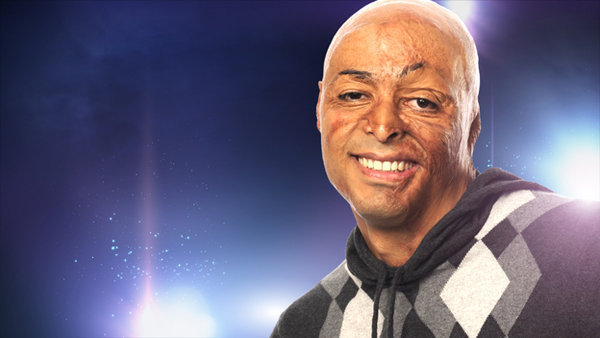
When J.R. Martinez, known from his roles on “All My Children” and “Dancing With the Stars,” was in the hospital recovering from burns over 40 percent of his body, including life-changing facial disfigurement, his mother had a very straight talk with him, one that would guide him to the true depths of his character.
See, J.R. was an American soldier in Iraq, having enlisted at just 19, when his Humvee ran over a landmine, catapulting him to a path of 33 surgeries in 34 months, resulting in the loss of an ear, and permanent facial disfigurement. J.R. describes lying in the hospital, glancing in the mirror, seeing a monster looking back where he once saw a handsome young man – all sending him into a deep, dark depression.
But, J.R.’s mother, older and wiser, saw something else in the situation: The truest essence of her son. “People aren’t going to love you for how you look,” she told J.R. “They’re going to love you for who you are. And, that is a true blessing.”
J.R.’s mom was so right – and J.R.’s success proves that. I mean, the grace and humility with which he presents himself doesn’t make his disfigurement go away; rather, it makes his character shine brighter, where his facial attributes are part of him, but not the sum of him. J.R. is living proof that our exterior facades are just that – facades – and it’s our true character that matters beyond all else.
Yet, not everyone understands this concept. Surely, there are many superficial people in our culture who dwell on appearance alone – their appearance, everyone else’s appearance – and there’s a personal tragedy to it. Literally, when one dwells on appearance, not only can they never be seemingly good enough – after all, there’s always someone better looking by such shallow standards – but they never see others beyond an exterior facade, resulting in never developing deeply sincere relationships.
An acquaintance told me the story of her being a smoking-hot 26-year-old, living life in the fast lane in a Southern California beach community, where her friends and boyfriends were all from wealthy families. She drove nothing but Mercedes since the age of 16; she went shopping virtually every day to keep up with the latest trends; she had breast augmentation, a nose job, and routine Botox treatments; her girlfriends were the hottest of the hot, and they could cut the line at any club; and, she refused to date a guy who didn’t have a buffed body and a Porsche, no exceptions. And, all was moving along perfectly in her world of self-described perfection – that is, until she reached down to grab a CD off of the floor of her newest Mercedes, crossed the lane on a twisting road, and slammed head-on into a guard rail, the impact leaving her a quadriplegic.
But, the accident and paralysis were just the beginning of what she saw as the biggest tragedy of the time. Upon the accident, friends initially rushed to her bedside, and then slowly they stopped coming or calling. While she was in rehab, her friends hit the clubs as usual, and her buffed boyfriend who she thought was Mr. Right (after all, he had a Porsche!), promptly began sleeping with her soon-former best friend. Indeed, she learned that her relationships were as much a facade as her glued-on fingernails and sprayed-on tan. “When we place so much emphasis on our exteriors that we overlook the importance of who people really are on the inside, we take a huge risk,” she shared with me. “Trust me, when your identity and view of others is simply a house of cards, it crumbles fast.”
Going back to J.R.’s mother, she was absolutely right in the scope of her advice: Disability does allow us to have often times deeper relationships, a sort of interpersonal mechanism that protects us from the shallow people among us. Disability is a sort of barometer that gauges the character of of others, only letting the best of the best get close to us – and that’s a great opportunity.
Yet, like all opportunities, we must welcome others accepting us, as-is. J.R. could have used his unique appearance and initial self-consciousness to hide from the world, a way of judging himself and becoming bitter toward others, a presumed lack of acceptance. But, instead, J.R. chose to see the depths of his own character, not just the scars on his face, and he put himself in the world, trusting that he would witness the best in others, as well. Of course, as we now know, his self-acceptance has created universal acceptance by millions of adoring fans, all based on his demonstrating the depths of his character, not an external facade.
As for me, I strive to dress nice and present myself well, but the reality is, I’m a visibly flawed guy with cerebral palsy when viewed on the surface – and I’m OK with that, as the depth of my character hopefully shines through to some. However, when some don’t have the capacity to see beyond my lack of physical perfection, I’m fine with that, too, where I’m glad not to have those “emotionally blind” people in my life. Call me shallow, but if someone is more concerned about the imperfection of my physical appearance than the quality of my character, I don’t want that person around me – and I’m glad that my disability serves as a smoke screen to keep such people away.
What’s really wonderful, though, is that when we recognize the interpersonal value of being embraced for our true character, not our superficial facades, we instinctively return the gesture, being much more open toward others. And, we end up with an amazing exchange – where we’re both seeing each other on the most genuine levels – and that’s how the sincerest relationships are formed. If I accept you for you, and you accept me for me, now we’re truly connecting – and that’s where we all should be in our interactions with those around us.
Someone recently asked me what true acceptance of others really means? And my answer was coy but fitting: True acceptance is the sincerest gift that we can share with another person.
The Glory of Vulnerability
By Mark E. Smith
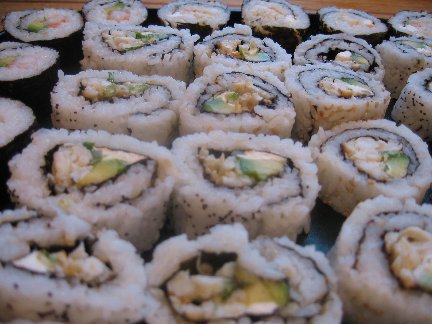
I wasn’t the least bit uncomfortable about it, nor was she. See, there I was, all dressed up to give a talk in front of a corporate group, but I was presented with a pre-talk lunch served by our gracious host, consisting of sushi rolls. I knew from the very sight of the rice-covered sushi rolls that, due to my poor coordination, there was no way that I could get them from the table to my mouth without rice and who knows what else ending up on my neatly-pressed pants….
So, I had two choices: One, I could simply not eat; or, two, I could have the courage to ask for help.
With little hesitation, I asked for help because it’s just as important to me to acknowledge my vulnerabilities as it is my strengths – that is, I want those around me to know my entirety, not just selected parts. I wouldn’t be true to myself or those around me if I only showed my strengths, and didn’t admit any limitations of my disability, my vulnerabilities.
Fortunately, my asking for help was easy in that instance based on the fact that a dear colleague of mine was with me, who’s traveled with me quite a bit, so asking her for a helping hand was natural. What’s interesting, though, is that getting to that comfort level – where I could turn to my colleague and say, “Would you mind feeding me my sushi, so I don’t get it on my clothes?” – took time and candor to evolve. On her part, my colleague’s sincere, genuine nature has been touching, and she’s proved truly intuitive in getting to know me as a person, disability and beyond – all of which speaks to the exceptional qualities of her character. However, I’ve likewise have had the openness not to hide any of my vulnerabilities – the realities of my disability – from her. She knows that I drink through a straw, I squirm in airplane seats to shift weight off of my rear, and can be a bit messy when I eat, and on and on. I am who I am, and I trust that my comfort in living with my vulnerabilities – where I don’t display only the so-called best of me, but the true me, flaws, spasms, and all! – has likewise made her more comfortable. None of us are perfect; we all need help at some point in our lives. And, allowing others to see our vulnerabilities is a positive trait, one that unifies, where asking for help and helping others is an inspiring exchange. We don’t get through life alone, and sharing our vulnerabilities is a key that we all need in living a life that allows us to truly connect with others in the most genuine ways.
Interestingly, researchers scoured the globe for the one aspect that most connects us with others – that is, what forms the deepest, most meaningful relationships on all levels? – and allowing ourselves to express our vulnerabilities topped the list. Vulnerabilities, it proves, are only weaknesses when we won’t admit them. However, when we admit our vulnerabilities, they become strengths because we’re showing ourselves to others in the most genuine ways – and that forms the most open connections with others, the sincerest relationships.
Of course, it’s easy to know why many people hide their vulnerabilities: They’re scared that others won’t accept them in their entirety, that others will judge them. But, this rarely proves the case. The basis of sharing vulnerabilities is formed within honesty and results in our fully opening ourselves up to others – and those are the foundations of healthy relationships. When we live freely with our vulnerabilities, we allow others to accept us wholly, and we accept others wholly, as well (if I expect you to accept my vulnerabilities, I likewise must accept yours, and we’re two perfectly imperfect people connecting on the sincerest level). But, here’s what’s really important: When we express vulnerabilities with others, we’re acknowledging our vulnerabilities within ourselves, and it’s the self-acknowledgment of our vulnerabilities – not denial! – that allows us to live healthier lives.
Addiction and recovery proves an enlightening study in how vulnerability can kill us or liberate us – sometimes literally – all based on whether we admit vulnerabilities. For example, an addict in the clinches of use, will never admit vulnerabilities. An addict won’t admit to causation, won’t express genuine feelings, will try to justify even the worst decisions, and will lie about everything under the sun, including lying to his or herself. That is, addicts run and hide from vulnerabilities via substance abuse – and, at best, it disconnects them from meaningful relationships, and, at worst, it literally kills them.
However, recovering addicts do just the opposite – they admit and address vulnerabilities. Think about the first words spoken by everyone at an Alcoholics Anonymous meeting: I’m Joe, and I’m an alcoholic. Admitting the vulnerability of addiction – that is, being honest and candid – liberates and connects. There’s remarkable empowerment in it. And, when getting into deep models of recovery, acknowledging the vulnerabilities that lead to the addiction – past traumas and such – is yet another way of profound recovery. That is, the only way addicts stop using is by acknowledging and addressing the underlying vulnerabilities that cause the addictive behavior in the first place.
In our personal lives, hiding behind our vulnerabilities – or, denying them through self-justification – is extremely dangerous, defeating so many potentials in our life: I’ve been hurt in a past relationship, so I’m not going to trust anyone again…. I don’t want to be seen as weak, so I’m not going to apologize…. I’m not going to show all of me because others will judge me…. Really, what such a closed emotional state says is, Overall, I’m going to self-sabotage meaningful relationships because I’m so scared to reveal my vulnerabilities – my complete self – to others.
It is astounding how painful and self-defeating it can be in not allowing ourselves to be vulnerable. At the very least, most of us can relate with the inner-conflict that occurs when we want to reach out to someone, but don’t out of the fear of feeling vulnerable – maybe it’s asking someone on a date, maybe it’s calling an estranged family member or loved-one to try to patch things up, or maybe it’s sharing one’s true feelings with a good friend. I’ve struggled with all of these – and continue to at times! – but what I’ve learned is that while there’s always the risk of the other person not being receptive, there’s also the more likely possibility that the other person will be receptive. And, the real reward in this process of overcoming our fears of vulnerability is that we’ve at least had the integrity to act on our true feelings, with sincere intent, living openly in every way – and that’s liberating, regardless of the final outcome.
The fact is, there’s a universal bond in the truth that none of us are perfect, that we all have vulnerabilities – and some are scary to admit to ourselves and others. Yet, when we live freely with our vulnerabilities, acknowledged by ourselves and shared with those close to us, we not only allow others to know us completely, but we’re far more open and accepting of others – and that builds connections of lasting trust and meaning. I have vulnerabilities, you have vulnerabilities, and it’s all OK. Let us live fully as perfectly imperfect people – with our glorious vulnerabilities exposed! – and our self-acceptance and relationships will flourish.
 PowerchairDiaries