Life as a Picasso

By Mark E. Smith

I recently spoke on a senate panel on aging. The panelists were heavy-hitters, including a U.S. senator and heads of government agencies. As speakers go, they were the best-of-the-best, both in presentation and knowledge. Then, there was me.

As a speaker, I prefer keynotes, not because I wish to be the star attraction, but because there’s a different dynamic on panels, especially when the other panelists are beyond great. It’s like sitting back stage as a musician and the band before you is phenomenal, and you’re thinking, Man, I can’t live up to what Iggy Pop just did!

What made the recent panel even more challenging was that I went last, so there I sat trembling in my boots – not emotionally, but literally, as I have uncontrollable body movements due to cerebral palsy – as I watched eloquent, brilliant speakers along our table command the room. So, how’d I move through it?

The same way that I always do. Public speaking can be tricky. Yet, if you know your subject, know your audience, and you’re skilled with rhetorical devices, public speaking is a bit of an illusion – it looks tougher than it is. For me, however, there’s a wild card added to the mix: cerebral palsy. My brain sends involuntary signals to my muscles and they do whatever they want, whenever they want. My central nervous system doesn’t care if I’m in bed watching TV or speaking in front of 250 statesmen. If it tells my legs to kick, they simply kick – formally known as a “spasm.” Speaking as a craft is easy for me; doing it with the physical unpredictability of cerebral palsy can be the harrowing part.

Given my situation, I view speaking in front of audiences like driving a race car. Driving a car at 150 mph around a race track takes skill, but even more so when the unexpected occurs. Race car drivers win races not based on simply going around a track, but in addressing peril when encountered. Did you see him keep his car from spinning off of the track!

When I’m publicly speaking, it’s the same phenomenon. I have my emotional and mental composure, but I never know what my body will throw my way. The ability to address spasms and uncontrolled body movements without missing a beat while speaking is my real craft. The way I do it is I let go of the mental and emotional constraints others often feel in such situations. When I sat on the senate panel, there was no way I could be as physically composed as the other speakers, so I threw that standard out the window and focused on being the only person I could be: me. I have cerebral palsy and a microphone – hold on to your seats, folks! In these ways, cerebral palsy becomes an asset of originality.

It doesn’t matter if we’re public speaking or living our everyday lives, the minute we let go of social pressures or preconceived notions of who we should be and just be ourselves, as-is, there’s no freer realm to be in. I understand that this is difficult for many. We live in a culture that presents ideals on how we should be. Yet, for many of us, it’s impossible for us to meet those ideals – there’s no product to resolve cerebral palsy – and in the larger scope, nor should anyone feel he or she has to live to such scripted ideals.

See, I view the world as the most spectacular art gallery. Each of our beauty isn’t blended on a single cultural canvas, in a single form, but seen within the borders of our unique frames. Photoshopped images are great; an original Picasso is amazing.

Awe Versus Inspiration

Canada’s Andre Viger (front) and Mel Fitzgerald (left) compete in a wheelchair event at the 1984 Olympic games in Los Angeles. (CP PHOTO/ COA/J Merrithew)

By Mark E. Smith

I have a home gym. Two or three nights per week, I go into that room in my house, put on old, sweat-crusted weight-lifting gloves, and start wailing away at the contraption. As it bangs and crashes, sounding like some sort of machine from the Industrial Revolution, I push, pull, and grunt. It’s a competition of me versus it. So, what drives me to keep working out, especially as a 46-year-old dad with cerebral palsy who could get away with taking the easy road at this point in life?

When I was an adolescent, I watched the greatest wheelchair racers of all time fly across my TV screen during events like the Boston Marathon and the 1984 Summer Olympics. They looked like gladiators. They had massive upper bodies, and all was squeezed into an ultralight racing wheelchair that they hurled down the road or around the track at insane speeds. Their triceps pumped the wheels like pistons.

Yet, I wasn’t in awe of them. Rather, I was inspired.

See, there’s a vast difference between being awed versus being inspired. When we’re awed, we never imagine that we can do what another person does. It’s like, That’s awesome, but I could never do that. However, when we’re inspired, we’re compelled to get out there and do it, no matter how rational or irrational the thought may seem. That band rocks – give me a guitar. This poetry is astounding – I need a pen. Her words are so eloquent – I’m learning to speak like her. That person has an amazing career – I’m going back to college. Inspiration moves us into action. In awe, we watch. With inspiration, we do.

I realized the profound difference between awe and inspiration in my adolescence, and in being inspired by the wheelchair racers I saw on TV, I said, I’m doing that! Of course, like a 12-year-old picking up a guitar at the Salvation Army with the intent of starting a band and becoming a rock star, I had no ability at that moment to truly become a wheelchair racer, especially given the severity of my disability. But, that’s the beauty of inspiration – it launches us toward something great. We may not know where we’re going to land in our attempt – did Jackson Pollock when he began dripping paint on canvas in 1947? – but we’re bound to go somewhere.

I pushed around in manual wheelchairs for years, struggling merely to become self-sufficient, literal miles from ever being a “racer.” It did, though, help lead me to weight lifting, which I excelled at. I couldn’t push a racing chair faster than a snail, but through tenacity in the gym, I could have an upper body that looked like I did! That spirit continues with me today every time I hit the gym: Why watch when I can do, and why not see how far I can get with my efforts?

All of us see people accomplishing seemingly amazing feats. Some take talent and some take years of hard work. Yet, the people doing them are merely people like each of us and, most often, if they’re doing it, we can take a shot at it, too. Don’t be awed by others; be inspired. After all, the only reason why others are where we’d like to be is because we simply haven’t tried – yet.

The Struggle is Real

By Mark E. Smith

Have you ever thought, I shouldn’t feel this way because others have it worse than I do? Most of us have reasoned with ourselves in that way at some point. While it’s empathetic toward others and is a coping mechanism, it has a huge downside: self-invalidation.

The fact is, everyone has struggles. However, trying to compare our adversities to those of others is impossible – because we are us and others are …well …others. Your struggles are as valid as anyone else’s because struggling isn’t based on a definable scale; rather, it’s relative to each of our experiences.

I know what it’s like to live with severe cerebral palsy, and I’m fairly emotionally adept at doing so. I’m struck when others express to me that they are inspired by me because as they face their adversities, they know individuals like me “have it much worse.” I understand the good intentions of such sentiments, but I also don’t want others discounting the totally valid emotions around their individual situations, as they very well could be struggling more than I am relative to our own circumstances. I have no idea what another is dealing with, and I never want anyone diminishing his or hers own adversities based on my visible ones.

All of this ties back into realizing that there’s validity in all adversity, in all struggles, for each individual. Just as we are kind enough to give credence to the struggles of others, we must extend it to ourselves, where we don’t compare and create a scenario of self-invalidation, but one of common experience. Adversity is not a measurement or a competition, and there’s certainly no hierarchy. We each have our struggles and no one can say one is easier to cope with than another. It’s all relative and individual.

Now, I’m not saying to wallow in self-pity – that’s at the other end of the scale and can devastate your life. What I am saying is, we shouldn’t dismiss our struggles because others have struggles. Everyone’s struggles should be embraced – including our own.

Ultimately, the truth of adversity is this: There are no struggles more or less significant than others…. Simply different.

Getting Framed

By Mark E. Smith

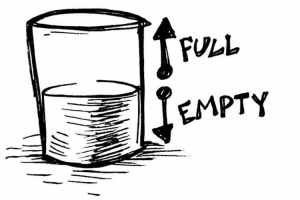
Is the glass half full or half empty? …There’re two sides to every coin. …Or, would you rather a steak that’s 80% lean or 20% fat?

All of those statements are utter clichés, but they tie into a psychological principle that dictates the way we see each situation: framing.

Framing is the psychological process that applies to whether we see a situation as negative or positive. The fact is, in even the worst of situations, we have the choice on how to frame them – that is, to see negatives, positives, or both – and the way we frame them dictates our success in addressing them, literally and emotionally.

I’m a firm believer in framing adversity as a tool for opportunity. No matter what happens, I believe in recognizing the opportunity in it. I once had a home severely flood, and as I evacuated, I told everyone, “It looks like I finally get to remodel….” And, I did get to remodel as a result of the unfortunate circumstance, where the house was far nicer than before it flooded.

So many aspects of our lives are like that: As the flood waters rush in, it’s difficult to see beyond the seeming disaster. However, if we frame life’s adversities so that we can draw positive aspects from them in the immediate and long term, it lessens the impact on us and allows us to move forward.

On top of using positive framing as a tool of coping, it’s invaluable as a tool for learning and growth. If we only see a situation as bad, we’re simply in victim mode – adversity only harms us – and we can’t move forward. However, if we frame adverse situations with at least some positives, we not only take control of the situation, but we learn and grow. Imagine if every time a professional sports team lost a game, they just went back to the locker room and sulked about how unfair the game was. They’d be the worst team in history. No team does that. Rather, they watch replays of the game to determine how mistakes were made, then they strive to improve in those areas. We lost that game, let’s learn from it to win the next.

If you’re not in the habit of framing adversity toward the positive, I know it’s hard. None of us want adversity in our life, and it can weigh us down. Yet, adversity enters our lives at times no matter what – which is why it’s so important to develop the habit of seeing positives. If we only see negatives, it tends to freeze us in place. However, if we can see a positive – even in the bleakest of situations – it allows us to begin moving forward. Most of us have had our hearts broken by an ended romance. Then, a well-meaning friend tells us, Don’t worry, there are other fish in the sea. While that cheesy saying lacks empathy in the moment, the painful end of one relationship most often does lead to a new, joyous chapter of love. In this way, even an ending in our life can eventually frame a wonderful beginning if we allow it.

If we can get to a place in our lives where we can frame adversities in the positive, we can then move forward, learn, and grow. That’s a great frame to be in.

Fear Strengthens My Grip

By Mark E. Smith

Every Monday, I meet our company’s new employees. It’s my role to share with them not what we do, but why we do what we do. We make mobility products and that’s a noble endeavor. I know that because my life depends on the products we make. And, I tell them about that. But, as a General Manager, in my slacks and button-down dress shirt, here’s what I don’t tell them or most people these days:

I’m nobody from nowhere. That truth drives me to push and pull and continue dragging myself up a mountain that I could easily fall from at any moment. Fear of falling has been my purest motivator.

Others have talent, education, abilities. I wasn’t born into any of it. If it wasn’t for my cerebral palsy, I’d likely be mowing lawns or asking at 46, Do you want fries with that? Now, there’s nothing wrong with jobs like that – it’s in my gene pool. But, that doesn’t work with cerebral palsy, so I had to go a different route: one that’s been a third luck, a third showing up, and a third blistering hard work.

Do you want to try a power wheelchair? Sure.

Do you want to take a swing at public school? Absolutely.

College? Let’s go.

So, I’ve moved through life knowing that guys like me don’t get a lot of breaks. So, when I do, I show up, shut up, and do what the task takes.

Along the way, my failure has been predicted by many. I’ve been OK with that. Although, I admit that the further I get up the mountain, the more I look down on them. Don’t tell me I can’t climb when you’re unwilling to climb with me – because I’m going for it, not out of spite, but opportunity.

The fact is, my only option in life is climbing a mountain. I know that with a single wrong move I can lose everything, I take nothing for granted. I am simply thankful for the next obstacle that comes my way – and fear strengthens my grip.

Writing Our Own Chapters

By Mark E. Smith

Do you mind if I share a quick story about my 20-year-old daughter? I hope she doesn’t. A while back, she called me from college, having received a speeding ticket. She explained that it wasn’t her fault, that she was unfamiliar with the area, that she didn’t know the speed limit, that she didn’t see the police officer. The ticket said she was traveling at 20 mph over the speed limit – and that was the only part I cared about. She broke the law and now had to pay the fine. At 20, my daughter is learning what her generation calls “adulting” – that is, how to take accountability.

Many of us, even though we don’t like to admit it, struggle with accountability, don’t we? My daughter isn’t the first to find every reason except her own lead foot for getting a speeding ticket! Many of us have likewise found every reason possible to place accountability elsewhere but on ourselves in circumstances ranging from financial difficulties to relationship struggles. It’s not that we’ve irresponsibly overspent, it’s that we just need more money. It’s not that we’re contributing to unhealthy patterns in a relationship, it’s that our partner is at fault. If we’ve lived to any experience, and we’re honest, we’ve certainly tried to wiggle out of accountability at points.

However, what about when we experience bad circumstances totally beyond our actions or control? Who’s accountable then, when some circumstance isn’t of our doing whatsoever?
The answer is, we are. See, if we want our lives to flourish, if we want to thrive amidst any adversity, we can’t pick and choose what we’re accountable for. Rather, we must assume accountability for all that happens to us, regardless if it’s our own making or a genuine misfortune. From as fleeting as my daughter’s speeding ticket to as profound as my cerebral palsy, we’re accountable for every circumstance in our lives.

Now, let’s clarify that this isn’t about blame. In fact, it’s about the polar opposite mindset. It’s about being in constructive control of our lives no matter what happens to us. Put simply, it’s about shifting from a victim mindset to a victory mindset. We don’t dwell or place responsibility on what’s happened to us, but we instead focus on moving our lives forward in ways that empower us. It’s flipping the script from reactive to constructive. This happened to me, now I’m accountable to address it, turning a negative into empowerment. I’ve spent my life living to this principle, and while I’m not flawless at it, it’s served me astoundingly well, empowering me in times of adversity more than any other factor.

As a reader of this blog – or if you’re among the many who saw the news stories and social media coverage –- you’ll recall that I experienced an unfortunate circumstance where I was removed from an American Airlines flight, arguably based on discrimination toward my disability.

In the wake of the incident, many suggested that I sue for monetary damages. We live in a litigious society and when we’re victimized, we sue. I thought of going that route, but as I explained to many, nothing could change what happened to me, but I certainly didn’t want it to happen to others with disabilities. Rather than being reactive and sue, I wanted to be accountable for what happened and thereby constructive. This ultimately meant pursuing routes of changes to air carrier policy to hopefully protect others.

I filed a formal complaint with the Department of Transportation under the Air Carrier Access Act to ensure my incident went on public record, where it helped expose a pattern of violations based on other formal complaints (I learned that in 2016, over 30,000 complaints were filed against the airlines by passengers with disabilities being mistreated). Next, we discussed my testifying before the Senate, but hearings ultimately weren’t needed because, right at that time, fortunately, Senator Tammy Baldwin and four co-sponsors introduced vital legislation that expands protection for passengers with disabilities. My point is, rather than being a victim, I assumed accountability to contribute to helping resolve a systematic issue.

We have the ability to do this in all areas of our lives. When we encounter adversity of any kind, from any origin, we don’t have to point outward toward who or what is responsible. Instead, let us turn inward and know that we’re accountable. In doing so, we remove the power from the circumstance to further victimize us and create the capacity for it to empower us. When we move from looking for responsibility to assuming accountability, we realize an amazing shift: Life doesn’t happen to us, but for us – and we’re in true control.

Let us not squander our amazing potential by looking to others for responsibility in what happens to us. It’s only when we assume accountability, regardless of circumstance, that personal empowerment occurs. Don’t let circumstances narrate your life when you can take the pen and write each captivating chapter.

Dare Not to Care What Others Think

By Mark E. Smith

If there’s one aspect of life that we all share, it’s knowing what it’s like to be judged, criticized, and disliked. Gandhi and Mother Teresa were among the greatest humanitarians in history – and even they continue being judged, criticized, and disliked by some. It’s odd but true: To be human is to know what it’s like to be disliked.

Most of us felt the pain of being disliked at some point during our school years, and that was extremely difficult because it’s a time when, according to psychology, we most want to fit in, with little coping mechanisms to help us when we’re told in some way that we don’t, as with experiencing bullying. However, being judged, criticized, and disliked doesn’t stop in school; it follows us into adulthood. And, how we address it within our adulthood dictates the quality of our lives. Others are going to judge, criticize, and dislike us – even disliking Gandhi and Mother Teresa! – but we have the choice to let it consume us or to rise to the understanding that it is what it is, and how others view us doesn’t define who we are. Which have you been choosing?

A friend of my wife recently posted on Facebook an experience that took my breath away on this subject:

I do what I do, having my family and also my career, because they make me happy and give me purpose, and have given me confidence in who I am. I was reminded of this earlier today when we were out furniture shopping. I don’t want my sons to live in a world where humans can be so cruel to each other.

We went to a large, chain furniture store, and as a male sales person was helping us, two female saleswomen were sitting at a table and immediately started speaking in another language about how fat I was, and how my dress was cute, but what a shame because I was so fat, but at least I made cute babies. I walked by, hearing this, holding my son’s hand. I told my husband to take my son and go look at the kid’s furniture, and I turned around and went passed the two women again, who continued to speak about me in another language, which I fluently speak. After about five minutes, I had had enough. I turned and faced them:

“I hope you realize I understand every word that came out of your mouths, and you should both be ashamed.”

I got back four stunned eyes looking at me and an, “Oh, I’m sorry, Ma’am.”

“Sorry” was a bit too late for this infuriated, pregnant mama, who has dealt with bullies like these all of her life. I told myself, “Leave now before you loose it!” But, my emotions got the best of me, so I turned around one more time and said to my salesman, “I want you to tell the manager what you hear me say now,” and I turned towards the women again:

“You are sad, so very sad, but you don’t break me. I’m going to continue wearing this dress no matter what you think of me and, yes, I do make beautiful babies like the one who I’m currently carrying and the one whose hand I was holding while you were belittling me, while not realizing I fluently speak and understand multiple languages. What you don’t know about me is that I’m happy. I’m a business owner. And, while you may call me fat, I wake up each day with a clear conscience that I’m raising my children to be better humans than you ever will be.”

I walked with my family out of the store.

My point for posting this is simple: Never let anyone steal your sparkle. Look at the life around you, and look within you to rise above it, and most of all, do not let it break you….

The fact is, despite self-confidence, it’s in our evolution to want validation and approval. We’re tribal creatures at heart, and once upon a time, not getting the approval of others meant banishment or death, so a momentary visceral reaction – and I emphasize, momentary – in such a situation as above is totally normal. We’ve all felt that sting and defense mechanism. So, for starters, we rightfully feel angry or hurt when judged, criticized, or disliked, regardless if it’s a stranger or someone close.

However, we no longer live in an evolutionary time of survival based on what others think. In fact, we live in a time where simply who we are – the character we demonstrate – dictates our success. Therefore, it’s to our advantage to focus not on what anyone thinks of us, but how we can purely be the best at who we are and what we do.

Have you ever noticed that the most comfortable, successful people aren’t concerned with what others think? It’s not that they’re arrogant or oblivious or don’t care. They want to be liked just as we all do. Yet, they innately understand that they don’t need to be liked in order to be of value. They know that they are of value because of who they are and what they do – and they don’t allow that to be up for debate by others.

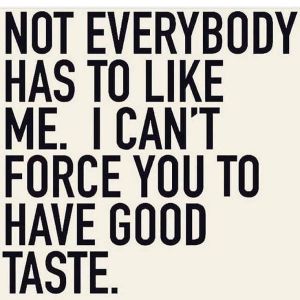
See, there’s a fundamental difference between wanting to be liked versus needing to be liked. We all want to be liked – who doesn’t? However, when we need to be liked, we alter our behavior to fit what we think others want. In that process, we may squelch the truest, most valuable parts of ourselves and, worst yet, when we don’t get approval, we feel crushed. That’s not only a tough, unhealthy way to live, but it limits us toward being the amazing person we are, as-is. If we’re always trying to please others, we can never let our true selves shine.

Indeed, we can spend our lives worrying about what others think of us, but we know that doesn’t work. So, let’s focus on what does work: being the best we can be, and letting the chips fall where they do. We can’t please everyone and not everyone is going to like us. That’s OK. Let them focus on whatever they wish while we focus on flourishing, as-is.

As one with a severe physical disability, I’ve had others try to dictate my life since the moment of my birth, when I was given only hours to live, then when I did live, I was deemed a “complete vegetable.” As my life has progressed, such projections toward me continue daily. I’ve been judged, criticized, mocked, and dismissed in every possible way, no matter due to cerebral palsy or being a public figure. But, what did cease long ago was my giving anyone’s interpretation of me credence. My path in life has been solely dictated by one person: Me. I’ve heard everyone’s opinions toward me, but my life proves the final say, as does each of ours.

Let us not worry about getting others’ approval, but focus on living to our own potential and desires. And, when we encounter people trying to get us to buy into getting their approval through their judgment, criticism, or dislike of us, let’s move past anger toward empathy. The world is a mirror, and such projections as those women in the furniture store are reflections of themselves. For this reason, I try not to get angry or pity those who seek to judge and criticize others, but have empathy for them. Healthy, happy, successful people do not judge and criticize others; rather, those with internal struggles do. I wouldn’t want to be in their shoes – or furniture store! Again, it’s normal to get angry, offended, or stung in the moment when encountering rudeness. But, empathy goes a long way toward the big picture that they’re struggling in ways we’re not.

The best impression that you can make of yourself in the world comes not from trying to impress others or by being concerned with what they think, but by being the truest you.  That’s the type of amazing individual that people ultimately flock to.

The Danger of Dissonance


By Mark E. Smith

Cognitive dissonance. Have you ever heard of it? Probably not, as it’s pretty much confined to psychology jargon. Yet, it impacts each of us in countless ways, and in understanding how it functions in our everyday lives, it can save us hassle and heartache in avoiding those who engage in it.

In simple terms, cognitive dissonance is when our beliefs are not reflected by our actions. For example, most smokers know that smoking will eventually harm them; yet, they still smoke. You might say, cognitive dissonance is the inexplicable logic of doing something contrary to one’s beliefs: Smoking is bad for me, but I smoke.

Fortunately, not everyone engages in cognitive dissonance. People on diets skip bad food for healthier choices – and, therefore, their beliefs and actions are in harmony, not dissonance. In fact, it’s said that, as evolved humans, we naturally seek cognitive consistency, where our beliefs and actions align, and if they don’t, mechanisms like guilt, shame, and remorse come in to get us back on track. That is, doing what’s right is more instinctive than doing what’s wrong or negating our values.

Of course, cognitive consistency – where our actions reflect our beliefs – is vital to living an integrity-based life, where we honor those around us by doing what we say. However, beyond our own behavior, we need to do a much better job in surrounding ourselves with people of cognitive consistency rather than cognitive dissonance. We need to assess those around us based more on actions than words.

See, rule number one with cognitive dissonance is that there’s danger in trusting people who say one thing but do another. People who claim to love you do not hurt you (raise your hand if you’ve ever been in such a relationship or have known someone in such a relationship). Therefore, if you’re witnessing someone whose words don’t align with his or her actions, don’t let it slide – there’s danger in dealing with such a person.

Rule number two is to look for actions that reinforce words before placing too much emphasis on an individual’s character. People engaging in cognitive dissonance will promise you the world, with no ability or intention to live up to those promises. My friends who participate in online dating share the universal experience of connecting with amazing people who come across via messaging and texts as “the one,” but then disappear when it’s time for an in-person date. Why does this happen?

The answer is, it’s an online form of cognitive dissonance. Anyone can say anything online, with no actions to back it up. When we encounter someone in the real world, we intrinsically know at least something about him or her, so it’s much tougher to get fooled (or “catfished,” as they say online), as opposed to only speaking to someone through the web. If a thoracic surgeon chats you up online, but consistently finds reasons not to meet for coffee – so many emergency hospital calls! – what are the odds that the person is telling the truth, as you see no actions to substantiate the words? However, if the cute teller at your bank asks you on a date, you already know he or she is truly a bank teller, where you’re witnessing actions, so there’s at least some known authenticity.

In the corporate world, a real problem is “professional interviewees.” These are individuals who have a golden tongue toward selling themselves, but never professionally execute all of the talents they boast. The fact is, in high-performance positions, it can take six months to one year to see real results or failings – and that’s right around the time too-good-to-be-true employees jump ship to the next unsuspecting company (read that, when their cognitive dissonance is shown). To address this, astute companies look for performance-proven queues in resumes, as well as hold performance-based interviews, where claims are reasonably able to be substantiated.

There’s likewise a lot to be said surrounding cognitive dissonance and the words I love you in our culture. People are quick to say those words – easy utterances of sound – but are not so consistent in putting actions behind them. We can say those words to our spouses and children all day long, but if we’re not actively engaged in their lives in loving ways, do those words truly have meaning? I say I love you to my wife and daughters a lot, but it’s my demonstrations of love toward them that creates meaning to the words. Saying I love you doesn’t create love; engaging in loving does.

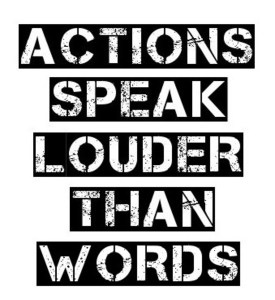
The examples could continue, and I’m sure you have your own that you’ve experienced and learned from. Yet, here’s what it all comes down to: Actions are an absolute, while words can waiver.

To truly know someone, let us not merely listen to words, but authenticate one’s character via observing one’s actions. We all find ourselves in vulnerable spots, where words can say exactly what we want to hear. However, if the words aren’t substantiated with actions – especially when the dissonance causes us harm of any kind – it’s time to break ties with such people in our lives. We deserve the reciprocation of accountable actions, not hollow words.

At the same time, we owe it to all around us to be as harmonious as possible with our own behavior, where we honor others with actions that live up to our words. So often our own behavior sets the tone of others’, and we must be authentic if we wish others to be authentic. It’s easy to point at someone and say, He’s exhibiting cognitive dissonance! Yet, let us also honestly look inward to ensure that we have cognitive consistency in our own behavior, as that’s ultimately where it all begins.

It’s cliché and true: Actions speak louder than words. As Stephen Covey puts it, “What you do has far greater impact than what you say.”

Survival Mode: Exit Here

By Mark E. Smith

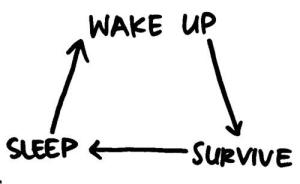
Have you ever wanted to stop merely surviving and live what you feel is a more deliberate life – that is, one where you feel truly in control and thriving?

I have, and I know many around me who have. However, making that shift from surviving to thriving is difficult, sometimes taking years or decades. Yet, it’s totally possible and vital in order to live to our potential and purpose.

For a lot of us, life placed us in survival mode from an early age. Any number of family dysfunctions or circumstances place children in survival mode. This creates a sort of predisposition toward survival mode living that often follows us into adulthood. I have an acquaintance who I’ve known for two decades and although hugely successful, I’ve seen the individual end up in predicaments, where I’ve thought, Why are you placing yourself in survival mode situations when you don’t need to? I recently found out that this individual had a horrific childhood, where survival mode was all that was known. In this way, when survival mode is ingrained in us from an early age, it can be an extremely difficult mindset to break. It goes back to the adage of our comfort zone isn’t necessarily comfortable; rather, it’s simply what we know – and, too often, survival mode is a comfort zone that we either remain in or return to.

But, here’s where the issue really comes in. When we live in survival mode as a child, it’s a rational coping mechanism – it helps us survive. However, as adults, where we have far more free will, living in survival mode can be disheartening at best, self-defeating at worst. After all, if we’re in survival mode with a relationship, with our health, in our finances or career – or all combined! – there’s an agonizing disconnect between where we are and where we want to be. We’re not moving forward when we’re in survival mode. We’re just …well …surviving.

Now, this isn’t to say that there aren’t valid reason to be in survival mode from time to time. Crises arise in all of our lives from time to time. Yet, there’s an exponential difference between going into temporary survival mode when appropriate crises dictate, versus living in a permanent or regressive state of survival mode where it inhibits our lives, growth, and success.

All of this leads to the question of, if we find ourselves feeling as though we’re merely surviving instead of thriving, how do we shift our lives to the latter?

It’s vital that we frame where we’re at, truly acknowledging to ourselves that our past or present doesn’t intrinsically define our future. With that foundation, we can then begin writing a road map that defines where we want to move our lives. This isn’t an overnight process, but a starting point. If we’re stuck in emotional survival, we have to take steps toward healing. If we’re stuck in financial survival, we have to take steps toward improving finances. This list of survival modes goes on and on, but the key is to truly realize that where we are isn’t where we must stay, and define where we want to be, beginning with small steps in that direction. We simply start somewhere, and even if we don’t know exactly where to start, pick something small to get your mindset to begin changing. Eight years ago I really wanted to get in shape. As one with cerebral palsy, my survival mode had been following what my body dictated. I was skinny, lacking strength and muscle. I didn’t suddenly get “ripped,” as that’s impossible. Rather, I picked up a five-pound weight – and just started somewhere. As a result, over the past eight years, I’ve gone from a 36” chest to a 44” chest, from lifting five pounds to 50 pounds, from surviving to thriving. We begin with baby steps, and months or years or decades later, we’re running proverbial marathons.

Change is tough and scary, especially when we’re living in a survival mode that’s all we ever known. And, yes, the unknown is often scarier than what we know – even when the life we know is harming us. However, we each deserve comfort, security, and happiness. You and I deserve these in all facets of our lives. If we’re in a cyclical survival mode, let us take a step – begin with a baby step! – toward a new direction, one where we don’t have to continue living with pain, anxiety, or fear. After all, the ultimate key to exiting survival mode is in realizing that we are capable and worthy of thriving.

When Not OK is OK

By Mark E. Smith

Let’s face it, we live in a culture where it’s not OK to …well …not be OK. And, I feed into that, don’t I?

Week after week, you tune in here to read about the positive sides of life, that no matter our struggles, there’s purpose and growth behind them. And, I not only believe that, but I live it, where the rewards of such a positive mindset have led my life to levels of success – education, family, career, community – that I was long told weren’t possible based on where I came from. Life is a blessing never to be taken for granted.

However, as eternally optimistic as I am, I’m not always OK – none of us are – and I’m OK with not being OK at times. In fact, it’s healthy for all of us to not be OK at times. We’re not singular in our emotions, and when times are tough, it’s vital to our emotional health – and sanity! – to express valid emotions, even if it’s shouting to the sky that we’re not OK. Life is a blessing, but when it tests every ounce of our emotional endurance, it would be irrational to simply laugh it off. We have emotional tools like frustration, anger, and fear for a reason – they serve us when no other emotions can as healthy coping mechanisms – and we shouldn’t be afraid to rely on them at appropriate times. Positivity is a real emotion and so is negativity in all of our lives. Where either fits in is about being present in our feelings based on valid moments and circumstances.

Showering is tough for me because it ranges from easy to a nightmare, and it varies night to night. Due to my cerebral palsy, on the most difficult nights, my balance and muscle spasms are at their worst, where falls and flailing limbs are extremely dangerous and scary in a shower. I’d like to tell you that I laugh at the adversity; but, when you break toes and gash your head, it’s a harrowing situation. So, how do I get through it?

By not being OK. In those times, I’m scared, angry and physically and emotionally hurting. The words coming out of my mouth are foul and grim. And, it’s all exactly the way it should be. In those moments, I should be feeling and expressing those emotions. In those moments it’s not just OK for me to not be OK, it’s completely rational behavior. You don’t watch a shower stream wash your own blood over your face, down the drain like a horror movie and think, This is wonderful! Rather, you think every profanity you can conjure because it’s all but unbearable. It’s being present with your emotions, as we all should be – no matter great times or horrible times.

In the larger scope, we as a culture do a terrible job at allowing anyone to simply not be OK when appropriate occasions call for it. As the feminist writer, Akila Richards, puts it, “We are expected to respond in the affirmative to the constant calls to action: show up and smile no matter what; think positive thoughts; kick fear to the curb; and be strong enough to push past our pain.”

The fact is, we each know from personal experience that always being expected to be positive, to always smile no matter the pain we’re in, is unrealistic and isolating. When we don’t feel safe to express warranted emotions, it merely piles on more pain. So, what are the solutions?

Firstly, we need to give ourselves permission to not be OK. Difficult moments to major life changes all elicit real emotions. It’s totally appropriate and healthy to feel those emotions.

Secondly, we need to have the courage and honesty to express those emotions to those around us – authenticity in who we are liberates us and allows others in. Those are powerful instruments toward building intimacy and truly living as ourselves amidst those who care about us. If I hid my tough moment from my wife, she wouldn’t know the full me; therefore, I’m OK with not being OK at times around her.

Thirdly, in knowing that it’s OK not to be OK, we need to have the empathy and strength to not pretend someone is OK when they’re obviously not. Opening a conversation that allows someone to express real emotion is a tremendous gift. I realize that we’re often hesitant to approach such conversations out of fear of not having the right words. However, most often simply acknowledging what the person is going through, then just listening, is all that’s needed. How are you feeling about the recent loss of your brother? I can only imagine how painful it must be….

What’s amazing about moments and periods of not being OK is that it’s among the healthiest ways to, in fact, be OK. Let us live with our emotions in the present, and by doing that, we’re less likely to carry baggage. After my worst nights in the shower, I get in a cozy king-size bed with my wife, turn on a fun TV show, and all is right in the world – that is, I moved through not being OK, and that allows me to be content just a few minutes later. In this way, you might say that allowing ourselves – and others! – to weather the emotional storms we all encounter from time to time is the surest way to achieve ultimate tranquility in our lives. After all, the most beautiful rainbows include rain.