[Speed = Distance / Time]

lamark

By Mark E. Smith

Among my routine rituals is running my power wheelchair through my company’s test lab “speed trap.” I’ve perfected aspects like tire air pressure, straight-line tracking, and battery type to get my production chair just a scant faster than it’s built to run. In this process over the years, I’ve learned a bit about life, too.

The mathematical equation for speed is [Speed = Distance / Time]. Put simply, how long it takes you to cover an amount of distance is how fast you’re going. As I’ve run my straight-line speed trap hundreds of times – a computer system measuring my distance over time to calculate my speed – I’ve realized it’s a metaphor for life. Our successes and failures are dictated by the same equation, how much or little progress we make over an amount of time impacts our lives.

See, if in our lives, we cover little distance over time, we’re not progressing. Think about our relationships, careers, finances, you name it – if it’s all where it was five years ago, with no progress, our distance over time is dismal. Our lives are stalled or even destructing.

To the contrary, when we make quick, rash, hasty decisions, jumping from one life path to the next, we’re moving so fast that we’re bound to make mistakes. Racing through life impulsively, without considering consequences always results in disasters.

The key, then, is to look at our lives as [Speed = Distance / Time] and find that optimal balance, where we’re making great progress, without making poor decisions or mistakes.

What I’ve learned in the speed trap – and life – is that the right speed is  prudent in practice, but still a little faster than average.

Let it Rain

adversity

By Mark E. Smith

Some had a limited life expectancy. Others had experienced life-changing injuries. While still others we’re born into it. All faced exceptional adversity, which made sense, as it was an expo for those with disability.

However, as I was surrounded by over 5,000 individuals that weekend facing adversity, I realized that the confidence, comfort and joy that many – not all, but many – exuded aligned with what I learned long ago: adversity dramatically improves our lives when we embrace it.

For those who haven’t experienced adversity or embraced it, they find fear in it and have sympathy toward those who live with it. For those of us who have experienced and embrace adversity know the remarkable role it serves in our lives. Our experiences have taught us that adversity shouldn’t be avoided, but actually welcomed.

See, adversity forces us to face problems and situations that are too big to resolve. In my situation, no one can change, fix or cure my cerebral palsy. And, because of that, it’s forced me to learn and grow in order to succeed in living with it. Think about what an extraordinarily fortunate situation that is to be in. Yes, we can grow without adversity, but like adding weights to a workout, adversity is a rare force that can fuel wisdom, inner-strength, understanding and perseverance, to name a few life-enhancing traits. Adversity, then, isn’t meant to restrict, but empower.

I realize that for some, adversity as empowerment is a ludicrous thought. After all, how is being seemingly down on one’s luck a positive in any way? Worse yet, when you’re down and you see someone in your situation who’s happy, that can be the perfect recipe for bitterness. But, again, if we view adversity with acceptance, we will intrinsically grow. If we embrace adversity, the challenges within will cause us to rise.

As the late singer, Prince, prepared to perform the Super Bowl half-time show, the producer called to tell him it was raining, convinced that Prince couldn’t or wouldn’t perform. Prince replied, “Can you make it rain harder?”

Prince ultimately performed among the most iconic concerts of all time, later noting that that caliber of performance could only be achieved when facing such adversity. That which he couldn’t resolve – the weather – elevated his performance.

There’s the notion in our culture that adversity is to be avoided, feared, that it’s tragic, life-detracting, that it’s asinine to even suggest welcoming it into our lives. However, that’s all gross misconception. The fact is, adversity allows us the remarkable opportunity to extract dignity from difficulty, strength from struggle, power from pain. That is, adversity allows us to not just rise in the rain, but it empowers us with the understanding that the harder it rains, the more we can rise.

Meals or Feasts?

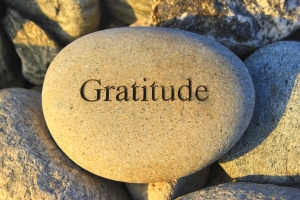
Gratitude rock

By Mark E. Smith

My life has been somewhat extraordinary in that I’ve known both sides of human experience – that is, what it’s like to live with exceptional adversity versus what it’s like to experience great fortune.

However, while my own life has made me acutely aware of extremes, it’s the individuals I encounter that have raised a profound question for me. In parts of my life, I interact with those facing tremendous adversity, while in others, I interact with those of great fortune. Overall, I’ve witnessed that people are people, and no matter how different two individuals’ life paths are, there’s a uniting humanity – people are people.

Yet, I’ve also witnessed a juxtaposition that’s intrigued me. If I shared that I knew a 40-year-old mother with progressing ALS who was bitter at the world because she would not live to see her children graduate high school, we all could empathize with her. On the other hand, if I shared that I knew a 40-year-old mother of great health and wealth who was dedicated to serving her community, we could empathize with her, as well. In both these scenarios, we could say that both women are doing the best that they can. And, indeed, in some form, I’ve known these women – and likewise men in the same situations – many times over.

But, here’s where the intriguing juxtaposition comes in. I similarly meet those facing tremendous adversity – literally that 40-year-old mother dying of ALS – who approaches every day with grace and joy, appreciative regardless of the devastating blow life has dealt. Meanwhile, I encounter those who are extremely fortunate – with health and wealth and thriving lives – who are bitter, jaded, living with a miserable sense of entitlement, as if the world owes them. How is it, then, that someone facing unimaginable adversity in life can live with such grace, while by contrast, I’ve more than once witnessed someone of great health and wealth throw a tantrum over the smallest, most trivial circumstance? How can this juxtaposition logically occur?

The answer is, gratitude. See, gratitude is the great equalizer – and you have it or you don’t. If you have it, it’s irrelevant what your situation is in life, as you’re grateful regardless of any circumstance. However, if you don’t have gratitude, you’ll conversely be bitter and jaded no matter how fortunate your plight. In this way, what life deals us has no bearing on our outlook – unimaginable adversity or great fortune are of no matter. What dictates our perspectives is whether we have… gratitude.

Author Melody Beattie writes, “Gratitude unlocks the fullness of life. It turns what we have into enough, and more. It turns denial into acceptance, chaos to order, confusion to clarity. It can turn a meal into a feast, a house into a home, a stranger into a friend….”

Therefore, if we are to understand the true origins of fulfillment in our lives and whether we find true contentment, we don’t need to weigh the scales of adversity versus good fortune. Rather, to understand fulfillment and contentment in our lives, we merely need to consider the levels of sincere gratitude we possess.

The Success of Being You

kermit

By Mark E. Smith

If you look back at the GOP primaries of 2016, an interesting dynamic occurred at one point. There were two candidates – Marco Rubio and Donald Trump – with very different dispositions. Rubio was historically one of a positive message, while Trump was much more aggressive. And, both personalities had their place, per voters. Some were drawn to Rubio’s personality, while others were drawn to Trump’s.

Going into the Florida primary, the state was arguably up for grabs. It was Rubio’s home state, giving a candidate typically an advantage, but Trump, a known businessman in Florida, had very strong poll numbers.

However, the week of the primary, a lot changed. While Trump stayed with his aggressive messaging, Rubio made an abrupt change with his. To supporters’ dismay, Rubio went from his typical messaging to very aggressive, Trump-like messaging. And, it contributed to costing Rubio the primary.

See, voters wanted the Marco Rubio they’d always known, not a candidate who suddenly engaged in Trump-like aggressive rhetoric. By all accounts, Rubio becoming someone he wasn’t proved a catastrophic mistake.

Of course, there were a lot of other dynamics – some going back years – that cost Rubio Florida, but by most political observers’ accounts, his trying to be someone he wasn’t in the final week was the tipping point for Rubio’s loss.

The whole situation reminds me of our personal lives, how miserably we fail when we try to be someone we’re not – and worse yet, the toll it takes on us.

Outwardly, we can seem ridiculous in trying to be someone we’re not. A buddy of mine is one of the kindest, most sincere guys you’ll ever meet – the kind of gentleman many women would fall for in an instant. But, he has it in his head that he has to be a “cool player” when it comes to meeting the ladies, transforming into a cologne-drenched show-off who’s… well… ridiculous. The female friends in our circle have told him the simple truth: being yourself attracts others, not trying to be a studly caricature.

When we’re outwardly trying to be someone we’re not, we mostly risk embarrassment – or not getting dates in my buddy’s case! However, when we’re trying to be someone we’re not on the inside, it’s painful at best, self-defeating at worst. When I began dating my wife, I put my best foot forward, but I also vowed to myself – and ultimately her – that I wasn’t going to hold any aspect of myself back. If she fell in love with me, great. But, if any aspect of who I am chased her away, it would be my loss, but at least I was honest in the process. Nowadays, when we’re in the kitchen and I’m admittedly letting my twisted sense of humor fly, sometimes to her dismay, I have the ultimate defense, “You knew who you were marrying!”

Imagine, though – or maybe you’re there now – how painful it is not to be able to fully express yourself out of fear of rejection by those you love. Think about what it’s like to be in a family dynamic or relationship where you don’t feel safe expressing who you truly are. We know clinically that when we keep aspects of our identity bottled up, rates of depression, low self-esteem, substance abuse, and even suicide all skyrocket. Not being ourselves can literally be dangerous. Marco Rubio lost an election; but, Tyler Clementi lost his life when he jumped off of the George Washington bridge due to the shame he felt from being outed as gay.

None of this need be – and it’s a two way street. We must have the courage to just be ourselves, and we likewise must create an interpersonal dynamic where we welcome others to be themselves. In living such an open life, just think of how easy, comfortable and fulfilling it all becomes, where you can just be you. A Chinese proverb puts it best: Tension is who you think you should be. Relaxation is who you are….

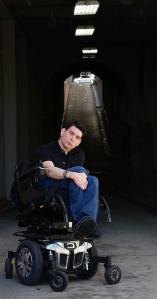
That Man – Spoken Word Video

Transcript:

That man. That man. No Sam I am, but I am a minority, rolling with authority, living life proudly as who I am – because, man, I am that man.

No, I’m not a misfit, but a paradigm shift, where when the world says I can’t, and I say screw you, Captain Sulu – because I can. Man, I am that man.

Like a two-dollar bill oddity disband, I can thrive and jive – on the dance floor, had a boombox back in ’84 – and the band plays on and on and on like the wheels rolling on my chair, wind blowing in hair. Because, man, I am that man.

There’s no price of admission – disability isn’t a curse or condition – it’s just the way it is, say it like it is, live it as it is – screw those with ignorance, where what some call a hairdo is really just friz. Because, man, I’m that man.

Bold and determined, bulldozing like a tank named Sherman, I am a minority, and I’ll use my authority to make the world stand on end – screw you, I refuse to pretend who I am, because I’m proud to be me, all that you see – shout it, cerebral palsy – because, man, I am that man.

The Je Ne Sais Quoi to it All

By Mark E. Smith

There’s an ultimate je ne sais quoi to it all. It’s the tipping point where your skin fits – perfectly. It’s that inexplicable eloquence as you glide through life defying any preconceived notions of who you should be, all because you just are who you are, not a facade or a mirage, but true from the inside, out. Your core, anchored stronger than concrete, even an 8.0 on the Richter scale can’t shake you. As Nina Simone put it, “I’ll tell you what freedom is to me – no fear.” And, I’ll add that in everything you do, you don’t need to worry about any of it. Man, Woman, brothers and sisters – the je ne sais quoi of us all – just be. You.

Video:

Foul Mouth Kids

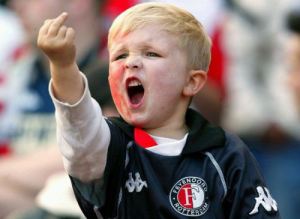
foul

By Mark E. Smith

In my neighborhood, none of us kids took anything from anyone. It was where the two sides of the tracks intersected – upper- and lower-class kids intertwined. Neither had much parental guidance. You just never knew where anyone’s parents were. Some were drinking in dark bars in the afternoon, others working in the city in high-rises till all hours, and some straddling both lives. Because of this, in my neighborhood, most kids had free reign from parents, and when out wondering our suburban streets, you didn’t take gruff from anyone.

Being the kid who used a wheelchair didn’t make me exempt from any of it – the dysfunctional home, taking jabs from the other kids or dishing it back. Mostly, though, I kept to myself after school. At 14, I had a lot going on teaching myself to be independent with cerebral palsy. I was three or four years into my mission of being as independent as possible and I saw a lot of progress. My main self-therapy was pushing my manual wheelchair for two hours or so after school every day. The repetitive motion of pushing my manual wheelchair was a sound exercise in strength and coordination. But, I was dismal at it. I’d started a few years earlier barely able to propel across our living room, and by this point, I could make it around our neighborhood. Yet, there was no grace in it.

I pushed painfully slowly. Really, it wasn’t even pushing – pushing implies consistent movement. For me, it was push, roll feet or inches, regather my flailing, spastic limbs and then push again. All that mattered, though, was that I was seeing progress.

As I went out each day, I purposely stayed on quiet streets. I needed to do what I had to do and didn’t want to be bothered. Besides, I never knew if anyone would understand why I was doing what I was doing, and I didn’t want to have to answer any questions. When I was eight, I was in a grocery store trying to buy a pack of gum and an elderly woman made a huge scene that crippled people like me shouldn’t be out alone in public. That experience shook me a bit, and I suppose it made me want to avoid such a scene while out pushing my manual wheelchair, self-aware of how awkward I looked. So, the side streets were my sanctuary, where I could push and progress at my own pace, in solitude.

There was a hill leading to our driveway. It wasn’t the steepest of hill, but long – maybe two blocks – lined by vacant land on each side. It took me a good year to get to where I could push up that hill myself, but I got to where I could do it, although it was forever a challenge, inch by inch.

One afternoon while halfway up the hill, a group of neighborhood kids came up from behind me.

“Need help?” one of them asked as they all surrounded me.

“Do I look like it?” I asked with an attitude, pushing toward a boy standing in my path.

“Yeah,” they all replied at once, laughing.

“Screw you!” I shouted, giving my chair another push, wanting to be left alone.

“Screw you!” they shouted back as they walked in front of me.

“You’ll never make it up the hill, retard,” one kid yelled.

I pushed even harder.

“And I’m going to kick your ass in school tomorrow!” I yelled.

Of course I made it up the hill, and I didn’t kick the kid’s ass in school the next day. I guess achieving one of my two goals wasn’t bad considering the circumstances.

From Dirt to Gold

First Dyson
First Dyson

By Mark E. Smith

A gracious colleague noted that I’m very skilled in business at seeing the positives and negatives in situations, and then pragmatically steering both toward the positive.

I replied, “That’s not a business skill, that’s a life skill that I’ve learned from disability experience, where if I didn’t know how to work with adversity, I wouldn’t be sitting here.”

In 1993, when Britain’s James Dyson introduced his first vacuum, it had a clear dust-collection canister of great controversy. Vacuums had always had bags, and the vacuum industry all said no one would want to see the dirt they vacuumed up in a clear canister. It was a totally valid point, proven by market research. Dyson had two choices: he could avoid the potential market controversy by enclosing the canister or he could see it as a counter-intuitive selling feature.

In among the most brilliant moves in business history, Dyson saw the controversial clear canister not as a detriment, but as an advantage. He wasn’t deterred by the market research, but embraced it proving his vacuum was unique. He used the clear canister to show consumers how his vacuum’s cyclonic action picked up more dirt than other vacuums – and consumers were mesmerized by it. People loved seeing how much gunk they vacuumed up! Within 18 months, it was the best-selling vacuum in the U.K., and today, virtually all vacuums have a clear canister.

So often when we face obstacles, we’re taught to work around them. However, working around obstacles rarely results in our greatest successes. Rather, working with obstacles is where success comes in. If you can succeed by addressing obstacles head on – like showing dirt in a vacuum canister instead of hiding it – that’s where ultimate success is found.

Many years ago, based on my disability, I couldn’t button buttons, so it was suggested that I have all of my clothing buttons replaced with Velcro. Velcro would work, except for one aspect – it wasn’t truly overcoming the obstacle, as I still couldn’t button buttons. I used thick, stiff wire and put a loop on one end, and discovered that by pushing it through a button hole, looping on to a button and pulling it back through, I could button buttons (other such tools are now sold). As a result, I could button any button. By addressing buttoning head-on, I solved it rather than avoiding it. Velcro was no solution; finding a way to button buttons was!

What I’ve learned is that life gives us obstacles no matter our circumstance, and we have the choice to use them as a deterrent or an opportunity. Maybe it’s based on my disability experience, business skill or smart-alecky tenacity, but when life presents me with obstacles, as it does all of us, I try my hardest to turn that canister of dirt into a pot of gold – obstacles into advantages, that is!

The Life and Death of Humor

To John: After writing the essay, I had to have an illustrator colleague bring my image to life - or death!  -Mark
To John: After writing the essay, I had to have an illustrator colleague bring my image to life – or death! -Mark

By Mark E. Smith

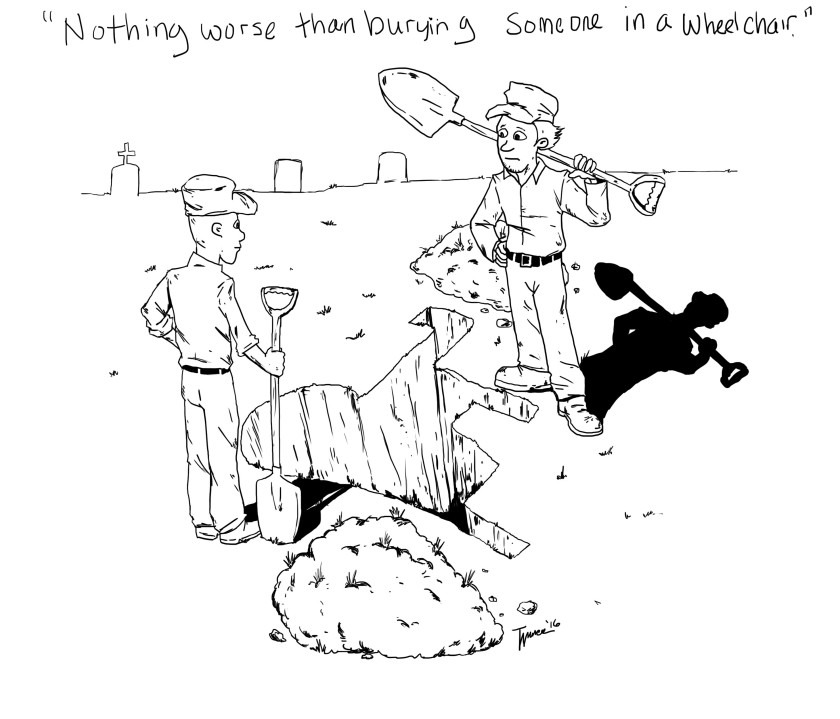
Among my all-time favorite people is Callahan – John Callahan. He’s been dead now for going on 6 years, and I’m sure there’s still a hilarious punchline to that waiting to be told… maybe a cartoon of two grave diggers with shovels standing over a grave dug in the silhouette of a wheelchair?

See, Callahan was abused as a child, an alcoholic by his teens, and a high-level quadriplegic by 21 from a drunk-driving accident. There’s nothing funny about any of that – except to Callahan and his millions of readers who understood through his twisted but totally candid cartoons that humor can be among the truest healing forces. I mean, his most famous cartoon was where cowboys on horses in the desert surrounded an empty wheelchair, noting, “Don’t worry, he won’t get far on foot,” exemplifies where tragedy evolved into humor in Callahan’s life. Many were mortified by the tasteless cartoon; but for those of us who live with disability, it was hilarious.

I’ve seen it so many times, where our pain, when addressed with humor, can become joy. And, making that transition is life-changing. If you can genuinely laugh at something, you’ve survived it. You’d be hard pressed to find a successful comedian who hasn’t experienced trauma, but through that has somehow found humor.

For me, humor has always kept me from the dark sides of life. If you ask me about cigarette smoking, I’ll tell you to go for it. After all, my mother smoked throughout her pregnancy with me, and I was born just fine, right? …The whole cerebral palsy thing was just an uncanny coincidence.

I likewise grew up with alcoholic parents, and they died from it at young ages. Along the way, I spent time accompanying my drunk mom to Alcoholics Anonymous meetings as a teenager – because when you’re 16, with cerebral palsy, it’s the one place your slurred speech and uncoordinated body gestures fit in. At times, I wanted to truly participate: “I’m Mark, and I’m not an alcoholic, but I sound like one and sometimes I pee my pants – where’s my AA coin!”

No, there was nothing funny about being born with cerebral palsy or having drunks for parents – it was all tough stuff. Yet, I survived it all, and I can’t help but see humor in most of it now. Humor, in so many ways, is the power to rise above pain, to take back our joy, our spirit.

As they say, that which does not kill us – or does! – only makes for a hilarious punchline. And, as Callahan taught us all so well with his work, if you’re not at the point yet where you can laugh at your own pain, you don’t need to worry – there are plenty of us who will do it for you!

Broken Pianos

piano

By Mark E. Smith

The story of American jazz piano great, Keith Jarrett’s, 1975 concert in Cologne, Germany, is legendary. See, Jarrett was scheduled to perform solo that night at the Opera House in front of a sold-out crowd of over 14,000 people, to be recorded live for an album.

However, when Jarrett arrived at the Opera House the afternoon of the concert – exhausted, with a bad back from touring Europe – he was horrified to find that they didn’t have his required piano. Instead, they had an old, small broken piano – not concert worthy.

The young promoter called around, but couldn’t come up with the needed piano. The best she could do was get the old piano tuned, but the upper keys were all but useless and the pedals didn’t work. Jarrett was done, insistent that he couldn’t perform without a proper, working instrument.

With 14,000 people waiting until close to midnight and recording equipment set up, the young promoter begged Jarrett to perform. With nothing but tenacity, Jarrett took a leap of faith in himself and walked onto the stage, standing behind the tiny, broken piano. The packed Opera House was silent.

Jarrett focused on only the piano’s center keys, the only ones that worked, and pounded them with ferocity that allowed the tiny piano to project, rearranging the songs in real time with each key strike. The result was over an hour concert that ended in a standing ovation – and became the best selling solo jazz album of all time, The Koln Concert, with over 3.5 million albums sold.

How often do we, in our own lives, find ourselves in Jarrett’s situation, seemingly not having what we need to succeed? How often do we only see limitations in the face of adversity? But, more importantly, how often do we have the tenacity and courage to do as Jarrett did, and not dwell on what may limit us, but strive to find that which may elevate us?

I’ve had my share of adversity in life, as have many who I’ve known. After all, adversity doesn’t discriminate. What I’ve learned is that when we succeed in adversity, we do so by using what we have, ignoring that which we don’t. We’re fearless experts at playing broken pianos.

It’s trite, cliché and undeniably true: Never let what you can’t do stop you from what you can do. There’s stunning form waiting to be played on our own broken pianos.