Origins of Kindness

1935402_10208453502359930_1117855726456685744_n

By Mark E. Smith

We hear of “random” acts of kindness, but more aptly, they’re usually “intentional” acts of kindness.

I often write about coming up the hard way, and that experience, of course, has shaped who I am, feeling extremely blessed for however little or however much I have in all areas of life.

I’m very fortunate to have the means to eat out – especially since it’s something I enjoy. After all, what’s more relaxing after a day at work than having a fine dinner somewhere? And, my wife and I have our favorites, including the restaurant our acquaintance, Gary, owns. The food’s great, the staff and patrons know us, and they always fit us in, with or without reservations. We’re just comfortable there.

As a result, it’s become a tradition that we go to Gary’s place for his Christmas Eve buffet – an unbelievable seafood spread. We get dressed up, settle into our table, and have a terrific festive holiday dinner among our family and those we know.

This year, however, was an exception. Indeed, we got dressed up, had a fantastic feast, and exchanged holiday greetings with the staff and those we knew from the community. But, when we asked for the bill, there wasn’t one.

See, Dr. Freiman, who grew up with Gary – both my age – sat with his family at the table next to us. And, as he and his family left, he quietly paid our bill. Why would Dr. Freiman do that?

Well, there’s more to his and Gary’s story than most know. Dr. Freiman, an ENT specialist, and Gary grew up together. In looking at either one today, you’d never guess their upbringing. After all, one’s a doctor and the other is a very successful chef.

Yet, they grew up together in the worst of the worst conditions, living in dive motels, neglected and abused. As Gary told me, he was as shocked as anyone years ago when he was working as a chef at a wedding, only to find out the groom-doctor was Mike Freiman, the kid he tagged around with in school. “Neither of us came from a real home and we were always in trouble together,” Gary told me. “It’s a miracle we each made it to this point.”

Gary knows a bit about my story, past and present, and as kindred spirits, we know the unsaid code that Dr. Freiman clearly also knows: When you’ve survived your knocks in life and achieve some level of success, you give to others, both out of empathy in having once been where some are, and in recognition of where others have gotten, as well.

As one who’s always felt it’s better to give than to receive – being fortunate where I’ve gotten in life – it was a true honor to receive such an understanding gift this past Christmas Eve by Dr. Freiman. Whether giving or receiving, we are truly blessed in the process.

Projecting Oneself

confidence

By Mark E. Smith

My friend texts me from a restaurant on New York City’s Upper East Side. He explains that it’s full of those who are ultra-wealthy, and they’re acting awkwardly toward him, as if they’ve never seen a person using a power wheelchair. He further texts that there’s an attractive, older women next to him who seems possibly approachable.

“Say to her casually, ‘I’m just back from London, and I’m amazed at how warm the weather is here,’ and see where the conversation leads,” I text back.

Of course, my buddy has never been to London and, yes, my reply was sarcastic.

We live in a culture where people may make totally uninformed, ignorant presumptions of us – and we can feel it sometimes, can’t we, like my friend in that restaurant. They perceive us as they wish. I mean, think about all of the stereotypes people can make about a gentleman using a wheelchair in public. And, it’s so easy for those of us who use wheelchairs to absorb those. It would be understandable for my friend to want to avoid that restaurant scene and high-tail it out of there. But, there’s every reason to stay.

No matter who you are – disability or not – you have far more control over such situations than you likely know. The fact is, just as others attempt to perceive us, we can completely project who we are, totally reversing the process. My text to my friend wasn’t meant for him to literally lie, but rather to imply gaining comfort in his skin. There was no reason for him not to fit in. It wasn’t up to those in the restaurant to tell him who he was; rather, he had the power to project who he was.

Being humble is among the most admirable traits. However, feeling as though you need to apologize for who you are should never be in our emotions. I use a power wheelchair, with severe cerebral palsy, right down to muscle spasms and labored speech. At 44 – and it took me a long time to get here – I don’t feel awkward in who I am, and I certainly would never apologize for who I am. As I go through the entirety of my daily life, I am who I am, and I’m not making an issue of it, and neither is anyone else, per me. Here I am, as I am, period.

And, that’s what I’ve learned: We teach people how to treat us by both how we view ourselves and what we project. If I’m in a conversation and I spasm, I correct my posture and keep with the conversation. If I don’t make it an issue, typically neither does anyone else. It’s amazing how our reactions and projections can completely dictate how others react to us. Just be you, and you’ll be impressed at how others recognize you as just that.

As for that awkward restaurant scene, how would I handle it? …I would just be myself.

When All Heals Stronger

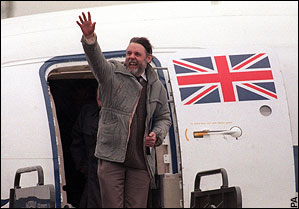
Terry Waite Released, Nov. 18,1991

By Mark E. Smith

In 1987, British humanitarian and envoy, Terry Waite, went to Lebanon to secure the release of four hostages. He, himself, was then taken hostage, enduring 1,763 days in solitary confinement – chained, beaten and subjected to mock execution.

Once released, Waite reflected on his experience years later, writing, “Suffering is universal: you attempt to subvert it so that it does not have a destructive, negative effect. You turn it around so that it becomes a creative, positive force.”

Waite’s interpretation of the impact of trauma is one that psychologists have been studying for some 30 years. It’s long been known that trauma – from early childhood experiences to those occurring later in life – can profoundly derail lives in so many destructive ways. It’s extremely hard to psychologically and emotionally recover when life has thrown you devastating blows. I know – I’ve had them. Yet, there’s a fascinating, researched side to trauma that many live, but few discuss: Trauma can serve as a mechanism for positive, personal growth.

Psychologists now formally call this process of turning trauma into triumph Post Traumatic Growth (PTG), which is the opposite of widely-known Post Traumatic Stress Disorder (PTSD). As I put it in context within my own life, I’m not better in spite of adversity; rather, I’m better because of adversity. No, I haven’t welcomed adversity into my life – after all, I didn’t choose my family’s dysfunction as a child or my cerebral palsy – but there’s no question it’s all shaped me into a person I’m proud of and fostered a strength toward successes I likely wouldn’t have otherwise. PTG is when you meet individuals whose lives seem to defy logic, those who’ve experienced trauma and adversity, only to go on to successful, healthy, happy lives.

Interestingly, researchers have found that approximately one-third of those who have experienced trauma or adversity have PTG as a catalyst in their lives. I look at the impact of PTG like exercising weights: adversity conditions us to lift among the heaviest of weights, so the rest of life (read that, far less weight) is easier to cope with and allows us perspectives others may not have. So, what are those perspectives?

Researchers looked at the common traits of PTG – that is, those not sunk by trauma and adversity, but elevated by it – and the common threads are striking: A greater appreciation and empathy toward others; an increased acceptance and comfort within oneself; and, an increased innate ability to live in the present and prioritize what’s truly important, having an unyielding sense of gratitude.

If you consider the emblematic positive effects of PTG, they seemingly go against logic, don’t they? After all, trauma and adversity do lead – at least in two-thirds of the population – to aspects of fear, distrust, resentment, self-defeat and bitterness, to name a few emotions. And, it all makes sense, as such reactions to trauma as PTSD are rightfully more common than not, tapping into totally valid, understandable emotional and mental states. It’s so difficult not to come out unscathed. Therefore, how is it that those with PTG escape the more-typical trauma-based path and actually become healthier, happier, more successful individuals? How has Terry Waite experienced among the worst that mankind can inflict, but has gone on to be a leading humanitarian on a global scale?

No one knows. However, what’s inspiring about research in Post Traumatic Growth is that it clearly shows the capacity of the human spirit to turn tragedy into triumph, where it may not be easily done, but it is possible. We don’t have to be defined by what’s happened to us. As Waite puts it, “Break my body, bend my mind, but my soul is not yours to possess….”

The True Meaning of Weakness

biggest-weakness

By Mark E. Smith

I love working out because it’s such a humbling experience. See, people often trick themselves into believing that working out is about strength; however, it’s literally an exercise in embracing weakness. After all, if you’re putting your all into your workout routine, you do so till failure, finding your ultimate weakness every time. If you’re doing it right, you never leave a workout accomplished but defeated.

Yet, what’s fascinating about working out is that by consistently acknowledging your weakness, it ultimately makes you stronger. This goes for all of life, where our greatest strengths originate from our truest weaknesses. If we wish to live to our best, we can’t focus only on our strengths, but we have to be wise enough to embrace and pursue our weaknesses.

I come from a lineage of addiction, and I’ve never thought myself stronger than it. I was born into it, science says it’s in my DNA as a genetic component, and was further solidified by the environment I was raised in. By all accounts, I statistically should be – and could be, as it’s never too late – an addict. It would be easy for me to say that I’m too level-headed or strong-spirited to be an addict. But, the fact is, it’s knowing my weaknesses toward addiction that have kept me off of that path. I’ve known my risk factors, and knowing my predisposed weaknesses within me keep me in check. I’m not inherently stronger than addiction, just wisely aware of my weaknesses. If you know you can’t out-wrestle a bear, stay away from bears!

Having a disability, my physical weaknesses are always front and center – at least as society recognizes them. After all, we live in a culture of hyper portrayals of masculinity and femininity. Men should be strong and independent, and women should be sexy and elegant. But, physical disability can make living up to those standards not just impossible, but excruciating. As a result, it’s so easy to push disability weaknesses – read that, vulnerabilities – down in denial or shame, especially when it comes to how the so-called weaknesses and our romantic partners interrelate. However, if you’re willing to expose and embrace your seeming weaknesses, it will take your life and relationships to a far deeper, rewarding level.

I’ve always had a whatever-it-takes attitude, and it’s served me well – that is, except when I’ve used it to mask disability-related weaknesses. I’ve spent decades struggling to use the toilet, where poor balance and poor coordination made the transfers a constant nightmare. I could never use the bathroom in the morning because I lacked the balance and coordination, and then in the evenings, falls from transfers weren’t uncommon. In my mind, my thought process was, no matter how hard it all was didn’t matter – I’d rather die trying than accept help. In my skewed, macho mind, what was less manly than having my wife help me transfer onto the toilet?

However, it was tough for my wife to see and hear me struggle. And, one eve, she just came up, tucked her arms under mine, and together we slid me onto the toilet, then off. It took a lot for me to accept that help, but it immediately made my life one thousand times easier. Yes, I had to admit a weakness to myself, that independently transferring onto the toilet was a huge problem. However, as a result, I summoned far more inner-strength and confidence by being secure enough in who I am to embrace such help from my wife – and it’s enhanced my life and our marriage.

From what I’ve learned in my own life, I don’t know why “weaknesses” in our culture are seen in such a poor light. After all, when weaknesses are embraced and addressed, they can be the ultimate form of strength.

The Iris Effect

12196161_10207777888755456_2604424288050660940_n

By Mark E. Smith

Ninety-four year old fashion icon, Iris Apfel, once said, “I’m not going to be a rebel and offend anybody, but I’m not going to live in somebody else’s image.”

Being somewhat of a public figure, I recently was engaged in a several-day online banter with an individual being very critical of me, to the point of irrational. Still, I felt the need to respond to his criticisms. For one, I didn’t want false statements about me left unaddressed in a public forum, and secondly, I was trying to be respectful and not ignore the individual. I didn’t take it too personally, but I also didn’t just let it emotionally go – and logistically it consumed a lot of time. However, I finally realized I didn’t deserve to be treated that way, and I didn’t care what else was said of me – and I simply ceased the unhealthy dialogue. I know who I am, I know what I do, and I’m proud of it all, so there’s no need to waste time with concern over others’ opinion of me – good or bad.

Most of us have been in this type of predicament, sometimes more serious than others, right down to abusive. I mean, maybe you know what it’s like to be inappropriately criticized, judged or condemned by others. And, it’s most painful when it’s by those who claim to love us. Something as small as a comment like, “You’re not going to wear that, are you?” after we’ve gotten dressed up can sting. Of course, situations like when parents stop talking to a child because he or she came out as gay can crush. From tiny comments to huge judgments, it all just hurts, doesn’t it?

But, there’s a way to stop it all, to take away the pain – and, more importantly, remove the power of others from effecting us. We need to realize that, if we’re good people, living good lives, no one has the right to criticize, condemn or judge us, period.

As I grew up with a severe disability, it was always in the back of my head whether others would accept me? This insecurity extended well into my adulthood. Granted, I was really good at concealing it, where self-confidence was a mask I wore. However, in my 30s – and it’s unfortunate that it took me that long to come to such a simple truth – I realized that I was to be accepted as I was, and I didn’t need anyone’s approval toward my having a disability. It’s really a brilliantly childish life strategy: I don’t need anyone to accept me because I don’t accept anyone who doesn’t accept me. It’s my ball, and if you don’t like the way I play, then I’m taking my ball and going home!

See, the prize is in you and me, not those who criticize, condemn or judge. I’ve run into several circumstances where friends have come out as gay to their parents, only to be shunned. Again, imagine how painful it is to have your parents shun you. However, who should shun who in such a circumstance? It’s painful and hard, but a child needs to say to his or her parents, I’m your child and I deserve to be loved as-is, and guess what, folks, until you love me as I deserve, you’re going to have an empty chair at the dining room table.

Life and relationships are full of compromises, but our intrinsic value isn’t. We shouldn’t live to others’ criticism, condemnation and judgment. I know, it can be hard to break free of investing in what others think of us, especially when it’s gotten to a toxic level in family dynamics and relationships. Yet, we owe it to ourselves to be our own cheerleaders, champions of the self, where the only opinion that counts is our own, based strictly on the positive, meaningful lives we lead.

Larger Than Our Pasts

elephant

By Mark E. Smith

A friend and I were eating at a fast-food joint when a couple sat at the table beside us.

The woman nicely said, “I forgot napkins.”

The guy burst out in anger, calling her filthy names, noting over and over how “stupid” she was.

Yet, she was unfazed by the verbal abuse.

My friend and I were mortified, noting if he does that in public, can you fathom the abuse at home?

“That’s learned behavior,” my friend said. “I guarantee you they both were raised in abusive homes.”

My friend was undoubtedly right. When you come from a realm of dysfunction – albeit, addiction, abuse, divorce, and so on – as a child, you’re four times as likely to live these as an adult, according to the National Institute on Health.

It’s the nature of the beast that psychologists call classical conditioning – learned ways become innate behaviors that go unquestioned by us. Put simply, if you’re raised by a verbally abusive parent, you’re likely to verbally abuse others or accept being verbally abused.

Interestingly, circus elephants are a perfect (but sad) example of this. Elephants are gigantic creatures led around by tiny tethers. They could break free in an instant, but they don’t? Why?

As babies, circus elephants are restrained, where, as hard as they try, they can’t escape. Although they grow to enormous strength, that early conditioning makes them innately believe that they’re forever restrained, even by a shoe-lace-thick line.

The fact is, we’re not much different than elephants, where extremely unhealthy treatment becomes innate behaviors. Family legacies can be wonderful; yet they can also destroy us when unhealthy. However, we truly don’t have to live unhealthy legacies – we can break free of their torturous tethers. No, we don’t see a lot of people do it because it takes so much, literally being so self-aware and courageously strong that you’re willing to question that which is all you know.

I grew up under extremely unhealthy circumstances, and while I was fortunate enough to question them – and that’s the only way to break free of a toxic legacy – I wasn’t totally successful at breaking free of them. I married an addict in my 20s. By my 30s, I knew my daughter was in deep trouble having a parent along the lines of my own, and I had to do two steps to hopefully pull her as far away as I could from that destructive legacy. Firstly, I had to get my ex-wife out of the home. But, secondly – and more importantly – I had to somehow help my daughter dispose of what she innately knew of addiction and cut that as her legacy. She had to do what many people never want to do – namely because it’s so painful – and question why her mom did what she did.

My daughter is now in college, and beyond all of her amazing accomplishments, the one I’m most inspired by is the courage she’s investing in breaking free of a dysfunctional legacy and creating another of self-awareness and emotional health. As a psychology major, she’s investing not just in her coursework and community, but in herself. The candor and awareness – sometimes the struggle – that I see in her papers is breathtaking:

I hid behind the white bedroom door at around 9 p.m. on that weeknight. I had school the next morning. It wasn’t an unfamiliar feeling as I stared into Dad’s dark brown eyes, both waiting for the police and my aunt to arrive. Yet, I’d never seen my father’s heart more heavy than in that moment. It was clearly a breaking point of fear and guilt and decision.

On the other side of this – the emotions, the door – was my mother. She was on the other side of that door, kitchen knife in hand, trying to get in, to get us. At that point, I realized that I had lost my mother for good to addiction.

The realities of addiction were imprinted on me – forever. They started when I was three, escalated in my adolescence, and remain chilling today when I have the strength to think about them.

…As for my mother, she’s no longer battling addiction, but in hospice dying from it – a mind and body destroyed. As for me, I’m still battling her addiction as part of my past, but with a better understanding not to make it part of my own future, but to help those where there’s still hope to break the cycle. That’s the best I can do with my legacy of addiction.

See, that’s the key to untethering ourselves from potentially life-destroying legacies: If we question them, it’s impossible to relive them. What happens if a 6,000lb grown elephant questions its tether? It breaks free. There’s a moment where we, too, can break free in realizing we don’t have to live that way – we can be larger than our pasts.

At the Heart of Smiling

12141599_10208009578662115_6936364041281133666_n

Every time you smile at someone, it is an action of love, a gift to that person, a beautiful thing. ― Mother Teresa

By Mark E. Smith

My father-in-law, a retired pastor, told me a great story over dinner.

He said, “My best friend, Gary, and I were both pastoring, and I noticed that at the end of services, everyone hugged Gary, while they only shook my hand. So, I asked Gary why that was? Gary replied, ‘You stick out your hand, while I open my arms….’”

What the two pastors were really discussing was that we receive what we offer. If you want a hand shake, put out your hand and you’ll get one. If you want a hug, open your arms and you’ll get one!

For me, I’ve always smiled. From as young as anyone can recall of me, I was always smiling. Part of it is my innate disposition, but the other part of it, as I’ve come to understand, is an appreciation for life. I’ve been through my share of adversities – and will forever struggle with some – and it’s gratitude toward all of it that keeps a joyful smile on my face.

However, smiling is more than only about my disposition or gratitude. It goes back to the conversation the pastors had. Truly, if you want to see the world smile, smile at it. I often share this story. I was at Walmart with my sister several years ago, and she noted how friendly and nice customers and employees were to me – the complete opposite of her experience of everyone being somber. I asked her to watch as we continued shopping. Per my usual, I smiled and made eye contact with complete strangers where that led to an exchange of a friendly how-are-you? “Just smile at people,” I said. “It changes everything.”

I’m at the point now where I smile at pretty much everyone. On my route to work, a crossing guard shared with me that she learned who I was by asking a friend in the neighborhood, “Who’s the guy in the power chair who’s always smiling?” If I’m at a stop light in my van, I’ll smile at those in cars next to me, and it’s amazing how a gruff guy’s demeanor will change or a woman will blush – a smile is a powerful exchange.

And, there’s science to this all. Firstly, smiling triggers a happiness feedback loop in our brain, so whether we smile because we’re happy or we become happy because we smile, it works. Secondly, numerous studies have shown that smiling increases our success, from home life to career. The average person smiles 20 times per day, whereas ultra-successful people smile 40 to 60 times per day. Smiles are warm, inviting and sincere – they’re a people magnet because we’re drawn to happiness.

Of course, I do run into being stereotyped sometimes based on my smiling. Well-meaning individuals noting my cerebral palsy come right out and ask, “How is it that someone in your predicament can find a reason to smile?”

I just smile and reply, “A life where you smile at the world and it smiles back at you is a fortunate predicament to be in….”

No More Second Chances

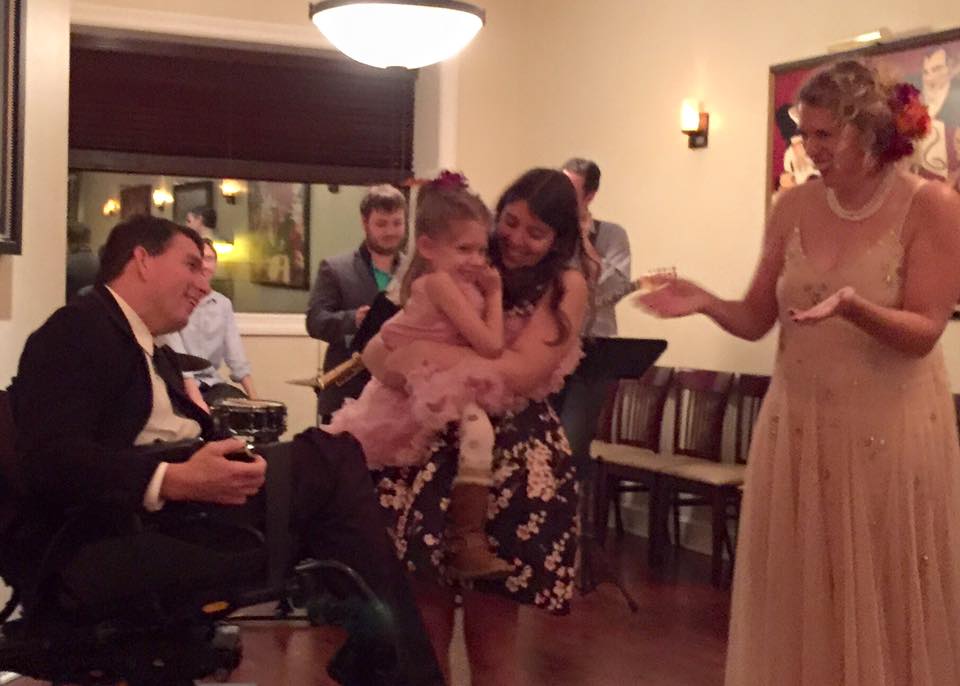
Smith Wedding Reception, October 10, 2015

By Mark E. Smith

On the surface, my life is one of second chances. In fact, from the moment of my birth, not breathing, resuscitated, then given only hours to live, my life started with a second chance.

As my life went on, second chance after second chance all but saved me from countless perils that could have stopped my life in its tracks. I went from lying on therapy mats in a special school to being mainstreamed in public school; I went from virtually no mobility to having a power chair; I went from moving into a garage to moving into my stepfather’s home; and, I ultimately went from not having a father to being among the most dedicated fathers myself. Indeed, if it wasn’t for second chances, my life would have derailed at so many points.

However, now at mid-life, my experiences and insights have allowed me to realize that second chances don’t truly exist beyond cultural mythology. Life doesn’t offer second chances. We can’t erase where we’ve been, we can’t change what’s happened, and we certainly don’t get do-overs. No, life is a journey, a linier equation, where all that we’ve experienced shapes who we are, where we are – the painful times, the prosperous times, the losses and gains, the tragedies and triumphs all serve a masterful purpose.

The notion of second chances suggests that the firsts were an error, not meant to be. Yet, without whatever came first – the tragedies, the mistakes, the failures, as commonly labeled – we could never have what came next, we could never continue on the journey that makes our lives… well… our lives. And, when we remove the notion of second chances from our beliefs, and value all aspects of our life as a linier journey, it gives meaning to all, turning even the most painful parts of our lives into purposeful, into having reason, into healing and success.

See, if we don’t look at life as second chances, but rather as what’s meant to take time to unfold and come to fruition, it’s impossible to be bitter, resentful or regretful of the past. Instead, we become intrinsically thankful not just of where we are, but likewise where we’ve been. Sometimes life’s journey is not to be questioned, but lived.

Our Truest Voice

speaking

By Mark E. Smith

I recently watched a Ted Talk by a public speaking coach who gave the secrets to being a great speaker. She spoke of relaxed posture. She spoke of soft breathing. She spoke of using your diaphragm. She spoke of controlled speech patterns. And, she spoke of overall body composure. Really, based on all she covered, I should never roll on a stage or speak in front of a group ever again because my cerebral palsy prevents every technique she noted. According to her, I’m the antithesis of a speaker, her worst nightmare.

Yet, over the past 25 years, I’ve spoken to more groups than I can count; I’ve made a remarkable number of TV appearances; and, I speak formally within my company in many capacities every day – all with tremendous efficacy. So, how do I – as one with severe cerebral palsy – defy the rules of the experts and achieve success in my career with so much speaking?

The answer is, I am just me and I always speak from the heart. I don’t need to be a polished robot, nor do I need to try to be someone I can never be. When you hear me speak – sometimes labored, sometimes slurred, sometimes spastic – you’re getting the real me. What greater gift can we give others than the real us, perfectly imperfect, speaking from the heart?

Among the reason why I address groups within our company is because I’m so passionate about what we do and I’m so inspired by the profound difference each employee makes in the lives of our customers. And, so one of my greatest privileges is speaking to groups of our employees, both weekly with new hires, and monthly at our birthday lunch, where we celebrate employees’ birthdays.

It’s my pleasure to share with you one of my talks with our employees. What I want you to note is that I’m clearly not what that speech coach envisioned. Rather, I’m real and imperfect – the two traits that we should all embrace to make a true impact in the lives of others. There’s no one more captivating than who we truly are.

Crank up the volume and enjoy this 12-minute talk:

First Drafts

hemingway

By Mark E. Smith

When my daughter told me that her first reading assignment in her college freshman English class was Ann Lamott’s “Shitty First Drafts,” I was thrilled. Now there’s a professor who knows how to teach!

“Shitty First Drafts” was never a stand-alone essay, but an excerpt from Bird by Bird, Lamott’s 1994 book on writing, aimed at writers living the writing life, and goes back to Hemingway who coined the subject of shitty first drafts. Yet, Lamott, who you might recognize as a very pop-culture and, interestingly, irreverent Christian writer, infused Bird by Bird with life lessons, where I, for one, have always viewed “shitty first drafts” as another one of Lamott’s ultimate metaphors for life.

Lamott’s assertion is that, as writers, the only way we ultimately get to clarity and success is by having the courage to embark on shitty first drafts:

…All good writers write them. This is how they end up with good second drafts and terrific third drafts…. Very few writers really know what they are doing until they’ve done it. Nor do they go about their business feeling dewy and thrilled. They do not type a few stiff warm-up sentences and then find themselves bounding along like huskies across the snow. One writer I know tells me that he sits down every morning and says to himself nicely, “It’s not like you don’t have a choice, because you do – you can either type, or kill yourself.” We all often feel like we are pulling teeth, even those writers whose prose ends up being the most natural and fluid. The right words and sentences just do not come pouring out like ticker tape most of the time.

Chances are, you’re not a writer. But, if your life is like mine, it’s certainly checkered with shitty first drafts. As Lamott puts it, we typically have no idea what we’re doing until we do it. And, I don’t know about you, but I can’t think of hardly any success in my life that didn’t begin as a shitty first draft – from living with my disability to school to career to finances to relationships to working out, and yes, writing. In fact, I have shitty first drafts every day, where based on my disability, two or three tries at any daily living task is the norm. However, I’m always thinking, learning, getting wiser as I do a task, so rather than getting frustrated, I hone in on getting better, improving with each “draft.”

When it comes to our lives, it’s vital to give ourselves permission – and have the courage! – to have shitty first drafts, namely because, as Lamott puts it, they lead to good second drafts and terrific third drafts. Do you know how I learned about finances and relationships, two cornerstones of life? Shitty first drafts! In my 20s, I got into debt up to my ears, by my 30s I paid everything off, and today I haven’t used credit in over a decade, living totally debt free. Relationships have had a similar path, having to learn about love through a lot of painful trial and error, but I think I’m a better partner today than I was 20 years ago. There are so many aspects of life that generally start with shitty first drafts; but, if we’re cognizant, self-aware and dedicated to growth, those shitty first drafts aren’t shitty at all – they’re assured paths to ultimate success.

So, as my 18-year-old daughter moves through her first semester of college, she’s not just reading about shitty first drafts, she’s undoubtedly living them at times, as we all have and do. Yes, it’s hard as a father not to jump in and correct my daughter’s “shitty first drafts,” but I know that by allowing her to learn and grow from them, her second and third drafts – read that, her accomplishments – will be amazing.