Living as a Wounded Healer

By Mark E. Smith

Over a decade ago, members on the WheelchairJunkie.com message board wrote disparaging comments about one particular model of wheelchair, noting its shortcomings, and word quickly spread among mobility consumers. The head of the company that manufactured the wheelchair model was so upset by the comments that he emailed many in the industry, explaining that the consumer opinions posted on WheelchairJunkie.com couldn’t be trusted because the site was run by a non-disabled individual. That non-disabled individual was, of course, me, a guy with cerebral palsy and a lifelong wheelchair user.

At the time, I thought that the gentleman’s comments, stating that I wasn’t disabled, were bizarre, humorous, and offensive all at once. After all, how does one legitimately accuse someone who clearly has a profound disability of not being disabled? However, what’s remained striking to me after all of these years of running the web site and living as among the most public individuals with a disability is that I sometimes still have readers accuse me of not being disabled. Truly, it seems like a month doesn’t go by where someone will state to me via email or phone words to the effect of, “Mark, maybe if you were disabled yourself, you’d understand what it’s like to live in a wheelchair….”

How one can read through the goliath collection of posts, articles, pictures, and videos that is WheelchairJunkie.com, and not recognize that I’m a disabled individual, is inexplicable to me. Yet, as odd as it sounds, some readers completely gloss over the blatant and obvious – that I’m Mr. Cerebral Palsy, himself! – and send me angry emails labeling me as able-bodied. How is that possible?

Finally, in an effort to address this peculiarity of my public persona, I strove to make a video response:

Beyond the strange emails that I receive, and my humorous video, truly there’s a very serious side to this subject. Some individuals are so self-absorbed by their disability experience that not only are they truly blind toward anyone else living with disability, but they ultimately lack a far more vital trait: Empathy.

Pioneering psychiatrist, Carl Jung, founded the concept of the “wounded healer” – deeming it as vital to our healthy interactions with others. In everyday practice, a “wounded healer” is one who uses his or her own experiences and hardships as a way to grow and empathize with others, helping them cope in their own struggles. Alcoholics Anonymous “sponsors” are based on the wounded healer principle, where recovering alcoholics act as support systems and mentor those newly finding sobriety – that is, no one knows the struggles of sobriety better than one who has accomplished it. Alcoholics Anonymous sponsors don’t say, Let me tell you how bad I’ve had it in life…. Rather, Alcoholics Anonymous sponsors say, I know how hard it is to get sober – and, based on what I’ve experienced, I’d like to help you get through the tough journey, as well. A wounded healer, then, is someone who’s experienced struggles, pain, and hardship, but instead of becoming bitter, he or she develops a heightened empathy, and is drawn toward helping others in similar circumstances.

The wounded healer principle is a vital and natural part of the healthy lives of those of us with disabilities, as well. Rather than our growing bitter and self-absorbed by disability experience – blind to the struggles of others – we inherently grow from our experience, developing heightened empathy, using our experiences to help others with disabilities on their journeys. After all, it’s hard for a fully-aware individual to experience any hardship without feeling empathy for those on a similar path, including living with disability.

I wonder, then, when some try to pull the you-don’t-know-what-it’s-like-to-be-disabled trick on me and others with disabilities, could it be that they, themselves, aren’t truly accepting what it’s like to be disabled, that their bitterness and lack of empathy has them in limbo or denial toward accepting disability as a part of their own lives?

The answer is, absolutely. The fact is, we must be honest about our own struggles in order to truly recognize and respect the struggles of others. We must completely acknowledge and accept our own disabilities if we are going to acknowledge and accept others’. An alcoholic can only see another’s alcoholism when he, himself, recognizes his own struggles to get sober. A healer can best understand the wounded when he, himself, has been wounded.

No, I don’t take it personally when one with a disability takes out his or her frustrations on me, accusing me of not knowing what it’s like to have a disability or use a wheelchair. Rather, I approach such individuals with patience and understanding. After all, I know what it’s like to be wounded.

186,880 Hours… and Counting

mechic
By Mark E. Smith

At this writing, it’s the week of my 38th birthday, also marking 32 years of my using a power wheelchair (though, not the exact same one, as that would be downright weird considering that my career is in wheelchair design and manufacturing – it would be like Apple’s Steve Jobs using a Sony Walkman from 1982 instead of the iPod that his company invented).

32 years of power wheelchairs – think about that for a moment. That’s 11,680 days that I’ve spent in a power wheelchair, or approximately 186,880 hours – the literal equivalent of 16 hours per day, 7 days per week, for 32 years. Yet, when I maneuver through a restaurant, people still comment how well I “drive that thing.” After, 186,880 hours of practice, one would hope that I can maneuver past a freakin’ table and chairs without smashing Bubba into the buffet.

In fact, after 11,680 days of power wheelchair use, one would assume that by now I can operate it blindfolded – not only through my house, but for blocks at a time. To the amusement of my friends, I’ve actually done it, too – a Chris Angel mind trick, where I forewent illusion and safety for luck and stupidity.

But, it took me a long time to get to where I could not only operate my power wheelchair blindfolded, but also simply keep it upright. In the 1970s, before engineers understood fiber optics or cellular technology, power wheelchair engineers apparently didn’t understand gravity, where they made power wheelchairs that were dangerously unstable outdoors, tipping over in the slightest breeze. So, like learning to kayak, I reckon that I spent my first 23,360 hours learning to simply keep my power wheelchair upright. At some point my mother should have put a “This-side-up!” decal on my wheelchair, so passerbys knew to pick me up. Still, the beauty of the industry back then was that they didn’t make true child-sized wheelchairs, so when I tipped over, I was surrounded by the finest, over-sized adult wheelchair – I was like an egg in the center of a gigantic suitcase, sliding side to side, without breaking. Humpty Dumpty had nothing on me.

And, in those days, I inadvertently found my first soap-box speaking platform, too – by sitting on it. There was no such thing as “pan” rehab seating – only vinyl slings – so if you needed custom seating, the therapists went Fred Flintstones on your butt, and built the finest, rock-hard, plywood seat insert that money could buy. After all, why rely on soft foams and rehab technologists when there’s a sawmill and woodwright around the bend?

Of course, reliability was a given – as in, there was none. I suspect that each power wheelchair was manually pushed off of the assembly line, as actually running it would have cut too much into the motors’ life span. And, then there were the parts that were so poor that they must have been made in a plastic spoon factory, right next to the plastic knives that always break. In fact, when you bought a new power wheelchair, you had to buy aftermarket “Davis Forks” to replace the Dixie-Cup cardboard ones that came on the power wheelchair. I suspect that the standard-issue, flimsy forks that broke upon first use were a practical joke gone too far – after all, there’s nothing funnier than seeing a little kid with cerebral palsy tip over in his wheelchair when the front wheels fall off; but, when, as a manufacturer, you do it to every wheelchair user in the country for years, the humor eventually wears off, even for Jerry Lewis, I suppose.

But, make no mistake, power wheelchairs have made my life. I was able to be one of the first severally disabled students mainstreamed in a public school because of a power wheelchair – sure, the teachers and other kids were a initially a bit freaked out by my wheelchair, but it got me around, mobile within in the public education system, ultimately to where they then couldn’t kick me out even when they tried out of sheer discrimination. As long as I could get myself to class, they couldn’t stop me from attending – they didn’t count on my power wheelchair as my secret weapon!

I’ve been to the top of Yosemite’s Glacier Point, and to Maui’s Black Sand Beach, both while using a power wheelchair. In other highs and lows, I met my true love while using a power wheelchair; then she dumped me while I used a power wheelchair; then lots of other chicks dumped me while I used a power wheelchair; and, then my true love eventually married me while I used a power wheelchair.

I met the President of the United States, senators, congressmen, and celebrities while using a power wheelchair; I graduated college with two degrees while using a power wheelchair; I authored books, appeared on television, and have raised my daughter – all while using a power wheelchair.

I’ve been hired – but never fired! – while using a power wheelchair. And, yes, I’ve even made whoopee while using a power wheelchair (actually, that’s a complete lie, but you know that you were wondering!).

And, that’s what makes power wheelchairs simply amazing to me: The life-building liberation that they provide. When I think of the unbridled empowerment that my power wheelchair has afforded me for the past 32 years – education, career, family, and success – I can’t fathom another device that I would have rather spent 186,880 hours using. It’s all taught me that the moment that one truly realizes that a wheelchair isn’t about confinement but is about liberation, a world of opportunity opens up, where one’s life is no longer centered around disability, but is about parenting and employment, black sand beaches and sunset strolls, if you wish.

Now, despite my successes, I’m sure that some might still look at my life – my severe cerebral palsy, my power wheelchair – and think to themselves, “I can’t imagine having to live in a power wheelchair for 32 years….”

And for them, I have a very simple reply: I can’t imagine living without one.

Too Hot For Sitting

jeans
By Mark E. Smith

If you haven’t heard, blue jeans are out of control. I was reading the fashion section of a men’s lifestyle magazine during a two-hour flight layover at an airport, intrigued by an article on high-end denim trends, where a pair of “in” jeans now range from $200 to $1,800 – and, according to the article, people are lining up to buy them.

Now, I haven’t been a jeans kind of guy in 20 years. Sure, in high school, all I wore were jeans; but, back then, I don’t recall any alternative. When I was in college, Levi’s began marketing Dockers – bringing back the khaki, chino type of pant – so I latched onto those as a bit more comfortable and upscale than jeans. And, once I entered the working world, I moved into dress slacks, sticking there ever since.

Nevertheless, on a whim, I bought my first pair of jeans in decades about a year ago at Wal-Mart for $14.99. I’ve worn them maybe 4 times, and they’ve seemed fine to me – jeans are just jeans, after all.

So, I was reading the magazine article in the airport terminal, thinking to myself, who in the hell would spend hundreds of dollars on a pair of jeans, when you can get them for $14.99 at Wal-Mart?

In fact, I was so intrigued by who would buy stratospherically-priced jeans, that I pulled up the web browser on my laptop, and punched in some of the jean designers mentioned in the article, looking at their web sites, seeing jeans after jeans that looked like… well… jeans. But, they were crazy-expensive. Out of curiosity, I clicked on the sale section of one designer’s web site, and browsed the so-called deals for the holidays: $798 jeans slashed to $449. However, as I scrolled past the still-crazy-priced sale jeans, I read what I thought was a typo: $345 jeans marked down to $29.95. Yes, $29.95 – with free shipping, no less!

And, as I read the product description, I couldn’t find any catch. Supposedly, these were the company’s signature jeans, made entirely in the U.S., from denim woven on an antique loom, hand dyed 56 times, and sewn by an individual who signed his or her name inside the pocket. Oh, and they were supposed to make my butt look fantastic. All for $29.95, with free shipping.

Of course, I couldn’t resist ordering a pair – the sole shock value alone of telling my friends at holiday parties that I was wearing $300 jeans would be worth the $29.95. So, I ordered them right there from my laptop in the airport, selecting the dark “1-year worn” denim color, instead of the 3- or 5-year light-colored options, because I also read in the magazine article that darker-colored jeans are a more upscale look. And, if I was paying a whopping $29.95 instead of Wal-Mart’s $14.99 – that’s double the price I would normally pay! – I expect to appear upscale.

A few days later, I fetched the package off of my porch after work, eager to see what $345 – or, $29.95 – jeans look like? Inside the cardboard box was a hinged wooden box. As I cautiously opened the wooden box, there were the jeans, wrapped in tissue paper, pressed, immaculately folded, with an embossed, leather pamphlet tied to the belt loop with a ribbon of raw denim, telling the story of their handcrafted origin. No, this wasn’t like coming home from Wal-Mart with a plastic grocery bag, and a pair of wrinkled jeans to throw in the washer before daring to wear them.

As I looked over the jeans, what struck me next was the “1-year-worn” appearance. The jeans looked exquisite, but with subtle color and crease lines where one moves most, including the fly area, which is a by-hand process that the pamphlet called “whiskering.” Beyond the extravagant packaging, I suppose that a good portion of the jeans’ manufacturing cost goes toward the dedicated garment worker who spends his or her days carefully sculpting weathered-looking crotches.

Lucky for me, I had a party to attend that night, so I slipped right into my new jewels of jeans. I must admit, they fit like a million bucks – or 345 bucks, or at least $29.95, with free shipping.

I also read in the men’s magazine that the way to rock jeans is to pair them with a button-up oxford shirt, sweater vest, and a weathered blazer, so I pulled those out of my closet, shaved, and hit my party.

After an hour or so at the party, I received my first comment on my jeans. “I’ve never seen you in jeans,” my friend, Jen, said, patting my knee. “They look good.

“They cost $300,” I said.

“No way?” she replied, looking at them closer, rubbing the fabric on my leg carefully with the tips of her nails, a freshly-lit cigarette between her fingers.

“Totally.” I said. “They’re from a boutique designer in Manhattan. I saw them in a magazine, and had to have them. They’re hot.”

“You’re insane,” she replied, laughing, then sipping her drink.

“Check this out,” I said, spinning my wheelchair around. “How do they make my butt look? Is my ass hot in them or what?”

“I don’t know – you’re sitting down,” she said, taking a drag off of her cigarette, blowing smoke upwards, then giggling.

Roll In Like You Own the Place

partymark
By Mark E. Smith

We hear of those who note that disability can be a hindrance in social settings. After all, if you roll into a club of the glamorous, and you’re the one using a wheelchair, it visually tags you as “different.” However, even in the most superficial of social scenes, who says that appearing as “different” because you use a wheelchair has to be bad for your social life? In fact, is it possible that your “difference” can actually work for you in the positive when it comes to making new friends and winning over a room full of strangers?

If you’ve ever met me in person, you know that I’m an always-upbeat, outgoing kind of guy, enjoying any social setting. I smile and say hello to everyone. I shake hands with men, and kiss women on the cheek. And, I always throw humor, wit, and charm into every conversation. I genuinely like people, and I learned long ago that when I relate warmly to others, they respond equally well to me. Sure, my disability still freaks out some people, but I find that in almost any circumstance, my personality can move them over to a level of comfort that helps them see beyond my disability, to the point where it can even give me an edge over others in a social scene.

I have been known to end up out carousing with friends every once in a while, landing at hip, trendy clubs where the guys and gals take pages from the Hollywood set. The dudes are typically pumped-up and decked-out in their designer duds, and the women are usually bleached, tanned, and nail-polished like Barbie dolls on the loose with Daddy’s platinum card. What’s often striking among such crowds, though, is that at some point, one of the “beautiful people” usually asks someone in my group who I am? In fact, recently a woman in such a scene asked if I was someone famous? My friends and I, of course, thought that the woman’s question was hilarious, especially since we overheard one of my friends reply, “That’s Mark – of course he’s famous.”

But, why would a stranger in a club ask if a cerebral-palsied guy using a wheelchair like me was famous?

Probably because when I’m out, I go big – all in, large and in charge.

I roll in elevated on my power chair’s seat lift, bump fists with the door man, and smile as I stroll through the crowd. I make eye contact with everyone I see, saying, “Hey, how are ya,” and move in like I owned the place. Within minutes, I’m chatting it up with folks around me, soon I’m grooving to the music, and my cache grows from there. At some point, the band often dedicates a song to me, and I end up partying the night away like a rock star, drawing moral boundaries when needed, but having such an over-the-top time that my friends know that there will be Monday morning stories to tell – or deny.

So, how do we, as those with disabilities, roll into a social situation and sway it our way? Or, more aptly, how does a big-eared, goofy-smiled, spastic dork like me me win over a jet-set crowed of strangers?

With energy and confidence – that’s how. It amazes me how some with disabilities automatically presume that the fact that they appear physically different penalizes them socially among strangers. But, it doesn’t have to. I mean, sure, if you’re utterly self-conscious about you’re disability, it will absolutely hold you back, where people may very well observe that you are shy, insecure, and uncomfortable when you roll into a room. And, no one seeking a good time wants to be around a shy, insecure, uncomfortable person with a disability – or any such person, for that matter.

However, what I’ve learned is that our “differences,” including disability, don’t have to be limiting disadvantages; rather, our “differences” can unquestionably serve us as empowering distinctions. It’s all in how we present ourselves – that is, outgoing, confident, and comfortable.

When you roll into a social scene in a wheelchair, people will notice you – and that can be a huge advantage over others who simply blend in when they enter a room. With everyone’s eyes drawn to you because you’re different, you then have the opportunity to turn it into a distinction by flashing your smile, making eye contact, saying hello to everyone you encounter, acting like you’re all but running for political office – that is, you can exude a confidence and charisma that’s unmistakable, where people think to themselves, “Who’s this cool cat in the wheelchair working the room?”

Then, there’s a snowball effect, with others noticing that people are warming up to you, peaking everyone’s interest even further. Next thing you know, you’ve got an entire scene of people comfortable, with women and men alike actually coming up and introducing themselves to you, where you’re holding court in the center of the place like you’re a true celeb. In these ways, it’s amazing how quickly you can turn your entire persona as one with a disability from one of obviously different to captivatingly distinct.

Surely, rolling into a room full of strangers like you’re a rock star is a scary thought for some. After all, lots of people are self-conscious and shy, and the perceived difference that disability suggests can absolutely affect one’s self-confidence for the worst – all of which adds up to making it seemingly impossible to pickup one’s social game and view one’s wheelchair as a people-magnet. Plus, based on lifestyle and career, some people don’t have an opportunity to hone their social skills as much as others.

However, it truly doesn’t take too much confidence or skill to begin – just enough courage and awareness to thrust yourself into the scene, and smile, make eye contact, and have light conversation. I often try to ditch my friends at some point when we’re out, and go off on my own to meet new people simply because it’s a skill that takes constant developing, where the more we socialize with strangers, the easier it gets – practice makes perfect. If you look at it that way, it’s truly quite simple, isn’t it? I may feel insecure on the inside, but I’m going to suck it up, flash a smile, look others in the eyes, and work my way through the crowd like I’m the popular co-ed on campus! And, you will be.

Now, just like anyone looking to work a social scene, it’s important to address the occasion as a whole, aware of how you present yourself and who you associate with. For starters, always dress appropriately for the occasion. If you show up at your local hot-spot in stained sweatpants and a wheelchair expecting to win over a crowed, you’ll appear out of place at best, creepy at worst. Disability doesn’t negate pride in appearance, and you should dress with flair, where people’s eyes transition from your wheelchair to noting how well you’re decked-out. Call it shallow, but simply dressing nice, with good grooming, goes a long way toward increasing one’s status, wheelchair or not.

Similarly, use discretion toward who you’re around – and who’s around you. Let’s face it, if the social scene has booze, the person using a wheelchair will likely become a draw for drunks. “I love you, man!” every drunk will say, putting their arms around you, patronizing. Stay away from these people, and when they approach, make it clear that you want them to leave you alone, period. You want others in the room to see you as empowered, and if others see you engaged with drunks patronizing you, others will likely write you off, back to “different” instead of as distinct. Esteemed, empowered people don’t associate with slobbering drunks, and neither should those with disabilities.

Put simply, view your wheelchair as a positive hook toward capturing attention, then let your class, character, and personality carry you the rest of the way. Dress the part, act the part, and make yourself the one to be known, disability and all.

Make no mistake, your disability will get others’ attention, but you have the ability to dictate that it’s for the better. The next time you’re out on the town, roll into the social scene like you own it, flashing a never-ending smile, acknowledging everyone with eye contact, striking up conversations with a quick wit, and show the room with your empowered presence that you’re not just the one with the wheelchair, but also the one with the charisma and personality to set the place ablaze.

It’s Not My Stuff, Man!


By Mark E. Smith

When it comes to using a wheelchair, I find few aspects more embarrassing and incriminating than my backpack.

Now, when I note wheelchair backpack, I should clarify that my backpack is of a tasteful black nylon that hangs neatly on the back of my chair, and blends in relatively well with my seating. What my backpack is not, is a rucksack made out of denim, with butterfly patches sewn on, made by Mom or Grandma. In fact, if I worked in the Legislature, I would ban denim rucksacks from ever being hung on wheelchairs, namely to prevent 12-year-old boys who use wheelchairs at school from being asked, “Why do you use a pansy-pack for your books?” (OK, maybe that’s my childhood issue to resolve.)

I should also clarify that when I say my backpack, I don’t really mean my backpack. Sure, the backpack hangs on the back of my wheelchair, but the backpack, itself, is essentially community property. The fact is, I can barely reach my backpack, and I certainly can’t see what’s in it, so I rarely use the darn thing; however, everyone else can both reach it, and see what’s in it – which is where the trouble begins, in that order.

As it turns out, backpacks are heavily in need by those who walk, but drastically underused, so it seems like whomever I’m with catches on to my backpack as the perfect place to store their stuff, which they then forget in my backpack. Then, my backpack ends up like a magician’s hat, where I never see what goes into it, but I’m always shocked by what comes out.

The last time that I was at a sporting event, the security guard asked me what was in my backpack, and when I told him it was empty, I wasn’t the least bit concerned when he looked inside my empty backpack – that is, till he started pulling stuff out.

“A Bratz doll,” he said, setting it on the table. “One pipe wrench. An empty Coke bottle. A snorkel. A Saturday Night Fever 8-track tape. And, three florescent yellow golf balls… For a dude with an empty backpack, you sure have some bizarre stuff.”

I felt like one of the suspects on the television show, Cops, where they’re searching his car, pulling out the craziest stuff ever – blow-up dolls, clown costumes, live chickens – and the guy’s pressed against the hood, proclaiming, “It’s not my stuff, Man!”

At some point, I suppose that I’d better get more control over my wheelchair’s backpack before I really get myself in trouble. Like the other night, this woman put her purse in my backpack for safe keeping at an event, and I guess it turned upside down at some point. So, the next morning, my wife went to stuff my rain gear in my backpack as I left for work, only to find lipstick and a carton of pantyhose in my backpack.

Of course, the true explanation, that some woman’s purse spilled in my backpack, wouldn’t be believed by any wife, no matter how true of a tale, so I thought it best to go all out with the first excuse that popped into my head: “Would you believe that I’ve been experimenting with cross-dressing?”

As I said, I really need to get control over my backpack.

The Dolphin Whisperer


By Mark E. Smith

Don’t you hate it when people talk behind your back about your disability – especially when they’re completely honest and sincere, and only tell the truth?

I mean, I really don’t mind when my friends, family, and colleagues talk about my disability behind my back with others – but, I just don’t want them doing it with honesty and sincerity. After all, as I tell them, if you’re going to answer others’ questions about my disability, at least have the decency to treat the conversation with the tact that I would: Lie to my every advantage.

My sister frustrates me till no end by telling her friends the truth about my disability. She’s 13 years younger than me, meaning that, mathematically, while I’m in my late 30s, her hot friends are in their mid 20s – and, trust me, that’s a great thing. It’s also the perfect opportunity for her to lie in my favor, making a great thing even better.

With my sister and I having a close relationship, we often run into her friends when we’re out together at dinner or at social events, and my disability sometimes comes up in her conversations after the fact, as with her friends casually noting, “I didn’t know that your brother uses a wheelchair?”

Now, these conversations are the perfect chance for my dear sister to score points for me, to respect my wishes and honor my spirit. She has the ideal opportunity to flat-out lie to her hot friends, manipulating them beyond any truths about me – middle-aged, married, big ears, dorky – and tell a tale worthy of tears, where they’ll long to reach out to me with their soft, silicone-enhanced touches:

We really don’t like to talk about my brother, Mark’s, disability because it’s so tragic…. He was a renowned dolphin trainer in Orlando during the 1980s and ’90s, who could actually communicate with the dolphins. In fact, he was known as the “Dolphin Whisperer.” One day, he slipped along side the tank while rushing to the aid of a baby dolphin in distress, falling, hitting his head on the concrete. He was in a coma for 6 months. Then, in a last-ditch effort, we rolled him in his hospital bed to the dolphin tank that was always so close to his heart. Remarkably, a dolphin came out of the water, and gently laid its head on Mark’s chest, refusing to leave. Miraculously, that day, Mark awoke from his coma. He’s had cerebral palsy ever since….

See, that’s a great story, one that works on two very powerful levels – not only do hot chicks love dolphins, but they also love dolphin trainers. Truly, everyone wins from such a touching story – especially me.

But, can you believe that my sister is so heartless that she forgoes such powerful prose about me, opting for the truth? I mean, come on, everyone knows that the fundamental principal to Disabled Dude 101, is that when a hot chick inquires about your disability, the truth is not to be told under any circumstance – a bold-faced lie is a necessity.

Sure, my sister naively explains that not only is it morally wrong to tell such lies, but that she also couldn’t keep a straight face when recounting such an absurd story about my disability. “Duh,” I tell her. “That’s why I took acting classes. If you wish to lie like a pro about this whole disability thing, you need professional training. It ain’t easy pulling tears from jaded, hot chicks in bustling bars – it takes years of practice and a lot of talent.”

As for my wife, she’s understandably offended by my self-serving compulsion to want others to tell tall tales about the origin of my disability. But, of course, she knows the honest to goodness truth from my confiding in her when we first met: I really received my disability while saving a school bus full of helpless children.

Misery

misery.jpg 

By Mark E. Smith 

Here’s a riddle: What’s the difference between you and me when our wheelchairs breakdown?

The answer is, when your wheelchair breaks down, it’s obviously a very serious issue. However, when my wheelchair breaks down, it’s a Stephen King movie in the making.

Now, I know that some assume that my own wheelchair never has issues. After all, I’m the WheelchairJunkie, himself, and my company makes my own wheelchair – not only am I supposed to have top-of-the-line equipment, but I’m also supposed to know exactly how to use and maintain my wheelchair at the level of a mobility professional. However, there’s one problem with that thought – my wheelchair doesn’t have a clue who I am!

Truly, if my wheelchair could talk, it would say, “Dude, all I know is that you’re a guy with cerebral palsy relying on me 18 hours per day, and when I’m ready to take a break, I don’t care who you are or what you’re doing – it’s lights out for me, brother!”

And, so my wheelchair does periodically have issues, just like I’m sure that Bill Gates finds himself pressing CTRL+ALT+DELETE to unfreeze his darn computer. Machines are machines and, unfortunately, they don’t care who we are. Of course, hopefully Bill Gates and I learn from any issues, and use the experience to help our engineering teams make better products, but we’re real people, using our own products, and surely issues occur from time to time.

Despite my machine – or powerchair, as it is – having little reverence for a mobility man of my seated stature, it at least had a keen sense of where to stop in this situation: On the sidewalk the other morning, about two blocks from my house, on my way to work, in relatively good winter weather – there are certainly worse places to breakdown.

Now, probably a lot like your instinct if your chair has ever stopped in its tracks, I immediately tried to turn it back on, hoping that maybe I just accidentally hit the power button. But, of course, life is never, ever so kind.

Nope! Sure, my chair came back on – flashing error codes, that is. I know that I sound like a rolling encyclopedia when I answer your questions and quickly note what error codes point to what condition. However, that’s when I’m calm and cool in my office – not stranded on a sidewalk, wondering how to get myself out of such a predicament? Therefore, not only didn’t I have a clue as to what the error codes on my joystick conveyed, but even if I did, I couldn’t do anything about it myself, unable to reach beyond my seat. Of course, I caught myself glancing back toward my house like a sailor adrift at sea, wondering if he can swim back to shore, to which the voice in my head reminded me, “Give it up, buddy, you’re stuck!” I hate my inner voice, namely because he’s always right.

I pulled out my cell phone, and called one of my co-workers for help – a true luxury that, unfortunately, most wheelchair users don’t have. However, while I waited for him to arrive, a woman came out of her house, noting that I was obviously stuck, smiling and glad to see me. She mentioned that she knew who I was, acknowledging that she knew where I worked, and called me by name; but, I had no clue who she was, other than a woman seemingly delighted to see me stuck in front of her house at 7:30 in the morning.

“Do you think that you can fix it?” she asked, smiling.

“No, I have someone on the way,” I said.

“Well, if you can’t fix it, I guess everyone’s in trouble then,” she replied, laughing. “It looks like Mr. Wheelchair is stuck.”

“Oh, I can fix it, just not here,” I said, clarifying the situation.


“Do you know what’s wrong with it?” she asked, looking at one side of my chair, then the other, as if she might see something wrong.

“No,” I simply said, looking up the street, hoping I’d see my co-worker coming my way.

“If you don’t know what’s wrong with it, how are you going to fix it?” she asked, still smiling, clearly enjoying this Q-and-A of the WheelchairJunkie stuck on the sidewalk.

So, it’s just my luck that I not only had my powerchair stop dead on my way to work, but in front of Annie Wilkes’ house, the Kathy Bates character from the movie, Misery, who holds her favorite writer hostage out of obsessive adoration.

Then, I swear, the woman popped the exact question reminiscent of Misery that I didn’t want to hear, “Why don’t you come inside the house and get warm.”

Firstly, again, I’ve seen the movie, and I wasn’t about to fall for that trick! Secondly, I was strapped into a 300 lb. powerchair that was dead in its tracks, and there were four steps into her house – she couldn’t get me in her house if she wanted to. Lucky for me.

“My co-worker will be here any moment,” I said, hoping I was right.

“Well, I just think this whole situation is hysterical!” she said, raising her voice like she’d won something.

Fortunately, my co-worker showed up with my accessible van that he’d picked up from my house, whisking me off to work and repair.

It turned out that earlier that morning, while I waited with my daughter at the school bus stop, my daughter was horsing around, and caught a cable on the back of my powerchair, sending my powerchair into an error code, which promptly went away. At the time, I reckoned that she’d simply jostled a connection; however, as I later learned, she’d pulled the cable to a point where the connector barely had contact, and it waited patiently to lose entire contact two blocks later, leaving me stranded. As I’ve explained to my daughter, accidents happen and once we found the issue at my office, a new cable allowed me to quickly get rolling again.

All of this reminds me of two important lessons: Firstly, my powerchair and daughter are just as quick to wreak havoc on my mobility as the next guy’s, as they don’t give a hoot who I am. And, secondly, from now on, I should avoid the sidewalk in front of that lady’s house – I may not get away from her next time!

That Kind of Dog

dogs2.jpg

By Mark E. Smith 

“Special-Needs Dog Finds Happy Home with Special-Needs Family” – that could be the sappy, sentimental headline to this story. Or, maybe not. 

Indeed, we’ve been raising a new addition in our family, 16-week-old Lola, a French Bulldog that we’ve had since she was 8-weeks old. We’ve been huge English Bulldog fans since getting our archetype of a Bully, Rosie, several years ago, as it’s tough not to love such original characters – licking, lumbering, drooling souls, who just want to hang out with you. So, with Rosie trained and settling in to adulthood – basically sleeping, with intermittent excitement over my coming home from work or dropped food from the table – we thought it was time to get her a playmate, or lounge mate, as the case may be.


However, rather than get another English Bulldog, my wife and I thought that we’d take inspiration from Brad Pitt and Angelina Jolie, seeking to create a kaleidoscope of ethnicities among our Bullies, opting for a French Bulldog. By breed, English Bulldogs are extremely lovable and loyal, but admittedly lazy. In comparison, French Bulldogs are just as lovable and loyal, but more active and comical, with ridiculous Mighty Mouse ears that standup.

After quite a search, we found Lola, who’s everything a French Bulldog should be: Lovable, loyal, and comical as heck, complete with ridiculous Mighty Mouse ears. What’s more, Lola is snow white, with a black ring around her left eye, looking every bit the part of a petite, French version of Petey from the Little Rascals. Oh, and did I mention that Lola is completely deaf?

Lola has congenital deafness that’s genetically linked to her pigmentation – white dogs of her breed are prone to deafness. However, what’s especially interesting to me is that Lola has no clue that she’s deaf.

Now, you’re likely saying, “Mark, she’s a freakin’ dog – of course she doesn’t know that she’s deaf!”

Fair enough, but she’s 100% adept, where deafness doesn’t seem to have any impact on her. In fact, she comes running when we set her bowl down even when she’s not looking – I suppose feeling the floor vibration. The only notable difference between Lola and a dog with hearing is that she doesn’t react to startle noises. A banging hammer next door or a compacting garbage truck gets most dogs riled up. But, not Lola – she remains completely calm, oblivious to such noises, happily playing, sleeping, and hanging out. Surely, in the wild, hearing is a vital sense, a protection mechanism; however, in a suburban home, where she lives a lush life, Lola doesn’t seem the least bit at any disadvantage over other dogs, acting and responding typically, right down to potty training and learning the type of gesture commands that are used for obedience with many dogs.

Of course, the big Bully, Rosie, is oblivious to Lola’s deafness, too – though, sometimes looking puzzled as to why the pup doesn’t awake when she barks at her, wanting to play? Nevertheless, Rosie has caught on to getting Lola’s attention with another sense: A whack with a paw!

Certainly, some people have general hang-ups toward disability, including when it comes to dogs, as I’ve learned. Both English and French Bulldogs of registered blood lines are very expensive, and hard to come by. But, whenever a pup has a disability, as with Lola’s deafness, price and demand drop. Due to her deafness, Lola was about one-third the price of her siblings, and some of our friends even questioned why one would pay for – or want – a deaf dog?

I’ve observed that people’s reactions to dogs with disabilities says a lot about how we view disability in our culture as a whole. The fact is, if I didn’t tell someone that Lola was deaf upon meeting her, one wouldn’t know – Lola’s just an adorable, loving, smart, attentive pup of pedigree. Yet, the minute that we, as humans, label her as disabled, her literal value becomes less. The dog’s own adeptness at living without hearing is proof to me that disability is more abstract and subjective as a label than many of us realize. While disability is very clear-cut in some cases, as with my cerebral palsy, it’s more a projected label on others who are far less physically impacted, and it’s startling to realize how quick we are as a society to devalue even a pet strictly based on the label of disabled.

I absolutely agree that I have a disability, that I’m disabled by virtually any definition, and I have no concern with anyone labeling me as such. But, I can’t say the same about my silly little dog, Lola, whose adeptness and complete unawareness of our labeling her as somehow less capable truly transcends what we call disability. And, there’s tremendous inspiration to watching her live so unabashedly as her entire self – a dog being a dog, hearing or not – unconcerned and unaffected by the social baggage that we humans label as disabled.

In actuality, then, I have to change the headline to a more realistic, less projected tag: “Dog Finds Home with Family.” Sure, there’s no sap in that headline, but at least it’s accurate.

Conspiracy of Three

I’m not superstitious – except when it comes to the number 3 and wheelchairs. 

Black cats can cross my path all day; I’ll roll underneath ladders without a care; and, my muscle spasms have caused me to break countless mirrors in my life. And, none of it worries me a bit.

But, if I encounter two users with wheelchair issues, I have to close my eyes, and count backward to negative 100. Why, you ask?  Because if I don’t break the curse, another user will experience a wheelchair issue.  After all, I don’t want anyone to have any wheelchair issue, ever, let alone three people.

But, it’s a proven fact that users have wheelchair issues in groups of 3. You’ve heard of people dying in groups of 3, well wheelchairs break in groups of 3, too. I don’t know why wheelchairs have issues in groups of 3, but they do. If someone in Tampa has a battery issue, and someone in Toledo has a seating issue, within ten minutes, I’ll receive an email from someone in Tempe with a funding issue. It’s always 3. Is it completely bizarre? Sure. Does it consistently occur? Absolutely. Read the WheelchairJunkie.com Message Board, you’ll see.

Of course, I’ve tried to figure out the cause of the Mystery Pattern of 3, looking for a scientific explanation – is it based on weather, or the seasons when people are outside more, or during months when more new wheelchairs are sold than others?  Maybe even the lunar phases somehow affect wheelchairs?  But, alas, I haven’t found an answer – at least, not based in science.

What I have concluded is that it’s a conspiracy.  No, I don’t normally believe in conspiracies – but, this one is just that, a conspiracy. After watching Oliver Stone’s JFK, and reading countless books on Area 54, I’ve determined that it’s probably not that wheelchairs break in threes, but that there’s a secret network where users make plans – even scheduling dates – sending me their issues in groups of threes, trying to freak me out (no, I’m not paranoid, either – except, of course, when it comes to people who are out to get me). 

I mean, how else do you explain the fact that Elvis, Jimmy Hoffa, and Amelia Earhart all contacted me the other night about their wheelchairs needing repair?

Monotubing Me

markmono1.jpg

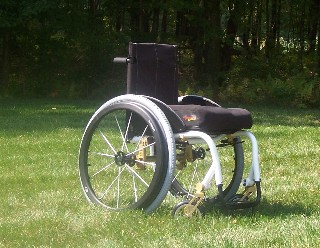
The saying that everything old becomes new again has never been truer than when it comes to today’s ultralight manual wheelchair market, where Rainer Kuschall’s decades-old monotube design is all the rage, with virtually all manual wheelchair manufacturers now offering monotube models. To use another cliché, one might say that the bandwagon is better late then never.

Nevertheless, even though it took 22 years for the monotube to catch on in the U.S., it’s done so for good reason: A monotube makes for a responsive but forgiving ride, in a lightweight, compact package, with a sleek, minimalistic aesthetic.

I’ve used a rigid frame style manual chair for the past two decades, with my most recent built 7 years ago. I’m no jock or super-para by any stretch. In fact, I’m a complete spazzo on wheels – which is all the more reason for me to use a rigid frame, as in for utmost durability and propulsion efficiencies, compensating for my spastic, tone-driven push strokes. So, with my company increasing its presence in the manual chair market, and my needing a new rigid, I was fortunate to be able to put together a frame set of my own this year – a monotube, no less – in time for flying to MedTrade and other upcoming travel.

My frame set aside, the choices that I made toward components – such as rear wheels and casters – are the most applicable topics of discussion, using aftermarket components that are widely available, ones that you might use on your own chair.

Weight is critical toward wheelchair propulsion, especially at the rear wheels. A heavier wheel simply requires more energy to accelerate and propel than a lighter wheel, so the lighter the rear wheels, the easier a manual wheelchair is to push. With this principal, I began with a Spinergy Spox LX rim, which is among the lightest rims available.

If I wished the absolute most efficient, lightest wheel configuration, I would have finished the Spinergy LX rim with an aluminum handrim and a 100psi clincher tire. However, being that I’m using the chair for travel in everyday enviroments, I chose to run a slightly heavier but more practical set-up.

For tires, I went with a 65 psi, 1-3/8” everyday tire. Everyday tires offer better terrain handling, hold optimally with brakes, offer increased puncture resistance, and better maintain air pressure than 100 psi clinchers. Unquestionably, 100 psi clincher tires are far more efficient on ideal, hard surfaces than 1-3/8” everyday tires; but for everyday use on unpredictable terrain, 1-3/8” everyday tires are a sound choice.

The handrims were another choice made out of practicality. I went with ergonomic handrims for better grip over standard tubular handrims. And, indeed, the ergonomic handrims allow a notably comfortable, efficient grip – even on my one hand that doesn’t have a much coordination – and they are tremendously more effective toward uphill pushing and downhill braking. As such, from an ergonomic viewpoint, they are fantastic. However, ergonomic handrims are much heavier than a standard aluminum handrim – about 1 lb. Per side – to the point where the wheel feels heavier. What’s more, because the weight of a handrim is spinning at the outermost portion of the wheel – the most consequential place to add weight to a manual wheelchair – the heavier rotational weight of the handrim surely detracts from performance. However, the question becomes, do the benefits of ergonomic handrims outweigh the drawbacks of extra weight?

In my use, absolutely – the increased propulsion efficiencies that I get from using ergonomic handrims is well worth the trade-off in weight. The ergonomic handrims simply allow me to propel the chair dramatically better (or, at least keep the darn thing rolling in a straight line, which is the best that I can hope for!).

On the front casters, I went big for a monotube with an 80-degree front frame bend, squeezing in 6”, soft-roll front casters. Again, on ideal, flat, hard, smooth surfaces, an 80mm or 4” caster would prove most responsive. However, in everyday use, on unpredictable surfaces, a big, 6” soft-roll makes for an easier, safer ride. And, they are totally smooth, void of chatter on rough surfaces, which is a nice difference from small, hard casters – the chair all but glides. Plus, the aluminum rims are always a classic cool look.

Another practical touch are my quick-release stroller handles, set behind the backrest. On the one hand, I need a low back height for self-propulsion, but then the push handles are too low for others to push me when needed. To address this, I added height-adjustable, quick-release stroller handles that are placed at the right location for a companion, without interferring with my my positioning.

Of course, even though we built my own chair, I wasn’t without fitting issues like many users, where my posture doesn’t like to conform to typical seating and angles – I’m not a sit-and-go kind of fit. As has always been the case, I build my seating as close to my needs as possible, then a lot of tweaking still has to occur with adjustments to angles, cushions, and straps. While I understand this involved process, my ever-teasing daughter viewed it a tad mored bluntly. While fitting myself at home in my new chair one evening, I explained to her that we had to take the chair back to my office for some changes to the backrest, as it wasn’t fitting my angles and posture quite right.

“So, the back is wrong?” she asked

“Yep – I need to make it fit my crazy posture better,” I said, transferring onto the couch, my daughter holding the chair.

“But, you’re the one who made it, right?” she asked.

“Yep,” I replied.

“If you made the back, and it’s wrong…” she said with a smile, “…then that means that you made you’re own chair wrong.”

“Exactly,” my wife chimed in from the kitchen, making my daughter laugh.

“Come here, shorty – let’s see how well you fit!” I said, grabbing my daughter, pulling her onto the couch, tickling her.

“I take it back, I tack it back! You are the WheelchairJunkie!” she exclaimed, laughing hysterically.

Indeed, monotube wheelchairs and kids are fun – and even more fun together.