The Ten-Percenters

marriage

By Mark E. Smith

Whenever I meet couples who’ve been married for several decades, I always ask them what’s their secret to a successful marriage?

“You need to weather the storms, the peaks and valleys,” they all essentially note. “You need to compromise and be willing to stick out the tough times. Love will pull you through.”

Interestingly, people always elude to how difficult marriage is, that to make it work, you have to be “too stubborn to quit,” as a gentleman told my fiancee and me on Valentine’s day.

However, while toughing out the bad times and being too stubborn to quit will keep any couple together, is that what anyone really wants in a marriage?

Out of every couple I’ve spoken with over the years, not one has ever told me that the success of their marriage has been due to mutual respect, unwavering trust, and sustained passion. No one’s ever said, “We constantly inspire each other….”

Respect, trust, passion, inspiration — why aren’t these the tenants of decades of a successful marriage? Why are couples accepting “toughing it out” as the key to marriage?

We live in a society with a fifty-one-percent divorce rate, and those who remain married are deemed successful. But, if your marriage is lacking respect, trust, passion, and inspiration, that’s not a success by any stretch.

Interestingly, if you look at the top reasons for divorce – communication breakdowns, infidelity, substance abuse, financial woes, lack of physical intimacy – they all go back to couples violating the four core values I note: respect, trust, passion and inspiration.

All of this leads me to a provocative question: where is accountability in relationships and marriages? There’s no magic to what makes a marriage a dream, a nightmare or a form of merely co-existing in-between: the two individuals’ behavior. Disrespect, infidelity or substance abuse don’t just randomly appear – pathology or not, someone makes the decision at some point to go down such paths. Again, marriages don’t mysteriously self-destruct – one or both partners pulls the pin, so to speak.

However, If you maintain respect, earn trust, fuel passion and foster inspiration, you’re guaranteed to live the most fulfilling life together. On the other hand, if you’re disrespectful, violate trust, defeat passion and uninspire each other, you’re doomed – either to a dissatisfying marriage or divorce. Go ahead and justify being in an unsatisfying marriage all one wishes – kids, money, being too stubborn to quit – but the goal should be living as a truly happy and passionate couple, not simply avoiding divorce. Again, there’s accountability where, as a couple from day one, over decades, you don’t justify or settle for poor behavior, but are dedicated to a lifetime of unwavering respect, trust, passion and inspiration.

Now, I may sound like an idealist, one who doesn’t know the challenges of marriage. To the contrary. I’ve known not only the challenges of marriage, but more so the opportunity within marriage to live to a higher standard. No, I haven’t been willing to accept disrespect, distrust, a lack of passion or inspiration. I’d rather be healthy and happy than in a dysfunctional, relationship. Yet, even more so, I’d rather share a life of respect, trust, passion and inspiration with my soul mate.

I know that some may see my relationship aspirations as unrealistic. I see them as accountable – and unquestionably possible. Of course, if everyone took my hard line toward love, that we shouldn’t compromise core healthy behavior and stay in dysfunctional relationships, the divorce rate might push 90%. But, the 10% of sustained marriages would be blissfully happy, living and loving with unwavering passion and ultimate security. I say, don’t settle, don’t compromise your marital happiness – and find yourself in the right relationship as a ten-percenter.
Pursuing Purpose

purpose

By Mark E. Smith

After talking with my vice president of human resources about the pros and cons of joining the enormous career social network site, LinkedIn, I built my profile, an online resume of sorts. In a mere two weeks, I accumulated over 450 “connections” with people I know from my career.

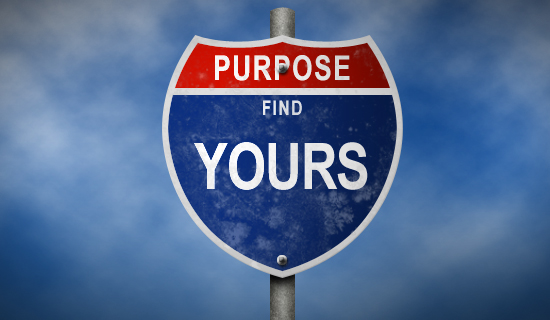
However, I’ve noticed an aspect missing from LinkedIn, the same aspect missed by most employers and employees in the hiring and career process. While LinkedIn is great at demonstrating what we do and what we’ve done, it’s not a vehicle that conveys why we do what we do – that is, it doesn’t convey the purpose in our lives.

Now, this isn’t a fault of LinkedIn, but a cultural one, where most career paths are more about literal job roles and salary than an individual’s purpose. And, that is a shame because when we don’t feel we’re living to our purpose – as in, I really want to be a photographer but I work in sales because it pays the bills – we lose a part of ourselves, including passion, in the processes. Yes, all of us need to make a living, but when we don’t feel purpose in our lives, it pulls us down, a sense of longing that we carry.

I’ve been very blessed to have career for which I feel purpose. My company manufactures mobility products, and the difference our products make in the lives of those we serve is profound – they allow individuals with severe disabilities to pursue education, career, family and community. On a daily basis I encounter harrowing stories of injury, illness and injustice, and to contribute solutions to individuals’ situations – as one with a severe disability, myself – it fills my life with purpose and passion.

In fact, I see so much purpose in what I do that I’m inspired to constantly spread that passion in my leadership roles. Every Monday at 4:30, I meet with our company’s new employees of all levels and talk about the purpose in what we do. “All of us need to make a living,” I say. “But, at our company, we’re also able to make a difference – that’s a remarkable opportunity in any career.”

Monthly, I also speak alongside our CEO at what we call our birthday lunch, where employees with birthdays in that month gather for a celebration and a company update. I speak to the vital role each employee serves, regardless of position, toward empowering our customers. After all, what’s more powerful than being reminded how you’ve positively impacted the lives of others – that’s purpose.

What’s intriguing to me, however, is when I read anonymous employee reviews online. I see disgruntled comments by our employees – as a large company, we get those – yet, even within the most disgruntled reviews, there’s almost always a positive mention of helping others. No, I don’t want anyone hating one’s boss or feeling underpaid, but the fact that one acknowledges seeing purpose in one’s job is a powerful sentiment.

At the other end of the spectrum, I also spend my days speaking with those who are unemployed. My peers with disabilities have a 75% unemployment rate based on remaining social barriers toward employment. Nevertheless, when I speak with my peers about their employment goals, it’s never about money or status. Rather, when I speak with my peers about their employment goals, they touch upon simply wishing to make a difference – that is, they want to live with a certain purpose.

Now, although purpose and career are a meaningful match – who doesn’t want to feel purpose in his or her work, right? – purpose extends much farther. I mean, the definition of purpose in our lives is that we feel that we have impact. For some, this may mean parenthood, while for others, it’s creating art or volunteering, and on and on. Purpose is what gives internal meaning to our lives. And, when we don’t feel purpose, we can feel a void and longing. So, how do we move beyond that void, into purpose?

A lot of times, it takes courage. My friend and colleague, Bryan, a triple amputee wounded Iraq veteran, shared with me that he felt so much purpose when on the road speaking, acting and volunteering. But, when he was home in Chicago, he felt a certain void, alone in his condo. However, he realized that much of the roles he loved serving – his purpose – were based in Los Angeles. So, Bryan took a leap of faith, packed up, and moved to L.A. His life and career have never been better, where he’s now able to constantly pursue his passions, right down to appearing in the current blockbuster movie, American Sniper.

As we think about our purpose in life, the question is, what do we feel truly fulfilled doing? Then, we must have the courage to live to that purpose. For me, I believed 14 years ago that my purpose was in serving my peers with mobility needs, so I moved across the country to join a small team to start a division of a parent company that subsequently grew into an industry-leading company in its own right. For Charles Bukowski, he worked at the Los Angeles post office as a filling clerk while going home at night to follow his purpose, poetry, going on to be a 20th-Century great, publishing thousands of poems and over 60 books. All of our purposes are different, but the way we achieve them is the same: in our hearts, we all know what ours is – we just need the courage to live it.

When We’re De-Elevated

1422565061579

Ny Mark E. Smith

It happened in an instant. In fact, as one who doesn’t experience anxiety and is pretty calm in virtually any situation, I began to panic. There’s a horrifyingly surreal quality to suddenly becoming invisible.

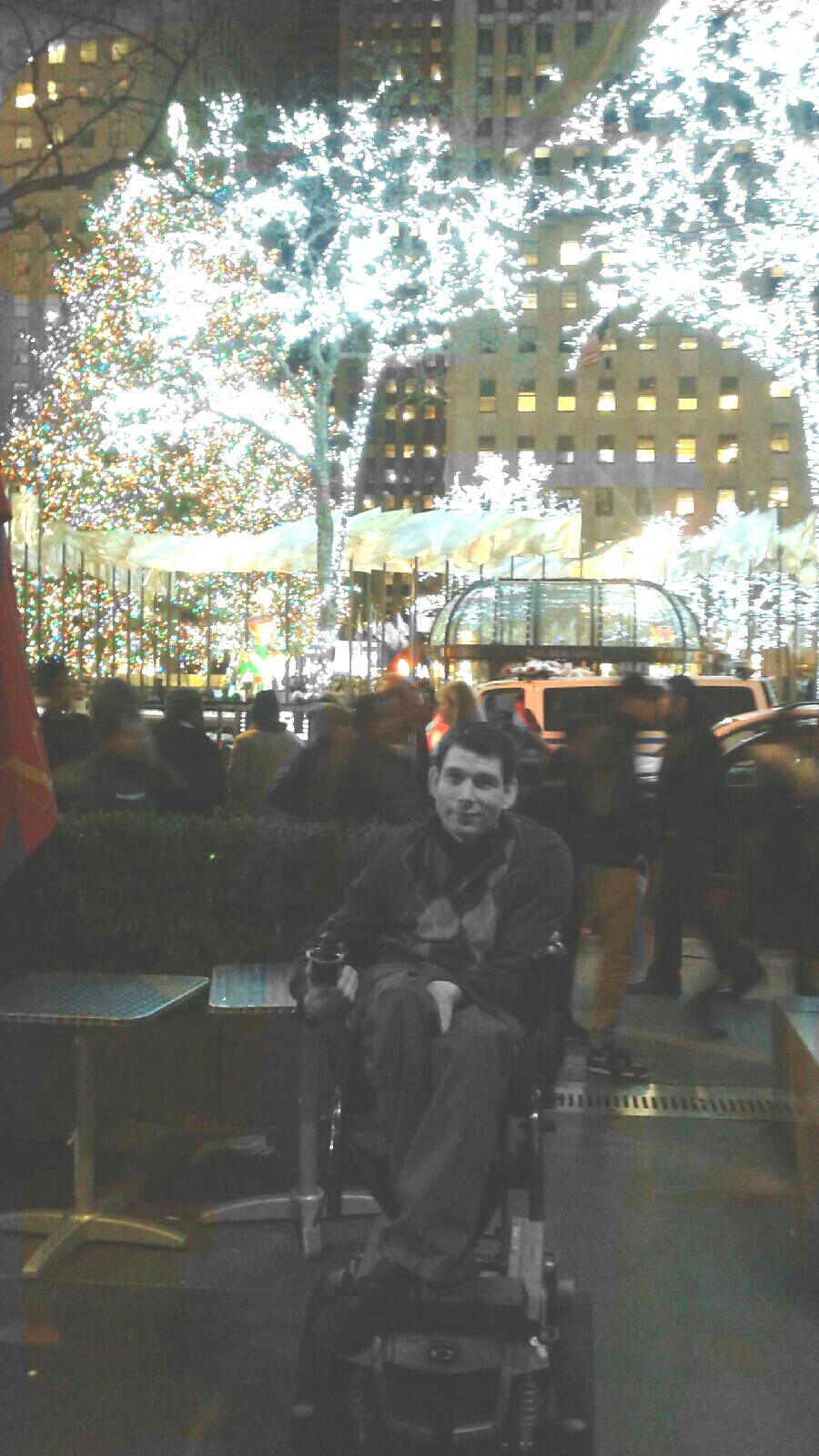
My family and I went to see the famed Rockefeller Christmas tree, and it was more crowded than anywhere I’ve ever been. However, because my power wheelchair has an elevating seat that places me at 5’7” tall, I worked my way through the crowd slowly but surely, eye-to-eye with those moving about, where people smiled at me, gingerly moving aside as needed for my 24”-wide power wheelchair to pass.

As we got closer to the tree, the crowd became so dense that I couldn’t see the ground, merely following the heads in front of me. Then, suddenly, my power wheelchair dropped down a medium-height curb leading to the tree. Although the unexpected curb startled me, all was fine and we continued to the tree, shoulder-to-shoulder in the crowd, finishing with a classic family photo of the tree behind us.

We worked our way back through the crowd, and I watched carefully for the curb, knowing that while I couldn’t climb it while elevated, I could lower my seat to standard wheelchair height and safely drive up it. As I reached the curb, the crowd continued flowing around me – that is, until I lowered my seat. Suddenly, at typical wheelchair height, my world changed. It was literally darker, more confined and, most shocking to me, I became invisible. While the crowd was moments earlier around me at standing height, now people were slamming into me, falling on me, oblivious to the fact that I was “down there.” I’d gone from a person in the crowd to suddenly invisible and of no stature simply by lowering my seat.

I yelled to my fiancee for some sort of help and in a panic, I charged the curb, clipping people along the way. For me, in among the rarest moments I’ve experienced, it felt like it was life or death – I was both fighting and fleeing.

Once up the curb, I quickly elevated my seat, and as people immediately began safely flowing back around me, I took a deep breath, composed myself, and realized a universal truth: Being invisible to society is terrifying.

For me, that was an experience I’ve culturally known in other ways as a man with a disability. Beyond the change in physical stature I described with my elevating seat, I’ve more readily been de-elevated in social stature at times. However, the de-elevation of who we are – where we become invisible in an instant based on ignorance, stereotyping and discrimination – is a disturbingly universal one.

Imagine how it feels as an African-American trying to hail a cab in a big city, and empty cabs pass you by. Imagine being gay at a dinner party where rhetoric arises, condemning homosexuality. Imagine being a woman shopping for a car, and the salesman only speaks to your husband. Imagine walking into a clothing store as one of a plus size, and the sales people ignore you. Imagine being in bed with your spouse, and he or she turns his or her back to you as you’re trying to communicate. Or, imagine being homeless on a Los Angeles sidewalk, and no one even looks at you as they pass. So many of us can relate with being de-elevated to invisible.

Yes, I was fortunate amidst the crowd at Rockefeller Center that eve because, at the touch of a button, I elevated back to being seen. However, life for many – including me as one with a disability – often isn’t so easily resolved. When we’re dismissed by others and made to feel invisible, there is no button to push. Rather, the experience of being made invisible based not on our character, but based on the ignorance, stereotyping and discrimination of others… well… just hurts.

Barbershop

BARBERSHOP

By Mark E. Smith

No, I wasn’t surprised, but it hasn’t happened to me in so long. Over my 44 years, I’ve seen so much progress toward social acceptance of all, that I simply don’t encounter such situations often anymore.

However, while society at large has changed – where diversity on all levels continues becoming the norm to the point that even using the word is becoming less relevant – some individuals don’t change. And, where I see this lack of change the most is as a generation gap.

So, when the 70-ish woman at the salon refused to cut my hair this past week due to my wheelchair and cerebral palsy, I wasn’t surprised. After all, she was raised in a time when those with disabilities were “cripples,” African-Americans were “negros,” and being openly gay didn’t exist. Yes, we hope that most evolve with the times, but we also know that limited life experiences can keep us from growing, it can keep prejudices ingrained in us. And, for this woman, I understood that disability – not me as an individual – was too much for her to process. In fact, I felt for her because she was beyond flustered while I was fine with the situation. I just wanted a haircut, not to judge her beliefs.

Of course, the salon manager, Andy, jumped in, cutting my hair – because that’s how we accept each other in society today, open, embracing, with grace and dignity, no matter who you are.

I left the salon with a haircut and a reminder that the beauty of practicing acceptance sometimes means likewise embracing those who don’t accept us at all.

Pitch 15

elcapitan

By Mark E. Smith

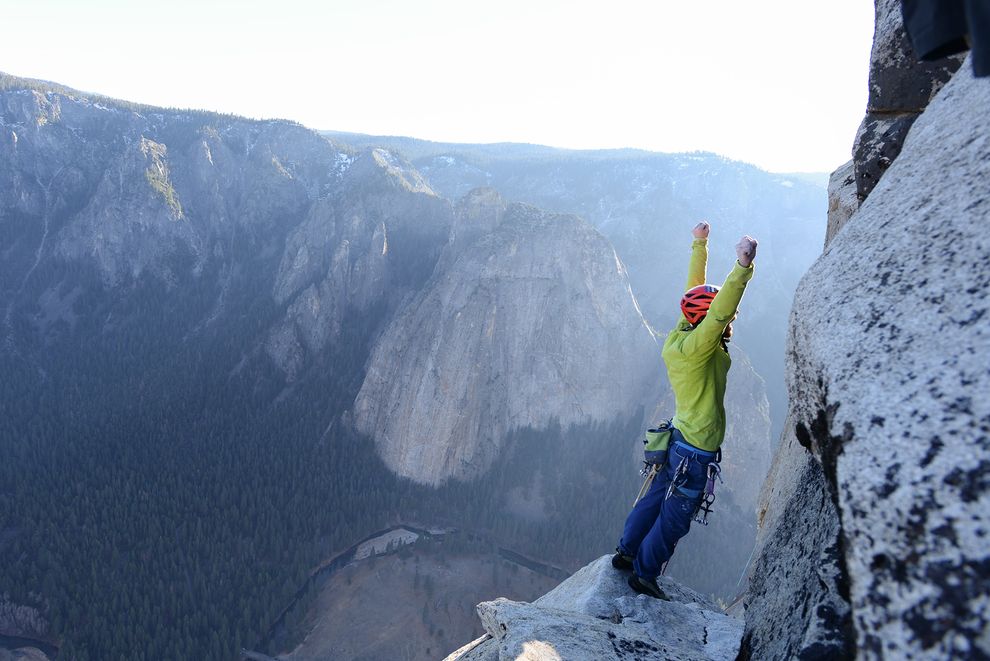
Kevin Jorgeson and Tommy Caldwell recently became the first rock climbers to “free climb” Yosemite’s mammoth 3,000-foot granite face, El Capitan. For the climbing community and public, what made the climb a record was the fact that the duo didn’t use any climbing aids – just bare hands griping crevices and climbing shoes pressed on the rock face.

However, the free climb wasn’t what impressed me. Rather, it was a story within the successful climb.

See, on day 8, on Pitch 15, one of the toughest stages, Caldwell zipped right up it. But, Jorgeson failed. In fact, he failed over a dozen more times, adding 7 days to the climb. Imagine the scene. Caldwell perched slightly above the pitch, watching his partner fail over and over, day after day. And, Jorgeson consistently failing to the point where he should have thrown in the towel. It looked to both men and the world watching that it was an impossible feat for Jorgeson.

Yet, despite exhaustion and escalating self doubt, Jorgeson finally conquered Pitch 15 after 7 days of trying. When asked what pulled him through, he replied, “Resolve. I didn’t see any other outcome but to make it….”

We all encounter Pitch 15s in our own lives, those times when we don’t think we can go on, those times where success seems impossible, adversity too looming. I’ve been there regarding living with disability many times. And, what I’ve learned, much like Jorgeson, is this: we can either concede and quit, or we can muster resolve and determination, where ultimate failure isn’t an option. We know the outcome of conceding and quitting – dreams dashed, an important part of our potential never realized. Yet, when we persevere through the seeming impossible, the results are astounding – we succeed.

Jorgeson’s dilemma on Pitch 15 was a unique one in physicality. After all, he’s among the first to free climb El Capitan. However, emotionally and mentally, his plight was universal – keep trying, against all odds, until you make it. Maybe you’re currently struggling in a college class or with sobriety or in a relationship or in your career. Again, you can always just quit tackling any adversity at any time – and if it’s obviously tough, no one will fault you.

Yet, here’s the universal truth when you have the courage not to quit: if you’re brave enough to tackle adversity, you’re brave enough to overcome it and succeed.

When Endings Aren’t

brettwalk

By Mark E. Smith

Endings. Where does one begin? Yes, that’s a haunting double entendre because the question is just that: Where do endings begin and where do we begin with endings?

Over the holidays, I was at my friend, Brett’s, house visiting his parents. I haven’t been there since he passed away last year of multiple sclerosis. I think I assumed Brett’s absence would be clear because, after all, he’s passed on. Yet, as I strolled along the sidewalk leading to his house, I looked up to his bedroom window – the room centered around a hospital bed, computer desk, his artwork and assorted eccentric collectibles – and I felt he was there. I realized in that moment that the end of Brett’s life that I’d assumed at his funeral, wasn’t. What, then, had changed with Brett’s passing?

Upon entering the house, I saw pictures of Brett in his trademark professorial glasses, and his artwork, and his room. We all ordered Chinese food just as before, and Brett constantly came into the conversation. Where was the end, the part where Brett was gone forever?

Brett wasn’t gone. He was there with us in very real ways. No, his mother can never hug him again – and I don’t know how a mother deals with that kind of pain – but I realized that evening that Brett will always be present with all of us who knew and loved him.

When it comes to life and death, where are the endings? Of course, we all know that there are no real endings, not even with one’s passing – it all carries on with us. Life is a journey and although the path may change, the experiences, memories, the impacts made on us never end – they merely evolve as our path continues.

From Cerebral Palsy to Quaaludes

Matt Fraser
Matt Fraser

By Mark E. Smith

Matt Fraser isn’t afraid to be nude. He also isn’t afraid to appear on stage at venues ranging from off-Broadway plays to movies to television shows, including this season’s smash hit, American Horror Story: Freak Show. And, his fearlessness doesn’t end there. Matt is a Black Belt, a forever-charming ladies man and even a BBC radio show host.

However, here’s the single most important aspect to the success in Matt’s life: Matt Fraser isn’t afraid to be Matt Fraser. He presents himself with authenticity and doesn’t give us any other choice. We either accept Matt for who he is – disability and all – or move on.

How many of us struggle or have struggled with being who we are? Maybe as children we behaved a certain way to please our parents that wasn’t authentic to our identity. Maybe in high school, we caved to peer pressure, not feeling safe to truly express ourselves. Maybe in our careers, we squelch our personalities to fit a corporate norm. And, how many of us have curbed our behaviors, feelings and wishes to please a partner? Indeed, we’ve all been there. Yet, here’s my question for you: Have any of these scenarios worked for you in the long term?

Of course not. It’s never worked for you or me because whenever we’re not 100% authentic, parts of us feel inadequate, denied, undesired, squelched – and that’s painful. However, if you want to avoid such a terrible fate, just be yourself! It will feel risky and scary at first, but soon it will feel liberating, the freest you’ve ever felt. Now, some in your life won’t be able to handle the real you because they’re used to a watered-down, squelched version. But, your world as a whole will feel anew, fresh air filling your lungs as never before.

I remember being in my 20s and very self-aware. I watched carefully what I said to whom, and although I often had zany, witty thoughts pop into my head, I rarely uttered them, fearing I’d sound uncouth. My brother, on the other hand, who shared my wit, said anything to anyone, and I observed how charmed others were by his authenticity. With my brother as an inspiration, I slowly let my authentic voice come out – I’d say exactly what I wished on stage and in witting – and that’s when my career took off in every direction. It was time for me to be… well… me.

Some two decades later, being Mark E. Smith is a blast. I mean, if you’re an adult and ask me, “What happened to you,” I’m not going to give you a politically-correct answer about cerebral palsy as I would have in my 20s. Rather, if you’re an adult ignorant enough to ask me that question at an airport or such, I’m going to be me and you’re getting a one word answer: Quaaludes!

Each of us were born to be who we are, and assuming we’re healthy individuals, we owe it to ourselves and those around us to simply be who we are. Society, partners, and you name it may try to squelch who you are. But, your obligation is to be a Matt Fraser and live your life beautifully, exactly who you are, never compromising your authenticity – and the world will embrace you.

Grinnin’ In Your Face

Son House
Son House

By Mark E. Smith

When I attended San Francisco State University’s creative writing program, we were allowed to focus on the genre of our choice. My peers mostly focused on poetry, fiction or full-length feature writing. I was the only one in my class, however, who focused almost exclusively on the short-short story, a genre others found too difficult because of its inherent limitations. Whether writing autobiography or fiction, I loved the constraint of having to tell a story – convey a profound message – in 1,000 words or less (that’s no more than two typed pages). The constraints of the short-short form, I found, made me maximize what I had, it made me more creative because I had to learn ways to do more with less.

Of course, looking back, I simply grabbed onto what I knew based on growing up with disability – that is, I was really good at taking limitations and using them to utmost potentials. Constraints, you see, don’t box us in; rather, they challenge us to find innovative solutions to work with what we have. I’ve never found that ease or excess bring out our full potential. However, constraints and limitations do. I know that it sounds counter-intuitive, but if you want to grow, work within limitations.

The way I learned really quickly how to manage money was by being broke. Again, I know that sounds counter-intuitive – how do you manage money that you don’t have? – but what being broke is really about is expertly managing the money that you do have. It goes right back to disability experience, doesn’t it? I focus on what I have, not what I lack.

I was grocery shopping with my daughter recently and we encountered a sort of mirror image of us at the grocery store – a presumed single father and two daughters. In his hand, he had a grocery list and a calculator, adding up the cost of items as he went. It was a familiar sight because I’ve done that. When you have financial constraints, you find ways to do more with less. In that moment, that gentleman was a financial wizard compared to many with far more money because each of his dollars was wisely watched and allocated. Attentiveness and creativity filled his cart beyond financial limitations. Again, limitations bring out the best in us.

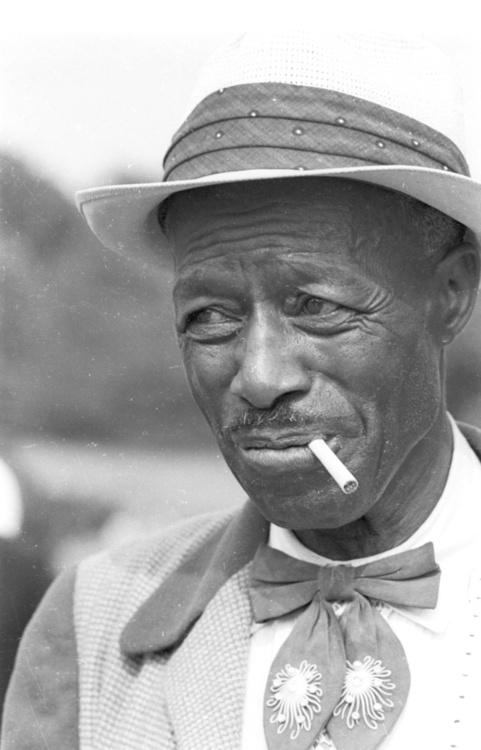
One of the greatest blues songs of all time is the mid 20th-century, “Grinnin’ in Your Face,” by Son House. In conceiving and performing the song, House had the ultimate constraints: no instruments and no formal musical training. How do you make an iconic song with none of that? Yet, by working around those constraints, he created a soul-penetrating song using just his voice and clapping, setting time to what sounded great to him. House found the ultimate instrument within the ultimate limitation: he used his voice and hands. Contemporary musician, Jack White, noted about House’s classic piece, “I didn’t know you could do that, just singing and clapping. It said everything about rock ‘n’ roll, expression, creativity, art – one man against the world.”

If we look at ourselves as writers, single parents, musicians, those with disabilities, and on and on, it’s amazing what we can do within constraints grinnin’ in our face. What’s fascinating is that constraints don’t limit us; rather, they inspire creativity, help us find better ways, and ultimately foster personal growth. However, what living with limitations truly does is empower us to realize that we don’t have limitations after all.

Prize Fighting

boxing

Mark E. Smith

As I lie on my bed in the surrounding silence, I should be angry, frustrated, maybe even panicked. I just literally beat the hell out of myself – scraped, bruised, exhausted – in three failed attempts to simply use the commode.

See, as one with cerebral palsy, in order to use the commode, I have to go from my power chair to my bed to my manual chair to the bathroom to the commode, keeping my balance on the commode, then back to my manual chair to my bed to my power chair. On my best days, it takes 20 minutes; on an average day, 40 minutes; and, on this day, after one and a half hours, I’ve not accomplished getting on the commode. I’ve tried three times, my uncooperative body struggling with every transfer, slamming me off of the commode, against walls, on the floor over and over.

Yet, as I lie here on my bed, I’m not angry, frustrated or panicked. While physically I’m uncomfortable, to say the least, I’m genuinely happy, full of gratitude. As poorly-functioning as this body is, it always gets me through. It’s the body of a prize fighter. It can get knocked down, bloodied, counted out by others, but it never quits and always gets back up.

For the moment, like a jaw-stung boxer dizzied on the canvas, I lie here with all things good streaming across my closed eyes. I think about the upcoming Christmas holiday – I’ve done no shopping yet, but I’m excited to give very meaningful gifts from a list I’ve been covertly gathering from those I love. I think about my daughter’s pending college applications to NYU and Cornell and the University of Pittsburgh, pondering if any of those are better choices than her seeded spot at George Mason University in the Washington D.C. area? I think about having my fiancee and soon-to-be step daughter back from their native west coast in about a week, joyed to be spending another holiday season together as a family on the appropriately wintry east coast. And, I think of the myriad of exciting aspects going on with my career. There’s so much gratitude in my life that I’m even thankful for the predicament I’m in – that is, having to simply use the bathroom, but knocking the hell out of myself in the process, seemingly unable to accomplish such an everyday task.

But, prize fighters never stay down long, and I’m about to sit up, struggle to transfer back into my manual chair, make my way to the bathroom and try to make the small but courageous leap from my manual chair to the commode once again. If I make it this time, fantastic. If my body fails to cooperate further, and I crash from wall to wall to the floor, having to start all over again, that’s great, too.

See, here’s the beauty of adversity: it’s not an easy route to success, but it is a proven route to success. Adversity makes us that promise – that is, as long as we’re willing to embrace it and address with gratitude and perseverance toward whatever it throws our way, we will ultimately achieve victory.

In this way, I’ve only gone three rounds – and I’ve got a lot more in me. Ring the bell. I’m ready.

Curveball King

The pitch

By Mark E. Smith

As a writer, I can tell you that life is a story that unfolds page-by-page as we live it. Some of it we can predict and when we get to those particular pages in life, those where our intuition is right. However, most aspects of life are totally unpredictable, and much like a novel that we can’t set down, each page brings twists and turns that leave us only wondering what will happen next?

As a person, much like a voracious reader, I learned to stop trying to predict life, to guess or try to control what comes next. Why? Because like a page-turner of a novel, we can rarely guess what comes next. Think about your own life. Go back 10 years. Could you have predicted the twists and turns – the unforeseen plots – that got you to where you are today? Certainly not.

Yet, it’s human nature to want to know how’s it all going to unfold? People may give you answers, from friends giving you comforting thoughts to medical professionals giving absolute diagnosis. However, no one truly knows. The couple who everyone proclaimed would be together forever ends up in a bitter divorce, while the individual with a grim medical prognosis goes on to a inexplicable cure. We’ve all seen these plot twists, the unpredictable nature of life. Therefore, if you try to predict life over the long term, you’re likely going to be both disheartened and surprised much of the time based on any given circumstance.

So, if it’s so difficult to predict life, how do we handle the twists and turns, the unknowns that are bound to come our way? To use a sports analogy that’s fitting, life throws us two pitches: a predictable fastball and an unpredictable curveball. But, here’s what’s astounding, in baseball and life: researches found that when batters hit a curveball, they’re more likely to hit a home run (it has to do with the spin of the ball, the way it deflects from the bat, and so on). Therefore, both our biggest disappointments and successes in life often come from the unforeseen, an unpredictable curveball that can either strike us out or bring us amazing opportunity. Yet, again, one can’t predict the outcome, but merely take each ball – life’s twists and turns, that is – as it comes.

What I’ve learned is to not try to predict or question the future, but to embrace whatever it brings. Whether life sends me a predictable fastball or unpredictable curveball, I accept them equally and take my best swing. Life is a novel – a baseball novel – and I’m forever excited to see how the plot unfolds as my protagonist strives to be the Curveball King.