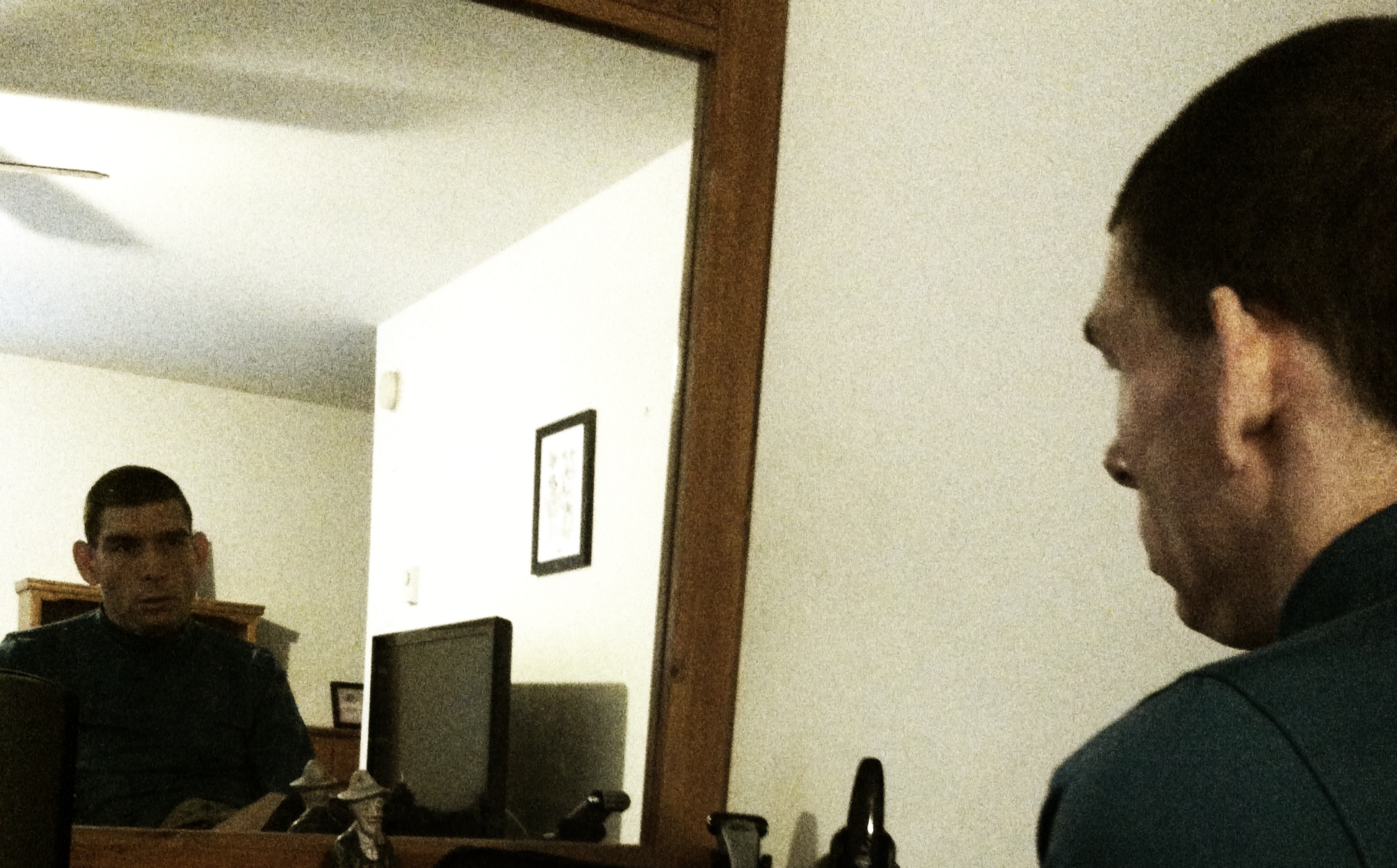
Play In Pain

By Mark E. Smith

At this writing, hurricane Sandy is bearing down on us, and it looks like I have to ride home in my power wheelchair in rain and 40mph winds. And, I’m totally fine with that – no big deal. Now, I have other options, but they seem illogical to me. I have over 400 hours of accumulated time off, so I could have stayed home, or even worked from home. Or, I could call someone to bring my van and pick me up. But, why would I do either of those? Schools are closed, and people are hunkering down with storm supplies, but a little discomfort – or, a lot – never persuaded me to stop from doing what’s best for me and those who count on me, like my going to work like any other day, regardless of a supposed looming hurricane.

We live in culture where too many people seem to resist “playing in pain,” sidelining themselves from the game of life, albeit due to emotional, physical, or mental challenges. It’s as if why try when you can just give up? There’s a storm brewing, so let’s cancel school. I’m sick, so I’m not going to work. My boyfriend broke up with me, so I’m going to sleep all weekend. I lost my job, so I’m just going to sit around the house….

No, just because bad things happen doesn’t mean that we throw in the towel, give up on ourselves, make excuses, or stop our lives. Rather, in times of adversity, we should pick up the pace. They make rain gear to weather storms, and when storms hit our own lives, you might say that rather than run and hide, we should don our rain gear – that is, our inner-strength – and head into the storm, head on. After all, weathering storms is how we grow and become stronger.

The next time you find yourself with the two options of adversity – to play in pain with pride, or seat yourself on the sidelines of life with pity – don your rain gear and head into the storm, with courage and tenacity. Choose to “play in pain,” and you will come out stronger.

That Thing Called Integrity

By Mark E. Smith

I did an interview recently, and both the interviewer and my public relations manager both expressed that if any of the questions were too personal, I should feel free to not answer them. And, so I tried to figure out what would be too personal for me to publicly address?

And, I couldn’t come up with what would be too personal for me to publicly answer, especially because the interview was for a mobility industry publication. I mean, it’s not like they’d ever ask if I’ve had sex in my wheelchair, right? But, if they did, I’d pull a Bill Clinton, and ask for a clarification of terms – and then reply with a resounding, Yes, and then share every sordid detail of each encounter that I could squeeze in before my publicist wisely censored me. …So, I was 20, and in the all-girls dorm at Santa Clara University one night, dating this really hot Psych major….

But, alas, to me at least, the questions were strikingly normal – just questions about growing up with my disability. And, then it hit me: I suppose some people do view speaking of their disabilities as too personal to discuss in public. But, not me, and as I got into the interview questions, I had no qualms about answering them, to an as-honestly-personal level as I could.

See, I know that everyone has differing levels of comfort and privacy. But, if you’re going to put yourself out there, don’t hold back. And, I believe that if someone – or, a readership – is candid enough to ask you a question, you owe it to them and yourself to give a completely candid answer, even when a lump develops in your throat and you have to say what you’re going to say in one breath or the tears will start flowing. After all, if you’re not going to expose yourself completely – your heart and soul, fear and shame – you’re lying to everyone, including yourself. It all comes down to a greatly underestimated trait called integrity.

So, I worked my way through the questions with what I learned about Gandhi. He never planned a speech. What he said, felt, and did were so congruent that he spoke solely from intuition and heart. To each question, I just strove to give an authentic answer.

The interview went great, and not thinking much about it, I left the transcript on my kitchen table. My daughter and sister were hanging out that eve, and began reading through it, par for the course, till they got to one specific question and answer:

What do you know now that you wish you knew then?
That I am worthy of love. I mean, I still struggle with it, but not nearly as much as I did in my teens and twenties. My father, till the day he died, expressed shame toward my disability, and my mother always blamed my disability for their divorce (which occurred when I was a toddler). My mother was also a life-long substance abuser and experienced mental illness, so I took the brunt of that chaos, much of which she blamed on my having a disability, as well. So, when you add that into the normal teen equation of wanting to fit in – but not fitting in due to disability – it was hard for me to look at myself in the mirror at, say, 17. Based on a lot of work on personal growth, and raising my daughter, I’ve come a long way toward truly feeling worthy of love – but, admittedly, I still struggle with it at times.

“Wow, that’s really brave of you to publicly share,” my sister said.

“It’s not brave at all,” I said. “It’s just being honest.”

Just Jump!

By Mark E. Smith

OK, I know what you’re thinking: Mark’s back in Vegas again? Publicly, I guess it does seem like I’m in Vegas a lot, but really it’s only a few weekends per year. …OK, so, yes, I’m in Vegas again – but I love this place! And, this time is different, namely because I’m with my girlfriend and our two daughters – sort of like the Brady Bunch, minus four kids, Alice, Sam the Butcher, and Cousin Oliver. But, really, we’re in Vegas for a three-day weekend on a much more serious note: Personal growth as individuals and as a group.

Our daughters are moving toward 14 and 16, mine being the older. It’s a pivotal time in their lives, where we want them to be empowered, to know their amazing potentials as strong, poised, confident young ladies. In this messed-up culture that sends airbrushed, cosmetically-enhanced messages that no woman is ever good enough, we say, nonsense – every woman is more than enough, perfect as-is, capable of whatever she dreams. And, this is why we’re in Vegas, encouraging our daughters to step of the 108th floor of the Stratosphere, plummeting 855 feet to the ground.

…Well, maybe I should clarify the jumping off of the building part. See, the Stratosphere, on the outreach of the Vegas strip, is a replica of Seattle’s Space Needle. The only real difference is that if you jump off the Space Needle, you die; whereas, with the Stratosphere, you’re perched on a ledge, wearing a harness, and as you leap, control cables guide you safely to the ground, slowing you to your feet at the end. Yet, despite the safety factors, stepping off of that ledge on the 108th floor, 855 feet off of the ground, and virtually free falling, takes a huge amount of courage and confidence. And, I explain this to our girls at dinner the night before:

At points in our lives, we each find ourselves perched on a ledge. If we have the courage to jump – maybe it’s a career step, or starting or ending a relationship, or any aspect of life that requires us to stretch our comfort zone – we grow. However, if we don’t have the courage to make those leaps, our lives stagnate, we go nowhere. Both of you girls are doing an amazing job in school, with huge life potential ahead of you. But, you’ll need to take leaps of courage along the way to do it. Let the literal Stratosphere SkyJump be a lesson in life, where you’ll carry it with you, knowing that you have the courage and strength to take big leaps in life whenever needed….

After the jump, I tell the girls how proud of them I am, and they share how the scariest part was preparing for the jump, that once they summoned the courage to step off of the ledge, the liberation of flying through the air was amazing.

Really, for all us, no matter our backgrounds or challenges, there’s a lesson to be learned here, isn’t there? Success in all areas of life is all but guaranteed, as long as we have the courage to take initial leaps out of our comfort zones. A lot of times challenges are easy, but stepping off of the ledge, into a seemingly new territory is the hard part. Yet, when we summon the courage to simply step off of the ledge, our lives always move to the next level. As I told the girls, just jump!

Raising Expectations

By Mark E. Smith

At this writing, my daughter is in her first week of the 10th grade. It’s unquestionably the most pivotal point in her academic career – and, make no mistake, the expectations are set high.

See, the 10th grade is where colleges begin looking at grade-point averages, curriculum, and extra-curricular activities toward college admissions – and, again, make no mistake, their expectations are set high, where they want the best of the best.

However, it’s really not the universities’ expectations that matter; rather, it’s my daughter’s expectations that matter. My daughter’s self-expectations will determine how well her school year – and ultimately all of high school – goes toward college admissions. So, wisely, she has set her expectations high, too. Her grade-point average can’t be below 3.8 and, ideally, should be a perfect 4.0 or higher (honors classes can increase it). Her expectations aren’t to cruise through high school with no forethought, but to expect nothing less than to remain at the top of her class.

Yet, here’s what’s interesting about my daughter: She’s not an intellectual genius or such – just a regular 15-year-old who happens to know that whatever expectations she sets create her success.

It’s truly a lesson for all of us: What we expect is typically what we achieve. Set low expectations for yourself, and you’ll receive dismal results. Set high expectations for yourself and you’ll achieve amazing results. My great-grandmother always said, “It’s just as easy to love a good man as it is a bad man, so why not love a good man?” Really, she was hitting at the heart of self-expectation – what you pursue is what you get, so pursue the best.

In the disability realm, I can tell you for a fact that self-expectations play the single largest role toward successful living. I’ve known those with the severest of disabilities, and those with minor disabilities – and while physicality should dictate that those with more severe disabilities should have a tougher plight, that those with minor disabilities should be more successful, it simply doesn’t prove true. We see some with minor disabilities wallowing in life, while those with sever disabilities achieve amazing success. It becomes evident, then, that the single key factor between success and failure is self-expectation. If one with a minor disability believes one’s life is over, it is – low self-expectation achieve low results. However, if one with high self-expectations believes one can accomplish anything, one can – again, high self-expectations accomplish high results.

The key, then, is for all of us to look at each aspect of our lives, and ask ourselves the vital question of, Am I setting my expectations high enough? I mean, Am I pursuing the career I’m capable of; am I pursuing the relationships I’m worth of; am I being the best parent that I can be? Most importantly, Am I setting my expectations high enough in all aspects of my life to achieve the high results I’m worthy of and that those around me deserve?

Of course, increasing our self-expectations can be scary at first. If we expect little, then there’s no risk of disappointment, right? Going back to my daughter, if she had low expectations toward her grades, a D wouldn’t matter. However, because her expectations are to achieve a 3.8 grade-point average or better, a D would be devastating. But, setting low expectations to avoid feelings of failure is flawed logic. Sure, if you have low expectations, you’re less likely to be disappointed by any failure; yet, that’s only because you’re setting yourself up for failure! Setting high self-expectations may seem like a risk for failure – and it sometimes can be in the short term – but in the long term, it’s the only true guarantee for success. Again, what we expect plays a key role in what we achieve, so simply raising our self-expectations – and putting effort toward it, of course – will bring success. Put simply, there’s nothing but risk in low expectations, as we will fail; however, there’s virtually no risk in high expectations because it ensures success at some level.

Let us each raise our self-expectations in all aspects of our lives, and live to those standards. Why? Because we’re each worth it.

Living as Josh Does

By Mark E. Smith

Twenty-one-year-old Josh has been an increasingly remarkable spirit in my life since I met him four years ago. I’ve never known a young person with such wisdom and insight, making our recent conversation par for the course based on Josh’s amazing character.

Josh was diagnosed in his adolescence with a very progressive form of muscular dystrophy. However, unlike many others with his prognosis, the disease didn’t progress as rapidly as usual – that is until approximately two years ago. In fact, when I first met Josh, he was still walking, using a mobility scooter for longer distances. Yet, in the last two years, the disease caught up with him, dramatically diminishing muscle tone. I’ve seen Josh go from drinking from a soda can normally, to struggling to lift it with two hands; and, I’ve seen Josh go from walking to not being able to transfer himself from a power wheelchair.

Make no mistake, the physical realities of Josh’s condition are disheartening. But, the lessons learned and the personal growth that’s resulted from his challenges have been inspiring, teaching us both invaluable lessons along the way.

Josh and I have traveled a lot together, working trade shows, summer camps, and advocacy events. We’ve lobbied the halls of Capitol Hill, and rock-starred it in Los Angeles. However, the heart of our friendship has been formed from our weekly phone calls, where every Thursday, Josh and I talk on the phone, tossing around subjects ranging from relationships to dealing with disability to music. My role is supposed to be that of mentor, but Josh has so much wisdom and is so reflective of the struggles and victories that we all face, that I often think I learn more from him than he does from me.

One of Josh’s recent victories – and a process that we talked about for many months – was his driving independently via an accessible van. After a year and a $120,000 in technology, Josh now independently drives a van with ultra-high-end hand controls that are closer to resembling those that control an airplane more so than a car. And, for his first long-distance drive this summer, he drove 3-1/2 hours to vacation at a lake where he vacationed often as a child.

When we spoke the week after his vacation, he explained to me that the trip was ultimately a realization for him: Most of the activities that he could do as a teen – boating, fishing, and so on – were no longer feasible or easily accomplished, that he realized in very real terms the progression of his condition.

I, of course, asked how he felt about his sudden realization of the progression of his condition? And, his answer was a lesson for all of us. Josh explained that what realizing how much his condition has progressed made him intimately understand is the importance of making the most of today because we don’t know what tomorrow brings.

I couldn’t have been prouder of Josh’s insight because it demonstrated a perspective that we should all live by: Being bitter or regretful of our pasts – or of what’s seemingly been lost – is pointless. Valuing our present – no matter the circumstances – is truly what it’s about.

Moving well beyond disability, think about how many of us dwell on past relationships, childhood trauma, lost jobs – you name it – where rather than accepting, healing, and evolving to live fully in the present, we just get stuck in the past. Josh could have likewise gotten caught in the past, returning home bitter as to what his condition has done. Instead, he recognized the past as just that – gone, done, over – and was even more inspired to appreciate whatever abilities that he has today. It’s kind of like rather than dwelling on how bad your past relationship was, you focus on how great the current one is – that’s how you move forward.

And, if there’s a single lesson that Josh teaches us, it’s to live in the present, simply appreciating all that we have today.

Consider the Source

By Mark E. Smith

Have you ever noticed how quick others are to make negative, diminishing comments as to your value as a person, from little snipes to direct put-downs? Often those closest to us are the worst offenders, using words to painfully try to degrade us. I remember as a very young child, my father constantly implying that I would never amount to anything due to my disability, and as much as the sting of that stays with me till this day, from as young as I can recall, I somehow had the insight to know that he was among the least qualified men on Earth to assess my “value.” The reality was, he was an unemployed alcoholic, who went on to be the poster boy for deadbeat dads – not exactly someone who should have been throwing stones in his glass house. If I could have expressed it at that young age, I would have gladly said, Remind me again how that beer can in your hand qualifies you as ultimate judge of my potential? You might say that I learned to “consider the source” at a very young age as to others’ assessments of me.

Of course, my father was no exception. It’s downright alarming how quick many are to strive to diminish others’ “value,” and it’s even more alarming how readily many take it to heart, feeling lesser because of what others have said. …Don’t be silly, you’ll never accomplish that. …Why would anyone ever love someone like you? …You’ll never amount to anything… I mean, I’m keeping my examples here tame compared to how vicious some can be – words from others that sting, scar, and damage. Think about how many children have had their dreams crushed, or how many spouses have had their self-worth shattered, by so-called loved ones diminishing their value with spiteful, hurtful, abusive words. Maybe you, too, have been there?

However, here’s what’s ironic about those who strive to diminish your value: They are not just morally wrong, they’re factually wrong. Assuming you’re living an integrity-based life, no one ever has a right to assess your value as a person – not your parents, not your significant other, not your friends, no one. While none of us are perfect – we all can always grow and improve – you are intrinsically “enough,” where you deserve to be embraced, wholly, as-is. No one gets a vote as to your intrinsic value – ever. You – and your higher power, if you practice such – are the sole deciding factor toward who you are, and what you can achieve, point blank.

What’s even more telling is when we consider the source of such verbal attacks. It’s never anyone of real merit. The Dali Lama or President never call to tell us how worthless we are. Rather, it’s always a bitter, deeply-troubled person – an alcoholic parent, spiteful spouse, or teen bully – who has no right to judge anyone. We know that anyone who’s compelled to belittle others to make oneself feel better is really projecting one’s own horrendous self image onto others.

I live my life very simply. I set my value high, where I know that I bring a vast offering to the table of life. Cerebral palsy is part of who I am, but not all of who I am. Yet, if someone is to be in my life at a sincere level, he or she must truly love and accept me wholly, as-is – no exceptions. In return, I love and accept others wholly, as-is. It’s these reciprocated, unconditional relationships that elevate our lives to levels of love, trust, and safety that are greater than many have ever known.

The next time someone takes a verbal swing at your value – not accepting you wholly, as-is – consider the source and don’t give such ignorant words credit. Little people say belittling things. Know that you are a giant in comparison, where you have unlimited potential to not just rise above all, but to truly soar.

Rock-Starring Into Oblivion

By Mark E. Smith

Indeed, I am on the cover of the July 2012 issue of New Mobility, as the author of the magazine’s feature story, which is an all-night, true-life tale of me in Vegas (and, yes, it involves booze, chicks, and a bowling shirt – that is, the cerebral palsy version of Charlie Sheen, minus bi-polar disorder and cocain).

For me, making the cover of New Mobility as just … well …me, is among the coolest accomplishment in my career – and very humbling. Appearing in mainstream magazines – usually skewed toward a heroic, inspirational persona – isn’t my gig. Who I really am is lost in that. But, to make the cover of New Mobility not because I’m an inspirational figure or because I’m interviewed or because I’m representing anything, but because I’m just me on a tangent in Vegas is pretty darn cool, the ultimate compliment from those who truly matter to me – my peers and readership. (And, it’s an impressive feat for a man of such indiscernible skill and as void of charm as me, where somehow my just hanging out in Vegas and writing about it qualifies as a partial way to make a living – I’m like the Kardashians, but with even less talent, if that’s possible.)

However, while the cover is already framed and hung with pride on a wall among other such achievements in my home, it ultimately represents a larger truth: Beyond the lasting positive impacts we’ve had on others, what we accomplished yesterday does not dictate our potential for today. There’s no riding what we did yesterday. A magazine cover is great, but it’s yesterday’s news – my sleeves remain rolled-up and working, making the most of today. After all, today is all we really have to work with. Life’s like peddling a bike – the minute you stop putting effort into it, you stop.

Think about how that concept applies to every part of our lives. So many people get caught up in yesterday that they completely waste today, using excuses from the past not to make the most of the present. I hit my sales target for the month, so I can coast for a bit. My relationship has been good, so I don’t need to do that little something extra for my partner. I accomplished that awesome feat, so surely I’ll forever command respect.

No, yesterday is gone, and our only true merit is based on what we are accomplishing today. Just because you hit your sales target doesn’t mean you stop there. Just because your relationship has been good doesn’t mean that you shouldn’t make things even better today. Just because you had major accomplishments doesn’t mean that you should quit striving.

If we’re going to be successful, we can’t look at life as riding waves, where we just try to coast from one periodic success to another. Rather, if we’re going to be successful, we must look at life as a never-ending mountain to climb, a daily work ethic toward new growth in all areas.

Sure, it’s nice to hang a new memento of my success on the wall – rock-starring it on the cover of New Mobility, looking every bit the absurd part – but it’s all just memories and decoration in the end. My only value is in my current project, whatever it may be, where I’m hopefully making a difference in the lives of others.

As you read the piece, I hope you’ll recognize that any sort of celebrity is really an illusion, where such stints as the glitz and glam of me rock-starring is cool, but it’s not where the true value in life is. Rather, the real message in the piece – as in life – is that it isn’t who we are or what we have accomplished that adds value to our lives, but it’s our capacity to embrace others, from all backgrounds, that truly makes us each a superstar from the inside out, everyone equally deserving of gracing a magazine cover.

Read “Freewheeling in Vegas” online here.

It’s What We Ask For

By Mark E. Smith

I’m very mindful of progressing week by week, month by month, year by year in my workout routine, regularly increasing the amount of weight on various excersises, constantly pushing myself to lift heavier and heavier weights, per each exercise on my universal gym.

However, I recently made a seemingly grievous error. In bopping out to my iPod and switching excercises, I forgot to change the weight on my machine. Instead of dropping the weight down from lat pulls to chest flies, I accidentally left the amount of weight far above the maximum weight with which I can do 20 reps of chest flies.

Not knowing that the weight was set too high, and mindlessly bopping to my music, I cranked out my 20 reps of chest flies. Sure, in the moment, each rep seemed a little harder, but I didn’t think anything of it, completing my set.

When I realized my error, I also realized a fact far more profound: My limitations weren’t where I thought they were. While in my mind I thought that I could only lift so much – which is where I set my limit – the reality was that, by mistake, I proved that I could physically lift much more. My body wasn’t holding me back, my self-expectations were.

My workout that day reminded me of how, in many aspects of our lives, we’re not limited by reality, but by our own self-imposed limitations, where our potentials are vastly greater than we recognize. I’m not looking for a better job because this is as good as I can get. I’m staying in this unsatisfying relationship because I’ll never find anyone who is a better match. I’m always broke, so I can’t save money. My relationship with my family will never get better – it is what it is. I’m 40, I can’t get back in shape. …Our self-imposed limitations go on and on, even though they’re not based on reality but limits we project upon ourselves – that is, low self-expectations.

Yet, when we take accountability – pushing ourselves beyond our self-imposed limitations – our lives expand to deliver what we ask of them. That is, our expectations for ourselves define the quality of our lives, so set them higher than you or anyone would expect. Believe that you’re qualified for that better job. Assert that you deserve the most fulfilling relationship. Have faith in your ability to save money. Expect your family to respect you. And, know that you can get in the best shape of your life. Again, the list goes on and on, but the fact is this: Where you set your limitations is what you’ll achieve, so set them high!

I heard a great parable. A man was walking down the street, when a homeless man asked him for a quarter.

“All you want is a quarter?” the man asked.

“Yep, just a quarter,” the homeless man replied.

The man pulled out a money clip filled with $100 bills, then he pulled out a shiny quarter, placing it in the homeless man’s hand. “Next time ask for more,” he said, holding up his money clip. “Life pays however much you ask.”

Too many of us sell ourselves short, setting limitations not based on our true potential, but based on low expectations that we place upon ourselves (or, worse yet, having been degraded by others, and believing it). The question is, however, why do so many set their expectations so low in many aspects of life?

The answer is, much of it is trauma-based conditioning that we don’t even realize (the clinical term is compulsive re-enactment). The easiest example that most of us can relate to is how amazing people consistently get caught-up in bad relationships – that is, where they base relationship decisions on devastatingly low expectations stemming from past experiences (usually trauma-based). What we know is that “conditioning,” from childhood on, creates our expectations, and as we live to those expectations, they get cemented within us, where we have an uncanny subconscious drive to seek those patterns – including painful, harmful ones – throughout adulthood. Studies show that if you grew up in a dysfunctional home, you will go on to pursue dysfunctional relationships. In fact, psychology shows that we’re the only creature that keeps pursuing patterns of trauma – no animal will keep pursuing that which has harmed it, but humans do, simply repeating self-defeating patterns over and over again. What makes this especially tragic, is that when healthy relationships or opportunities arise, our conditioned low expectations cause us to either avoid them or self-sabotage them – and it’s created a culture where, statistically, half of us can’t sustain marriages, let alone get through one day without self-doubt toward many aspects of our lives.

Now, when it comes to compulsive re-enactment – that is, consistently pursuing living to a lower standard than we deserve or are capable of achieving – I am simplifying a profoundly complex emotional condition. However, it ties into an easily understood goal: Let us raise our self-expectations, no longer relying on dysfunctional comfort zones or self-defeating patterns, but have the courage – because we’re all capable! – to push beyond them, raising our expectations. When you find a healthy relationship, but don’t feel unworthy or are scared, raise your expectations, and take a chance on it, truly investing yourself in new ways that you’ve never known. When you don’t feel qualified to pursue a better job, raise your expectations, and know that you are equipped. And, when anyone questions your stature in any way, raise your expectations, sticking up for yourself, empowered. In short, if any aspect of your life isn’t going your way – truly toward your healthy interests – you owe it to yourself to ask, Do I just keep settling for as-is, or do I evoke the courage to raise my expectations, inviting positive change?

The correct answer is, of course, you raise your expectations, no matter how much courage it takes. By raising your self-expectations – and following through with the work needed to live up to them (which can be unfamiliar and scary), you’ll be surprised at how the quarters in your life turn into $100 bills. It can’t be said enough: Life pays what you ask of it. Ask for a lot – you deserve it.

Failing Greatly

By Mark E. Smith

Anyone who saw the movie, Apollo 13 – or never saw the film! – knows the iconic phrase, Failure isn’t an option.

Indeed, the phrase is inspirational and catchy, now part of our motivational lexicon. However, here’s what few know: Not only was the phrase a fictional creation for the film and book, but it was derived from the NASA Control Room philosophy that really meant that quitting was never an option.

See, the catch phrase was skewed from an interview where Apollo 13 flight controller, Jerry Bostick, said, “…When bad things happened, we just calmly laid out all the options, and failure was not one of them. We never panicked, and we never gave up on finding a solution.”

Truly, what Bostick expressed was that failures – or, in his words, “bad things” – occurred all of the time, but what the flight control team did was never quit, they never gave up on finding solutions. They wouldn’t accept a failure as an end-all.

That’s such a vital distinction: Failures are bound to occur in virtually all that we do. However, quitting in the face of them is not an option. In fact, among the greatest people and accomplishments have always been born from huge failures. Babe Ruth struck-out 1,330 times. Henry Ford went broke five times. Jack Canfield’s Chicken Soup for the Soul manuscript was rejected by 140 publishers. James Dyson’s vacuum had 5,127 failed prototypes.

Of course, these catastrophic failures lead to among the greatest success stories in history. Babe Ruth, is arguably the greatest baseball player of all time. Henry Ford revolutionized manufacturing and the automobile. Chicken Soup for the Soul has sold 130 million copies. And, the Dyson vacuum became a market leader, changing its industry.

As Confucius put it, “Our greatest glory is not in never failing but in rising every time we fail.” As Samuel Beckett put it, “Ever tried. Ever failed. No matter. Try again. Fail again. Fail better.” And, as President John F. Kennedy put it, “Only those who dare to fail greatly can achieve greatly.”

All of these great men – as well as all wise individuals – know that failure is part of the path to success. Learning always involves failure – it’s why students study, athletes practice, and businessmen develop. Failure is “practice making perfect.”

Now, I’ve outlined a few extraordinary examples of huge failures leading to astounding successes. However, failure – and how we address it – plays an even more important role in our personal, everyday lives. If we fail, and quit as a result, we lose everything, it’s game over. Yet, if like the greats that I’ve previously noted, if we fail, but keep striving, finding new approaches and solutions, learning and growing, we will ultimately succeed. No matter if it’s my two year-old niece who was frustrated by a baby gate, so she used her toy box as a ladder to climb over it, or my friend who went on over 30 job interviews before landing his dream job, both experienced failure after failure, but followed through with a tenacity to success.

As for me, my life remains one big failure. From my daily living skills, to my career, to my relationships, to my parenting, truly, there’s nothing that I haven’t failed at. Heck, I’m failing at this very writing as I create the first draft (by the time you read this essay, I will have failed with four or five drafts). But, I don’t give up, ever. There’s nothing too physically tough, too intellectually challenging, to financially burdensome, too emotionally harrowing for me to ultimately succeed at. Sure, again, I will – and have! – fail at many aspects of life, unquestionably many more times to come. But, failure doesn’t scare or deter me; rather, failure drives me to push harder. Through failures, I learn, I grow, I adapt, I change my approach, and eventually I succeed. I’m going to fail, but in that process, I know that I’m moving closer to success.

I don’t know what challenges – read that, failures – you’re facing in your life right now. However, try shifting your perspective to a mode where you see failures as direct paths toward success. Does it take perseverance? Yes. Does it take determination? Of course. Does it take patience? Sure. But, does it ultimately lead to success? Absolutely. After all, without failures, there is no success.

What The Real Question Is

By Mark E. Smith

My friend was recently interviewed on a television show. And, based on my friend being a triple amputee, the subject of sex came up, and the interviewer was bold enough to ask, “Can you?”

My friend answered, “Yes, I do well,” and both he and the interviewer chuckled.

However, I sat on the edge of my seat waiting for the real question to be asked relating to the subject: “What about true trust and emotional intimacy – are you capable of having that?”

But, the question was never asked, keeping on par with how skewed both our personal and cultural perspectives on sexuality are.

I mean, many question whether those with disabilities can have sex, and it’s an assumed that those who are able-bodied can have sex. Yet, few ever ask anyone or ourselves, Are you truly capable of exceptional trust and emotional intimacy? – which is a far bigger part of sexuality than the physicality of jumping in bed (which is absurdly easy). In fact, the physicality of sex is often a mask or mechanism to avoid true intimacy. For many, physically engaging in sex is far easier than engaging in emotional intimacy – there’s less vulnerability involved. Physically acting is easy; opening ourselves up to be emotionally vulnerable is a much tougher, scary process. I read a wonderful quote that said, “Truly making love means allowing ourselves to be emotionally vulnerable and finding security and pleasure in it.”

I see many of my peers – regardless of disability – who use sex as a way to avoid real feelings, or confuse it for feelings. If we have esteem issues, body image issues, vulnerability issues, having sex is a quick, validating fix. I must be a real man because she’s having sex with me – see I am worthy! But, such superficial validation is never lasting (and often merely has negative results on our emotional issues in the long run – the validation leaves with the sex). Sure, feeling desired in the moment can chase away all kinds of insecurities. But, once the moment passes, all of our emotional struggles are still there, only magnified for the worse. Put simply, physical sex for the wrong motives can often drive us farther apart from real intimacy with others, and emotionally isolate us further.

In this way, we often have the process backward: Sex doesn’t lead to true trust and intimacy; rather, true trust and intimacy leads to great, healthy relationships – and all of that leads to truly healthy sexual experiences that then encompass the mind, body, and soul (it’s the difference between staring at the ceiling versus making the Earth stop in its rotation, time standing still).

Therefore, forget the question of, Can you have sex? It’s an absurd, moot point. And, start asking the question of, Are you capable of true trust and emotional intimacy? It’s only then that we’re on our way to deep, loving, lasting relationships.