The Wonder of Suffering


By Mark E. Smith

Why do we suffer? If you’re like most of humanity, you’ve probably asked that question based on your own pain or in witnessing the pain of others. Even if you’re among the most optimistic, you’ve likely wondered, why does such a cruel aspect of life as suffering exist?

Now, we have to preface this conversation with the fact that not all suffering is equal. Even when some are more adept at enduring suffering than others, we know that not all plights are equal. Although one may be suffering due to, say, a job loss, it can’t be equated with third-degree burns over 90% of one’s body.

Yet, on a more universal scale, we all encounter some sort of suffering at points in our lives, albeit physical, emotional or mental – or all three. With this fact, though, a fundamental question remains: is there a purpose for suffering, and if so, what is it?

Psychologists Richard Tedeschi and Lawrence Colhoun studied individuals who experienced tremendous suffering, from having a serious illness, to experiencing the death of a loved one, to serving in combat, to living as a refugee. Regardless of the causation of suffering, the researchers found striking patterns in the ultimate affect that suffering had on the individuals: “positive life changes.”

Specifically, the researchers discovered that those who suffered experienced personal growth. The individuals discovered strengths and abilities they didn’t know they had; they found deeper meaning in relationships; they took far less for granted than others; and, they had a more philosophical sense of awareness, including greater empathy for others.

Along these lines, other research also shows benefits from suffering, but getting to those benefits isn’t an easy plight. Psychologist, Judith Neal, researched those who’ve suffered to notable degrees, finding a harrowing path that can lead us from suffering to personal growth. Neal, in fact, identified a sort of road map that we commonly follow. In the process of suffering, proposes Neal, we begin in a dark state. Then we enter a phase of trying to find sense in it all. Next, we discover new perspectives and values. It’s at this point that we discover new meaning and purpose in life. The key is not to get stuck in the dark state, but to move through what researchers assert is a natural, instinctive survival model that results in growth.

Anecdotally, based on my career and the population I’m part of due to my having a disability, I’ve witnessed thousands of individual ”suffering” by both medical and empathetic definition. I’ve watched very close friends die slowly from such progressive diseases as muscular dystrophy, multiple sclerosis, and ALS. Yet, more poignantly, I’ve seen most ultimately thrive in the midst of it all, sharing with me the positive life transformations they’ve gained through suffering. No, not everyone navigates this process – I’ve likewise had friends commit suicide over suffering – and we shouldn’t expect suffering to be rosy or welcome it or seek it out. However, from formal research to my own life experience, I do believe that there is a purpose within suffering: it’s a catalyst for growth. In our darkest times, let us trust in that purpose.

Brave New World of Trust and Intimacy

By Mark E. Smith

Words are just that – words. While they have formal definitions, the way we interpret and experience words vary greatly. Trust and intimacy are two such words that, despite formal definition, have dramatically different connotations and practices in our relationships.

On the surface, most see trust in a relationship as intertwined with commitment, meaning your partner isn’t going to betray you. Similarly, intimacy generally means closeness, both emotionally and physically. However, while most couples have built relationships on these core principles for countless generations, the scope of what trust and intimacy mean within relationships is dramatically changing in our culture as we speak.

See, baby boomers, born between 1946 and 1964, are now between 53 and 71, to the tune of 76 million, the largest aging population in US history. Of course, there are a lot of aspects to the baby boomer aging population, but one that is especially intriguing is the shift couples are having to make when it comes to trust and intimacy. I’m not a baby boomer myself, but as a married man with a disability, I have an understanding of what many aging couples are facing, where trust and intimacy are taking on deeper, more complex meanings within relationships based on changing abilities.

The reality is, while baby boomers are demonstrating living longer than their parents’ generation, it means facing such realities as later-in-life illnesses and debilitating medical conditions. As a result, couples are finding themselves in the circumstance of one spouse caring for the other – and it’s a complex transition. Trust and intimacy, then, become a whole different experience from what a couple once knew.

In many situations, the individual needing caregiving must trust enough to feel safe in sharing vulnerabilities with his or her spouse – and that can be a harrowing leap of faith. It may have been that trust was once about fidelity or finances, whereas now it’s about your spouse helping you use the commode or bathe. That’s a big leap in trust for many. Similarly, the caregiving spouse must trust that his or her spouse is comfortable in receiving help.

On the intimacy side, it can likewise be a difficult transition. Imagine being a modest person, where your spouse must now assist you in very private living skills, such as bathing. Intimacy takes on a whole new meaning. It requires a deep understanding of each other’s emotions given the circumstance, and that can be tricky.

Interestingly, when couples are able to expand their scopes of trust and intimacy to include illness, disability, and caregiving, it can bring them ultimately closer together. The key I’ve witnessed, though, is that long-standing routines of life must remain in order to keep perspective and romance within the relationship. And, depending on the circumstance, that can be hard to do (and sometimes impossible). My wife helps me considerably in the mornings and eves, but the bulk of our life is that of a 40-something couple with children moving through life. In our case, while my disability and her caregiving aren’t the ideal, we have evolved and expanded our scope of trust and intimacy, and it adds to our unity as a couple. Put simply, we’ve learned what we can work through together – and that’s empowering to all aspects of our marriage.

Such circumstances are an increasing part of relationships within our culture as it ages, and I hope couples are able to navigate these new waters in ways that expand trust and intimacy rather than erode it. Life is about change and growth – and fortunate couples evolve together, regardless of what life sends their way.

The Beard Effect

By Mark E. Smith

My entire adult life, I’ve tried to grow a full beard – alas, to no avail. I was of the ‘80s generation, where George Michael rocked that close-cropped beard, and nothing was more masculine than that, right? Yet, every time I tried to grow a full beard to trim George Michael style, it always came in thin, and after two weeks, I gave up and shaved. I just couldn’t grow a beard.

However, several weeks ago, at this writing, I found a video by chance on YouTube regarding growing beards, and that piqued my interest. After doing further research, I learned that there’s literal anatomical science to growing a beard. While some men have thicker or darker facial hair than others, the universal fact is, all of our facial hair grows at approximately the same rate – 0.011” per day – and it takes one month to grow a beard. Therefore, I’ve learned, it’s not my genetics that has prevented my growing a full beard, but my lack of patience.

Not unlike my previous beard-growing mindset, I recently heard a great saying: we overestimate what we can do in two weeks, and underestimate what we can do in two years. And, on both fronts, patience and effort play a role.

How many of us have wanted to snap our fingers and somehow magically change an aspect of our life? We don’t want to spend a year getting in shape, two years getting finances in order, three years building a relationship, or four years going back to school to advance our careers. Heck, I don’t want to wait a month to grow a beard! Rather, we just want change now!

Yet, change doesn’t happen at the snap of our fingers. Rather, it takes patience, effort, and time. We don’t get into shape overnight; it takes consistent exercise and training. We don’t get our finances in order based on one paycheck; it takes long-term discipline and budgeting. We don’t build or repair a relationship in an eve; it takes constant introspection, understanding, and communication. And, we don’t elevate our careers in a day; it takes an ongoing practice of professional growth.

However, when we have patience and apply the effort needed, not over two weeks, but, say, two years, we accomplish extraordinary growth and changes in our lives. I wish there was a magic pill that allowed change to occur overnight. However, there’s not. We are fortunate, though, to have a formula that gets us to our goals, aspirations, and dreams: patience + effort + time = success.

I’ve applied this principle to many aspects throughout my life, and it’s never failed. Some successes take longer than planned – I recall spending every day for close to a decade learning to tie my shoes based on my disability – but patience, effort and time always pay off.

Along the way, especially when we don’t see immediate results, we’re bound to get discouraged – and that’s a great sign. We only feel discouraged when we’re truly trying, so recognizing it as a hallmark that we’re making progress is vital to growth. Discouragement doesn’t need to be a roadblock, but a sign that we’re heading in the right direction. Let it lead us past!

Surely, growing a beard is trivial compared to the many profound areas that we struggle with in moving our lives forward. Yet, the core principles are the same. Let us have the strength to invest patience, effort and time into what we desire – and it is then that our dreams and goals become reality.

House on the Hill

By Mark E. Smith

Profound life change can be hard and scary. However, do you know what’s even harder and scarier? Acknowledging it to ourselves and others. Yet, when we do, that’s when the most rewarding change occurs.

My wife and I were very fortunate to buy our “forever house.” We’d financially striven toward it, and finding it was a two-year process unto itself. It had to be the right house, at the right location, at the right price – and we nailed it. Then, due to my wheelchair use, we did some remodeling, and my wife made our beautiful home even more beautiful with her design skills. People were kind, and the compliments on our home flowed. By all accounts, we were blessed, and as one who didn’t come from much, I never took a moment of it for granted – I was privileged to own the big yellow house on the hill.

Based on renovations and moving, it was a long process getting into our new home. I was satisfied with the accessibility renovations – although slightly different from my previous home of 15 years – and was eager to move in. As moving day approached, I was as excited as anyone.
Once moved in, however, little felt right to me. Although I’d made accessibility renovations, aspects like using the bathroom was physically different and difficult. I had to learn new ways of doing necessities like using the commode and showering. I found myself working hard to learn and adapt to new ways of doing everyday tasks, and it was physically and emotionally taxing.

My wife was phenomenally supportive toward my physical struggles, but I wasn’t being open about my emotional ones. Even I wasn’t clear on what I was feeling because, on the one hand, I wasn’t longing for my previous house, but I was wondering if this struggle was necessary just to have our dream home? I wasn’t to the point of resentment, but close to it. Every time someone complimented our home, I’d smile and think to myself, This house may look beautiful to you, but it’s wearing on me…. It’s an isolating experience pretending all is perfect when it’s not.

Yet, my wife knew all was not perfect. One night as we got ready for bed, she asked if I thought the house was a mistake based on my struggles? I was open with her and explained that I didn’t think about going backward – that is, I didn’t miss the old house – but I was struggling to move forward. Physically and emotionally, I was struggling with all of the changes in my daily routines. The house and all was great, but I was battling through the process of a profound life change, as with the process of battling to relearn my physical independence in this new environment.

That realization – where I wasn’t struggling with the house, but the process of a profound life change, itself – was a wake-up call. I didn’t need to give the house time; rather, I needed to give myself time. See, that’s a key to a profound life change: we need to allow ourselves to admit that we’re struggling with it, and give ourselves leeway to move through the process. It’s too easy to blame something, or run away, giving up on a situation. Real fortitude comes when we admit we’re struggling with change, and give ourselves time to move through it, succeeding on the other side.

I’m not there yet – the commode transfers are still difficult and intimidating, to name one aspect – but adjusting to profound life changes take time. However, I’ve been through this process before and I’m ultimately comfortable with the intrinsic discomfort. I’m tackling the changes and related emotions as they come, and I’m so looking forward to the last part of this period of change in my life: Summer evenings on the porch, enjoying the breeze passing through the century-old evergreens….

When the Soul Gets Strong

By Mark E. Smith

Have you struggled to find the reasons? I have. See, whenever we face physical adversity or emotional trauma – and I’ve faced both – we often struggle to find the reasons. The search for reasons often manifests itself in blame or guilt (and guilt is truly just the word that means we blame ourselves, so it’s all blame!).

Raise your hand if you’ve ever been through adversity or trauma and, in the search for the reasons, blamed someone, some event, or yourself. My hand is raised because when we experience adversity or trauma, going into a state of blame is a natural reaction and coping mechanism. Blame is a way we try to find the reasons for whatever has happened to us.

I remember being 13, in a fishing boat with my stepfather, who had his issues, but genuinely loved me. As we fished on a still lake in Oregon one summer afternoon, he shared with me his struggles with who was to blame for my having cerebral palsy? As he pointed out, on the one hand, the overdose of the epidural during my birthing process could have resulted in my loss of oxygen and, subsequently, cerebral palsy. Yet, my mother was open with him about her having smoked and consumed alcohol throughout her pregnancy, which also could have been the causation of my condition. “It’s just so horrible that either of those did this to you,” he said, fiddling with his fishing line.

It was a fitting conversation because I was at a point where I, too, was looking for the reasons that explained our current life and there was a lot of blame going around in my head. My mother and stepfather loved me, but they were a mess in every possible way. They were drunk, high, volatile and broke. And, in my teen mind, I had a lot to blame, including myself.

From as young as I can remember until her death, my mother swore that my biological father left because of my disability. So, as a child and as a teen, I held in a lot of blame. I blamed my father for leaving, but I also blamed myself for my cerebral palsy causing him to leave, which led to the dysfunctional dynamic of my mother and stepfather, and the scarring chain of events went on and on.

Yet, while I looked for the reasons to blame for my home life, interestingly I didn’t seek blame toward my disability, itself. In fact, I was at an age where I was developing physical independence, and I found that the more I accomplished in spite of cerebral palsy, the more my esteem developed. The adversity of severe cerebral palsy wasn’t detracting from my life, but it was enhancing it. Cerebral palsy proved to be my lifesaver in a youth that was otherwise spinning in chaos. Among all of this, a life truth that many have found over the centuries also revealed itself: cerebral palsy didn’t happen to me, it happened for me. Cerebral palsy, which was expressed to me as a negative, was manifesting itself in my life as a positive.

As I grew out of my teens and into my 20s, my personal momentum stayed on track. However, I continued internally struggling with my parents and upbringing. I was still looking for the reasons, and that process transcended from blame to resentment to disdain.

Then, my daughter was born. I was in the delivery room, and was blessed as the first to hold her. At that moment, all of my issues with my parents, for the most part, washed away. I was no longer concerned with being someone’s child, but rejoicing in being a father.

Friends of mine were also starting families around that time and expressed fear in whether they’d make good parents? I told everyone that I had no fear because if I simply gave my daughter that which I longed for as a child – parental presence, stability, unconditional love, modeled emotional health, and so on – all would fall into place. It was at that point that the truth about adversity again spoke to me: my dysfunctional upbringing didn’t happen to me, but for me. I was a better father because of the adversity I faced in my own family growing up.

I don’t want anyone to experience adversity or trauma. However, when we do, there’s no need to search for reasons or blame. We know the reason: it makes us stronger. We face adversity and trauma because it dramatically improves who we can be. No, it’s not any easy process, and because we may struggle with it doesn’t mean we’re weak. To the contrary, we struggle with adversity and trauma because we’re building incredible strength. It’s the gym of life, where the further we’re pushed, the stronger we become. And, once we get to the other side – realizing that adversity and trauma don’t happen to us, but for us – we have a solace and strength that takes our lives to heights we never dreamed.

Miles to Go

woods

By Mark E. Smith

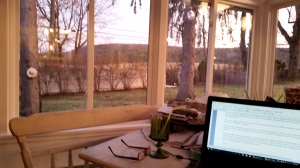
Whose woods are these I think I know. It’s the eve of my 46th birthday, and from the kitchen table – my in-laws marital set from 50 years ago – I look off past a pasture, into the rolling hills of woods. The glassed-in room makes such a vista easy, and it’s different not just from season to season, but from morning to eve.

A glass of wine sits on the table, and it’s alright. It’s all alright now.

Someone said that the pasture and the rolling hills of woods reminded her of Argentina. I’ve never been. But, do beautiful vistas change, regardless of geography? Pastures, rolling hills of woods?

My wife is upstairs painting. No, not the fine art she’s trained in, but our master bedroom. We sprung to have the first floor painted, but the second floor is sweat equity. The third floor is her art studio. It wonderfully just is.

The sun is setting on the hills of woods, and the reds and greens of the trees are incredibly vibrant for March. Some sort of evergreen trees, I imagine.

My father in his early life could have told me what sort of trees they are. After serving in Viet Nam, he studied to become a master landscaper in his early 20s. He could have told me a lot. By 30, though, all was lost.

The other night, I was trying to think of when my father died, then my mother, and I don’t recall. I’ve always heard that we remember these things down to the second – where we were, what we were doing. But, I just don’t. All was strained for decades, lives in turmoil, then it just ended, first my father, then my mother. Sometimes it just ends; dates don’t matter.

I check on our eight-year-old in the adjoining family room. She’s watching the Muppet Show, and I start the fireplace as the sun sets. Our oldest turns 20 the day after my birthday, and won’t return home from college for another two weeks, spring break. She hasn’t seen any of the paint in person. There’s always progress on the house that we’re excited to show her. Nuances discovered from its 1828 roots to changes we’ve made. It’s home now – ours.

Robert Frost, among the “New England poets,” captured rural settings like this in his work. I think of “Mending Wall,” where, in the spring, my 2daughter and I, too, will stroll our property lines, resetting stones on walls and placing pieces of the old timber fencing back on its hand-carved posts.

I could tell you how I got here, 46, my wife, the kids, the house, the rolling hills of woods. But, the beauty of life isn’t just the growth from where we stem, but the promise of where we’re going.

I gaze out the windows. The woods are lovely, dark and deep, but I have promises to keep. And miles to go before I sleep, and miles to go before I sleep.

This Day

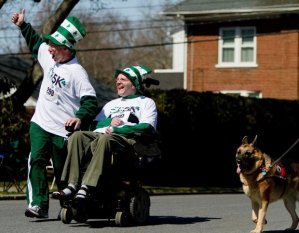
In memory of Dr. Brett Weber, who lived every day like it was Saint Patrick's Day (except for the beer!)
In memory of Dr. Brett Weber, who lived every day like it was Saint Patrick’s Day (except for the beer!)

By Mark E. Smith

Mahatma Gandhi said, “Live as if you were to die tomorrow. Learn as though you will live forever.”

If today were your last day on Earth, what would you do? The more profound question is, are you doing it?

In my forever learning, I’ve taken to heart both the fragility and power of life. In being a member of and serving those with disabilities, I’ve known many passings. I’ve watched friends die of MS after the span of a decade or more. I’ve had friends with ALS who’ve only lived three years from diagnosis. And, I’ve had friends with quadriplegia who simply didn’t wake up one morning. Even when there seems to be a predictability to death – as with a terminal condition – there’s not. Anyone of us can die at any time, disability, illness or otherwise. And, we do.

Having known so many who have passed away, it’s made me oddly at ease with death. It literally has long been part of my life, just as it’s a part of life, itself. This isn’t to say I’m not heartbroken with each passing, but I’ve learned not to struggle with the reality of death. Grief for me has become less about sadness and more about fond remembrance. My life has been changed by knowing all who have passed, and their wonderful impact on me has never stopped at their passings – it’s carried on with me.

And, there within resides among my greatest life lessons: honor the fragility and power of life, as Gandhi put it, as if we may die tomorrow. What does that really mean, though?

Living as if you were to die tomorrow means deeply recognizing the power in life we all have. For each of us, priorities are a little different, but there are universal truths. Deeply value and express gratitude to those around us by constantly reaching out to our loved ones, friends and strangers alike. Live our dreams now, rather than putting them off. Find beauty and meaning in as many moments as we can, even in the difficult or mundane. Accept what we can’t change, and move on. Have fun! And, as my wise wife puts it, “Every day, do important things.” Life is what we make it, so why not live to a degree that doesn’t just bring joy and meaning into our lives, but to everyone around us?

As for me, I’m not worried about living or dying tomorrow – I’m fine with either fate. I’m just relishing every moment of today. No matter if it’s rain or shine, I’m using my power wheelchair to dance in it all!

Answering the Phone – Again

red-phone1

By Mark E. Smith

For 17 years, I’ve worked in various roles within a power wheelchair and scooter manufacturer, most recently in the capacity as a general manager. That seems like a straight-forward career, doesn’t it? After all, how complex can wheelchairs and scooters and accompanying products be?

The answer is, quite. See, ultimately, I don’t just work with mobility technology, but the people who use it – and that is phenomenally complex. Living with disability ranges from complicated at best, to harrowing at worst, and the people I serve experience some of life’s most difficult emotions. To further this complexity, no two people I serve are in the same circumstance. Day to day, I deal with all socio-economic positions, the widest range of medical needs, and, alas, an infinite number of perspectives on living with disability. As I bluntly put it, individuals I serve can range from frustrating to heart-wrenching. It is a role, however, I cherish because as one with a disability myself, I often feel that I’m in the trenches right next to those I serve.

Interestingly, my career has paralleled the growth of the Internet and e-commerce, where virtually all of those I serve reach out to me electronically, from email to Facebook to texting – the ways of 21-century communication. If someone is in need of my assistance, it lands as a font in front of me on a screen. While digital correspondence is effective – and has allowed me to serve countless individuals over the years – I recently realized that it wasn’t fully meeting the needs of many I serve. Yes, it’s convenient, gets a point across, and works 24 hours per day. However, I’ve long found myself reading between the lines of digital correspondence. Sure, wheelchair problems are easily written. But, often there are hints of issues beyond a rattling wheel or growling motor. Topics from I don’t have anyone to help me to I lost my health insurance creep into the correspondences. So, I wondered, how could I better serve individuals beyond what’s volleyed in text on a screen? How could I get more of individuals’ stories in order to both better meet their mobility needs and connect with them, person-to-person?

I did something radical – I literally went backward with technology in order to improve my relations with those I serve. One Monday morning, I put a stake in the ground and vowed that my response to any electronic correspondence I received was going to be, “Please call me at your earliest convenience, and I’ll be glad to help.” …And it worked. My office and cell phone began ringing, and not only was I able to more quickly, accurately diagnose individuals’ mobility needs, but I was able to get to know them on a very real, personal level, and that, too, allowed me to better serve them.

The result has been astounding. I still hear heart-wrenching stories, but not so much anger or frustrations, and more importantly, I hear the entirety of individuals’ experiences. Each call serves someone’s mobility needs, but also connects us on a far more interpersonal level than digital correspondence. What I’ve learned is that the greatest technologies of all are the ones that best allow us to truly connect in our shared humanity.

Dropping the F-Bomb: Fear

speak-up-quote

By Mark E. Smith

Have you ever thought about the power that fear has in your life? No, I don’t mean a fear such as that of public speaking or bugs or heights – those are all trivial. I’m speaking of fears that truly impact us: the fear to express ourselves to our partners; the fear of expressing vulnerabilities; the fear to truly just be who we are; and other such fears that emotionally stifle us.

And, it’s painful and debilitating, isn’t it? How many of us have been in a marriage or relationship, and have an inexplicable – or, sometimes, rightful – fear of expressing our needs or desires to our partners? We lay in bed at night, feeling alone, and our hearts just ache, don’t they?

Or, how many of us are living with trauma in our past of some kind, and we fear sharing it with anyone? The result is we feel isolated, needing to keep people at arm’s length, don’t we?

Or, how many of us are dissatisfied with our life paths overall, but we fear telling anyone because we don’t want to rock the boat or upset those around us? It leaves us trapped, doesn’t it?

I’ve faced many challenges in my life, but the absolute most difficult has been conquering such deep emotional fears of expression. And, it remains an ongoing process, where bursts of courage have been allowing me to slowly become more and more open over the years – read that, more honest with myself and those around me. I’ve been on a deliberate and liberating path from emotionally fearful to fearless.

In knowing my struggles and progress in this very personal emotional battle, I recently had the privilege of having a friend confide his fear to me. He was diagnosed two years ago with ALS, which has progressed very rapidly, his now using a power wheelchair and losing physical abilities day-by-day till he passes away. However, he’s been the picture of strength, not only for his wife and children, but for his whole community.

Despite his outward portrayal, he shared with me that he’s been keeping a secret, one he fears telling anyone. As I listened, he paused and said just two words: I’m scared.

Everyone handles adversity in his or her own way. However, any reasonable person who’s slowly dying, leaving behind a spouse and children has every reason to be scared. Yet, out of fear of not being “the strong one” that all labeled him as, he was terrified to express his real emotion, not wanting to let others down, as he put it. Meanwhile, he was struggling on this frightening journey internally alone – fear had him trapped within himself.

I asked, if he was to put his fear aside and share those two words – I’m scared – with his wife, how would she react? His answer was breathtaking: I know she’d reply, “I’m scared, too….”

I haven’t learned if he was able to ever have that conversation with his wife, but I hope he did because I trust it would bring them closer together and allow them to be more open in supporting each other in this process. You can’t have genuinely heartfelt conversations as long as you have fear.

See, that’s what overcoming such fear does – it opens us up. Sometimes we receive a positive response to releasing our deepest fears into the world, while other times a disappointing response. However, the reward of expressing ourselves, despite our fears, is in our actions, not the result. The power, for example, in coming out as gay isn’t in seeking approval; rather, it’s about not living in fear of being oneself. This equally applies to no matter what we’re keeping inside. Expression over fear liberates.

What I’ve learned in my own process – from my relationships to my career – is that life is more authentic when I choose to live openly as myself rather than stifled by fear.

Expressing Truth in Struggles

struggle

By Mark E. Smith

I had the privilege of Ms. Wheelchair International, Yvette Pegues, visiting recently. She’s one, like many of us, who’s not only faced challenges, but continues facing them on a daily basis. As I always value, our conversations became deep and heartfelt very quickly, and she asked me a profound question: How do we express the truth of our struggles?

It’s a question many of us who struggle – whether physically, emotionally or mentally – face every day. After all, how candid should we be about our struggles, and with whom?

For me, I see it as a vital balance. We all have those in our lives who pour out every little problem to everyone they meet. There’s nothing authentic about ”woe-is-me” individuals. However, what is authentic is sharing valid, appropriate truth about our struggles. See, when we genuinely have struggles in our lives, it can feel natural to keep them to ourselves because… well… we don’t want to feel like we’re playing the woe-is-me card. Yet, not only do we benefit from being honest about our struggles, but it can also serve others. The only way others can truly know and help us is by our letting them know of our struggles, and in that process it can be remarkably comforting to others because they, too, have their struggles. For all of us, there’s power in not feeling alone – and that’s what the process of sharing the truth of our struggles does.

My wife and I were at church one Sunday, and a parishioner came up to us and said, “I know it took you more than most to get here this morning, and I want you to know I appreciate that.” His words were kind and empathetic – and remarkably true. He had to have known of disability experience, as it does take many of us hours to get ready in the morning. Nevertheless, what touched me was his emotional extension, having the heart to subtly say to me, a stranger, I know the truth of your struggles.

For those of us who know struggles in our own lives, we can be remarkably intuitive in recognizing it in others. Expressing the truth of struggles that we see in another can be an ultimate act of compassion and connection. No, we don’t need to give a drawn-out soliloquy. Rather a simple acknowledgement that simply says, I truly see you, and you’re not alone in this… can take weight off of the spirit.

Let us not just have the courage to express the truth of our own struggles, but to also have the courage to express the truth of others’ struggles, with compassion and connection. Ultimately, let expressing the truth of our struggles not be about us, but togetherness.