The “Heart” of Complex Rehab Technology – Video

By Mark E. Smith

When most consumers think of complex rehab technology, they think of… well… technology. However, some today don’t realize that the true nature of complex rehab technology – stemming from the original and current innovators – isn’t just about mobility products, but it’s about the heart, ordinary individuals performing the extraordinary simply to better the lives of others. It’s with great privilege that I share one story from my lifetime journey and passion in complex rehab, where heroes in my life taught me so much about the “heart” in complex rehab. Enjoy the video.

A Dog’s Life

photo (19)

By Mark E. Smith

I’m sitting on my deck, roasting marshmallows this summer’s eve, my English bulldog, Rosie, sleeping on the honey-colored wood. Years ago, she would have ran off into the woods chasing critters, but now she’s eight, and would likely rather be laying on the couch in the air-conditioned house. However, this eve, it’s just her and me, so we stick together, relaxing on the deck.

“Rosie, you’ve gotten old and lazy,” I tell her, and she opens one eye, not moving a muscle, jowls flopped on the deck. “You’re no good for conversation anymore when all you do is sleep.”

I built this place twelve years ago, loving the property – close to work and town, yet rural and serene. In fact, the deck is designed so that when sitting on it, it overlooks lawn and woods and a creek, no other homes seen or traffic heard – just the nature of the Pocono region that stays lush and green throughout the summer – the grass, the trees, the native ferns.

Oddly, although I’ve always maintained my property and deck – often mowing twice per week, spraying surrounding weeds, and keeping the deck stained – I’ve never really enjoyed any of it till this year. I bought some cheap patio furniture and a not-so-cheap gas fire pit, and it’s all turned out well, soothing décor that gives me a front-row seat to nature without leaving home.

“Rosie, you’re snoring,” I pipe at the dog, wondering if I’m getting old like her, too?

Some eves I sit out here with my daughter. Some eves I sit out here and read. Some eves I sit out here and write. And, some eves I just sit here – with Rosie, the fire flickering, the lush grass, dense woods, and evening breeze surrounding me. And, I’m content. Maybe I am getting older, wiser, more relaxed?

“Rosie, in people years, you’d be fifty eight,” I tell her, and she opens her one eye again, slightly. “If you were a person, you couldn’t get away with your laziness. But, because you’re a mush-faced bulldog, it’s charming. And, maybe you’re just smarter than most – no one bothers you, and you don’t bother anyone.”

Those close to me say they’ve noticed changes in me, too. My sister said she’s observed that I only tell funny stories about our parents these days – I guess I’m letting the bad ones go. I was just down in Washington D.C., having lunch with my life-long best friend, and I think he sensed a more laid-back me. My daughter, work, the house, the dog – it’s all good, and I just don’t worry about much else. Like Rosie, I try not to bother anyone, and I don’t want anyone bothering me.

I toss Rosie a raw marshmallow, it landing directly in front of her face. She sniffs it, then scarves it down, looking to me for another.

“You’ve got it all figured out, Rosie,” I say. “Why waste time chasing the futile when, with faith and patience, life will eventually bless us with its best – and sometimes a marshmallow.”

Brawling with Books

wheelsofchange

Mark E. Smith

The prevalence of alcoholism and drug abuse of many great writers, both past and present, is unmistakable, as is their urge to travel, expatriation in some cases. From Hemingway to Boroughs to Bourdain, our best writers have all sought escape in their lives. Why is that?

As a writer, I can tell you that the answer is, fear – and escapism from it. Spaulding Gray’s monologue – turned into a 1992 film – Monster in a Box, chronicled his emotional struggles to finish his first novel. In fact, on March 7, 2004, Gray committed suicide, a bout of depression that those close to him say was triggered by his struggles in writing his latest book.

See, many don’t realize the fear that most true writers have toward writing. If you’ve been in a bad relationship, knowing that leaving would lead to success, but you couldn’t find the courage to do it, that’s what sitting down to write is like. If you’ve been dissatisfied with your job, knowing that you could do better elsewhere, but were scared to make that leap, that’s what sitting down to write is like. Or, if you’ve ever wanted to diet and exercise, but were intimidated to start because of the commitment required, that’s what sitting down to write is like. It’s simply the fear of failure that stops many in their tracks, causing them to seek diversions or escapes instead of assuming accountability and just accomplishing the task at hand.

But, not me. At the age of 23, I met with a book publisher, and he verbally tore my manuscript to shreds, calling it “amateurish,” and I thought, I’ve spent two years writing this with nothing more than a belief that I could do it, so call me what you will – but, in my mind, I’ve had the courage to do it, and that’s all the validation I need….

“But, there’s more to this story,” he continued. “You might just be among the most fearless writers I’ve ever met, so let’s see if you’ve got the balls to take this manuscript from good to great – and, if you do, I’ll publish it.”

From that day forward, fearless was my only way of writing. I may fail miserably in the attempt – and I have at times – but fear will never stop me ultimately succeeding.

And, so this past spring, when I embarked on my most ambitious book project to date, a part of me thought, How am I going to pull this off? Yet, a bigger part of me was like, Man, I’ve published over 1,000 formal pieces, with five books under my belt – I can do this….

The concept was to capture the birth, evolution, current state, and future of complex rehab – and, most importantly, tell the stories behind the story in an astoundingly compelling way. In my mind, it was like setting out writing The Social Network (the story behind Facebook) – that is, could I make what would seem a pretty mundane subject, and find the extraordinary in it? I remember one of my colleagues saying, “You’re the only one who can take this subject and make it fascinating.” Easier said than done, I thought. But, I was up to it.

With a dose of fearlessness, I went to work, tracing the roots, interviewing the individuals, and capturing the iconic moment of complex rehab, and it’s taken me on both an extraordinary professional and personal journey. At first it was intimidating and laborious, just a push to get through the first chapter. I remember saying to the woman working as my editor, I’m nine pages into this, and it isn’t getting easier. However, then I remembered that the best writing comes from fearlessness, and so I did what many in the complex rehab industry would view as a pretty bold move: I went to Ohio, rolled through the doors of Invacare, and sat one-on-one with Mal Mixon, in his office, for three hours, interviewing him about the evolution of complex rehab technology, Invacare having innovated several key technologies in the early 1980s. And, from there (with his sharing some pretty astounding never-told-before stories), I was like, Wow, these are the types of awe-inspiring first-person stories I need to write the book that I know that I can write – and, more importantly, the type of book that people won’t be able to stop reading.

From there, the writing and interviews snowballed, where I wasn’t writing from fear or pressure, but inspiration and passion. In no time this past spring, I had a book coming together that captivated me – one heck of a story unfolding. No, the manuscript won’t be done for about six more weeks at this writing, but I wake up seven days per week itching to squeeze in that day’s writing where I can.

In so many areas of life, fear dictates what we accomplish – or, don’t accomplish, as it is. However, when we put fear aside, and say, Yeah, I can do this regardless of the challenge, we will ultimately accomplish it. Replace fear and escapism with inspiration and passion, and you’ll be amazed where your goals will lead.

Upward Mobility

964849_10201126408272601_756192260_o

By Mark E. Smith

Anyone who tells you that “all men are created equal” is simply stating rhetorical idealism. The fact is, we know we’re not all born equal – some are born into lives of privilege, while others are born into far more grave circumstances.

If you weren’t born into a life of privilege – albeit, wealth, a stable home, good health, and so on – you’ve probably seen your hopes and dreams thwarted at some point. When an upper-class kid, with good-looks, athleticism, and not a stress in the world goes to college on his or parent’s dime, a lot is a given, success is almost a birth right. However, if you’re like some of us who weren’t so fortunate, you don’t stare at silver platters, but you encounter a lot of roadblocks and mountains to climb. And, that’s OK – be happy for the privileged ones, but also see the extraordinary potential in yourself and others like you, those who have to work harder, those who face greater adversity, those for whom it takes more time, but get there, no less.

See, you can’t worry about what those of privilege have, or that you got the proverbial short end of the straw. So what if she has Daddy’s money, or he got a promotion by being at the right place at the right time. Life isn’t just about luck of the draw; it’s a marathon about tenacity. You have what you have, no matter how little, and it’s your job to make the most of it, building upon it over the long term – with laser-like focus, unwavering drive, and, yes, do-or-die tenacity. You have no safety net, and that in itself will make you a better tight rope walker in the end – you won’t fall because you can’t risk falling.

And, none of it is easy – climbing mountains never is. But, it’s totally possible. At times, you may have to make extreme sacrifices – maybe you live in a hole-in-the-wall place, with no television, subsisting on Top Ramen because the little money you have covers the books for your community college courses. Or, maybe you go to work despite health issues because you wish to excel in your career regardless of any adversities. The fact is, as long as you have unyielding tenacity and focus – where you have the guts to make sacrifices that others run from – you will succeed, period. Life isn’t for the privileged; life is for the strong.

Interestingly, political beliefs aside, our most recent three presidents are a great study in privilege versus tenacity – and where the playing field is leveled. President George W. Bush certainly worked hard in his life, but was born into privilege and a family legacy that led him to President, his grandfather a U.S. Senator, and his father, of course, a President. By contrast, President Clinton’s father died three months before his birth, and his later stepfather was a gambler and alcoholic who abused his mother, with President Clinton earning his way through college on scholarships. Similarly, President Obama came from a broken home, mostly raised by his grandparents, putting himself through school. So, we have three presidents of practically speaking the same era, and one was born into privilege, while two came from very humble beginnings. The point is, tenacity can catch up with privilege in the end – but it takes work and vision and guts.

If we truly look at the backgrounds of our 42nd and 44th presidents, there’s tremendous inspiration in that. You don’t need to be of the birth right of the 43rd president – lineage of privilege and power – to be among the most successful people on Earth. Rather, you can come from the so-called bottom, never feel lower than anyone else, and chart a course of personal empowerment. No, you statistically won’t ever be the president, like Clinton or Obama, but think of what you can accomplish in the way of education, career, community, and family – there’s nothing holding you back.

And, you mustn’t let success stop with you. You must have a moral and ethical compass to help others. You don’t want to be smug and selfish, but kind and giving – a leader in action. You see ignorance on the Internet, in line at the grocery store, on cable news shows. You don’t want to be that guy. You want to have the backbone to lead others from despair, not create it. See, the ultimate form of success isn’t in just bettering your life, but bettering others, bettering the world around you as you rise.

Life is simple geography: regardless of where you start, you can go anywhere – just plot an extraordinary course and follow it unrelentingly.

The Power of Abandonment

Mark Sit Skiing 1987
Mark Sit Skiing 1988

In art and dream may you proceed with abandon. -Patti Smith

By Mark E. Smith

The only sport that my disability level ever truly allowed me to compete in was downhill sit-skiing in the 1980s, when the technology – a kayak-type device, steered with short poles and edges on the bottom – just matched my limited coordination well enough to allow me to snow ski. In fact, it taught me a lot about how having the courage to push our boundaries isn’t about risks, but rewards.

It was the 1988 Western Regionals for what then was called National Handicapped Sports and Recreation, the governing body of adaptive snow skiing. In order to qualify for Nationals, one had to time in at Regionals, and my region was especially competitive because it was home to world-class athletes like Marilyn Hamilton, Dave Kiley, and Peter Axelson. However, I was lucky in that adaptive ski technology was rapidly changing that year, and those three ultra-skiers were in a new class called “mono-skis,” a technology that my lack of balance wouldn’t allow. So, the sit-ski class that I raced in was much smaller that season; yet, ultimately no less competitive.

My foremost competition was Mike Moleski, a paraplegic who was almost twice my age and definitely twice my size. I was a skinny 17-year-old kid with cerebral palsy, and Mike was a 30-something jock with muscles galore. He was also a bit of a loose canon. He appeared every bit your stoned surfer dude, right down to bleach-blond hair, and he sit-skied like he was on fire. I don’t know why, but when everyone else moved to the newer technology mono-ski class, he stayed in the sit-ski class with me.

And, I had no hopes of beating Mike, no matter how well I skied. He was too big, too strong, too coordinated, and too daring for me to realistically compete against on the race course. And, my coach knew it. “You’ve got three possible outcomes here,” my coach told me. “You can ski your own race and finish the course, but likely not qualify for Nationals. You can ski with abandonment and risk blowing out of the course, getting disqualified. Or, you can ski with abandonment and at least have a shot at keeping up with Mike and qualifying for Nationals.”

Of the three choices, only the two made sense to me: Ski with abandonment. Taking the safe way would get me down the course, but likely not with the time that I needed, so why even race? However, while skiing with abandonment would risk a disqualification if I got out of control and missed a gate, blowing the course, I still had an equal chance of ranking a leading time if by some miracle I could pull it off. I figured out of the three choices, only skiing with abandonment – and pulling it off – gave me a shot at qualifying for nationals.

The mono-ski class raced first, and the course was so steep and fast that they decided to start us sit-skiers off lower on the course. Mono-skis are a seat frame mounted to a single ski, with exceptional turning and edge control, so they handle high speeds and steep terrain better. Sit-skis are more of a sled, so they drift and speed can quickly become difficult to control. So, when I saw the steepness and speed of the course – even at half way – I was scared. I was no longer worried about blowing out of the course, but actually getting hurt.

Mike went first, and I saw his ski drifting as he flew down the hard-packed course, barely making each gate. If he was having trouble holding turns at speed, I was really in trouble. But, he finished the course, with a time I knew I couldn’t match – unless I skied with abandonment.

As the buzzer went off, I thrust myself out of the starting gate, and was immediately accelerated by gravity. Mike was smart in that he tried to stay in the trough carved by earlier racers, using it like a bobsled shoot to help steer his course. But, it likewise seemed to slow him down, so just past the first gate, I jumped out of the trough and opted a straighter, faster, more dangerous line, struggling to stay center course, hitting speeds that made it seem like the gates were much closer than they were. But, I soon figured that I really needed no technique, just abandonment. I applied no speed control whatsoever, and just used all of my strength to center the sled on each gate. And, as I hit the finish line, I had no hopes of stopping but to throw the sit-ski on its side, skidding to a stop in front of the crowd. Everyone cheered, including Mike – my time within a second of his – with my coach picking me up, sit-ski and all.

Sometimes in life – no matter sports, love, career, or disability, to name a few – the safest way isn’t always the surest or most rewarding way to accomplish what you wish. Sometimes you have to take calculated risks, and say, I don’t know how this is going to turn out. But, I’m going to put it all in my own hands, and give it a shot….

Heavy Sky

window

Now I’m a grown man, with a child of my own, and I swear I’m not going to let her know all of the pain that I’ve known. -Art Alexakis

By Mark E. Smith

When I was 17, I spent a lot of that summer camping in Yosemite’s White Wolfe region. It was part independence building, part adventure, part escape. I attended forestry seminars that summer, and learned that wild fires can prove good for the environment. Dense forests fill up with debris, and stifle new growth; however, a wild fire clears out the old, and allows new plants and trees to grow. What initially seems like destruction, actually builds a new, stronger habitat.

At that time, I wasn’t in touch with my father. He’d walked out on my brother and me many years earlier. We were little, maybe five and six, or a bit older – it’s hard to date such things, probably because it’s too painful to remember exactly when your father left. But, I remember.

Regardless of dates or circumstances, when your father drives away for the last time, it creates a void in you that many say never goes away – it’s just a heavy sky that’s left over you. And, as the seasons pass, you learn that other people, who you love, leave and don’t come back, either. It’s emotional dominoes set into motion by the man who’s supposed to be a boy’s hero, and you learn to just fall with them, relationship after relationship, where the fear of abandonment becomes the security of being alone.

Yet, you grow strong in ways, where you never distrust because there’s always a chance that someone might stay. You’re forever a seven-year-old starring out of the living room window, with the possibility that Dad might pull up in his pick-up truck, boozed up but playful. And, so you learn to trust in a counter-intuitive way – it’s the dream that’s the only comfort to hold onto.

And, you likewise learn to never leave anyone because you don’t want her or him to know the pain that you’ve known. Yes, everyone’s going to promise to be by you till the end, but who dare live up to it? You will live up to it because you won’t be like him.

And, then there is her, your own child, and as a broken man, there’s something remarkably whole about you in that single role, where your pieces come back together, and you see everyone around you in the sunlight of spring. It’s inexplicable that where only destruction has been, beauty emerges – a single flower among ravaged woods. And, you realize that the injustice of not having a father is corrected by being a father – the better man, you are for it all.

It Gets Better

morgan
Morgan Duffy & Crew, Stanford Class of 2013

By Mark E. Smith

Author’s Note: There’s a disturbing undercurrent that, in this modern day, some teens with physical disabilities still feel isolated, depressed, even suicidal. So, let us talk about being a teen with a disability, and how life gets better….

As a teenager struggling with having a disability, you need to know only one truth: Life gets better – remarkably better.

I remember being a teenager with cerebral palsy and, like you, I remember struggling with it all – feeling different, but wanting to fit in; being treated different, but wanting to fit in, or, at times, feeling completely “normal,” but not being accepted as such. No, high school for me wasn’t all terrible – there were some good friends and good times, as I hope there are for you. We should all see good where there’s good. But, it wasn’t easy for me being different. But, it did get better. And, I know it may not be easy for you right now, but it will get better – remarkably better.

See, high school is tough for everyone, typically a confusing time, and everyone just wants to fit in. I have a 16-year-old daughter who “fits the mold,” and it’s even tough for her and her friends at times. Like you and my daughter and her friends, I just wanted to fit in, too – to have the right friends, have the right persona, and get invited to the right parties. And, for me, maybe like you, sometimes it worked, and sometimes it didn’t. Well, a lot of times it didn’t work. And, when it didn’t work – the occasional bully calling me “retard,” or not getting invited to different events and such – it really, really hurt. At points, I, too, just wanted to give up and die. And, before it gets better, sometimes it gets worse.

I remember at among the lowest points in my teen years, I had a girlfriend who I thought truly accepted me, but when it came time to dance at the prom, she wouldn’t dance with me because I used a wheelchair. I remember thinking that my disability was the blame, that if I wasn’t plagued by cerebral palsy, I’d have all of the friends, girlfriends, and coolness in the world. However, I would never be accepted or successful because of my disability.

But, I was wrong. High school and my peers had no impact on my ultimately living a happy, successful life. The day that I graduated, virtually everything got better for me. I went from bullies calling me “retard,” to being a writer, speaker, and academic. I was soon invited to real parties, with amazing people, even getting to meet the President of the United States. And, while no relationship is perfect, I had my ultimate dances with amazing women since – loving, accepting, sincere. It all got better – remarkably better.

My daughter and I were planting Marigolds this spring in a flower bed in front of our home. It was a 70-degree sunny day, where our English bulldog lay on the ultra-green grass. And, although my life, again, isn’t perfect, I was reminded of all I’ve been blessed with – my daughter, a career that helps others, a nice home, the respect of those in my community – and I thought back to my days in high school, wondering where those who treated me poorly are today? Oddly, when I was on Capitol Hill recently, none were there. I don’t see any of them in magazines that I write for, or any with Internet followings. And, I have to wonder with a smile, is their grass as green as mine?

The fact is, while those who hurt you today in school may seem so powerful, they’ll soon enough get lost in the world. But, you. You were born into the extraordinary, with capacities toward life success that they’ll likely never realize. Let’s wish them well, but they don’t have what you have – that is, potential waiting to explode. And, it will, where your life is going to get better – remarkably better. You’re a survivor and a thriver, and that which seems to work against you now, will work for you soon. You’ve been given the gifts of tenacity, perseverance, and empathy – traits that are rocket fuel for life, just waiting to ignite your life in the most rewarding of ways.

My young friend, Morgan Duffy, graduates from Stanford University in a few weeks at this writing. She’s a Dalai Lama Fellow; she’s done an internship on Capitol Hill; and, she’s studied abroad. And, get this, she’s accepted a job with Genentech – without even applying (the recruiters found her based on her accomplishments). But, I’ll let Morgan’s own words explain the rest of her story:

So I’d like to tell you that I am your average 21 year old, living life and learning through mistakes and experiences. Most of my experiences, however, are less than average. Three years ago, I packed up my life and moved from the small city of Scranton, PA to begin my college education at Stanford University. I am a Cross Cultural Health and Intervention major with interests in disability, health policy, social justice, women’s health and choice. Like most, my interests are based in experience. I am a woman with a physical disability, who navigates the world in a wheelchair. And I like to feel the world beneath me in that way, taking each bump and knock consistently and steadily. My mother is a nurse, and through my years listening to her complain of the inefficiencies and inequities of modern US health, I have been motivated to learn how to change this. Social justice was the foundation of my high school career at Scranton Prep, and I have vowed to never forget.

Morgan isn’t an exception, she’s the rule – just as you are. You, too, will leave your town and “feel the world beneath you,” as Morgan puts it, going on to successes that won’t just change you, but will change the world.

It may all seem tough today, but the strength to hold on was born into you – there’s a purpose for who we each are, and yours is extraordinary. Tough out the tough times, as it all gets better, remarkably better. And, yes, the grass will be greener on the other side. I’ll see you there.

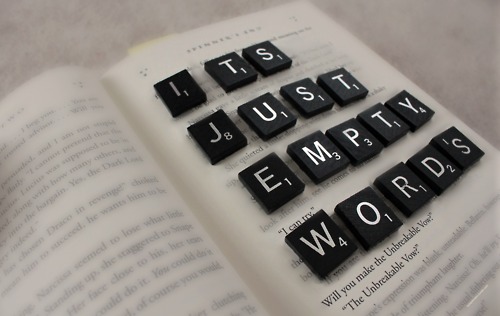
Empty Words

emptywords

By Mark E. Smith

The two symbolic, ground-breaking shovels that sit in the corner of his office catch my eye. One is gold-plated and the other, chrome. They’re the type of shovels that dignitaries and politicization use to pose with in a dirt patch when kicking-off a new development project. And, they’re leaning in the corner of his stately office, which clearly has not been remodeled since the 1980s, right down to worn leather chairs. But, all is spotless clean – even the shiny shovels.

I could picture him back in the day, likely slamming one of those shovels onto a board room table, and saying in a larger-than-life voice to his executive team, “Are we going to dig our own grave, or dig our way to the top?”

Yet, now he’s a kind, calm, soft-spoken older man, a proud grandfather. And, as he talks I feel a bit writer and a bit grandson. “Never trust words,” he says. “Flow charts, a good dresser, a great speaker – never trust any of it. Only trust results. When someone delivers, trust that. Trust whomever backs you in the trenches.”

And, for a moment, my eyes drift back to the shovels leaning in the corner, and I think about how true his words are, not just in business, but in life. As a writer and speaker, I’m a contradiction in that I’ve always distrusted words. It goes back to my mom and her always lying about not being drunk, my therapist would say. And, while maybe that’s where my distrust of words likely began, it runs more universally than that. I’ve learned that when we truly care about others, we don’t just say it, we show it. Show me you care about me, show me you love me – don’t just tell me. I’ve fallen for words too many times, only to be hurt by them – empty, hollow in the end, the words, me, all of it. You have, I have, we all have. And, what’s insane is that we continue wanting to hear them, the words, and believe in them – I’ll pick up the pace, I’ll make things right, I’ll quit doing it, I’ll change…. But, what’s any of it mean if there’s no action or effort behind the words?

The answer is, nothing. Here’s the fact: when we look and don’t listen – that is, when we gauge a person on what they do, not what he or she says – it’s the ultimate truth of what we mean to that person. No matter if it’s an employee, friend, or love interest, follow what one does, not what one says. Lots of people will say they’re there for you; but, who’s truly there in the sincerest ways? It quickly becomes a short list, doesn’t it?

And, yes, it’s a painful realization, but also a poignant one. See, in the process of realizing how adrift we are, alone at sea, we likewise realize who’s truly there for us, not in words, but in heart, soul, good times and bad. Words are so often an empty gesture; but, actions of the heart always prove true intent. Grab those who put their hearts and souls out there for you – hold on to them, truly trust in them, no longer adrift but anchored by them.

And, as he continues speaking, I stare at the shiny shovels, and again wonder why any of us still trust in words at all?

Find A Way

findaway

By Mark E. Smith

I’m not a miracle worker, but no matter what problem you throw at me, I can tell you in three words how to solve it: Find a way.

If there’s one life-changing, ever-empowering truth that disability experience has taught me, it’s that there’s always a way to resolve or accomplish what we wish – we just have to find a way to do it. It may not be initially evident; it may not be easy; it may not seem practical; and, it may even seem ludicrous. Yet, to any challenge or situation in life, there is a way to resolve it – we just have to find the way.

I often share the story of my shoe laces. For the first 25 years of my life, I couldn’t tie my own shoes based on my lack of dexterity and coordination. Now, in the grand scheme of life, not being able to tie one’s own shoes may not seem like a big deal – after all, there are far more serious limitations in life – but it was one of the last pieces to my physical independence. The ability to tie my own shoes meant the difference between being able to fully dress independently or forever rely on others.

For years, I tried all sorts of shoes, with all sorts of practice. But, alas, I could never coordinate shoe laces well enough to tie them. I even got to the point where I could make the loops, but as I went to cross them, all fell apart. It was forever frustrating, to say the least, right down to my brother having to tie my shoes on my wedding day.

Yet, after years of practice, trial, error, and failure, I was so close to tying my own shoes that I knew that I could do it – I just had to find a way. And, so I reanalyzed my process, and realized that where the issue was, was that when I went to cross the shoe lace loops, my poor coordination over-extended the shoelaces, causing them to come undone. If only I had more shoelace length to work with, I could cinch the loops before pulling the ends out…. And, in that was the answer: get longer shoelaces! Indeed, I found a way, and till this day, 72” shoelaces are the solution I use to tie my shoes. It wasn’t that I couldn’t tie my own shoes; rather, I simply had to find a way to do it.

Finding a way is amazing because it empowers us to find a solution to any problem rather than accepting it. A task or situation may seem impossible, but if we truly believe that there is a way to successfully solve it – we just have to find it – it inspires us to not just try, but try harder, as well as go into situations with a can-do attitude.

I admit, I’ve become pretty skilled at finding a way, where when I encounter a challenge, I don’t shy from it; rather, I go into find-a-way mode. I recently wanted to interview a business titan for a book I’m writing. The individual is bigger than life, worth an estimated $2-billion, and has an insanely busy schedule. I remember thinking, How am I going to track this individual down, let alone get a several-hour interview? The answer immediately struck me: Find a way.

I thought for a moment who might have the individual’s personal contact information – as I wanted to get direct to the source – and with a single email exchange, I scored both the individual’s and the individual’s assistant’s contact information. Bingo! I then sent an email to the assistant, and within 20 minutes, I had an interview scheduled. I flew to the individual’s headquarters, and ended up with an amazing two-hour interview. If I had told most folks who I wanted to interview and where, they would have thought it crazy. There’s no way you’ll pull that off, most would have said. However, knowing that I just had to find a way to pull it all together made the seemingly impossible ridiculously easy. There I was, having flown partly across the country, sitting in the individual’s stately office, hearing amazing, never-before-told stories to include in my book.

See, that’s the eloquence of find a way – it immediately makes the impossible totally plausible. Are you having difficulty accomplishing a goal? Find a way. Are you struggling to get the results in a particular aspect of your career that you want? Find a way. Do you want to make major changes to your life? Find a way. Do you want to live your dreams? Find a way!

No, anything truly worth striving for isn’t easy, nor without complications. But, if it’s truly worth doing – if you’re truly dedicated to accomplishing it – there’s a way to do it. Find it. Live it. Never give up hope, as there’s always a way….

Dream On

equalrights

I never doubted that equal rights was the right direction. Most reforms, most problems are complicated. But to me there is nothing complicated about ordinary equality. -Alice Paul

By Mark E. Smith

When I was born, there was no humility in disability, just the medical authority calling people like me the vegetative minority. No, I couldn’t walk, speak or crawl; but, with my toddler eyes and ears, I saw and heard it all. Dream on.

And, as I grew, no one knew what my fate would be, a prognosis based on speculative hyperbole. But, still, with ignorance, everyone all labeled me – crippled. …Yep, that was me. Yet, inside hid the person I knew I could be. And, at night, when I cried — trapped by an ignorant society — even my mother couldn’t comfort me. Dream on.

When I was seven and sent to the back of the church, I was taught children like me didn’t go to Heaven. How could a God, who I came from, not let me with a disability into his kingdom? It wasn’t some Father’s place to say we aren’t anointed by the Lord based on physicality, when inside me, I knew I was appointed, worthy of spirituality. Dream on.

Mainstream education brought taunts and stares – kids who didn’t know better, teachers who didn’t care. I could read but I couldn’t write, so I bought a thrift-store typewriter and clicked the keys, teaching myself to type one night. And the words that flowed were bold and grew, and I knew I had something to say to the world – even at eight years old. That’s right. Dream on.

My family fell apart, ignorance toward my condition stung at my heart, and back in those days, a step into a store meant I could get in, and they had the right to refuse me service, a hypocrisy to no win. America the beautiful, the bold and the brave; but, my wheels of steel made everyone my master, gave me little more than the rights of slave. A country founded from oppression, surviving wars and the Depression, and I still I faced daily oppression? Stigmas did follow me, and I felt this: Where was truth in equality? Dream on.

But, for me segregation didn’t stop my education, and I wouldn’t give up my mind’s elevation. Heart strings tatter, but a spirit that wouldn’t shatter, I’d just move on; different day, same song. Things went wrong, but I’d move on. Dream on.

I remember at the prom when she wouldn’t dance with me, then going home that night, questioning my sexuality – for months it went on, the depression, a repeated song. I awoke in the hospital despite the pills taken, and it registered with me that I wasn’t a soul forsaken. I was who I was and just had to be me, why drown in self-loathing when I could swim in a sea – of acceptance. That had to be me. Dream on.

It all got easier as I went, worth the sweat and the tears that were spent – but who knows. I was always told that life goes as it goes till we grow old, and the forces that once held us down soon push us up from the ground. Our weaknesses become our strength, and those who’ve wronged us, we should thank – adversity from diversity is a character that we build, and successes that are earned create lives that are willed. Dream on.

Still, think what you will, but when I travel from the Pacific Northwest to Capitol Hill, there’s ground to be gained, equality sustained, where one nation for all is exactly where we fall – short. And, until everyone – regardless of disability, gender, sexual orientation, race, or religion, of unity, not division –is seen as humanly proficient, not different or deficient, I will continue to question America, the bold, the beautiful, and the brave as it holds up discrimination and prejudice to save – yes, even in this so-called progressive age. Until there’s equality for all, as a nation we fall. But, as for me, I’m optimistic. I dream on.