Removing the Mobility Ruts from Our Roads

road.jpg

By Mark E. Smith

Have you ever wondered how NASCAR drivers maneuver their cars with such precision at such death-defying speeds, slipping between each other, inches apart, at 190 MPH?

It turns out that in their professional training as drivers, NASCAR racers are taught a vital psychological skill: When driving a race car, only focus on where you want to go, blocking out everything else from your mind.

Now, if you realize how you, yourself, think when you’re driving a car, you likely take the opposite approach, telling yourself, “Watch out for that pothole,” or “Don’t sideswipe that guardrail!”

Put simply, professional race car drivers focus on the positives in front of them, while everyday drivers typically focus on the negatives.

Of course, we don’t need to be race car drivers or psychologists to realize that what we focus on plays a major role in our success in any situation. If we focus on the positives, the successes that we seek are more likely to occur, and, conversely, if we focus on the negatives, we diminish our odds of success. In other words, if we focus on the smooth road ahead, that’s where we will go, and if we see nothing but potholes, surely we destine ourselves to a bumpy ride.

I’m amazed by those with disabilities who take a bleak outlook toward their mobility products, only seeing the negatives, where they’ll tell you that since the day that the began using wheelchairs, their lives have been nothing but potholes. “Every provider is a jerk, wheelchairs stink, and it’s all part of a system out to get me,” we hear people say.

Along these lines, I ran across someone recently who remained upset about an experience that he had five years ago, where he explained to me that his provider had done him wrong. No, I wasn’t involved in the situation, and I have no way of knowing the whole story, but clearly the man was upset, even after all of these years.

As one who always looks in a positive, forward direction, I asked the man if he had a sound wheelchair now, and if he had a good provider? “Yes I do,” he told me. “But, that doesn’t matter. At any moment this chair’s going to break, and my provider is going to stick it to me.”

On the road of life, the gentleman was doing nothing but looking for those darn potholes. He was so bitter about what had once happened, that he simply refused to trust a provider or wheelchair ever again, unable to appreciate the mobility and support that he now has.

Sure, you might be thinking to yourself, “See, Mark, poor provider experiences ruin our lives.”

Yet, I ask you, does a bad provider experience or an unreliable wheelchair truly have the ability to ruin our lives, to make us forever bitter, to despise every moment that we spend in a wheelchair?

Only if we let it.

I didn’t choose my disability – or the fact that I have to use a wheelchair – but I sure as heck can choose the attitude that I use toward dealing with it. And, I can tell you that bitterness and disdain never got me anywhere, not in life, nor with mobility. Heck, if I were to follow the lead of some with chips on their shoulders about wheelchairs, I wouldn’t be where I am today. I mean, I was a kid stuck in bed, who couldn’t go outside, who missed school because my wheelchairs were so poorly made and the industry was so unregulated when I was growing up.

But, I never got discouraged, I never wrote off the world and focused only on the potholes in my path. Rather, I realized that there were still great people who were a help, not a hindrance – as with those who ultimately repaired my wheelchairs. I realized that wheelchairs were a liberator, not a restriction – as they allowed me to pursue my passions in life. And, most importantly, I realized that when I simply focused on the positives of my mobility, my life became better than I ever dreamed.

Surely, disability experience proves a difficult emotional struggle for many, and issues with our wheelchairs and providers can prove painfully distressing at times. But, holding onto that distress does nothing but hold us back. At some point, we have to stop viewing our wheelchair issues as lifelong afflictions, and regard them as what they are, temporary situations. We mustn’t ask ourselves, ”When will my wheelchair break again?” or think, “I need a new wheelchair – here I go again dealing with nightmare providers.” Instead, must wake up everyday looking forward to where our wheelchairs will take us, how they will allow each and every one of us to fulfill our purposes in life.

No, I can’t guarantee you that your wheelchair will never break down – they’re physical products, and issues occur. Similarly, I can’t guarantee you that you’ll never have problems with your provider – they’re real people, where some have real problems.

However, what I can guarantee you is that your perspective ultimately rules every aspect of your life, including your mobility. While we all face the ebbs and flows of life, with low points occurring – as with issues with our wheelchairs or providers – we must remind ourselves of the old adage that these times, too, shall pass, and refuse to allow temporary situations to become permanent afflictions.

Be confident in the smooth road ahead for you by banning bitterness, trusting in the goodness of people, and believing in the awesome power of mobility to foster your life on a superhighway of success.
People First, Then Wheelchairs

littlegirl.jpg 

By Mark E. Smith 

What if I told you that even the most liberating wheelchairs have virtually nothing to do with technology? You might very well think that I’d lost my mind, namely since with all of the aerospace materials and advanced electronics used today, surely wheelchairs are technology-based.

However, I ask you to hold off judging my sanity for one moment, and consider one all-important question: If the most liberating wheelchairs have little to do with technology, what do they have to do with? 

In a word, people. It’s interesting how as users, providers, and manufacturers, we can get so wrapped up in the fundamentals of wheelchair technology that, at times, some forget that wheelchairs are less about technology, and more about people and the lives that they lead. I mean, surely we have to look at wheelchairs as high-tech solutions that empower our lives.However, in the purest form, a wheelchair isn’t about its technology; rather, it’s about the person who uses it. After all, you can have the most advanced wheelchair in the world, but if it doesn’t fit your lifestyle, it’s a moot point.

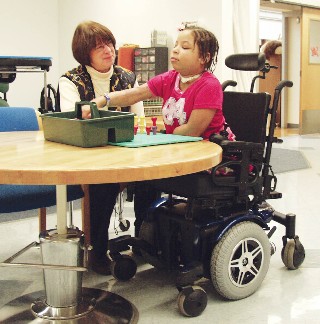
I recently had the pleasure of meeting with a family who was in the process of selecting a new power wheelchair for their daughter. As it turned out, the daughter was exactly my own daughter’s age, ten. While their daughter had spina bifida, she of course had everything in common with my own daughter – Webkinz collecting, adoring Hannah Montana, obsessing over Lip Smackers fruity lip balm, and all of the other subjects that ten-year-old girls are into these days.

Now, while it would have been easy to jump right in and speak with the family about typical power wheelchair specs – seating, speed, the differences between models, and such – we spoke very little of it to begin with. What we did discuss was how the daughter liked to play tetherball during gym at school, how she participates in a Girl Scouts troop, and how she spends a lot of time at her grandparents’ home. Surely, these topics may seem a bit off from the conversation of selecting a new power wheelchair; however, they were as important to the selection process as any other technical specifications – and, arguably, more so.

The fact is, the most important role of the young lady’s new wheelchair would be to allow her to live to her fullest, to be as independent and active as possible in every aspect of life sought. In this way, selecting a new wheelchair wasn’t about selecting a device; rather, it was about serving her needs – that is, playing tetherball, volunteering in her community with her Girl Scouts troop, or bopping out at the Hanna Montana concert. Put simply, a new power wheelchair had to be about her needs, wishes, and wants, not merely four wheels and a seat or the latest-greatest technology.

I heard from the family last week, and they expressed how much the young lady is now enjoying her new power wheelchair. The power elevating seat allows her to be at the height of the other kids when playing tetherball; the large batteries allow her to go from school to her Girl Scouts meeting without worrying about range; and, the ultra-compact power base allows her to maneuver all but effortlessly in her grandparents’ small home. As it turned out, a wheelchair was successfully chosen that allows her to be her in every sense.

Of course, wheelchairs have everything to do with technology, where advancements have dramatically improved our mobility. However, above all else, wheelchairs have to do with people, where selection and use is about one’s individual lifestyle, not sterile technology.

No matter if you’re a wheelchair user, provider, or manufacturer, it’s vital to remind yourself from time to time of the foremost rule toward mobility products: People first, then wheelchairs. 

Dearest Mariah, RE: Dr. Hawking

mariah-carey.jpg 

By Mark E. Smith

Maybe I’m naive or eternally optimistic, but I truly root for whack-job celebs, where I want to see them turn their lives around, where they would prove the world wrong. After all, as one with a disability, some people project traits on me that aren’t accurate, so I fathom that the same could be said about celebrities. Sure, I see Britney Spears wigging out each night on the cable news networks; however, part of me wants to believe that she’s just misunderstood rather than a drug-addicted, bipolar, child-neglecting, egomaniacal, nut-job who only wants to get her groove on with losers. I mean, we all have bad days, right?

And, so this brings me to another kookoo celeb who I root for: Mariah Carey. Now, my take on Mariah Carey is that she’s so beautiful and vocally talented that I desperately want to know that she’s not the crazy cliché that the media portrays. Every time I see her on television, I get up close to the screen, hoping to hear some kind of proof that her IQ is a higher number than her dress size. Please, Mariah, utter the words I want to hear – quote Nietzsche or explain macro economics – prove to me that there’s not just a loose marble rattling in that overly-hair-sprayed head of yours. 

But, alas, Mariah shattered my hopes again this past week, noting that she wants Stephen Hawking’s augmentive communication device so that she doesn’t have to speak or write: “Before a big show I have to do ‘vocal rest’ where I’m not allowed to speak for two days. It’s so boring having to write notes to everyone! I need Stephen Hawking’s voice machine for when I’m on vocal rest,” explained Mariah.

As if her statement isn’t silly enough, there are reports that she went on to say that using Hawking’s communicator would make her sound smarter, too.  

Apparently Mariah is completely clueless to the whole disability thing, not understanding that Dr. Hawking doesn’t use a communicator because he’s a hip, Hollywood cat, but because he needs to as a result of ALS. Well, I guess someone should bring her up to speed on this, and it might as well be me: 

My Dearest Mariah, 

I am writing to you on the subject of Dr. Hawking’s augmentive communication device – or, “text messenger thingy,” as you might call it. I would convey this correspondence in the form of a coloring book for your best understanding, but my drawing skills are on par with your acting skills – that is, very poor. Therefore, please excuse any polysyllabic words in this letter that may confuse you. 

Firstly, I shall point out that Dr. Hawking has a condition called amyotrophic lateral sclerosis (ALS), which affects his speech, and requires him to use his augmentive communication device to communicate with others. And, no, he doesn’t use it just because he doesn’t want to write, just like guys don’t date you for your worldliness. In fact, Dr. Hawking’s communicator is truly a tool of liberation, allowing him to live a highly-successful life, including dictating books that you wouldn’t understand and teaching college courses to which you can’t enroll (see, outside of Hollywood, the rest of the world has something called “standards”). 

Secondly, please understand that Dr. Hawking’s communicator doesn’t make him smart. I know that you look into a mirror for hours like a parakeet, thinking that there’s someone talking back at you, but I hope that you can recognize that Dr. Hawking’s communicator merely speaks the words that he inputs into the device, a process called text-to-speech. Put simply, the reason why Dr. Hawking sounds smart is because he is, just like the reason why you sound like an overmedicated airhead is because… well… you know. 

Lastly, while you may not fully understand why it’s in entirely in poor taste for you to make light of Dr. Hawking’s communicator, I have one final reason why you should think twice before wanting a communicator of your own: You have to know how to spell to use it. I thank you for your time, and I look forward to seeing you on the next season of the show “Celebrity Rehab.” 

Hugs & Kisses,

-Mark

Misery

misery.jpg 

By Mark E. Smith 

Here’s a riddle: What’s the difference between you and me when our wheelchairs breakdown?

The answer is, when your wheelchair breaks down, it’s obviously a very serious issue. However, when my wheelchair breaks down, it’s a Stephen King movie in the making.

Now, I know that some assume that my own wheelchair never has issues. After all, I’m the WheelchairJunkie, himself, and my company makes my own wheelchair – not only am I supposed to have top-of-the-line equipment, but I’m also supposed to know exactly how to use and maintain my wheelchair at the level of a mobility professional. However, there’s one problem with that thought – my wheelchair doesn’t have a clue who I am!

Truly, if my wheelchair could talk, it would say, “Dude, all I know is that you’re a guy with cerebral palsy relying on me 18 hours per day, and when I’m ready to take a break, I don’t care who you are or what you’re doing – it’s lights out for me, brother!”

And, so my wheelchair does periodically have issues, just like I’m sure that Bill Gates finds himself pressing CTRL+ALT+DELETE to unfreeze his darn computer. Machines are machines and, unfortunately, they don’t care who we are. Of course, hopefully Bill Gates and I learn from any issues, and use the experience to help our engineering teams make better products, but we’re real people, using our own products, and surely issues occur from time to time.

Despite my machine – or powerchair, as it is – having little reverence for a mobility man of my seated stature, it at least had a keen sense of where to stop in this situation: On the sidewalk the other morning, about two blocks from my house, on my way to work, in relatively good winter weather – there are certainly worse places to breakdown.

Now, probably a lot like your instinct if your chair has ever stopped in its tracks, I immediately tried to turn it back on, hoping that maybe I just accidentally hit the power button. But, of course, life is never, ever so kind.

Nope! Sure, my chair came back on – flashing error codes, that is. I know that I sound like a rolling encyclopedia when I answer your questions and quickly note what error codes point to what condition. However, that’s when I’m calm and cool in my office – not stranded on a sidewalk, wondering how to get myself out of such a predicament? Therefore, not only didn’t I have a clue as to what the error codes on my joystick conveyed, but even if I did, I couldn’t do anything about it myself, unable to reach beyond my seat. Of course, I caught myself glancing back toward my house like a sailor adrift at sea, wondering if he can swim back to shore, to which the voice in my head reminded me, “Give it up, buddy, you’re stuck!” I hate my inner voice, namely because he’s always right.

I pulled out my cell phone, and called one of my co-workers for help – a true luxury that, unfortunately, most wheelchair users don’t have. However, while I waited for him to arrive, a woman came out of her house, noting that I was obviously stuck, smiling and glad to see me. She mentioned that she knew who I was, acknowledging that she knew where I worked, and called me by name; but, I had no clue who she was, other than a woman seemingly delighted to see me stuck in front of her house at 7:30 in the morning.

“Do you think that you can fix it?” she asked, smiling.

“No, I have someone on the way,” I said.

“Well, if you can’t fix it, I guess everyone’s in trouble then,” she replied, laughing. “It looks like Mr. Wheelchair is stuck.”

“Oh, I can fix it, just not here,” I said, clarifying the situation.


“Do you know what’s wrong with it?” she asked, looking at one side of my chair, then the other, as if she might see something wrong.

“No,” I simply said, looking up the street, hoping I’d see my co-worker coming my way.

“If you don’t know what’s wrong with it, how are you going to fix it?” she asked, still smiling, clearly enjoying this Q-and-A of the WheelchairJunkie stuck on the sidewalk.

So, it’s just my luck that I not only had my powerchair stop dead on my way to work, but in front of Annie Wilkes’ house, the Kathy Bates character from the movie, Misery, who holds her favorite writer hostage out of obsessive adoration.

Then, I swear, the woman popped the exact question reminiscent of Misery that I didn’t want to hear, “Why don’t you come inside the house and get warm.”

Firstly, again, I’ve seen the movie, and I wasn’t about to fall for that trick! Secondly, I was strapped into a 300 lb. powerchair that was dead in its tracks, and there were four steps into her house – she couldn’t get me in her house if she wanted to. Lucky for me.

“My co-worker will be here any moment,” I said, hoping I was right.

“Well, I just think this whole situation is hysterical!” she said, raising her voice like she’d won something.

Fortunately, my co-worker showed up with my accessible van that he’d picked up from my house, whisking me off to work and repair.

It turned out that earlier that morning, while I waited with my daughter at the school bus stop, my daughter was horsing around, and caught a cable on the back of my powerchair, sending my powerchair into an error code, which promptly went away. At the time, I reckoned that she’d simply jostled a connection; however, as I later learned, she’d pulled the cable to a point where the connector barely had contact, and it waited patiently to lose entire contact two blocks later, leaving me stranded. As I’ve explained to my daughter, accidents happen and once we found the issue at my office, a new cable allowed me to quickly get rolling again.

All of this reminds me of two important lessons: Firstly, my powerchair and daughter are just as quick to wreak havoc on my mobility as the next guy’s, as they don’t give a hoot who I am. And, secondly, from now on, I should avoid the sidewalk in front of that lady’s house – I may not get away from her next time!

Pop-Up Disability

web-pop-up_ads.jpg 

By Mark E. Smith

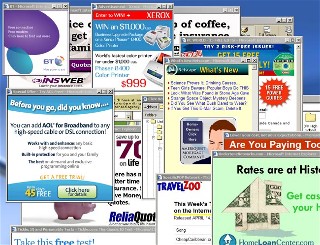
What ever happened to the Internet as the great equalizer, where our disabilities weren’t supposed to matter? How is it now that seemingly everywhere I surf on the web, so-called disability-related banner ads are plastered on my screen, illustrating that someone somewhere has me clearly tagged as a web surfer who has a disability?

My brother-in-law is a computer geek by profession, so he clears my cookies and caches, and all of the other cyber stuff floating around in my machine that can splatter my Dell’s DNA on the Internet. Still, when I log on to sites like Google or MySpace, disability ads blaze across my screen (how is it that the MySpace staff can’t tell a 41-year-old perverted predator from a 14-year-old Hannah Montana fan, but they know instantly that I have a disability the minute that I log on?).

One theory for my getting pegged as a wheelchair user online is that because I visit my own site, WheelchairJunkie.com, that other sites that I visit simply see ”wheelchair” as a popular term in my browser, and cater ads to me accordingly.

Nevertheless, what amuses me is that the so-called disability ads steered toward me as a demographic are always totally wrong. I often get an ad pushed at me for an adjustable bed, with a 70-year-old lady propped up with a fried chicken TV dinner on her lap. Show me a 25-year-old blond, in a bikini, on a water bed decked in silk sheets, and then I might click – but, show me 70-year-olds eating fried chicken in bed, and I’m clicking the other direction in a hurry.

My favorite disability-related ad is one I call “Gangster Guy,” which pops up every time I visit Fox News (which I guess I deserve for visiting Fox News!). I’m so distracted by Gangster Guy’s ridiculous nature that I don’t even know what he’s advertising, but if you’ve seen him, you know who I’m referring to: He’s a thugged-out gangster-looking dude in a wheelchair, complete with baggy Sean John jeans and a Gucci hat swiveled to the side like he just rolled out of an inner-city rehab, gunshot wound and all. Yet, in all seriousness, what disturbs me about the ad is that I’ve been to the country’s inner-city rehab hospitals, where the vast majority of in-patients are gunshot victims who look just like the dude in the ad, many shot as a result of gang affiliations, where they’re not allowed to be discharged in red or blue wheelchairs out of fear that such gang colors will simply get them shot again. So, as charming as a hip-hop disability-related ad may seem, clearly the advertiser has never been to an inner-city rehab to fully understand the demographic portrayed by Gangster Guy.

The fact is, I’m a 36-year-old dad, working a white-collar job by day and pontificating as a writer by night. I don’t have anything in common with old ladies eating fried chicken in adjustable beds or gangsters wearing unlaced Adidas – and I certainly don’t click on such ads.

Nevertheless, there’s still hope for me as a revenue-generating ad clicker online. If the advertisers stop stereotyping me as a surfer with a disability, and slip content on my screen that might tie into my true demographic – men’s business attire, parenting, reading, minivans, bikini models on water beds – then they might sucker me in after all.

Disability Rights or Child Welfare?

motherchild.jpg 

By Mark E. Smith


They say that there’s always two sides to every story, but aren’t the facts still the facts? This is one of those cases – surrounding a parent with a disability, no less.


“A disabled mother fights again for right to raise her child,” is the headline of a circulating news story this week, And, if you’re a parent with a disability like I am, that headline is sure to capture your attention, conjuring natural thoughts of, “You mean someone, presumably a court, isn’t allowing a mother to raise her child because the mother has a disability?”


Then, the opening of the article confirms such a thought:


The first time Sabreena Westphal went to court to try to keep her children, she became a celebrity. Suffering from cerebral palsy and unable to walk or fully use her arms, she was still determined to care for her two young sons. Disabled parents and advocates rallied behind the young woman with the pixie haircut and impish smile who, at the time nearly 20 years ago, went by the name Tiffany Callo. She was the subject of a book, “A Mother’s Touch: The Tiffany Callo Story.” She rode in a limousine to an appearance on “Donahue.”

But the book didn’t come with a happy ending. Her little boys were adopted and taken far from her San Jose home.

Five years ago, she became pregnant again. And now she’s back in court.This time, Westphal, 40, is trying to prevent her 5-year-old daughter from being adopted by a couple in San Joaquin County. This time, she has the Americans with Disabilities Act of 1990 on her side and a political landscape that has changed substantially for disabled Americans.

As if those details aren’t alarming enough, it turns out the Westphal and the father of the 5-year-old have had an additional streak of bad luck, with Westphal having been hit by a car in her power wheelchair, and her child’s father being hospitalized for lupus.Surely, Westphal sounds like a mother with the world against her.

However, as one learns more of the story, another side comes out, one generated more by facts from social workers, courts, and family members than by a heavily-spun disability rights story: Westphal’s disability clearly isn’t the reason why her kids have been taken away. In fact, as reported, Westphal has a 20-year history dating back to drug use, relationship volatilities, a lack of developing a healthy support system, accusations of child abuse, passing her children off to neighbors and family members, and habitually failing to comply with the standards that social workers put in place to care for her children.

Line up Westphal, the disability-rights activists, and the media spinning the story, and it becomes obvious that they’re all overlooking the most important part of the issue: The 5-year-old child’s welfare.In fact, this story isn’t about disability or the ADA at all; rather, this is a story about a child whose needs were reportedly neglected by her parents, including a mother who failed to provide adequate support for all three of her children at different times.

I appreciate that Westphal wants her child back, using disability rights as a soapbox; however, is that really what’s best for the child?

Based on what I’ve read, of course not. The 5-year-old needs a stable, safe, functional, caring home, and, disability or not, Westphal has reportedly failed to meet those obligations, arguably through making poor decisions over and over again.

Beyond my own fatherhood, I’ve known many couples with disabilities raising children, where social workers have never entered the picture. And, there’s no secret to the success of these parents – they simply provide stable, safe, nurturing, responsible homes, where the child’s needs come before their own. These are principals that all appropriate parents follow, regardless of disability.

There’s no doubt that the Westphal story is ultimately sad all the way around, where everyone in the story seems on the razor’s edge of life. However, the real tragedy is the experience of the child. Westphal, by all accounts, has been given chance after chance to turn her life around, and has failed to do so. Yet, the child never had a chance, born into a reported unfit home, shuffled to neighbors and family, neglected by her parents, never to know the parental bonding, trust, and stability that every child requires.

And, that’s where I, as a parent, believe that this case comes into a clear, concise perspective: It’s not about disability rights in the least. Instead, it’s a case exclusively about responsible parties – family, social workers, and the courts – determining what’s best for a child.

That Kind of Dog

dogs2.jpg

By Mark E. Smith 

“Special-Needs Dog Finds Happy Home with Special-Needs Family” – that could be the sappy, sentimental headline to this story. Or, maybe not. 

Indeed, we’ve been raising a new addition in our family, 16-week-old Lola, a French Bulldog that we’ve had since she was 8-weeks old. We’ve been huge English Bulldog fans since getting our archetype of a Bully, Rosie, several years ago, as it’s tough not to love such original characters – licking, lumbering, drooling souls, who just want to hang out with you. So, with Rosie trained and settling in to adulthood – basically sleeping, with intermittent excitement over my coming home from work or dropped food from the table – we thought it was time to get her a playmate, or lounge mate, as the case may be.


However, rather than get another English Bulldog, my wife and I thought that we’d take inspiration from Brad Pitt and Angelina Jolie, seeking to create a kaleidoscope of ethnicities among our Bullies, opting for a French Bulldog. By breed, English Bulldogs are extremely lovable and loyal, but admittedly lazy. In comparison, French Bulldogs are just as lovable and loyal, but more active and comical, with ridiculous Mighty Mouse ears that standup.

After quite a search, we found Lola, who’s everything a French Bulldog should be: Lovable, loyal, and comical as heck, complete with ridiculous Mighty Mouse ears. What’s more, Lola is snow white, with a black ring around her left eye, looking every bit the part of a petite, French version of Petey from the Little Rascals. Oh, and did I mention that Lola is completely deaf?

Lola has congenital deafness that’s genetically linked to her pigmentation – white dogs of her breed are prone to deafness. However, what’s especially interesting to me is that Lola has no clue that she’s deaf.

Now, you’re likely saying, “Mark, she’s a freakin’ dog – of course she doesn’t know that she’s deaf!”

Fair enough, but she’s 100% adept, where deafness doesn’t seem to have any impact on her. In fact, she comes running when we set her bowl down even when she’s not looking – I suppose feeling the floor vibration. The only notable difference between Lola and a dog with hearing is that she doesn’t react to startle noises. A banging hammer next door or a compacting garbage truck gets most dogs riled up. But, not Lola – she remains completely calm, oblivious to such noises, happily playing, sleeping, and hanging out. Surely, in the wild, hearing is a vital sense, a protection mechanism; however, in a suburban home, where she lives a lush life, Lola doesn’t seem the least bit at any disadvantage over other dogs, acting and responding typically, right down to potty training and learning the type of gesture commands that are used for obedience with many dogs.

Of course, the big Bully, Rosie, is oblivious to Lola’s deafness, too – though, sometimes looking puzzled as to why the pup doesn’t awake when she barks at her, wanting to play? Nevertheless, Rosie has caught on to getting Lola’s attention with another sense: A whack with a paw!

Certainly, some people have general hang-ups toward disability, including when it comes to dogs, as I’ve learned. Both English and French Bulldogs of registered blood lines are very expensive, and hard to come by. But, whenever a pup has a disability, as with Lola’s deafness, price and demand drop. Due to her deafness, Lola was about one-third the price of her siblings, and some of our friends even questioned why one would pay for – or want – a deaf dog?

I’ve observed that people’s reactions to dogs with disabilities says a lot about how we view disability in our culture as a whole. The fact is, if I didn’t tell someone that Lola was deaf upon meeting her, one wouldn’t know – Lola’s just an adorable, loving, smart, attentive pup of pedigree. Yet, the minute that we, as humans, label her as disabled, her literal value becomes less. The dog’s own adeptness at living without hearing is proof to me that disability is more abstract and subjective as a label than many of us realize. While disability is very clear-cut in some cases, as with my cerebral palsy, it’s more a projected label on others who are far less physically impacted, and it’s startling to realize how quick we are as a society to devalue even a pet strictly based on the label of disabled.

I absolutely agree that I have a disability, that I’m disabled by virtually any definition, and I have no concern with anyone labeling me as such. But, I can’t say the same about my silly little dog, Lola, whose adeptness and complete unawareness of our labeling her as somehow less capable truly transcends what we call disability. And, there’s tremendous inspiration to watching her live so unabashedly as her entire self – a dog being a dog, hearing or not – unconcerned and unaffected by the social baggage that we humans label as disabled.

In actuality, then, I have to change the headline to a more realistic, less projected tag: “Dog Finds Home with Family.” Sure, there’s no sap in that headline, but at least it’s accurate.

Crazy Like Brett in the New Year

Brett

(Brett pictured with Sophia)

By Mark E. Smith

When I meet fans of WheelchairJunkie.com in-person, they always have a million questions. However, almost everyone asks one specific question, word for word, “Is that guy, Brett, on the message board, crazy?”

“Absolutely nuts,” I confirm. “I’m waiting for him to mail me his severed ear like Van Gogh.”

Of course, in real life, Brett isn’t crazy in the least – but, he is among the most inspired individuals I’ve ever had the pleasure of knowing, where he quietly strives to empower those around him, making his community a better place in the process, day after day, no matter how his life has changed.

I’m not sure how long I’ve known Brett, but my first encounters with him must have been seven or eight years ago. And, I’ve been a fortunate witness ever since to the powerful life journey that he’s lead.

In 1991, Brett was graduated with both a B.S. in biology and a B.A. in art, going on to pursue a doctorate in neuroscience. In 1997, his education goals were achieved, earning a Ph.D. from Temple University. And, in-between, Brett pursued his passion for teaching, pointing to a likely path as an inspired young professor.

However, as you, yourself, may know, there are no certainties in life, no guarantees that if we simply work hard and live well, we are assured of calm futures. For Brett, this reality was presented in the first-person when, in 1997, just one week before receiving his doctorate, he was diagnosed with multiple sclerosis.

By 1999, Brett used a wheelchair and scooter, facing the progressive realities that many with M.S. experience. As I knew Brett through correspondences and meeting up with him at expos, I saw that there were obviously tough changes occurring in his life, the ebbs and flows of romantic relationships complicated by disability, the realization of losing portions of his independence, and the necessity to make changes in his living arrangements due to his progressing condition.

Yet, the more Brett’s life changed, the more focused he became, finding safe harbor in his two truest foundations, religion and art. It was these two passions that compelled him not to let M.S. slow him, but to inspire him. In the 10 years since his diagnosis, Brett has become a fixture in the M.S. community. Not only has he played a key role in championing 21st-century awareness for M.S., voicing the need for more research and a cure, but he’s a tireless volunteer and participant at Good Shepherd Rehabilitation Hospital in Allentown, Pennsylvania, where he helps lead the art-wellness program and raises funds through such activities as an annual M.S. Walk team. In fact, in 2007, Brett embarked on the acclaimed Faces of M.S. Mask Project, an art endeavor in which participants created plaster masks of their own faces, painted as an expression of themselves in light of the disease. Of course, with such a positive outlook, it’s no wonder that Brett is a sought-after speaker, including delivering keynote addresses at M.S. conferences.

Personally, Brett is an artist in the truest sense, his paintings coming from within, the canvas calling him, a passion that is a bit hobby, therapy, study, and vocation mixed in, recognized by galleries, showings, and patronages. And, when not volunteering or working on his art, Brett practices a deep devotion of faith, leading prayer groups and singing in his church’s choir – a clear source of his inner-strength.

Of course, Brett will tell you that much of his success comes from his not being alone on his journey, with unyielding love and support from his parents and family, as well as his best friend, Sophia, his extraordinary German shepherd service dog who’s always by his side as confidant, partner, assistant, and cheerleader.

Despite the countless lessons that Brett’s zeal teaches many of us, what strikes me most of all is that his life prove among my own foremost beliefs: Life doesn’t always work out the way we want, but if we have faith, it does workout exactly the way that it’s supposed to – that is, presenting us with opportunities to learn, grow, and empower, making a difference in the lives of many others along the way.

In the New Year, let us all strive to follow Brett’s lead. Let’s not dwell on what we’ve lost or don’t have, or concern ourselves with what unwanted life changes may come our ways next. Rather, let’s draw upon our strengths and passions, and allow them to lead us toward making a difference in our our own communities and in the lives of those around us. Let us know that although we may not be able to control what happens to our bodies, with dedication, fortitude, and perseverance, we can control the impact that we make in the world – an impact that offers understanding, hope, and empowerment to others.

Conspiracy of Three

I’m not superstitious – except when it comes to the number 3 and wheelchairs. 

Black cats can cross my path all day; I’ll roll underneath ladders without a care; and, my muscle spasms have caused me to break countless mirrors in my life. And, none of it worries me a bit.

But, if I encounter two users with wheelchair issues, I have to close my eyes, and count backward to negative 100. Why, you ask?  Because if I don’t break the curse, another user will experience a wheelchair issue.  After all, I don’t want anyone to have any wheelchair issue, ever, let alone three people.

But, it’s a proven fact that users have wheelchair issues in groups of 3. You’ve heard of people dying in groups of 3, well wheelchairs break in groups of 3, too. I don’t know why wheelchairs have issues in groups of 3, but they do. If someone in Tampa has a battery issue, and someone in Toledo has a seating issue, within ten minutes, I’ll receive an email from someone in Tempe with a funding issue. It’s always 3. Is it completely bizarre? Sure. Does it consistently occur? Absolutely. Read the WheelchairJunkie.com Message Board, you’ll see.

Of course, I’ve tried to figure out the cause of the Mystery Pattern of 3, looking for a scientific explanation – is it based on weather, or the seasons when people are outside more, or during months when more new wheelchairs are sold than others?  Maybe even the lunar phases somehow affect wheelchairs?  But, alas, I haven’t found an answer – at least, not based in science.

What I have concluded is that it’s a conspiracy.  No, I don’t normally believe in conspiracies – but, this one is just that, a conspiracy. After watching Oliver Stone’s JFK, and reading countless books on Area 54, I’ve determined that it’s probably not that wheelchairs break in threes, but that there’s a secret network where users make plans – even scheduling dates – sending me their issues in groups of threes, trying to freak me out (no, I’m not paranoid, either – except, of course, when it comes to people who are out to get me). 

I mean, how else do you explain the fact that Elvis, Jimmy Hoffa, and Amelia Earhart all contacted me the other night about their wheelchairs needing repair?

Sitting Tall

After 33 years of wheelchair use, I recently got my first elevating seat. Surely, I’ve known countless people who have had elevating seats on their wheelchairs with great success, and my company has manufactured them for many years; however, personally, I just never had one.


Environmentally, an elevating seat makes clear sense: It gives the ability to reach high places. Additionally, with the popularity of raised tables and bars at restaurants, an elevating seat increases social access, as well as allowing one to see over standing crowds at concerts and sporting events.


However, what’s truly captured my interest was in the common sentiment that I’ve heard users of elevating seats convey, that being able to look others directly eye-to-eye when elevated, as if standing, was a life-changing experience, for once not having to look up to others.


This expressed benefit of an elevating seat changing users’ literal perspectives on the world intrigued me. I’ve always lived my life quite comfortably and assuredly by using a wheelchair at a visual height of 4-foot-something, so was I missing out on some aspect of sitting taller at 5-foot-something that I never realized – that is, would being taller change the way I saw myself, others, and the world?

Based on all of the remarkable life-changing experiences I’ve heard, I was admittedly a bit nervous elevating for the first time. After all, was I going to realize all that I’ve missed out on by not being elevated all of these years? Would my wife, daughter, and house look different? Or, would I possibly feel different about myself, having greater confidence or esteem by being at literal eye level of others?

Nope. I hate to burst your inspired bubble, but sitting a foot taller makes no intellectual difference to me. I mean, sure I can reach higher places, and being able to sit at raised tables and see over crowds is fantastic – it makes the feature well worth buying. But, perception wise, it doesn’t make a darn bit of difference toward who I am. My wife, daughter, and house look the same to me, and, in fact, I don’t visually see any difference sitting about a foot taller than usual – and I certainly don’t feel any difference.

The fact is, I’ve never felt like I look up at the world or that it looks down on me. In my everyday seated position, socially and intellectually, I’ve always felt on a level field, right down to looking people in the eyes when we speak. Some might say that my view stems from my never having walked, that if I walked, my view from a wheelchair would seem different, like others really were looking down to me. 

I couldn’t disagree more. If one has a complex emotional hang-up regarding disability, a belief that one is less of a person when sitting in a wheelchair than when standing up, of course one will view height as an issue, believing that sitting taller somehow makes them appear less disabled. However, I say that height has nothing to do with me as a person or the extent to which others perceive disability. No matter if I’m a foot taller or shorter, looking at eye level or breast level, I’m still the same person. (And, in the interest of full disclosure, even when I’m sitting at eye level, I’m still predisposed to look at breast level, but only on certain individuals – this proves that added height does not change me for the better.) 

Interestingly, I heard a gentleman note that upon elevating his seat, his wife wanted to dance with him for the first time in 20 years. It is a touching sentiment; yet, it’s completely twisted, too. His wife wouldn’t dance with him at 4-foot-something, but would at 5-foot-something – how is that a relationship to appreciate? If my wife based any of our relationship on my height, not on who I am as a husband, father, and person, I’d skip the new elevating wheelchair, and, instead, look for a new wife! 

In fact, upon elevating the first time, I asked my wife what she thought of my new stance, to which she shrugged and noted, “It looks like an elevating seat to me.” 

No, an elevating seat didn’t turn me into Brad Pitt in my wife’s eyes. But, that’s alright – she’s always danced with me no matter how short and dorky I am. 

The fact is, as terrific as an elevating seat is toward environmental access – and we should all have one for that reason – it doesn’t change who we are. Anyone basing one’s self-worth or esteem on how tall one sits is missing out on a fundamental key to succeeding with disability: We are bigger than our bodies, and it’s not what we see, but it’s how we see ourselves. Sitting tall, it turns out, isn’t about height at all.