The Best Kinds of Crazy

By Mark E. Smith

One of my college buddies was the private pilot on comedian, Howie Mandel’s, national comedy tours in the early 1990s. My buddy’s observation was that Mandel was genuinely crazy, that he never saw Mandel waiver from his on-stage persona, that on the jet, Mandel would simply waffle between being hysterically funny and clinically irrational. In fact, Mandel billed himself as “a wild and crazy borderline psychotic.”

Of course, we now know that Mandel publicly discusses one of his diagnosed mental illnesses, mysophobia, an irrational fear of germs. Yet, based on my buddy’s stories and Mandel’s over-the-top persona, it’s reasonable to wonder if Mandel has other conditions, as well?

Interestingly, the psychology community has been studying a link between mental illness and very successful people for two decades, and their findings are fascinating. “Hypomania” is a persistent mood that causes an exaggeration of thoughts that’s most often linked to bipolar disorder, where one can be energized, euphoric, overflowing with ideas, extra social, and a risk-taker. These traits may not only be seen in those suffering profound mental illness, but are also seen in extraordinarily successful people. After all, from show business to entrepreneurial business, being energized, euphoric, overflowing with ideas, extra social, and a risk-taker are all traits that allow one to succeed where others would fail. Therefore, there is a debate in the psychology community that certain kinds of diagnosed mental illness may not be “crazy” at all, but actually an evolutionary advantage.

I’ve witnessed this similar phenomena in physical disability terms, where physical disability isn’t debilitating for some, but actually elevating, where their lives aren’t restricted by it, but empowered.

What’s extraordinary about physical disability is that if we’re to succeed, it requires us to more intently focus on abilities, where our lives aren’t about what we can’t do, but what we can do. The average person without disability goes through life with a fairly fixed outlook toward what’s possible, rarely questioning it, rarely recognizing the chances that present choices.

However, when it comes to physical disability, we’re forced to question at points in our lives, Can I do that? – and, what’s remarkable is that the question most often leads to, How do I do it? which leads to accomplishing what was once thought impossible. So, this progression of constantly questioning what’s possible leads to never-ending expansions of our lives, where the possibilities eventually become endless, where we forget about the initial question of, Can I do it?, and begin only asking, How do I do it? And, it’s at that point that we see nothing but potentials. Put simply, while other people stop at what’s practical or seemingly rational, we intrinsically push ours live much further, toward what’s truly achievable on a scale that others don’t fully grasp. In ways, we may seem crazy.

And, because we can live on such a larger scale, where …well …anything seems possible, it can perplex those without disabilities who live strikingly limited lives. When someone questions how you do something, or sees your goals as unrealistic, it’s not reflective of you as one with a disability – again, you think and live on a larger scale than most! – but it merely reflects the closed mindsets of those who haven’t had the opportunity to become so visionary.

Indeed, physical disability intrinsically opens us to possibilities, proving not a limiting factor in our lives, but truly an unlimited factor, where what some inaccurately define as debilitating is ultimately liberating. And, surely there’s enormous value, reward, and blessing to living in a counter-intuitive realm, where crazy can prove a higher level of sanity, and physical disability can prove a higher level of ability.

Moments In Time


(Mom and me)

By Mark E. Smith

I’m having lunch in Club 33 in Disneyland – and I’m with Amy, who my friends have only known from reading about her in my first book, published in 1995, 6 years after I graduated high school.

But, now it’s 16 years later after the publishing of that book – and 22 years since I last saw Amy – and in an uncanny twist not lost on me, we’re in “The Most Magical Place on Earth,” eating lunch at the hidden, exclusive Club 33, where a friend of mine has been kind enough to get me all-but-impossible reservations, jumping a 14-year waiting list, per Disney hype.

I struggle more than ever with the validity of my first book, and I’m glad it’s long out of print. Its title, Growing Up With Cerebral Palsy, was way too literal and boring for me as my childhood autobiography, but the publisher insisted that it would sell well to libraries and schools – and he was right. And, I dislike its simplistic, diary-type writing style – yet, people still note it as candid and enduring.

However, what troubles me most about the book is the emotional place I was in while writing it, where I was still struggling to come to terms with my mother’s profound alcoholism.

What’s haunted me is that while all other “characters” in the book are treated as they truly were, from my alcoholic father, to Amy, my high school crush, not a word was mentioned of my mother’s alcoholism – I painted her as a one-dimensional saint. The progression of her alcoholism was so painful to me at the writing of the book in my early 20s that I went from writing of her as a heroic figure raising a child with cerebral palsy to not being able to write about her at all. If you read the book cover-to-cover, my mother simply disappears by the end, an unexplained absence. It’s a book that’s both strikingly candid and full of absolute denial – and I’ve fought with that truth since the day it was published.

And, here I am, 16 years later, having lunch with Amy, my high school crush from the book, at Club 33 – and my mom is dying of cancer, her apartment being cleaned out and her cremation arrangements made. And, all of this is weighing on me. Amy thinks I’m tired from our being up all night talking, and I am, but I’m also struggling to both live in this amazing moment with Amy who’s just here for me without conditions, while simultaneously struggling with the fact that my mom is 3,000 miles away dying. It’s all just emotionally whirling around me like the constant visuals of Disney, itself, never knowing where to look because it’s all larger than me – overwhelming.

I haven’t had a real relationship with my mom in about 15 years. The initial royalty check from my first book went toward my mom’s stint in rehab where she chugged a 5th of vodka between there and coming to see me upon her “successful completion.” I’m sure now that my naive – but well-wished – attempt at her sobriety (and the many others), was just me trying to make things right – my mom’s health, the sentiments of the book, the sober relationship with my mom that I so desperately wanted. But, I never did make it right, I never found a way to sober-up my mom, not for my graduations, wedding, or the birth of my daughter. In my rational mind, I know now that only my mom could make things right through pursuing sobriety – but the loyal son in me still feels that I let her down in some way, that if I could do so much for myself and others, why’d I forever fail at helping my own mom?

And, what cuts deepest is that my mom didn’t fail me – she saved me. She was a troubled 20-year-old, with a son born with cerebral palsy, and when the doctors told her that there was no hope, that she’d best leave me to die, she took me home and somehow pulled it together to keep me alive. Yes, by the time I was 7 or 8, her addiction had the best of her – and, as a father, myself, I can’t fathom how she put alcohol before her children. But, in the most vital days of my early life, she was there for me – the only one. That can’t be overlooked or underrated in any narrative.

I previously saw my mother just a few days earlier at my sister’s wedding. She was a frail skeleton of herself – all treatments done, just waiting to die. My sister went through great lengths to make sure Mom had a custom-tailored dress, her hair and makeup done, looking like a woman of eloquence, stunning. And, yes, she was drinking. And, for once it was OK – it was all OK. I can no longer judge her; I can only love her for who she is, unconditionally, as she did for me over 40 years ago.

“I’ve never seen you look more beautiful,” I told Mom at the wedding, just living in the moment, all of our past erased by her just being there, my seeing her just as her, unconditionally.

After our lunch at Club 33, Amy and I caught up with the kids, and rode the rides with them at Disney, all in a magical universe. Later that night, Amy and I simply stayed up talking, our kids tucked asleep, where for a moment in time – two imperfect people trying to make sense of such present changes in our lives – we were just there in completeness for each other, ourselves, unconditionally.

The next morning, I awoke to my daughter singing as she packed. Amy was gone, having caught an early-morning flight. Her perfume was still in the air, a reminder of what had been for a moment in time. I had to put on a good face for my daughter, and while it took all my emotional might, I managed to get up and going. I had to go back to a reality where my mother was dying, where I was essentially a single father in a failed marriage, where I didn’t know if I’d see Amy again in a month, 22 years, or ever. But, I had to go back home, home to address it all.

I put on my Ray Ban sunglasses, heavy and dark, swung open the hotel room door, and headed out into the world – one that’s not perfect or fair or even understandable at times. But, at least I was re-entering a world where I was a more feeling man.

Upon returning home, my schedule for the work week was busy. I had a Medtrade planning committee project due and a conference call; I had a radio interview to do; I had a mid-week overnight trip to New York City involving a speaking engagement; I had all of my normal office duties and WheelchairJunkie.com responsibilities to tend to; my wife was supposed to be moving out of the house per our split-up; and, I had my daughter to care for. But, I could easily handle it all – just get it done, task by task, as always.

But, my mom was still dying. And, as much as I thought all was made amends just two weeks earlier at my sister’s wedding, I had to speak with her one more time – and on the deepest level. What was said and recognized at the wedding wasn’t enough. There was more to be said, to be healed. And, so in the middle of a crazy work day, I grabbed my cell phone and called my sister.

“I need to see Mom and talk to her tonight,” I said. “It has to be tonight.”

“She’s not doing well at all,” my sister said. “We can try to get you over there tonight, but she may not be totally with it. The hospice says she’s not doing good at all.”

“I don’t care,” I said. “I just need to see her, and tell her something.”

The day past, and by evening, my sister called, noting that Mom wasn’t doing well still, that in the next morning, she’d be moving into my sister’s for her final days, with home hospice care – the way my sister wanted it. But, inexplicably to all of us, my mother wanted to speak with me, too, and wanted to join us for a family meal, despite her inability to eat.

We made late reservations at my favorite restaurant, where I’m known, where I’ve frequented every week for quite some time, where I’m comfortable having the deepest conversations over dinner and drinks with friends, where birthdays have been celebrated, friendships strengthened, and good-byes to leaving colleagues have been said. If I was to speak with Mom, it was a comfortable place to do it.

But, as I drove to meet my sister and mom at the restaurant, I was more scared about what I was going to say than ever in my life. I’ve met with the President of the United States; I’ve done countless interviews; and, I’ve spoken in front of countless groups. But, this was different, rattling to my core. How do you look at your dying mother after so much tension and pain between you, and definitively express your ultimate gratitude and love? How can that ever be put into words?

Sitting at the table, bread and drinks served, I just followed my heart. “Mom, I wanted to talk to you not because you’re dying, but because you’re living,” I said, putting my arm around her. “Despite all that’s gone on, you were there for me at the toughest point in my life, when no one thought I would live, and you pulled me through – and I can’t express my love and gratitude enough for what you did for me.”

My mother saw my tears and stopped me there. And, in a moment I never expected, with a sobriety I hadn’t recalled in her since I was very young, she explained her side of it all – her regrets, her shortcomings, her absolute remorse toward the life she led and what she put us through. And, in the greatest act of kindness I’ve ever witnessed, she – too frail to walk by herself, eat, or talk above a slight whisper – made every effort with her words to apologize to me, my sister, and my daughter, one-by-one. A woman who long lived among the most selfish lives – which is what addicts do – used among the last moments of her life to offer among the most unselfish acts, all on her own accord, apologizing to her children, trying to make things right while she still could.

As tears flooded the table, our salads were served, and my mother asked, “Marko, do you need a spoon for that?”

And, for a split second I chuckled – after all, who eats salad with a spoon? But, then I realized that my mother literally went back to being my mother at that instant, where around the age of 5, when I was learning to feed myself, I could only manipulate a spoon, not a fork. And, although I’ve eaten with forks for decades now, my mother had taken us both back to a specific moment in time, before her world disappeared into a bottle of vodka, when she was just my mother, unconditionally.

“I’ve got this covered, Mom,” I said, picking up my fork.

At this writing, my mother is passing. For me, our life is like bookends: Yes, there was a lot of complexity in our lives in-between my birth and her death; but, on each end she gave my the greatest gifts of all – life at the beginning and healing at the end.

I Refuse….

By Mark E. Smith

I refuse to be that guy, the one in the wheelchair, who strangers see rolling from here to there – crumpled-up and bound. No, I’m flying by, with bulging biceps and a tattoo that say, You can’t define me, so F- you and F- him, too.

I refused to be pigeonholed, stereotyped, or discriminated against – because, while I can’t kick-in doors with my legs, I can obliterate them with my intellect, where I will outwit, out-charm, and alarm with an I.Q. that will rock you like The Who trashing a stage.

I refuse to be dismissed – swinging palsied fists when I get pissed – and when I say I’m going to do it, you better step back, stand away, and make a path because I will not stop till it’s done, son. The ticktock of the clock tells me to do it better, faster, more accomplished, like I’m a man on fire trying to outrun the flames, where my disability is empowerment, not an object of shame.

I refuse to be undesired – my game is my attire – where I smile while chugging a double of Southern Comfort at a bar, with a swagger that women must admire – my distinctions aren’t distress but a cut above the rest. Man, I love her in that low-cut, red dress.

I refuse to sing the blues or follow the rules that say disability is tragic. In my mind, it’s a blessing of magic, where I’m different as you can see, and I refuse to be anyone but me – and I dare… you heard me… I dare to disagree.

Yeah, World, as you may or may not see… damn… it’s good to be me, no matter what you think of my dis-a-bility.

Will It Kill Me?

By Mark E. Smith

Is it literally going to kill me – and, if not, then I’m going through with it for my own betterment and growth. This is the code I strive to live by.

I’ve most recently been tested on this mindset, where I’ve admittedly become obsessed with riding my 6-wheel-drive, amphibious ATV on the 110 acres adjacent to my home. After my obligations for the day are done, I go out to my garage, put on full moto gear, fire up the ATV, and roar up the “Mountain Trail,” as I’ve nicknamed it. I’ve been getting faster and faster on the wooded trail sections, seeing how quickly I can slalom around the oaks without nailing a tree; and, I climb and descend hills too steep and tall to walk up or down.

At times, maybe I’m pushing myself and my vehicle to the very limits, where I drive up to the edge of embankments so high and steep that I can’t see the Earth past my ATV’s hood – just the sky straight ahead – and I summon the courage to simply drive off, where I trust that my driving skills, my vehicle, and the terrain will allow me to make it down unscathed. And, no matter how risky or uncertain a circumstance has seemed, overcoming my fear and tackling terrain I never imagined that I could, has never let me down, proving enormously liberating, where I’m pushing my mind and body far past previous barriers, to great personal growth, where if I can overcome fear and obstacles in my ATV, it carries over into my everyday life. If it’s literally not going to kill me – flying cross country alone for business, giving a talk in front of hundreds of people, being as open and honest as possible with those around me, tackling a seemingly impossible independent living skill, driving my ATV off of a several-hundred-foot-tall embankment, or any other anxiety-filled life experience – I’m going to do it, period. After all, if it won’t literally kill me, then there’s no valid excuse not to push myself forward.

Interestingly, I’ve observed that the process of moving forward once in motion is easy – it’s summonsing the courage to make the decision to initiate momentum in life that’s hard. Trust me, I’ve sat atop embankments – both in my ATV and in life, wanting to twist the throttle and just go for it – where fear had a grip on me, daring me to overcome it. Yet, once I’ve said to heck with fear, and just gunned it, my life in any circumstance has flourished. So, it’s the “saying to heck with fear” aspect that really proves the hardest part of change and growth. Life is really just one, big twelve-step program, where committing to the process of change is the hardest – and most crucial – part.

A lot of times we know what we should do – or must do – but committing to doing it, where we know there’s no turning back, can prove the hardest moves we ever make. It’s among the scariest questions in life – that is, should I or shouldn’t I? – in committing to decisions. I recently had the amazing opportunity to participate as a volunteer at an adaptive water sports clinic by Champions Made From Adversity in Georgia – a fantastic organization. Our crew was one of around six boats pulling those of all types of disabilities on tubes and sit-skis. What astounded me was that, as a seasoned boater myself, I know lots of “able-bodied” people who won’t tube or water ski out of fear. Yet, there I was in Georgia, with peers of all ages and disabilities, who were overcoming all fear to simply tackle what in many cases they never imagined doing – that is, with limited use over one’s body, putting one’s trust in a situation that was literally dragging them into the unknown: Heading out into a gigantic, deep lake at speed, bucking and bouncing, not knowing if they would drown (lifeguards on jetskis did parallel every run, so when someone fell out, rescue was immediate).

What I witnessed was that not only wasn’t anyone harmed – even when they fell out! – but the participants were actually empowered by the experience of overcoming their fear. Make no mistake, some were terrified getting in the tube – it was the hardest part of the process for them – but they still did it. And, we had the privilege of watching their lives change at 20 mph behind a boat, where they realized the liberation of, If it won’t kill me, I’m going to attempt it in an effort to better myself, even if I’m initially terrified.

Just like those with great trepidation to get into the tube at the adaptive water sports clinic, I’ve sat atop harrowing embankments in my ATV, hand on throttle, for minutes at a time, where it’s taken all of my courage to simply gun it, dropping into the unknown – but, I’ve always done it, landing tougher and more confident at the bottom. Yet, what I’ve grown to know is that overcoming short-term fear and stress is the catalyst for long-term growth and success, that getting past fear leads to liberation, no matter in the physical, emotional, or interpersonal. Much like I’ve learned that I can survive descending and climbing through the steepest ravines in my ATV, I can do the same in life, where overcoming initial fear will bring me to amazing vistas.

I wonder, what are you not tackling in your own life simply out of fear of the unknown? If you attempt it, will it literally kill you? If not, then there’s truly nothing stopping you from pursuing what you’ve thought too impractical, scary, or impossible – you, too, can summons the courage, no matter what you’re facing, to not just tackle the unknown, but to actually thrive in the attempt. Once we push beyond anxiety toward change – albeit, physical, emotional, interpersonal, or all in one – and propel ourselves forward in positive directions, the personal rewards are astounding: Vistas in our life appear that we never knew existed.

The No-Excuses Generation

By Mark E. Smith

At some point – maybe 15 or 20 years ago – the meaning of disabled became blurred to me as I began recognizing the seemingly unlimited potentials in my life. And, in more recent years, the meaning has become all but moot to me, merely definitions in medical books, as I’ve widely witnessed the truly unlimited potential in others’ lives, those who have achieved enormous success in every facet, regardless of disability.

Sure, if I put myself in the shoes of someone who doesn’t know anyone with a “severe disability,” I understand that his or her perception of disability – or, lack thereof – is pretty grim, with stereotypes of our living limited lives in countless ways, full of dependencies on others, from our families to the government.

And, while these stereotypes may hold true for some with disabilities based on any number of circumstances, there’s a fascinating segment of individuals with “severe disabilities” where limitations and dependencies aren’t the case at all – that is, where disability isn’t disability, where beyond a medical diagnosis, the scorecard of one’s life simply transcends what one might define as disabled, entering the realm of even exceeding the mainstream’s definitions of success.

While many credit the ADA in 1990 as a social door-opener for those with disabilities, it was truly 1970s legislation and that era’s independent living movement in the U.S. that created a generation – born between 1965 and 1975 with “severe disabilities” – who came into a society of every-increasing opportunities, and were encouraged by the spirit of the 1980s and 1990s to fully use every resource they could access. Therefore, we’re now seeing many between the ages of 35 and 45 – born with “severe disabilities” – living such successful lives that it truly questions the common wisdom of what it means to be “disabled.” When we look at the demographics of this generation (a notably small group compared to the overall disability population), it’s statistically distinguished from younger and older generations of those with disabilities based on education level, employment success, wealth-building, physical independence, social status, community involvement, and committed relationships. Indeed, you might say there’s a new generation of young, upwardly-mobile professionals (yuppies) – and they have disabilities.

An example is a family I know who’s truly living the American dream – custom home, pool, luxury cars, children attending a private school, vacation home, easily pulling in a 6-figure income. Oh, and the husband has very severe cerebral palsy. Because of the sensitivity of his position, I can’t tell you his job, but he’s high-up in a certain branch of the government. I recently jokingly asked his wife what she saw in a schmuck like him, and to my surprise, she gave me a candid answer: “I wanted a perfect 10. All my friends were willing to settle; but, I knew I wanted it all,” she told me. “He had to be smart, worldly, a great listener, respected by all, a hard-worker, a great father, and someone who was secure enough to support my dreams, too. And, I found it all in him, my perfect 10.”

Her ability to look at the complete picture of her husband, not his medical diagnosis, is such a profound insight – and it’s the same insight that’s defining this generation that’s arguably transcending “disability.” Put simply, this generation of those with disabilities isn’t dwelling on “disability,” but looking at the whole of life, where limitations are replaced by abilities, where dependency is replaced by independence. And, the results are astounding, where many with severe disabilities haven’t just beat all of the grim statistics of those with disabilities living in America – as in lower rates of education and higher rates of unemployment and poverty – but actually exceed the mainstream when it comes to education, income, and social mobility.

Interestingly, beyond a visibility to friends on social networks like Facebook, this generation generally avoids the limelight, not partaking in inspirational stories on television or boasting of their accomplishments in public venues. Instead, there’s a quiet humility to their successes, where they are the families next door. They demonstrate that they’re not out to prove anything to anyone, but that they’re simply living their best because it’s the right way to live, regardless of disability.

The question, however, remains: How has this generation reached the higher rungs of status and economics with inherently severe disabilities?

Again, the answer includes a combination of timing and mindset. The 1970s cracked the door of opportunity for those with disabilities, and this generation burst it wide open, seizing every opportunity in sight. Disability wasn’t seen as an obstacle, but just a trait, where all other abilities, talents, and opportunities superseded it. As one of my buddies put it, ”I wasn’t worried in the least about my spina bifida in college – I was focused on building a career.”

And, it’s a mindset that we all can learn from: Disability doesn’t have to be a defining state or ultimately limiting condition, but, in many ways, just a label – a label we can choose not to represent who we are. That is, we can have a disability, but not be “disabled” by it. As another friend of mine put it, “Why would I choose to be disabled when, with some effort, I can be educated, employed, wealthy, and in love – and then just have disability as a sidebar to it all?”

Telling Our Daughters

By Mark E. Smith

As the father of a 14-year-old, I often find myself in an odd predicament. Whenever I show someone her picture, or she’s with me at an event, people graciously note how beautiful she is. And, while I sincerely appreciate such comments, thanking them, I never really say what I’m thinking: You really have no idea how beautiful she is.

See, as with all 14-year-old girls, my daughter’s beauty isn’t based on her exterior facade that conforms to a symmetrical face, slim stature, and flowing hair that pop-culture idolizes, but a beauty that’s within – that which is inherent within all young ladies. My daughter exhibits remarkable loyalty to her friends, where her sense of popularity at school isn’t about who wears what, or who knows whom, but that everyone is her friend, where she reaches out to others based on the quality of their characters, not so-called “status.” And, she exhibits a remarkable sense of empathy, where if one of her friend’s family is going through personal struggles – divorce, job loss, abuse – she finds ways that she can help comfort that friend in times of need.

My job, of course, as her father is not just to support my daughter, but to have very direct conversations with her about how proud I am of her, that she’s inherently beautiful, that I want to support her growth into a strong, independent, emotionally healthy young woman. Researchers have proven that a woman’s most formative years toward her lifelong self-esteem and identity are in her teens – and it’s a make-or-break time for fathers who will shape, for better or for worse, their daughters’ identities.

Yet, our obligation toward building life-inspiring self-esteem in young ladies in their teens can’t stop with our own daughters, but must be extended to others we meet. The fact is, when women enter their 20s with low self-esteem, it’s often too late for any of us to have an impact. We know that low self-esteem established in the teen years often manifests itself in a woman’s adult life through destructive relationships with men – from as subtle as being controlled and having little voice in a relationship, to as blatant as abuse – and through alarming forms of “self-medication” ranging from drugs and alcohol to promiscuity. The fact is, when women need outside stimuli to feel validated, as opposed to simply knowing their intrinsic strength and beauty from within, so much of their potential is lost, where no matter how much we strive to help such an adult woman recognize her inherent beauty, the emotional scars are usually so thick that it’s among life’s toughest hurdles to overcome.

It’s for these reasons why we should all reach out to young ladies in their formative teen years, where they’re still open to seeing their intrinsic beauty, where as mothers and fathers, aunts and uncles, teachers and coaches, we should never pass on showing a teen her intrinsic beauty while we still have the opportunity to truly make a difference with strikingly simple but vital words of encouragement.

As a father himself, Rene Szalay of Ki Mobility, recently presented me with a remarkable opportunity to hopefully make a difference in a young lady’s life. I first met Rene 22 years ago at an adaptive sports camp in Chico, California. I graduated high school a few weeks before the camp, so it was my first real foray into the “wheelchair world.” Rene, however, was four years older than me, and a literal star in the wheelchair tennis world. At the camp, I witnessed how the teens looked up to Rene, and I realized the impact that we can each have on the young people around us – it was a powerful lesson in inspiration. For the following 22 years, I never crossed paths with Rene again; yet, his presence at that camp stuck with me.

Recently, while working an Abilities Expo, I joined fellow mobility industry colleagues after hours – everyone usually hangs out together regardless of our companies and roles – and Rene was among this particular group, gracious enough to note that he is a bit of a fan of my work. As I’m typically wound a bit over-the-top, I ended up horsing around with the group, and didn’t get a chance to see if Rene remembered Chico, 22 years earlier? However, the following day, true to Rene’s character that I recalled, he showed up at my booth with a 14-year-old young lady and her mother, noting that they really should speak with me. I had no idea what it was about, but I know that guys like Rene and I put people before products, and if he left his booth to bring the daughter and mother to my booth, it probably wasn’t product-related.

The young lady had cerebral palsy, and used a manual wheelchair. In typical 40-year-old-dad fashion, I asked her what her favorite subjects in school were and such – the cliché questions we use to build some rapport. However, eventually what came out was that she was struggling socially in school, that she didn’t feel like she fit in as the only one with a disability among her classmates. I told her a bit about my being the lone student with a disability when I was her age, and how my own daughter and her peers likewise struggle with questions of identity, that other young ladies feel just as insecure, but some just hide it better than others (adults are no exception at that, either!). Yet, what I mostly discussed with her was who she really was, loving Shakespeare and classical music – amazing for a 14-year-old. And, as I told her, I was in awe of her intellect and wisdom, that beyond her adorable appearance – complete with pink highlighted bangs on her blond hair – her inherent beauty shined, that there was no doubt that she would go on to do great things. “Concentrate on developing who you truly are, avoiding the no-win game of trying to fit a made-up social mold,” I shared. “Being exactly like everyone else in life gets us no where – we just blend into a crowd, or live to other people’s bland standards. But, being yourself, where your unique gifts and beauty shines, is where you thrive in the world. You are beautiful, just as everyone is in their unique ways, and your intellect and wisdom are going to propel you to an amazing, impacting life. …It only gets better from here.”

I’m known for pulling people aside and having extremely candid conversations, where I’m not bashful about laying the cards on the table if I see someone struggling in emotional pain or going down destructive paths, where I’ll share that there are healthy ways to get one’s life back on track. Again, though, with adults, such talks usually have little effect beyond the moment because one person’s caring can’t overcome the other person’s lifetime of pain – serious work must be done, and few adults have the capacity, tools, and will to shift their lives (and when it is done to a meaningful level – ridding dysfunctional behaviors – formal counseling is typically involved).

However, we know that the door is still wide open on teenagers, where adult mentors can show a 14-year-old young lady her inherent beauty and it truly registers. If you have a young lady in your life, don’t pass on those moments that emphasize her inherent beauty, where you help polish the strengths that she’ll use to live a healthy, happy, impacting life.

Right-Brain Thinking

By Mark E. Smith

When considering the human brain, most picture a single, sponge-like structure, all within a protective housing – the cranium – that’s little more than the size of a melon.

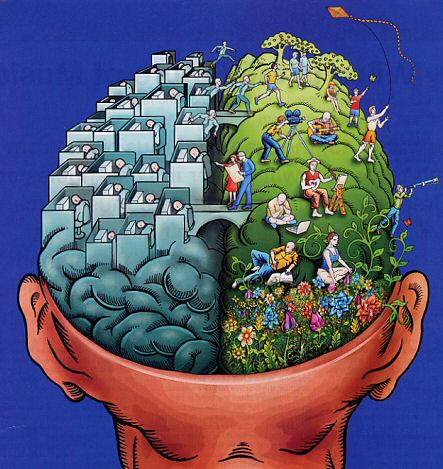
However, what many don’t realize is that the brain isn’t singular, but literally plural – that is, two distinctly separate halves (known as the left and right hemispheres), that communicate with each other to the totality of 1,000 trillion synaptic connections, but, in fact, think very differently from one another. And, when we understand how the two hemispheres of our brain think – that is, the very distinct lateralization of brain function – we better understand how we process events and live our lives, disability and all.

The left hemisphere is our memory bank, you might say. It thinks in a linear, analytical fashion, putting together the past and imagining the future to form methodical thoughts. When we dwell on the past or ponder the future, it’s our left hemisphere at work.

To the contrary, the right hemisphere doesn’t concern itself much with the past or the future, but is about the present, the here and now, the inspired moments in our lives (though, there is evidence that clinical depression is based on a hyperactive right hemisphere that distorts the way the mind intakes information, inherently turning to pessimistic, negative, nonconstructive thinking styles). When we are caught up in a moment, where our sole focus is what’s happening in the present, our right hemisphere is in affect.

In many ways, then, our left hemisphere is the weight of the world on us, with all of our past and future concerns flying around in trillions of stress-filled synaptic connections, whereas our right hemisphere is just glad to be here, taking in the moment.

When it comes to disability – and much of life, really – the right hemisphere is truly what we should primarily run on, the single cylinder that’s about the here and now. After all, when we hear of others’ discouragement with disability and life, so much of it is based on pain of the past, and fear of the future – it’s the left hemisphere tying one’s stomach in knots. Therefore, shifting from left-brain thinking to right-brain thinking frees us of many of the emotional burdens holding us back in life, keeping us centered and inspired in the present.

Interestingly, most clinical treatment of psychological or emotional trauma (both common elements in disability experience, as well), strives to move us from holding on and constantly reliving the past, to truly living in the present, where the original trauma no longer impacts our daily lives. That is, moving beyond trauma involves a shift from left-brain to right-brain thinking, where we’re not haunted by the past or dreading the future, but truly living in the present – our lives liberated, all baggage left at the door.

And, we do obtain striking clarity and room to breathe when we shift to right-brain thinking, where with the exception of being in the midst of a freak accident or trauma in the immediate, life in the present is a whole lot more relevant and comfortable than dwelling on the past or fearing the future.

Now, the fact is, it is hard for us as humans to make the shift from left-brain to right-brain thinking, especially when we’ve experienced trauma. We’re statistically prone to left-brain thinking after having experienced many forms of trauma, where we seek left-hemisphere life paths that lead us to dysfunctional behavior (a clinical basis of “post traumatic stress disorders,”), that causes us to indirectly relive the trauma over and over. We know that women who were abused as children are more likely to be in abusive spousal relationships as adults. We know that men who had alcoholic fathers are far more likely to be alcoholics as adults. And, we know that many with disabilities can get caught up dwelling on the origin and impact of their conditions or illnesses, frozen in time. In plain language, although we know that the traumas in our pasts are over, our left-brain thinking keeps us stuck reliving the experience – often literally recreating it through life choices.

The true magic of shifting to right-brain thinking, however, is that it proves that our traumatic pasts can be just that – our pasts – having little effect on our present (where distressing memories are essentially updated with more relevant thoughts in the here and now). In my late teens and early 20s, I was haunted by my father’s having walked out on my brother and me when we were kids, where I desperately wanted answers – my left-brain thinking was torturing me. However, the birth of my daughter was a wake-up call, where in a very cognizant way, I recognized that I had to shift from my left-brain anxiety about not having a father, to my right-brain focus of being a father. And, it was at that moment – where I made the decision to stop living in the past, and focus on the present – that my life changed, that a weight was lifted from my shoulders. My father died without any sort of closure for me – there wasn’t the happy ending or clear-cut answers I’d long wished. However, I was – and remain – at peace with that because my adult life isn’t about my father, but is wholly about my being a father, where my right brain is in full affect, having cherished every day of the past 14 years with my daughter.

The question as a whole, though, remains: How do people realistically shift from left-brain, stress-filled thinking to right-brain, content-in-the-moment thinking? After all, many of our careers and lives demand that we live very left-brain lives, where reminders of the past and objectives for the future are intrinsic to our lives. And, in cases of trauma like an accident that’s caused disability, the disability in itself can be a constant trigger, reminding us of the past or raising questions for the future.

Researchers know that right-brain thinking is both kinetic and holistic – it’s what’s fully engaging our bodies and minds at this moment. The reason why adrenalin-based activities like exercise or sports are so stress-relieving is because they’re right-brain oriented – you’re not concerned about the past or future when you’re simply trying to bench press one more rep. Similarly, creative endeavors require right-brain thinking – as I write this, I can’t be plagued by the past or future, as I’m in this moment, creating this sentence. Therefore, finding areas in our lives that inherently require using our right brain – simply listening to music is a great one! – are invaluable toward relieving stress, and keeping us in the present.

In my own life, where my career is left-brain based – where I can often feel like everyone’s mobility issues are on my shoulders, where the emails and such never stop – I’ve evolved aspects of my life toward right-brain activities, where they naturally balance my life. My daughter and dogs are constant sources of right-brain, in-the-moment focus, as is working out, boating, and reading. As one living in a left-brain world, so to speak, I’m able to find great reward and relief in the right-brain parts of my life.

Indeed, we can hold on to that left-brain thinking, where its catalog of memories – especially the traumatic – fill our lives with anxiety, fear, and destructive paths, leading us no where fast. Yet, we’re presented with a miracle of the mind, where our capacity to use right-brain thinking liberates us from the past, and places us in the present, where we don’t just survive, but thrive.

Listen to your right brain, where the past truly is the past, and the present has all the potential to be whatever you make it. After all, living in the here and now, making the most of this day, is the most rewarding place to be.

When Disability Becomes Humility

By Mark E. Smith

In Buddhism, humility is associated with being liberated from any suffering or anguish in life. In Christianity, humility is defined as recognizing one’s own defects, and holding a humble opinion of oneself. And, in Islam, humility translates to surrender.

Indeed, virtually all of the world’s religions feature humility as an ultimate goal of mankind, and its essence is best defined by Chan (Zen) Master Li Yuansong: “Enlightenment can come only after humility – the wisdom of realizing one’s own ignorance, insignificance, and lowliness, without which one cannot see the truth.”

Not unlike world religion, disability also contains humility as an ultimate form of being, where we recognize our limitations not with resentment, but with gratitude. And, it’s that gratitude – our humility – that allows us to have grounded perspectives in life regarding what’s truly important, where life can prove to be more about our connections with others, and less about status or materialism or physicality.

At the core of humility is humbleness, and few plights in life are more humbling than living with a severe disability. While those with disabilities are not precluded from achieving the trappings of the ego – recognition, success, wealth, and so on – disability is remarkably grounding for many, far canceling out any pretentiousness in most cases. For example, one may be very blessed with a well-paying career and success, but that doesn’t alter the reality that having to rely on others for physical care is a universally humbling experience.

However, the humbling realities of disability don’t have to be troubling as some express, but can actually be liberating, increasing our capacity to connect with others, our humility. Again, rooted within humility is the wisdom that none of us are of ultimate strength or infallibility, but that we all have weaknesses and needs. Put simply, disability, by nature, allows us to inescapably see our weaknesses – which is actually a strength – giving us the humility to respect the plights of others beyond our own challenges.

I was recently working the Abilities Expo in downtown Los Angeles, and had a wonderful walk each morning – about a mile and a half – from my hotel to the convention center. The weather was beautiful, so it was a refreshing start to my long days by racing my power wheelchair past the skyscrapers of downtown, weaving my way through crowds of commuters on foot and darting across hectic, traffic-filled intersections.

One morning, I came upon a homeless man sleeping on the sidewalk. He especially stood out to me because he was exceptionally dirty, with no possessions, sleeping on the bare concrete – a contrast to the many other homeless that I saw who had sleeping bags and shopping carts full of clothing and such. With so much going on – racing to a trade show, city traffic buzzing around me – his presence literally brought my world to a halt.

With time to spare, I went in the coffee shop around the corner, bought two breakfast sandwiches, two cartons of orange juice, and grabbed a straw. I then returned to the homeless gentleman, waking him up, offering him breakfast. He didn’t say much, but he accepted the breakfast sandwich and juice.

In my shirt and tie, I sat there with him, carefully eating my breakfast sandwich, as not to spill on my clothes. I didn’t, however, open my juice because it was beyond my dexterity – I reckoned I’d save it until one of my colleagues at the convention center could open it for me.

We sat there silently eating – folks passing us on the sidewalk – when, suddenly, the homeless gentleman took my orange juice carton and straw off of my lap, opened my juice, put the straw in, and observantly gave me sips on queue, following my bites.

What struck me was the remarkable humility in the gentleman. Although he was more down on his luck than arguably anyone in Los Angeles – and who knows how or why? – he still had the humility to recognize my needs, graciously serving me my orange juice when I could not. No, I can’t entirely explain why I stopped in my tracks that morning to have breakfast with that gentleman, but I know that it fit somewhere in my disability-based understanding that my plight in life is no more worthy than anyone else’s, that if I was to have breakfast, so should the gentleman sleeping on the sidewalk. However, what truly inspired me was that despite the gentleman’s seeming needs, he recognized mine in accordance with his own via the very nurturing act of helping me with my juice, words unspoken.

It’s easy to think we’re above others based on status, and it’s even easier to think we’re beneath others based on our seeming weaknesses, including the humbling aspects of disability. And, yet, it seems so hard for many to simply realize that we all share a common humanity, where shared humility brings us together from all walks of life, right down to a guy with cerebral palsy having breakfast with a homeless gentleman on a sidewalk, where both find gratitude in the challenges of life where others may not.

Prepared for Discrimination Disasters

By Mark E. Smith

If you live in a northern climate where it snows each winter, have you ever noticed that there’s a segment of the population that is seemingly shocked every time it snows – as if they have amnesia from the last 60 winters they’ve lived through? People actually stockpile bread and milk the day before each forecasted storm, as if this mysterious thing called snow might usher in an apocalypse. I’ve lived in snow country for 10 years, and what I’ve learned is pretty darn elementary: It snows throughout every winter – there’s no surprise or mystery to it. I know what to expect, I’m prepared for it, and I go about my life with rationality when it occurs.

Many people address ignorance and discrimination the same way some northerners address snow: They’re shocked every time it happens. Yet, we all know that ignorance and discrimination occurs around us – albeit more readily to those of us of diversity than others – so why are we so shocked and unprepared when we encounter it?

Of course, none of us wish to encounter ignorance or discrimination – it hurts and it disconnects us from our sense of belonging, unjustly questioning the completeness of our humanity – and we simply don’t want to even think of such experiences, as it’s scary and painful. Studies in psychology prove that we are far more subconsciously adept at avoiding pain than toward addressing any other emotion. Therefore, we block the foreseen potential pain of facing ignorance or discrimination from our daily awareness as a sort of self-preservation mechanism. For example, if we thought that everywhere we went was a potential for facing ignorance and discrimination, we might never leave the house. To the contrary, we most often block such realistic potential from our minds – after all, we can encounter ignorance and discrimination in the world around us – and, in a sort of denial, we assume that we’re universally going to be treated with equality and legality. Because of this, when we’re treated with ignorance and discrimination, we’re caught by surprise, most often shocked and horrified – and, worst of all, unprepared to address it.

However, I’ve learned that there’s tremendous merit to living with an awareness that we may be treated with ignorance and discrimination at virtually any time. After all, we know that ignorance and discrimination can and does occur – it’s why we have civil rights legislation, including the ADA – so why not live with a preparedness toward addressing it when encountered?

Indeed, acknowledging the existence of ignorance and discrimination – not denying it! – is a key to solving it. Being shocked by it dramatically reduces our ability to address it, and addressing it is vital, as we don’t want it occurring to the next person. When we’re shocked by ignorance and discrimination, we’re caught off guard, and don’t know how to react. Yet, when we’re prepared for it, we know exactly what to do.

A friend of mine went for a job interview for an inside sales position at a major Internet retailer. He’s a paraplegic, with full use of his upper body, so his disability had absolutely no bearing on his ability to perform the job, which required sitting in a cubical, using a computer and phone. When arriving for the interview, the interviewer took one look at his using a wheelchair and said, “Wow, are you going to be able to get down these halls OK?”

My friend was prepared in life for facing ignorance and discrimination at times, and although he wasn’t looking for trouble, his instincts told him when it was on its way. While others with disabilities may have dismissed the interviewer’s initial comment, not wanting to think that they were about to face ignorance or discrimination, my friend recognized that comment as a sign that the interview might not be performed as fairly as most would hope.

In the interview room, my friend casually pulled out a pen and pad, and took notes, summarizing the interview as it went. Every time the interviewer directly asked about his disability – which is illegal – my friend was especially careful to note the details, right down to the time. Again, my friend wasn’t looking for trouble, but he also wasn’t shocked or in denial of ignorance and discrimination. And, as he encountered it during that interview, he knew exactly what to do: Play it cool, document it, and legally address it later.

As you might presume, my friend didn’t get the job, one that he was qualified for. But, the fact that he documented that around 10 minutes of the 15 minute interview involved the interviewer’s probing questions about my friend’s disability resulted in the interviewer being fired, disability awareness training throughout the company, and a settlement for my friend. No, we don’t know whether the company has totally changed its ways, but my friend’s preparedness toward facing ignorance and discrimination definitely had some positive outcomes.

One fundamental technique that my friend used was not to be shocked by ignorance and discrimination, but to be wise toward it. See, when we’re shocked, we’re either motionless or overreacting, neither of which is the best tact. Being motionless does us no good because we’re not collecting the information needed to later address the issue, and confronting the perpetrator doesn’t work, either, because if the perpetrator had proper judgment to begin with, he or she wouldn’t engage in such behavior. Rather, when prepared for ignorance and discrimination, we instinctively know to take in vital information, minimize emotion, and save seeking resolution for the proper channels.

We want to believe that we live in a just society, one of equality for all. And, based on the laws, we do live in a just society. However, people and companies don’t always follow the laws, they don’t always treat everyone with equality. In this way, we shouldn’t live in fear of facing ignorance and discrimination – or, worse yet, deny its existence – but we should recognize its potential to occur, and be prepared when it does, handling it with a level of composure and dignity that is sure to bring positive results no matter how unjustly we’re treated.

Fool’s Gold

By Mark E. Smith

I saw an on-line correspondence by someone I’ve met in-person, and the individual was describing “their” own disability. What caught my attention was that the individual’s description of their disability seemed exaggerated beyond belief. I was so struck by the individual’s seemingly exaggeration of their disability that I called a mutual acquaintance who confirmed that, indeed, the description was dramatically exaggerated – leaving us both wondering why the individual would make their disability out to be far more physically severe than it actually was? I mean, if one were a paraplegic with full use of one’s arms, why would one clearly lead others to believe that one was a quadriplegic with virtually no use of one’s arms?

Of course, in the spectrum of disability, this wasn’t the first time that I’ve witnessed someone exaggerate the physical facts of one’s disability, describing one’s disability as medically far more severe than it truly is. And, I’m always left with the question, Why do some wish to make themselves out to seem more physically disabled than they are? To be really blunt, How dysfunctional do you have to be to seemingly wish to be more disabled among your peers than you really are?

When I was working at a college years ago, a colleague of mine and I were sitting in my office one evening talking about minority-based literature. And, specifically, we discussed how there is a “hierarchy of hardship” in western culture, where the tougher one’s plight in life, the more respect one earns from others. In today’s world, we see this in the rap music industry, where street thugs like 50 Cent, who began dealing drugs at age 12, are idolized with “street cred” in their music careers, whereas rapper, Rick Ross, lost much of his following when it came out that contrary to his “thug-filled” lyrics, he’d actually worked as a prison corrections officer. Likewise, as my colleague and I discussed, there is a certain “street cred” to disability, where the bigger your physical challenges, the higher up in the disability hierarchy you may be seen.

In this way, there is some merit to the thought that those who exaggerate their disabilities are looking to up their street cred within the disability community, so to speak. However, there’s also a much deeper, self-defeating aspect to those who exaggerate the extent of their physical disabilities: They’re trying to convince themselves of reasons why they’re struggling with self-acceptance and a lack of success in life.

Unfortunately, due to remaining stereotypes, severity of disability still gets us off of the hook in many parts of life. The reason why the media still makes a big deal about a student with a severe disability graduating college, for example, is because our culture places lower expectations on those with disabilities – and, as it works, the more severe the disability, the lower the expectations. If you have a severe disability and you succeed, you’re heroic; but, if you have a sever disability and do nothing, that’s fine, as well – after all, those with disabilities can’t be expected to live up to mainstream standards, as their plights are already harrowing enough, or so implies mainstream stereotypes.

Now, with that principle in mind, if you’re one with a disability who’s struggling with self-acceptance and not willing to put forth extreme efforts to succeed, what’s the easiest way to justify your complacent path in life?

By convincing yourself that you’re far more disabled than you really are, of course! Really, it’s a brilliant – albeit, self-defeating – strategy that actually works. If you can convince yourself – and, ideally, those close to you who don’t know any better, as with family members – that you’re too disabled to have a healthy emotional life, attend college, work, or care for yourself, then you’re off of the hook. All shame is removed from the equation because, as you’ve convinced yourself, you’re a victim in all this – that is, the severity of your disability.

However, here are the two fatal flaws when you invest in such a dysfunctional coping mechanism: Firstly, your peers with disabilities label you as a fool who no one takes seriously, and, secondly, convincing yourself that you’re more severely disabled than you are ruins your life!

You might get by convincing family, friends, and the mainstream that your disability is the worst fate on Earth (because they can still be manipulated). But, it never flies within the disability community, where those with truly the most severe disabilities will look at you and laugh, rolling away, writing you off as a “tool.” I’ve seen it countless times, where there are, say, a table full of successful individuals with medically-defined severe disabilities, and someone of notably less physical severity will join the party, and start going on and on about how disabled he or she is, only to have all others label it as a pathetic attempt for attention or as a scapegoat for shortcomings in life compared to others.

I was sitting in a hotel lounge after working an Abilities Expo once, and a paraplegic was at our table going on and on about how disabled he was, how the world was doing him wrong. With us was a young lady with muscular dystrophy, on a ventilator, with no use of her arms, and she had a career as a social worker. As the gentleman went on and on about how terrible his life was with a disability, the young lady suddenly said, “I’ll bet you $5 that you can’t pick up that glass that’s in front of you.”

The gentleman didn’t think twice, simply picking up the glass. The young lady smiled, and said, “Man, when you can pick up a glass, you’re right, you must have it tougher than many of us in life. Reach in my backpack, and grab $5 out of my wallet – you clearly need it more than the rest of us.”

Again, you can exaggerate your disability in culture at large, but it will make you a fool among your peers with disabilities.

Nevertheless, in the grand scheme of life, looking foolish among peers isn’t nearly as consequential as convincing yourself that disability effects your life more than it should. The minute that you create any false limitations in your life, the only one that’s ultimately harmed is you. Make every excuse in the world why your life is a horrible plight – including exaggerating disability – but it doesn’t change the fact that you’re the one removing yourself from the game, you’re dictating your own limitations toward success.

So, if you find yourself feeling like your disability is the worst plight ever, making it more severe than it is, how do you change that self-destructive mindset?

The answer is strikingly simple: Stop dwelling on your disability, and start focusing on your abilities. Sure, it takes accountability, where you say, I’m responsible for the outcomes in my life, and my disability doesn’t void my remaining abilities, whatever they may be. Value your abilities, and use them to their fullest – never complaining, but always thankful – and your life will go in directions that you never dreamed.

Of course, there’s never any thought among my successful friends as to who has the severest physical disability. Sure, we all have varying degrees of physical disabilities, where a clinical observation might deem quadriplegia more severe than a below-the-knee amputation. However, when we’re each focused on living life to our fullest potentials, no one is more or less disabled than the next person – we’re all simply on a level playing field, living our best.