Who Really has the Power

report-card

By Mark E. Smith

I thrive on possessing power. But, not in the way you might think. In my business and family, I, in fact, practice the opposite, seeing my roles as humbly serving others. And, yet, when it comes to me, power is synonymous with personal accountability. I learned at an early age that in order to have power, you must be personally accountable; and, if you’re not personally accountable, you have no power. You can control life or life can control you. It’s initially circumstance, but ultimately choice.

It all started with my failing Biology in high school, namely because I wasn’t doing my homework. I wanted to do my homework, but my home life was a mess. My mother and stepfather made our home Hell. I came home from school each day to my mother in the most horrendous conditions – always drunk, but sometimes high, overdosed, manic, or suicidal – and then my stepfather came home drunk, where they fought and smashed up the house. My mother loved to break things and my stepfather loved to scream, and it made for long nights. On top of that, I was struggling to develop my independent living skills due to my cerebral palsy. How was I to somehow do homework with so much volatility in my life?

I lay in bed looking at my report card one night feeling ashamed because it was dotted with Fs and Ds. I’d worked really hard to be mainstreamed in an era when it wasn’t common practice, and I was watching it all slip away. I tossed the report card on the floor and decided my parents and cerebral palsy weren’t going to dictate my grades. I had the power, not them.

I went from a failing student to the honor roll the next report card period by literally locking my bedroom door in the evenings and letting my parents trash the house and there lives as I focused on my homework. I remember typing my homework while trembling and crying as my mom pounded on my door, screaming. Still, I wasn’t giving her power over my life. My grades were my responsibility – and I had the power to succeed over all.

Those years of finishing high school with A’s didn’t make me smarter, but they did make me wiser. I learned that our lives, in the long term, aren’t dictated by anyone or anything, but us. Circumstances may set us up as victims, but we can choose to be victors.
Pink Undies in the O.R.

photo (24)

By Mark E. Smith

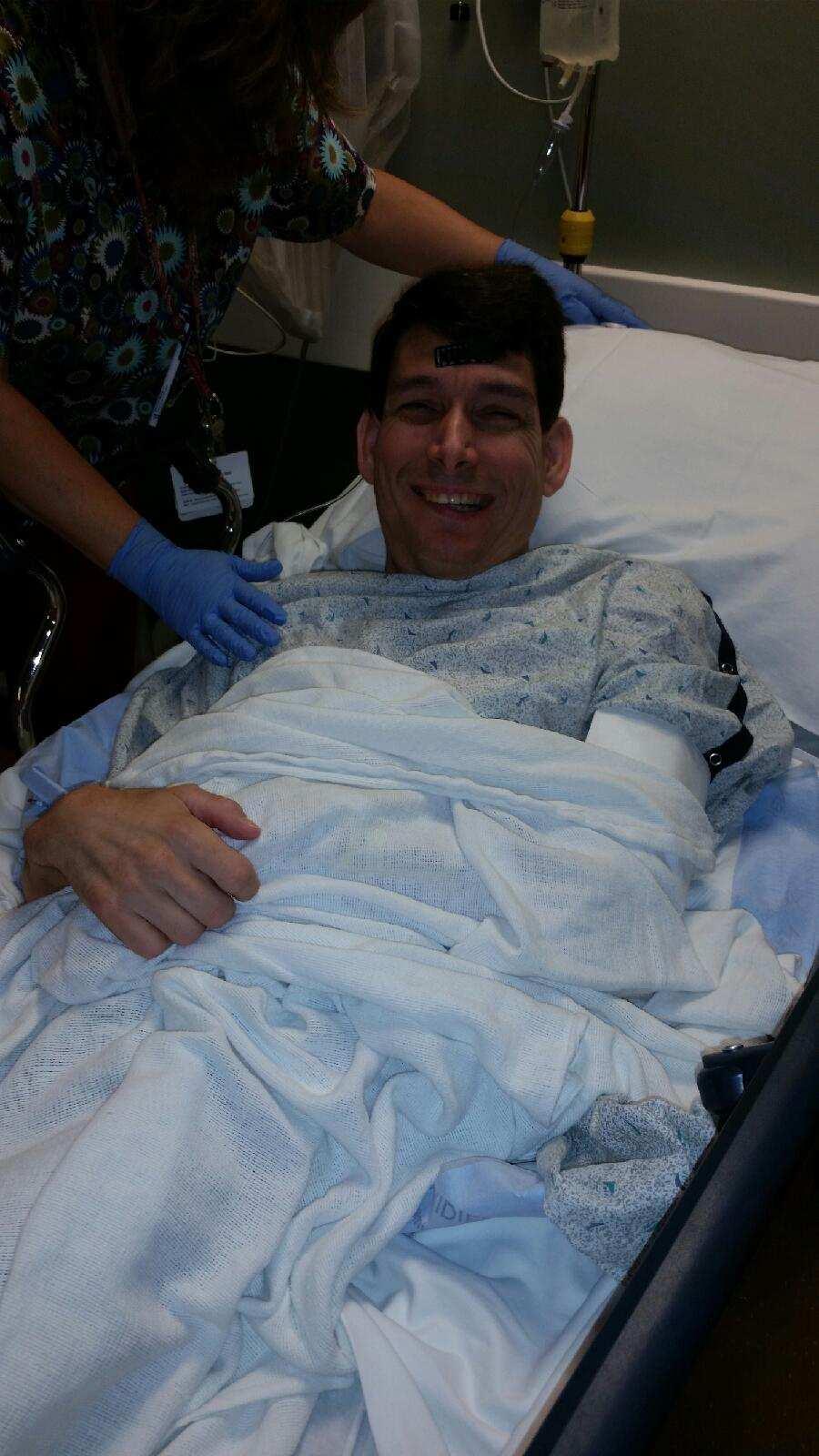
So, I’m laying stretched out on the surgical hospital bed in my neon-pink underwear and nothing else. And, I’m great with it. Muscular, with my trademark tattoo of the universal wheelchair symbol on my shoulder, I feel like a superhero. Cerebral Palsy Man here to save the day! But, the medical staff is here to save me – or at least figure out how to fix me up so they don’t have to literally save me. This is pre-surgery surgery, or as I like to call it, surgery.

My sister is with me because she’s had the worst luck of anyone I know – cancer, a critical automobile accident, over 20 surgeries. She knows the practice of medicine so well that I often have medical professionals ask if she’s one, herself. In this way, my sister is a double-edged sword: she’s great to have in the room as a medical advocate, but I don’t want her touching me out of fear her bad luck will rub off.

The nurse loves my pink undies, and I think she’s a bit charmed by my sense of humor around it all – my pink undies, flaunting my body regardless of disability, and my optimism toward the procedure itself.

Yet, I’m genuinely scared. I’m so scared that I’ve waited to do this far longer than I should have. It was my physician and friend who finally convinced me, knowing how potentially serious this could all be if I kept putting off surgery and treatment of anything else found in the process. Then once the specialists told me of the extreme risk my health was under, I knew I had to take responsibility, not just for myself, but for the sake of those who love me. And, I still have a lot of lovin’ to do.

The nurse asks me to put on the hospital gown, and I want to wear it as a cape. But, she insists I wear it the right way. My sister helps me put it on as I pout like her four-year-old. But, I want to wear it like a cape!

The anesthesiologist comes in and notes my “chronic” cerebral palsy. Is there non-chronic cerebral palsy, where you only have it on, say, Thursdays? She then stands at a computer and asks me questions from the screen, including, do I get short of breath walking up stairs?

My sister bursts out laughing and I point to my power chair parked against the wall, saying with absolute seriousness, “Only when I’m carrying that up stairs.”

Finally, the surgeon comes in to give me the rundown before we go into the O.R. He’s wearing the exact model watch I own and love, and for a moment I wonder if a man of such impeccable taste is wearing pink undies, too?

Now I’m getting even more scared, and the anesthesiologist isn’t helping. The initial shot that was supposed to put me in La-La Land still allows me to recite the first page of Chaucer’s Canterbury Tales – from the tenth grade. Still alert, I watch out of my peripheral vision as they roll me into the O.R. And, I see the size of the camera they’re going to slide down my esophagus and the table of tools they’ll ultimately use to take three biopsies. And, I watch as the anesthesiologist injects a new drug into my I.V.

Next thing I know, I awake. I think I’m still in the O.R., but as I open my eyes, a nurse tells me I’m in recovery. I’m still on my back, with the gown on, but I’m oddly now wearing pants, socks and shoes, with no recollection of the procedure or getting dressed.

“How are you feeling?” the nurse asks.

“…Like the morning after an awesome night in Vegas,” I reply. “How’d I end up here, and where’s my shirt?”

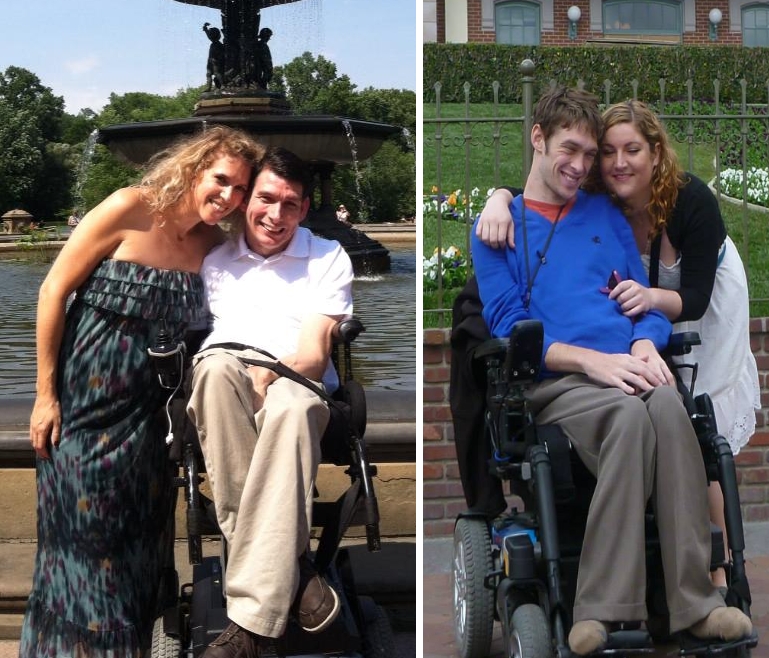
Zach And I Are In Love

Holly & Mark / Gillian & Zach

By Mark E. Smith

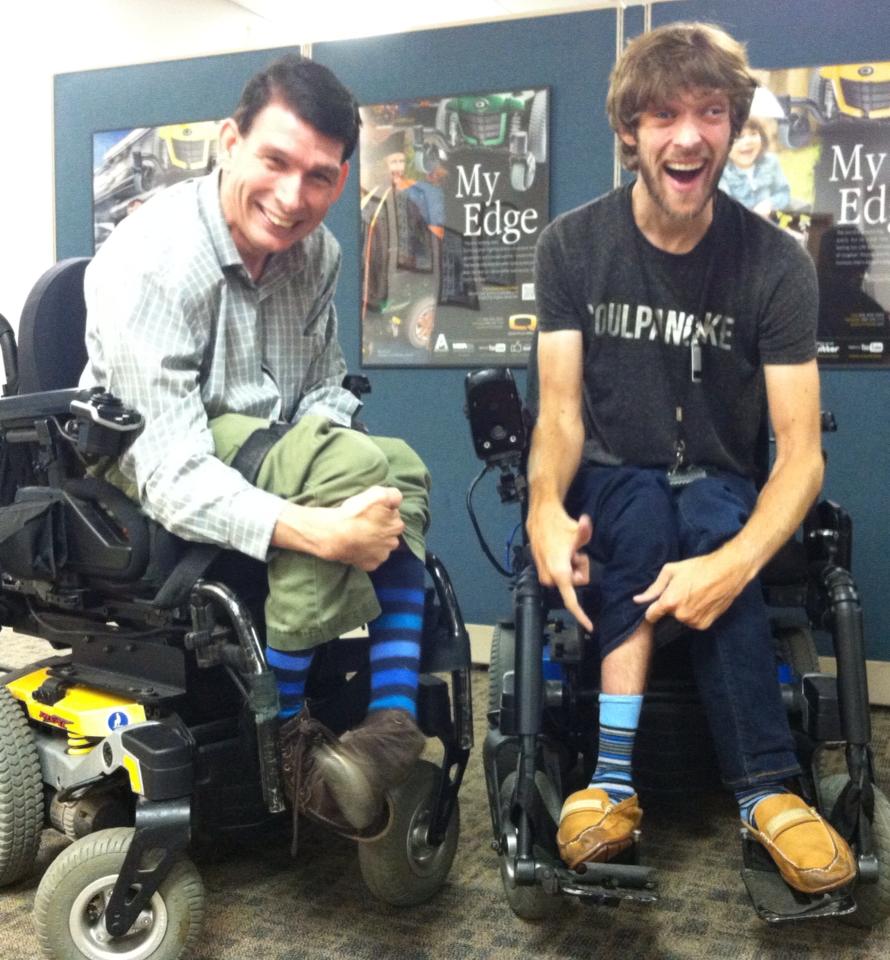
It’s official: Zach Anner and I – the two most eligible men with cerebral palsy in America – are in love.

Now, when I say that Zach and I have been the two most eligible men with cerebral palsy in America, what I really mean is, we couldn’t get dates if our lives depended on it. And, while we were tempted to date each other out of pure complacency, it turned out that waiting for the two most beautiful women in the world to sweep us off of our feet (which, let’s be honest, isn’t hard to do when we’re not on our feet to begin with), turned out to be a better idea. I should clarify that we weren’t both waiting for the two most beautiful women each, which would equal four women in total and would be really weird and a TLC reality show, but one amazing woman each. And, we scored!

In an uncanny twist, about 10 months ago, Zach and I started falling in love – with two separate women, not each other! – in Southern California. And, amazing women they were (they, of course, still are amazing, even more so, but I’m trying to keep my tense straight). Zach’s beloved Gillian is an internationally-known singer-song writer, and my beloved Holly is an artist. Both women are creative, witty, caring souls, who’s personalities truly radiate at a tangible level. Their depths of character range from funny to empathetic to being up for all that life has to offer. So, how did Zach and I ultimately get so blessed with such amazing women?

Cerebral Palsy. Fellas, trust me on this one. Forget the cheesy pick-up lines, fancy cars and medical degrees. All you need to attract a woman is cerebral palsy. Even if you don’t have cerebral palsy, say that you do. You can have a Ferrari and medical degree, but unless you tack cerebral palsy on the end, you don’t have a chance. Why? Because every woman knows cerebral palsy is where it’s at.

Of course, cerebral palsy has nothing to do with Zach and my finding love. The truth be told, we know the real secret to our finding the two most amazing women in the world: We’re just ourselves. What makes Zach and me who we are is just that – we’re happy as we are, cerebral palsy, poor posture, twisted senses of humor and all. And, with self-acceptance comes a confidence and comfort, where we have the ability to laugh and love and embrace life with an enthusiasm that’s contagious. We’re easy to love, but we equally love easily, where we know that vulnerability is a strength, empathy is a gift, and a true lover is also a best friend.

If you want to be loved for you… well… just be you.

Awesome socks don't hurt, either!
Awesome socks don’t hurt, either!

Confessions of a Bad Alcoholic

drunk

To John, February 5, 1951 – July 24, 2010

By Mark E. Smith

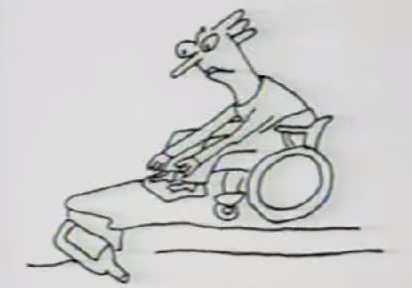
If you’ve read the research of recent years, then you probably already know about me: I’m an alcoholic.

Indeed, the medical establishment has concluded that alcoholism is hereditary – that is, if your family tree is lined with drunks, you’re a drunk, too. Or, you’re at tremendous risk of being a drunk. Walking past a bar or liquor store is like a metal shaving passing a magnet – it wants to suck you in!

For me, being an alcoholic is torturous because I think it’s the only thing I’ve failed at. I mean, I’m a bad alcoholic – really bad. My parents, grandparents, great grandparents and probably their parents were great at it. I mean, my mother and father had it down to a science – it’s not easy losing everything, including your life. But, me, I’m a terrible alcoholic. I’m so bad of a drinker that I haven’t drank today, nor did I drink yesterday or the day before or the day before or the day before or the day before….

But, my alcoholism even gets worse, pathetic, really. I’ve never hidden bottles, lost jobs, sobbed, Please take me back, ruined a wedding or child’s birthday party, bathed in cologne, slept on the front lawn in my clothes, wondered how my car keeps getting smashed up, vomited blood, feigned vertigo, passed out with a lit cigarette and burned my fingers, lied to everyone about everything, stole money from my child’s piggie bank, stood with belligerent narcissism before a judge, drank because of this or that, drank vodka from a water bottle at church, hugged a tree while the Earth spun at tremendous speed and I urinated on myself, or explained to a bank teller why my signature doesn’t match. Yes, I’m a terrible alcoholic.

However, here’s what I’m really good at: a little thing called personal accountability. Unlike the color of my hair, hereditary doesn’t dictate jack squat when it comes to my being an alcoholic or not. Life gives me free will to choose my path. And, while I understand the science, it’s 100 percent my choice to drink or not to drink. My mother did nine months in jail due to her third DUI, and upon being released, she stopped by a liquor store on the way home and downed a pint of vodka. Time and time again, I’ve watched people around me choose to re-elect life-destroying alcoholism, while others choose sobriety (and the science behind addiction recovery shows that the only time alcoholics maintain sobriety is when they literally choose to).

In this way, I’m among the worst alcoholics you’ll ever meet because I’ve turned my back on my own heredity.

Kids Be Kids

specialneeds


By Mark E. Smith

As a classically-trained writer, I understand words – their efficacy or impotence, the way they twirl off of the tongue and echo in the ear. Words are powerful, captivating, emotive. And, sometimes, words are defining, both in the positive and negative.

For some time, as a writer, as a parent and as one with a disability – but, really, just as a person – I’ve been struggling with three words that we use to define what I’ve come to know as an ambiguous, possibly specious term: special needs child.

I, of course, understand our social definition of a special needs child, that of a child with a physical, emotional or intellectual disability. But, is it – special needs child – a logical term to use? I mean, I’m not questioning it from a political-correctness or ethical perspective. I simply question if the label is logical?

And, I don’t think it is. After all, have you ever met a child who didn’t have special needs? Of course not. If we truly acknowledge what each child in our life needs, every child is a special needs child. There are eight children in my close family, and they’re all so unique in character and at different stages from one another that each one has special needs. Why only project “special needs” onto children who have disabilities when every child clearly has special needs?

The label also represents a type of reverse discrimination that’s unfair to all children. If you’re with several children in public, and one has a disability, adults often fawn over the child who has a disability and ignore the other children. Yes, such adults mean well, but they’re doing more harm than good. Such situations inadvertently patronize disability and ignore others – everyone loses.

Instead, let’s see kids as kids. Each is special and unique and has needs, and should be recognized as such. Most importantly, let’s drop the labels altogether, and just let all kids be kids.

Rising With Adversity

Rising to Adversity

By Mark E. Smith

It’s become such a widely-used phrase that it’s even transcended into the secular lexicon: God only gives us what we can handle.

Yet, within the meaning of that phrase, that belief – which suggests that we are somehow preordained for a heroic role – the individual plight is lost. And, without delving into theology or questioning one’s spiritual beliefs, I’ve witnessed a much different perspective to facing adversity: We only handle that which we choose to handle.

See, within adversity, there’s always a specific choice – that is, to rise as the Phoenix or to crumble as a house of cards. And, yes, we all have the capacity for both, where in moments we can teeter in-between. However, ultimately, we rise or crumble, where the will and choice is ours.

I’ve seen plenty crumble, choosing not to fight, not to implement free will in the face of adversity. I’ve seen those who have given up the moment that times get tough in health, relationships, careers. But, I’ve never witnessed anyone who wasn’t ultimately equipped to face adversity. It’s as they say in any rehabilitation program, You have the tools. It’s your choice whether to use them.

And, yet, I’ve also seen so many make the immediate choice to rise. An acquaintance of mine, with twin 13-year-old daughters, lost his wife to multiple sclerosis. While he rightfully could have given up on all – only seeing how unjust life can be – he sought counseling and healing, and he said to me, “I lost the love of my life, but I will not let it rob me of my love for life.”

For those of us who face adversity on a daily basis – and rise – we learn to dance with it gracefully. Yes, there are routinely challenging moments. However, instead of being discouraged by them, we move through them, then release them. Again, it’s a choice that we have, to go into adversity, succeed in spite of it, then release it, letting it go. And, that’s when we rise.

Now, there are those who are very humble in their plights of choosing to address adversity, not running from it, noting, for example, “I’m the parent of a special needs child. Being there however needed is what parents simply do. It’s just right.” However, unfortunately, that parental mindset is not a given. Lot’s of parents choose not to be parents after all. From one parent choosing to exit the picture, to special needs children as among the highest at-risk groups for foster care, not all parents choose to face adversity. Among the most painful experiences of my life was several years ago when I visited a live-in care facility for special needs children. I was struck by how active and engaged the children were, perplexed why they we’re there and not living at home? “Most of the children’s parents here are quite affluent, and the child’s special needs don’t fit their lifestyle,” the director told me. Not all parents do what’s right. Some choose not to embrace adversity with their children, but choose to shun it. Therefore, those parents who choose to embrace adversity with their children cannot be taken for granted – their choice is among the most noble in humanity.

Within all of this, then, is the key to adversity. If we choose to crumble, life stops and joy dissolves. However, if we choose with tenacity to face adversity, move through it, then release it, we will rise. Adversity isn’t a choice, but facing it is. And, the fact is this: we’re all equipped to face adversity, and when we do, we rise.

The Real Investment of Complex Rehab Technology

MarkESmith300

By Mark E. Smith

I strive not to overlap my print writing with my online writing because, really, there’s too much of my work floating around the literary world as it is. How much of me can any one reader take? However, I’m crossing my own boundaries and linking you to a very poignant piece in this month’s print edition of Mobility Management Magazine. You’ll learn a bit more about my life journey — and hopefully a bit more about others’ and your own. http://mobilitymgmt.com/Articles/2014/06/01/Complex-Rehab-Technology-Investment.aspx

I Have no Time for Busy

Too busy concept.

By Mark E. Smith

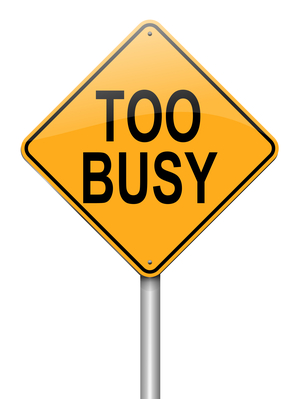
Let’s be honest, there’s no such thing as busy. I mean, it’s a cop-out word that really means insensitive, unorganized, self-absorbed and, sometimes, lazy. It’s the epitome of an overwhelmed, often self-centered person that says nothing about productivity.

See, I’m a very productive person, but I never consider myself busy, especially when it comes to people. Melissa sits outside my office in her cubicle, and I suppose that if you asked her if I’m busy, she’d tell you yes because I’m usually a flurry of activity, with my keyboard keys clanking, phone chattering, door opening and closing. Yet, I’m never busy. Rather, I’m productive To me, busy is an end-all, a shut-down. It’s when you walk into someone’s office and he or she says, I can’t talk now, I’m busy. Or, it’s when your romantic partner says, I don’t have time for this discussion, I’m busy. It’s a complete dismissal of who you are and your importance – and it hurts and erodes trust. And, I avoid such insensitive behavior like the plague because I want to be productive, emotionally available and successful – and busy doesn’t allow any of that.

Now, this isn’t to say we shouldn’t set healthy boundaries. None of us can do all tasks and meet all needs at once. However, prioritizing instead of shutting down is the key. If I’m given a task at work and I already have a full plate, I simply state, Thank you, I’ll get to it once I’m finished with X, Y, and Z. I never turn down work based on being busy – again, self-absorbed, lazy people do that. Similarly, I prioritize people, where I try to offer immediate availability, but if I can’t, I’ll acknowledge their sincere importance by saying such a validating reply as, Can I call you back in an hour, as I’m in the middle of this urgent task, and I really want to focus on you when we talk. And, I strive to keep others abreast to my day’s schedule, so they know why I may be unavailable at certain times.

Of course also in the area of boundaries, we don’t want to become dumping stations for others’ work or have emotionally unhealthy, needy people consume our time. However, even then, busy is a cop-out. Rather, address the root causes and define boundaries instead of simply proclaiming, I’m busy.

In this way, if you want to be productive, successful and emotionally available, being busy doesn’t work. Ultimately, I have all the time in the world for work and those I care about. But, I have no time for people who tell me they’re busy.

All of Us

STRUGGLE

By Mark E. Smith

Why is it that others rarely see our deepest struggles? Sometimes it’s because we don’t allow others to see or know of our struggles. And, sometimes it’s because others seemingly don’t want to see our struggles, as it’s too painful, too real to witness. After all, most want to believe in ideals, that those we love and care about will never face struggles.

Yet, we all have struggles. The parent. The high school senior. One with a disability. The recovering addict. The couple that just celebrated their 30th anniversary. The financially strapped. The ultra wealthy. The minority. The majority. We all have struggles. Different, yes. But, struggles, no less.

And, there’s a beauty and pride to it all that too few realize. See, when we’re struggling, it feels like a battle for survival, but we’re truly thriving. People who don’t struggle at some point in life aren’t learning, growing, trying to better themselves. In this way, the struggle is emblematic of a victor, not a victim.

And, all of this leaves us, as those who struggle, with a question of ultimate integrity: If we don’t allow others to know of our struggles, how will they not feel alone in theirs?