The No-Excuses Generation

By Mark E. Smith

At some point – maybe 15 or 20 years ago – the meaning of disabled became blurred to me as I began recognizing the seemingly unlimited potentials in my life. And, in more recent years, the meaning has become all but moot to me, merely definitions in medical books, as I’ve widely witnessed the truly unlimited potential in others’ lives, those who have achieved enormous success in every facet, regardless of disability.

Sure, if I put myself in the shoes of someone who doesn’t know anyone with a “severe disability,” I understand that his or her perception of disability – or, lack thereof – is pretty grim, with stereotypes of our living limited lives in countless ways, full of dependencies on others, from our families to the government.

And, while these stereotypes may hold true for some with disabilities based on any number of circumstances, there’s a fascinating segment of individuals with “severe disabilities” where limitations and dependencies aren’t the case at all – that is, where disability isn’t disability, where beyond a medical diagnosis, the scorecard of one’s life simply transcends what one might define as disabled, entering the realm of even exceeding the mainstream’s definitions of success.

While many credit the ADA in 1990 as a social door-opener for those with disabilities, it was truly 1970s legislation and that era’s independent living movement in the U.S. that created a generation – born between 1965 and 1975 with “severe disabilities” – who came into a society of every-increasing opportunities, and were encouraged by the spirit of the 1980s and 1990s to fully use every resource they could access. Therefore, we’re now seeing many between the ages of 35 and 45 – born with “severe disabilities” – living such successful lives that it truly questions the common wisdom of what it means to be “disabled.” When we look at the demographics of this generation (a notably small group compared to the overall disability population), it’s statistically distinguished from younger and older generations of those with disabilities based on education level, employment success, wealth-building, physical independence, social status, community involvement, and committed relationships. Indeed, you might say there’s a new generation of young, upwardly-mobile professionals (yuppies) – and they have disabilities.

An example is a family I know who’s truly living the American dream – custom home, pool, luxury cars, children attending a private school, vacation home, easily pulling in a 6-figure income. Oh, and the husband has very severe cerebral palsy. Because of the sensitivity of his position, I can’t tell you his job, but he’s high-up in a certain branch of the government. I recently jokingly asked his wife what she saw in a schmuck like him, and to my surprise, she gave me a candid answer: “I wanted a perfect 10. All my friends were willing to settle; but, I knew I wanted it all,” she told me. “He had to be smart, worldly, a great listener, respected by all, a hard-worker, a great father, and someone who was secure enough to support my dreams, too. And, I found it all in him, my perfect 10.”

Her ability to look at the complete picture of her husband, not his medical diagnosis, is such a profound insight – and it’s the same insight that’s defining this generation that’s arguably transcending “disability.” Put simply, this generation of those with disabilities isn’t dwelling on “disability,” but looking at the whole of life, where limitations are replaced by abilities, where dependency is replaced by independence. And, the results are astounding, where many with severe disabilities haven’t just beat all of the grim statistics of those with disabilities living in America – as in lower rates of education and higher rates of unemployment and poverty – but actually exceed the mainstream when it comes to education, income, and social mobility.

Interestingly, beyond a visibility to friends on social networks like Facebook, this generation generally avoids the limelight, not partaking in inspirational stories on television or boasting of their accomplishments in public venues. Instead, there’s a quiet humility to their successes, where they are the families next door. They demonstrate that they’re not out to prove anything to anyone, but that they’re simply living their best because it’s the right way to live, regardless of disability.

The question, however, remains: How has this generation reached the higher rungs of status and economics with inherently severe disabilities?

Again, the answer includes a combination of timing and mindset. The 1970s cracked the door of opportunity for those with disabilities, and this generation burst it wide open, seizing every opportunity in sight. Disability wasn’t seen as an obstacle, but just a trait, where all other abilities, talents, and opportunities superseded it. As one of my buddies put it, ”I wasn’t worried in the least about my spina bifida in college – I was focused on building a career.”

And, it’s a mindset that we all can learn from: Disability doesn’t have to be a defining state or ultimately limiting condition, but, in many ways, just a label – a label we can choose not to represent who we are. That is, we can have a disability, but not be “disabled” by it. As another friend of mine put it, “Why would I choose to be disabled when, with some effort, I can be educated, employed, wealthy, and in love – and then just have disability as a sidebar to it all?”
Telling Our Daughters

By Mark E. Smith

As the father of a 14-year-old, I often find myself in an odd predicament. Whenever I show someone her picture, or she’s with me at an event, people graciously note how beautiful she is. And, while I sincerely appreciate such comments, thanking them, I never really say what I’m thinking: You really have no idea how beautiful she is.

See, as with all 14-year-old girls, my daughter’s beauty isn’t based on her exterior facade that conforms to a symmetrical face, slim stature, and flowing hair that pop-culture idolizes, but a beauty that’s within – that which is inherent within all young ladies. My daughter exhibits remarkable loyalty to her friends, where her sense of popularity at school isn’t about who wears what, or who knows whom, but that everyone is her friend, where she reaches out to others based on the quality of their characters, not so-called “status.” And, she exhibits a remarkable sense of empathy, where if one of her friend’s family is going through personal struggles – divorce, job loss, abuse – she finds ways that she can help comfort that friend in times of need.

My job, of course, as her father is not just to support my daughter, but to have very direct conversations with her about how proud I am of her, that she’s inherently beautiful, that I want to support her growth into a strong, independent, emotionally healthy young woman. Researchers have proven that a woman’s most formative years toward her lifelong self-esteem and identity are in her teens – and it’s a make-or-break time for fathers who will shape, for better or for worse, their daughters’ identities.

Yet, our obligation toward building life-inspiring self-esteem in young ladies in their teens can’t stop with our own daughters, but must be extended to others we meet. The fact is, when women enter their 20s with low self-esteem, it’s often too late for any of us to have an impact. We know that low self-esteem established in the teen years often manifests itself in a woman’s adult life through destructive relationships with men – from as subtle as being controlled and having little voice in a relationship, to as blatant as abuse – and through alarming forms of “self-medication” ranging from drugs and alcohol to promiscuity. The fact is, when women need outside stimuli to feel validated, as opposed to simply knowing their intrinsic strength and beauty from within, so much of their potential is lost, where no matter how much we strive to help such an adult woman recognize her inherent beauty, the emotional scars are usually so thick that it’s among life’s toughest hurdles to overcome.

It’s for these reasons why we should all reach out to young ladies in their formative teen years, where they’re still open to seeing their intrinsic beauty, where as mothers and fathers, aunts and uncles, teachers and coaches, we should never pass on showing a teen her intrinsic beauty while we still have the opportunity to truly make a difference with strikingly simple but vital words of encouragement.

As a father himself, Rene Szalay of Ki Mobility, recently presented me with a remarkable opportunity to hopefully make a difference in a young lady’s life. I first met Rene 22 years ago at an adaptive sports camp in Chico, California. I graduated high school a few weeks before the camp, so it was my first real foray into the “wheelchair world.” Rene, however, was four years older than me, and a literal star in the wheelchair tennis world. At the camp, I witnessed how the teens looked up to Rene, and I realized the impact that we can each have on the young people around us – it was a powerful lesson in inspiration. For the following 22 years, I never crossed paths with Rene again; yet, his presence at that camp stuck with me.

Recently, while working an Abilities Expo, I joined fellow mobility industry colleagues after hours – everyone usually hangs out together regardless of our companies and roles – and Rene was among this particular group, gracious enough to note that he is a bit of a fan of my work. As I’m typically wound a bit over-the-top, I ended up horsing around with the group, and didn’t get a chance to see if Rene remembered Chico, 22 years earlier? However, the following day, true to Rene’s character that I recalled, he showed up at my booth with a 14-year-old young lady and her mother, noting that they really should speak with me. I had no idea what it was about, but I know that guys like Rene and I put people before products, and if he left his booth to bring the daughter and mother to my booth, it probably wasn’t product-related.

The young lady had cerebral palsy, and used a manual wheelchair. In typical 40-year-old-dad fashion, I asked her what her favorite subjects in school were and such – the cliché questions we use to build some rapport. However, eventually what came out was that she was struggling socially in school, that she didn’t feel like she fit in as the only one with a disability among her classmates. I told her a bit about my being the lone student with a disability when I was her age, and how my own daughter and her peers likewise struggle with questions of identity, that other young ladies feel just as insecure, but some just hide it better than others (adults are no exception at that, either!). Yet, what I mostly discussed with her was who she really was, loving Shakespeare and classical music – amazing for a 14-year-old. And, as I told her, I was in awe of her intellect and wisdom, that beyond her adorable appearance – complete with pink highlighted bangs on her blond hair – her inherent beauty shined, that there was no doubt that she would go on to do great things. “Concentrate on developing who you truly are, avoiding the no-win game of trying to fit a made-up social mold,” I shared. “Being exactly like everyone else in life gets us no where – we just blend into a crowd, or live to other people’s bland standards. But, being yourself, where your unique gifts and beauty shines, is where you thrive in the world. You are beautiful, just as everyone is in their unique ways, and your intellect and wisdom are going to propel you to an amazing, impacting life. …It only gets better from here.”

I’m known for pulling people aside and having extremely candid conversations, where I’m not bashful about laying the cards on the table if I see someone struggling in emotional pain or going down destructive paths, where I’ll share that there are healthy ways to get one’s life back on track. Again, though, with adults, such talks usually have little effect beyond the moment because one person’s caring can’t overcome the other person’s lifetime of pain – serious work must be done, and few adults have the capacity, tools, and will to shift their lives (and when it is done to a meaningful level – ridding dysfunctional behaviors – formal counseling is typically involved).

However, we know that the door is still wide open on teenagers, where adult mentors can show a 14-year-old young lady her inherent beauty and it truly registers. If you have a young lady in your life, don’t pass on those moments that emphasize her inherent beauty, where you help polish the strengths that she’ll use to live a healthy, happy, impacting life.

Right-Brain Thinking

By Mark E. Smith

When considering the human brain, most picture a single, sponge-like structure, all within a protective housing – the cranium – that’s little more than the size of a melon.

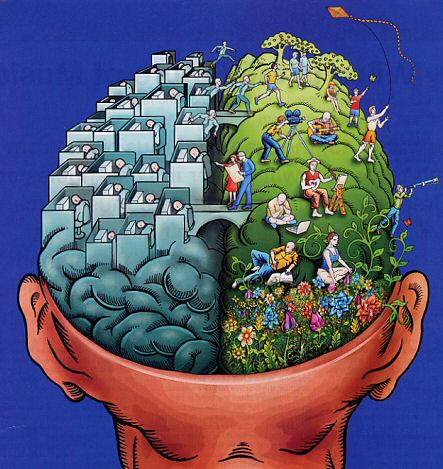
However, what many don’t realize is that the brain isn’t singular, but literally plural – that is, two distinctly separate halves (known as the left and right hemispheres), that communicate with each other to the totality of 1,000 trillion synaptic connections, but, in fact, think very differently from one another. And, when we understand how the two hemispheres of our brain think – that is, the very distinct lateralization of brain function – we better understand how we process events and live our lives, disability and all.

The left hemisphere is our memory bank, you might say. It thinks in a linear, analytical fashion, putting together the past and imagining the future to form methodical thoughts. When we dwell on the past or ponder the future, it’s our left hemisphere at work.

To the contrary, the right hemisphere doesn’t concern itself much with the past or the future, but is about the present, the here and now, the inspired moments in our lives (though, there is evidence that clinical depression is based on a hyperactive right hemisphere that distorts the way the mind intakes information, inherently turning to pessimistic, negative, nonconstructive thinking styles). When we are caught up in a moment, where our sole focus is what’s happening in the present, our right hemisphere is in affect.

In many ways, then, our left hemisphere is the weight of the world on us, with all of our past and future concerns flying around in trillions of stress-filled synaptic connections, whereas our right hemisphere is just glad to be here, taking in the moment.

When it comes to disability – and much of life, really – the right hemisphere is truly what we should primarily run on, the single cylinder that’s about the here and now. After all, when we hear of others’ discouragement with disability and life, so much of it is based on pain of the past, and fear of the future – it’s the left hemisphere tying one’s stomach in knots. Therefore, shifting from left-brain thinking to right-brain thinking frees us of many of the emotional burdens holding us back in life, keeping us centered and inspired in the present.

Interestingly, most clinical treatment of psychological or emotional trauma (both common elements in disability experience, as well), strives to move us from holding on and constantly reliving the past, to truly living in the present, where the original trauma no longer impacts our daily lives. That is, moving beyond trauma involves a shift from left-brain to right-brain thinking, where we’re not haunted by the past or dreading the future, but truly living in the present – our lives liberated, all baggage left at the door.

And, we do obtain striking clarity and room to breathe when we shift to right-brain thinking, where with the exception of being in the midst of a freak accident or trauma in the immediate, life in the present is a whole lot more relevant and comfortable than dwelling on the past or fearing the future.

Now, the fact is, it is hard for us as humans to make the shift from left-brain to right-brain thinking, especially when we’ve experienced trauma. We’re statistically prone to left-brain thinking after having experienced many forms of trauma, where we seek left-hemisphere life paths that lead us to dysfunctional behavior (a clinical basis of “post traumatic stress disorders,”), that causes us to indirectly relive the trauma over and over. We know that women who were abused as children are more likely to be in abusive spousal relationships as adults. We know that men who had alcoholic fathers are far more likely to be alcoholics as adults. And, we know that many with disabilities can get caught up dwelling on the origin and impact of their conditions or illnesses, frozen in time. In plain language, although we know that the traumas in our pasts are over, our left-brain thinking keeps us stuck reliving the experience – often literally recreating it through life choices.

The true magic of shifting to right-brain thinking, however, is that it proves that our traumatic pasts can be just that – our pasts – having little effect on our present (where distressing memories are essentially updated with more relevant thoughts in the here and now). In my late teens and early 20s, I was haunted by my father’s having walked out on my brother and me when we were kids, where I desperately wanted answers – my left-brain thinking was torturing me. However, the birth of my daughter was a wake-up call, where in a very cognizant way, I recognized that I had to shift from my left-brain anxiety about not having a father, to my right-brain focus of being a father. And, it was at that moment – where I made the decision to stop living in the past, and focus on the present – that my life changed, that a weight was lifted from my shoulders. My father died without any sort of closure for me – there wasn’t the happy ending or clear-cut answers I’d long wished. However, I was – and remain – at peace with that because my adult life isn’t about my father, but is wholly about my being a father, where my right brain is in full affect, having cherished every day of the past 14 years with my daughter.

The question as a whole, though, remains: How do people realistically shift from left-brain, stress-filled thinking to right-brain, content-in-the-moment thinking? After all, many of our careers and lives demand that we live very left-brain lives, where reminders of the past and objectives for the future are intrinsic to our lives. And, in cases of trauma like an accident that’s caused disability, the disability in itself can be a constant trigger, reminding us of the past or raising questions for the future.

Researchers know that right-brain thinking is both kinetic and holistic – it’s what’s fully engaging our bodies and minds at this moment. The reason why adrenalin-based activities like exercise or sports are so stress-relieving is because they’re right-brain oriented – you’re not concerned about the past or future when you’re simply trying to bench press one more rep. Similarly, creative endeavors require right-brain thinking – as I write this, I can’t be plagued by the past or future, as I’m in this moment, creating this sentence. Therefore, finding areas in our lives that inherently require using our right brain – simply listening to music is a great one! – are invaluable toward relieving stress, and keeping us in the present.

In my own life, where my career is left-brain based – where I can often feel like everyone’s mobility issues are on my shoulders, where the emails and such never stop – I’ve evolved aspects of my life toward right-brain activities, where they naturally balance my life. My daughter and dogs are constant sources of right-brain, in-the-moment focus, as is working out, boating, and reading. As one living in a left-brain world, so to speak, I’m able to find great reward and relief in the right-brain parts of my life.

Indeed, we can hold on to that left-brain thinking, where its catalog of memories – especially the traumatic – fill our lives with anxiety, fear, and destructive paths, leading us no where fast. Yet, we’re presented with a miracle of the mind, where our capacity to use right-brain thinking liberates us from the past, and places us in the present, where we don’t just survive, but thrive.

Listen to your right brain, where the past truly is the past, and the present has all the potential to be whatever you make it. After all, living in the here and now, making the most of this day, is the most rewarding place to be.

When Disability Becomes Humility

By Mark E. Smith

In Buddhism, humility is associated with being liberated from any suffering or anguish in life. In Christianity, humility is defined as recognizing one’s own defects, and holding a humble opinion of oneself. And, in Islam, humility translates to surrender.

Indeed, virtually all of the world’s religions feature humility as an ultimate goal of mankind, and its essence is best defined by Chan (Zen) Master Li Yuansong: “Enlightenment can come only after humility – the wisdom of realizing one’s own ignorance, insignificance, and lowliness, without which one cannot see the truth.”

Not unlike world religion, disability also contains humility as an ultimate form of being, where we recognize our limitations not with resentment, but with gratitude. And, it’s that gratitude – our humility – that allows us to have grounded perspectives in life regarding what’s truly important, where life can prove to be more about our connections with others, and less about status or materialism or physicality.

At the core of humility is humbleness, and few plights in life are more humbling than living with a severe disability. While those with disabilities are not precluded from achieving the trappings of the ego – recognition, success, wealth, and so on – disability is remarkably grounding for many, far canceling out any pretentiousness in most cases. For example, one may be very blessed with a well-paying career and success, but that doesn’t alter the reality that having to rely on others for physical care is a universally humbling experience.

However, the humbling realities of disability don’t have to be troubling as some express, but can actually be liberating, increasing our capacity to connect with others, our humility. Again, rooted within humility is the wisdom that none of us are of ultimate strength or infallibility, but that we all have weaknesses and needs. Put simply, disability, by nature, allows us to inescapably see our weaknesses – which is actually a strength – giving us the humility to respect the plights of others beyond our own challenges.

I was recently working the Abilities Expo in downtown Los Angeles, and had a wonderful walk each morning – about a mile and a half – from my hotel to the convention center. The weather was beautiful, so it was a refreshing start to my long days by racing my power wheelchair past the skyscrapers of downtown, weaving my way through crowds of commuters on foot and darting across hectic, traffic-filled intersections.

One morning, I came upon a homeless man sleeping on the sidewalk. He especially stood out to me because he was exceptionally dirty, with no possessions, sleeping on the bare concrete – a contrast to the many other homeless that I saw who had sleeping bags and shopping carts full of clothing and such. With so much going on – racing to a trade show, city traffic buzzing around me – his presence literally brought my world to a halt.

With time to spare, I went in the coffee shop around the corner, bought two breakfast sandwiches, two cartons of orange juice, and grabbed a straw. I then returned to the homeless gentleman, waking him up, offering him breakfast. He didn’t say much, but he accepted the breakfast sandwich and juice.

In my shirt and tie, I sat there with him, carefully eating my breakfast sandwich, as not to spill on my clothes. I didn’t, however, open my juice because it was beyond my dexterity – I reckoned I’d save it until one of my colleagues at the convention center could open it for me.

We sat there silently eating – folks passing us on the sidewalk – when, suddenly, the homeless gentleman took my orange juice carton and straw off of my lap, opened my juice, put the straw in, and observantly gave me sips on queue, following my bites.

What struck me was the remarkable humility in the gentleman. Although he was more down on his luck than arguably anyone in Los Angeles – and who knows how or why? – he still had the humility to recognize my needs, graciously serving me my orange juice when I could not. No, I can’t entirely explain why I stopped in my tracks that morning to have breakfast with that gentleman, but I know that it fit somewhere in my disability-based understanding that my plight in life is no more worthy than anyone else’s, that if I was to have breakfast, so should the gentleman sleeping on the sidewalk. However, what truly inspired me was that despite the gentleman’s seeming needs, he recognized mine in accordance with his own via the very nurturing act of helping me with my juice, words unspoken.

It’s easy to think we’re above others based on status, and it’s even easier to think we’re beneath others based on our seeming weaknesses, including the humbling aspects of disability. And, yet, it seems so hard for many to simply realize that we all share a common humanity, where shared humility brings us together from all walks of life, right down to a guy with cerebral palsy having breakfast with a homeless gentleman on a sidewalk, where both find gratitude in the challenges of life where others may not.

Prepared for Discrimination Disasters

By Mark E. Smith

If you live in a northern climate where it snows each winter, have you ever noticed that there’s a segment of the population that is seemingly shocked every time it snows – as if they have amnesia from the last 60 winters they’ve lived through? People actually stockpile bread and milk the day before each forecasted storm, as if this mysterious thing called snow might usher in an apocalypse. I’ve lived in snow country for 10 years, and what I’ve learned is pretty darn elementary: It snows throughout every winter – there’s no surprise or mystery to it. I know what to expect, I’m prepared for it, and I go about my life with rationality when it occurs.

Many people address ignorance and discrimination the same way some northerners address snow: They’re shocked every time it happens. Yet, we all know that ignorance and discrimination occurs around us – albeit more readily to those of us of diversity than others – so why are we so shocked and unprepared when we encounter it?

Of course, none of us wish to encounter ignorance or discrimination – it hurts and it disconnects us from our sense of belonging, unjustly questioning the completeness of our humanity – and we simply don’t want to even think of such experiences, as it’s scary and painful. Studies in psychology prove that we are far more subconsciously adept at avoiding pain than toward addressing any other emotion. Therefore, we block the foreseen potential pain of facing ignorance or discrimination from our daily awareness as a sort of self-preservation mechanism. For example, if we thought that everywhere we went was a potential for facing ignorance and discrimination, we might never leave the house. To the contrary, we most often block such realistic potential from our minds – after all, we can encounter ignorance and discrimination in the world around us – and, in a sort of denial, we assume that we’re universally going to be treated with equality and legality. Because of this, when we’re treated with ignorance and discrimination, we’re caught by surprise, most often shocked and horrified – and, worst of all, unprepared to address it.

However, I’ve learned that there’s tremendous merit to living with an awareness that we may be treated with ignorance and discrimination at virtually any time. After all, we know that ignorance and discrimination can and does occur – it’s why we have civil rights legislation, including the ADA – so why not live with a preparedness toward addressing it when encountered?

Indeed, acknowledging the existence of ignorance and discrimination – not denying it! – is a key to solving it. Being shocked by it dramatically reduces our ability to address it, and addressing it is vital, as we don’t want it occurring to the next person. When we’re shocked by ignorance and discrimination, we’re caught off guard, and don’t know how to react. Yet, when we’re prepared for it, we know exactly what to do.

A friend of mine went for a job interview for an inside sales position at a major Internet retailer. He’s a paraplegic, with full use of his upper body, so his disability had absolutely no bearing on his ability to perform the job, which required sitting in a cubical, using a computer and phone. When arriving for the interview, the interviewer took one look at his using a wheelchair and said, “Wow, are you going to be able to get down these halls OK?”

My friend was prepared in life for facing ignorance and discrimination at times, and although he wasn’t looking for trouble, his instincts told him when it was on its way. While others with disabilities may have dismissed the interviewer’s initial comment, not wanting to think that they were about to face ignorance or discrimination, my friend recognized that comment as a sign that the interview might not be performed as fairly as most would hope.

In the interview room, my friend casually pulled out a pen and pad, and took notes, summarizing the interview as it went. Every time the interviewer directly asked about his disability – which is illegal – my friend was especially careful to note the details, right down to the time. Again, my friend wasn’t looking for trouble, but he also wasn’t shocked or in denial of ignorance and discrimination. And, as he encountered it during that interview, he knew exactly what to do: Play it cool, document it, and legally address it later.

As you might presume, my friend didn’t get the job, one that he was qualified for. But, the fact that he documented that around 10 minutes of the 15 minute interview involved the interviewer’s probing questions about my friend’s disability resulted in the interviewer being fired, disability awareness training throughout the company, and a settlement for my friend. No, we don’t know whether the company has totally changed its ways, but my friend’s preparedness toward facing ignorance and discrimination definitely had some positive outcomes.

One fundamental technique that my friend used was not to be shocked by ignorance and discrimination, but to be wise toward it. See, when we’re shocked, we’re either motionless or overreacting, neither of which is the best tact. Being motionless does us no good because we’re not collecting the information needed to later address the issue, and confronting the perpetrator doesn’t work, either, because if the perpetrator had proper judgment to begin with, he or she wouldn’t engage in such behavior. Rather, when prepared for ignorance and discrimination, we instinctively know to take in vital information, minimize emotion, and save seeking resolution for the proper channels.

We want to believe that we live in a just society, one of equality for all. And, based on the laws, we do live in a just society. However, people and companies don’t always follow the laws, they don’t always treat everyone with equality. In this way, we shouldn’t live in fear of facing ignorance and discrimination – or, worse yet, deny its existence – but we should recognize its potential to occur, and be prepared when it does, handling it with a level of composure and dignity that is sure to bring positive results no matter how unjustly we’re treated.

It’s The One’s We Reach

By Mark E. Smith

No reputable drug and alcohol recovery program will publish its success rate, namely because industry wide, success rates are disturbingly low – in the 5% range. That is, approximately 95% of in-patients eventually relapse.

With such a low success rate, one might conclude that recovery programs don’t work. But, they do – for those who make an effort to change their own lives. Recovery programs are a tool for those who are dedicated to the process, where people who help themselves will succeed, and those who continue poor behaviors, fail.

One has to admire recovery counselors. I mean, imagine investing your heart and soul in striving to help many, where 95% of your efforts fail. At what point do you simply give up, noting that if people won’t help themselves, why should you strive to help them?

The answer is simple – if you can positively change the lives of only 5% of those you interact with, that’s a profound impact on others. However, accepting the realization that 95% of your efforts won’t succeed takes some understanding, the understanding that you can’t help everyone, but you can make an admirable attempt and help some. Your true success is in your making the effort, regardless of the outcome.

Most of us have friends, acquaintances, and family members who are living troubled lives on some level, where a simple change in behavior could dramatically improve their lives. And, when we’re at our best, we step in, striving to offer words of wisdom and encouragement. No, we don’t preach or lecture, but simply share that life doesn’t have to be so hard.

I had the privilege of sitting down with a young woman in her 20s, whose life is a mess – severe abandonment issues from a troubled family, engaging in promiscuity, alcoholic, and an overall emotional train wreck. But, as I explained to her, none of it has to be. By investing in herself, as with entering counseling and truly putting effort into addressing the negatives in her life, she could see real changes in real time.

I asked her if anyone had ever had such a conversation with her, and she said, no. And, I explained to her that I’ve overcome challenges in my own life, many with the help of others, and I’d be willing to assist in her getting her life on track if she felt that I could help in some way.

Unfortunately, not only didn’t she take me up on my offer to support her move toward positive efforts, but her life continues escalating in very troubling directions. She has every capacity to change – with effort, of course – but no seeming will to do so. In all fairness, though, when all one’s ever known is dysfunctional behavior, getting off of that path takes a monumental shift in mindset, often with a Herculean effort behind it. Yet, it is possible – and vital if one’s going to redirect one’s life.

In my several-hour conversation with her, I believe that she was extremely candid with me, but has no wish to get out of the rough waters she’s in – it’s the behavior she knows, her strikingly uncomfortable “comfort zone,” and she’s not changing it. So, considering her outlook, did I waste my time in reaching out to her?

Not at all. Again, when we strive to help others, our success is in the effort, not the outcome. We can be voices of reason and make sincere attempts to connect with others, but if they’re not receptive or willing to help themselves, at least we made the attempt.

In the disability realm, this subject constantly comes up, where family members ask, How can I help my loved one not be defeated by disability?

The fact is, some are defeated by disability, giving up on life, where their families want to help. Still, the process goes back to the adage that you can only help one who wishes to help oneself. You can offer all of the support in the world, but if one refuses change, there’s nothing you can do. This doesn’t mean that you shouldn’t make an attempt to help, but don’t feel like you’ve failed if the individual doesn’t respond. You can wish with all your might that your loved one with a disability gets his or her life on track; however, if he or she refuses to take the lead in the process, you should have a clear conscience, where your effort was commendable regardless of the outcome. If you want to enroll in community college, we’ll gladly pay the tuition. However, if you chose to spend the rest of your life uneducated, unemployed, and living in public housing, with a victim mentality toward your disability, we’ll be greatly disappointed, but your failure won’t be our responsibility in any way. …It’s this matter-of-fact approach that families must take.

Of course, reaching out to others is a risk, where the outcome most often isn’t what we wish – few people are willing to leave their comfort zones (again, as inherently dysfunctional as their “comfort zones” can be), and move their lives in healthier directions. And, for those of us who have striven to face challenges, and see the amazing potential in each individual’s life, it can be heart wrenching when we reach out to others in support, only to have them reject their own potentials. There’s a sense of loss when we know someone who could transform his or her life in a seeming instant – and is presented with the opportunity! – but he or she chooses to stay on a bleak course.

Still, we must recognize the 5% rule, that even if 95% of our efforts inspire no change in others, our consistent efforts to put ourselves on the line by reaching out to others will impact someone, somewhere, sometime – and that’s where the value resides in our efforts. Let us strive to reach out to everyone, don’t be discouraged when our efforts aren’t valued by others, and let us feel privileged to witness the positive changes and growth in the 5% of of sincere individuals bettering themselves.

The Necessity of Challenge

By Mark E. Smith

Have you noticed how life has an uncanny way of placing lessons in front of us?

I was flipping through the channels, and came across a story about Kyle Maynard, born without arms or legs. Now in his mid-20s, Kyle not only was a high school championship wrestler, but went on to attend the University of Georgia, won ESPN’s Espy Award, appeared on every major talk show, authored a book, became among the top motivational speakers, modeled for Abercrombie & Fitch, opened his own CrossFit gym, and most recently fought in a sanctioned mixed martial arts fight.

So, I watched the quick story about Kyle, not thinking much about it because in the circle many of us travel, we’re all just doing what he’s doing – that is valuing what abilities we have, and making the most of them, consistently embracing new challenges.

However, here’s where the unexpected life lesson comes in: I changed the channel to NBC, where The Biggest Loser was on – a reality-type show about losing weight. And, I immediately encountered a 350 lb. woman crying that she couldn’t run on the treadmill. Meanwhile, the fitness coaches were screaming at her. Admittedly, in one of my most judgmental thoughts, I wished I could have been there screaming at her, too, as she should have been absolutely ashamed of herself. She was born with 100% of abilities – all four limbs, the ability to walk, and all – and she was crying over having to jog on a treadmill, all because she refused to rise to the simplest challenge. I went as far as to presume that the reason why she was obese was due to a lack of will toward facing any challenges, that eating was an escape to avoid any issues in her life – it’s psychology 101.

Now, before you judge me by stating that obesity is a disability that can’t be prevented, you need to know two facts: Firstly, according to U.S. and Canadian studies, “At an individual level, a combination of excessive caloric intake and a lack of physical activity is thought to explain most cases of obesity. A limited number of cases are due primarily to genetics, medical reasons, or psychiatric illness.” Therefore, obesity, primarily, is totally behavioral and preventable in most cases.

Secondly, The Biggest Loser only takes contestants who have behavioral obesity, so the woman crying about running on the treadmill wasn’t doing so for physical reasons, but out of an utter inability to tackle even the easiest challenge.

For me, the juxtaposition was profound: Kyle was born with no arms or legs and has taken full accountability for his life, filled with gratitude toward what he’s been given, gladly embracing ever-increasing challenges. On the other hand, the woman on The Biggest Loser was born with full physical abilities, ate herself to obesity, avoiding accountability, and took her life for such granted that she didn’t even have the willpower to run on a treadmill. What’s wrong with this picture?

Actually, the side-by-side comparison of Kyle and The Biggest Loser woman exemplifies a much larger picture of what’s going on today in America – that is, we’re seeing those with among the severest disabilities thrive to astounding success while much of the mainstream seems complacent in their lives. Biologically, it defies logic – that is a person with a sever disability shouldn’t excel over an able-bodied person, as the able-bodied person has every physical advantage, but we see it happening time and time again.

Yet, we know scientifically that our success at virtually any endeavor – even the most physical ones – has far more to do with the mind than the body. See, Kyle’s success is based on his lifelong mental skills of facing challenges, whereas The Biggest Loser contestant had no concept of facing challenges because she’d likely avoided them her whole life.

And, this is where we see the true reason of why those with severe disabilities can excel over the able-bodied mainstream – we know how to face challenges by nature of our everyday lives, and we’re not intimidated by whatever comes our way. See, challenges are like exercise – the more we face them, the stronger and more adept we become. And, when you’ve spent your life overcoming disability-related hurdles, you’re strikingly equipped to face virtually any challenges that come your way. Any limits in life can quickly disappear with such a highly-evolved skill set.

We had a snow and ice storm recently, and like every other day, I simply drove my power wheelchair to work – no big deal in my mind. Sure, I’ve been in some very bad conditions (even a State of Emergency once), but I truly don’t care what the weather is or how treacherous the conditions – I’m going to work because it’s simply what I do everyday, and no matter how bad the weather, it doesn’t phase me.

However, some people in my region don’t go to work in such storms because they somehow see it as too risky. In literal terms, I can drive my power wheelchair to work in the severest weather without a second thought, but others refuse to drive their heated 4-wheel drives. This fact goes back to the more challenges that we face, the more adept we become – and the less likely we are to see excuses in any circumstance. I know that I can survive the worst weather because I’ve done it. However, the person in the SUV who’s never moved beyond such a challenge has a far more limited view of what’s achievable. If much of life has been a physical cake walk, few develop the ability to face notable challenges, and it sets them at a disadvantage. However, if we’ve constantly faced – and embraced – challenges, we not only become proficient at persevering and facing challenges, but we also pursue opportunities that others pass upon.

While some of us have had little choice in whether we faced obstacles, we still at some point learned to embrace them, recognizing the empowerment that comes from the process. And, what’s vital – and personally inspiring – is to never stop seeking new challenges, ones that further broaden our potential, where the world around us becomes truly boundless. In my own life, I continue facing the challenges of my cerebral palsy – a never-ending life lesson on facing all-day adversity – but I’m likewise always placing additional challenges upon it, making my life seemingly much harder than it needs to be in the short term to ensure absolute empowerment in the long term. Unlike millions who think working 9 to 5 is enough, not doing much more in life, I know that I can push myself mentally, emotionally, physically, and intellectually much farther, where I simply don’t stop where others do. Driving my power wheelchair to work in the snow doesn’t phase me. I’m glad to stay up till 2:00 a.m. getting a writing job done. I’ll travel cross country by myself. I’ll go to work with a 102-degree fever. I’ll workout in my gym even after even the most exhausting day. I assume absolute financial accountability, living debt-free. I’ll throw myself off of my boat and work on my swimming, once thought impossible. And, I do all of this because it keeps me in the best overall shape possible, where I know that life is going to send more challenges my way, and when it does, I’ll simply say, Bring them on – I’m equipped to handle them.

For many, with and without disabilities, it’s tempting to make life as easy as possible. But, again, such a passive approach in life is counterproductive. If you want to truly get somewhere in life, make it as challenging as possible. For parents and caregivers, don’t be so quick to assist your loved ones with disabilities – if a task is just outside their abilities, let them struggle to accomplish it, rising to the challenge. As those with disabilities, ourselves, let us not ask for help, but struggle to accomplish a task, where we learn tenacity in facing challenges and breaking barriers. And, for all of us, challenges should rule our lives, where we’re primed to work two jobs, attend night school, hit the gym, go to work no matter what, and not ever use an excuse not to push ourselves beyond what others might perceive as illogical.

Every time that we face a challenge, we push the boundaries of our lives a little further. Why waste your life crying on a treadmill when by simply pursuing challenges, you can broaden your life on a limitless scale.

The Effort of Hope

By Mark E. Smith

About a year ago, I had the privilege of speaking in front of about 100 inner-city youth going through a “life development program.” These were teens from the roughest streets of Philadelphia, relocated to a rural, live-in vocational program where they accomplished everything from earning a GED, to learning a vocation, to developing independent living skills. And, as the director of the program explained to me, while these young adults knew how to survive in the toughest of scenarios – abusive parents, violent neighborhoods, and a drug-infested culture – they struggled to see the potential of an educated, career-based life. It wasn’t that they didn’t want a healthy, successful life; rather, they didn’t know that they could achieve one. That is, hope wasn’t part of their emotional vocabulary. And, so among the reasons why the program invited me to speak and share my story of overcoming some tough odds was to further introduce the teens to hope, illustrated by my successes despite adversity.

Hope is a fascinating subject, where researchers have found it to be our most powerful life tool toward moving forward no matter our situation. We often confuse wishing with hope – but they’re very different. Wishing merely projects our thoughts into the universe, with no personal action behind it – that is, the only way we get results via wishing is by happenstance, coincidence, or blind luck. Generally, wishing does us little good in our everyday lives. You can wish with all of your might, for example, that your credit card debt will go away; but, as we all know, simply wishing debt away has no result – debt doesn’t disapear based on wishes.

However, hope is a much different process – it inspires us into action, and that does change our lives in very real ways. People who have hope possess the ability to look beyond their current situations, knowing that change in their lives is possible. Think for a moment how powerful of mindset that is: One without hope always feels trapped in current states, while one with hope always believes there’s something around the corner and seeks it. Hope, then, is a catalyst toward moving our lives forward in positive directions. In contrast to one simply wishing away credit card debt to no result, hope inspires us that we have the capacity to spend less, work more, and get out of debt. Wishing, then, proves futile while hope inspires action-based results.

Few places illustrate the power of hope better than in the workplace. No matter a company and its culture, the hopeless and hopeful employees are easy to spot, with few outlooks in-between. The hopeless show up every day dreading their jobs, dissatisfied with their lives, self-proclaimed victims of circumstance. They’ll tell you that their lives are stuck in a rut because of a bad boss, a poor economy, and on and on. Sure, they wish their lives would change, but without acting upon hope, they’re going nowhere.

In contrast, employees with hope are always on the look-out for new potential. Maybe they can ultimately transfer departments to a better boss, or maybe they have their resumes out at other companies. They don’t know exactly what’s going to improve their situations, but hope motivates them to try everything under the sun to move their careers forward. They’re not wishing, they’re doing, knowing that with effort, their careers can change.

Yet, here’s the real question that researchers have striven to answer: How do we find hope our lives to begin with – especially in circumstances when all around us is seemingly bleak?

I want to take you back to the program of inner-city city youth who I spoke with, and imagine for a moment that you’re among them. Say you’re a 16-year-old who’s grown up in West Philadelphia, in public housing. You’ve been raised by your grandmother because you’ve never known your father, and your mother’s a heroine addict. Your 14-year-old cousin just had her first baby, and on your way home from school everyday, you passed drug dealers and prostitutes – the only ones with money. Most of your friends are locked up, in some sort of gang, or are roaming the streets, few left in school. And, this is the only environment you know. There are successful people on TV, but that’s the closest you’ve seen to any kind of existence beyond your neighborhood, and it’s inexplicable to you how anyone on TV got to where they are in life. Now, how do you find hope for any future besides the grim reality that surrounds you?

Researchers have learned that while we, as humans, have the innate ability to hope, it must be socially triggered within us, then exercised by us. Literally, someone must inspire hope within us, and then we must run with it on our own. If inner-city kids stay in an inner-city environment, where there’s a culture of hopelessness – that is, no self-realization that there are possibilities for their lives beyond their grim surroundings – they will simply live hopeless lives, repeating generations of teen pregnancy, lack of education, drug use, and crime.

Yet, when such at-risk young adults as those attending the program that I visited are removed from their grim environment, and they are shown by others the boundless opportunities that they really have, they learn the foremost catalyst for succeeding in life: Hope. That is, they can then see the new potentials that their actions bring.

What’s even more amazing is that with hope as a socially initiated mindset, it’s not exclusive to common experience. See, hope allows us to relate to others on the overall theme of facing and overcoming adversity, regardless of type or origin. As a 40-year-old white guy, with a graduate education, white-collar income, and cerebral palsy, I may seem a world away from inner-city teens of ethnicity. Yet, in speaking with them that day – and as they later shared with me in a follow-up letter – we both inspired each other with hope. They looked at me and thought, Man, if he can get that far with cerebral palsy, I can make it through this program. Meanwhile, I remain in awe of them, thinking to myself, If these teens can grow up in the toughest of environments, and work their butts off to move their lives in new directions with such courage and effort, there’s no excuse for me not to push myself to take on more in life, no matter how scary a challenge may seem. Indeed, a mutual conveyance of hope is life-changing for all.

It’s no coincidence that all life-changing programs – from spinal cord injury rehabilitation programs to 12-step recovery programs to offender reform programs – include the key component of mentors who have transcended their challenges and demonstrate hope for others. Again, hope stems from social awareness, where what we see in others effects what we can envision for ourselves – and when we see someone else who’s accomplished a goal, we have a better understanding that we can, too. We, then, have hope.

What we must realize is that hope is the key ingredient that moves us forward, where while we can never totally know the outcome of any well-intended effort, it’ sure to take us somewhere positive in the process. If you’re struggling with a seemingly hopeless situation – maybe you’re in an unsatisfying job, relationship, or lifestyle, in general – make an effort to find hope. For example, if you hate your job, feeling trapped by what you perceive as limitations based on your company’s culture, your education, and the economy, but the guy next to you with the same skill set just found a better job, follow his lead, use him as a catalyst for developing your own hope. After, all, we see this opportunity for hope within the disability community all of the time, where those with the severest physical disabilities are often the most successful – educated, with esteemed careers, and healthy families – and they offer us all hope that we can achieve the same. We must look at others and tell ourselves, If he or she did it, I can, too – that’s how finding hope works.

And, if you’re one who’s overcome challenges to great success – maybe disability, or addiction, or unemployment, or weight loss, or changed your life in a dramatically positive way – make yourself a “conveyor of hope” to others. Again, hope isn’t challenge-specific, but life-specific. Maybe you’ve overcome tremendous challenges with your disability, but your friend is struggling with weight loss. You should make an effort to be a conveyor of hope in such situations, noting something to the effect of, I’ve never struggled with weight loss, but I remember how frustrating my physical rehab was after my accident, where I put so much effort into it and saw little results at the beginning. But, I stuck with it, and eventually the results came, where I learned that perseverance pays off. No matter the challenge, such a personal anecdote is sure to inspire hope in others.

Of course, there are no constants in life, and such is the case with hope, where we all can lose hope from time to time. I, myself, have struggled in such moments, earlier in life with incurably alcoholic parents, and later in life with an ailing marriage. And, yet, amidst those times of great inner turmoil, where I saw no resolution to the situations in the moment, reminding myself to recognize hope for the future pulled me out of those moments of despair, knowing that although I couldn’t predict the future, I had hope that all would work out for me as long as I pursued productive, healthy actions. See, hope ties into the old adage that it only works when we work it – and when we truly work it, backing it up with efforts to move our lives forward, it has its way of working seeming miracles for us.

No, hope isn’t a guarantee to success or the route to an ideal outcome. Rather, hope is a compass of direction, a mechanism where when we truly work at it – send out those resumes, hit that gym, pursue healthy relationships, accept your disability! – our efforts have an inexplicable way of propelling our lives to levels of satisfaction that we never dreamed.

From Humble to the Humbling

By Mark E. Smith

Humble is an intriguing word, one that many can’t literally define, and when they do, “not arrogant” is a definition that often comes up. If you read corporate mantras these days, virtually all companies state wanting “humble” employees, ones who presumably aren’t arrogant, and recognize that they always have room for improvement – admirable traits, of course.

For those of us with disabilities, while being humble is a great trait to have, we have no choice but to endure the “humbling” – and there are profound differences in shifting from the adjective form, humble, to the verb, humbling, truly unveiling disability experience at a level that others rarely see.

In our public persona, whether we’re at work, on a date, or wherever, we, as those with disabilities, have the ability to appear just as humble or arrogant as anyone else. Yet, we are distinct from most others in a very striking way: We can’t escape living truly humbling lives, regardless of our persona.

What many don’t realize is that while the definition of humble is, “modest, or not arrogant,” the definition of humbling is, “to lower in condition, importance, or dignity.” And, as those living with severe disabilities, virtually all of us have struggled with the intrinsically humbling nature of disability experience at times, if not much of the time – that is, disability can make us feel very undignified and lesser than others at certain moments, no matter our acceptance or successes.

Grand Rapids-based author and speaker, Johnnie Tuitel, has flown over one-half million miles – all while having cerebral palsy and using a power wheelchair. Tuitel, poised and polished, was recently on his way from West Palm Beach to Kansas City, to speak at the National Self Advocacy Conference, and all was on schedule as he was transferred into his airline seat by U.S. Airways attendants. By all appearances, Tuitel was a successful businessman, on a typical business trip, where disability wasn’t an issue. However, all of that was about to change.

Soon, a U.S. Airways gate manager and flight attendant approached Tuitel, explaining to him that he would be removed from the plane immediately because he was “too disabled to fly alone.” According to U.S. Airway’s policy – and arguably in violation of the Americans with Disabilities Act – they do not allow those with severe disabilities to fly alone. And, the gate manager flagged Tuitel as too disabled to fly alone.

Imagine for a moment the reality of Tuitel’s situation, and how humbling it was to him, as it would be to any of us. Due solely to Tuitel’s disability, he was transposed in an instant by U.S. Airways from a man of common humanity, on the level of every other passenger, to being deemed a lesser human being, unfit to fly. In the immediate, it must have been shocking, angering, and humiliating to Tuitel; but, ultimately, it was humbling, where per the very definition, Tuitel was unjustly made of lower importance than others, with his dignity removed – simply a consequence beyond his control of living with a disability.

Indeed, many of us can relate with Tuitel’s experience of how humbling it can be dealing with the public when we have a disability, where common aspects like a waitress speaking to our companions instead of us, directly – as if our physical conditions effect our intelligence – can adversely effect our dignity. Tuitel’s experience may be shocking to some; however, for many of us with disabilities, it’s recognized as more common than we’d ever wish, where we know such humbling experiences all too well – and how they often appear out of nowhere, beyond our control, simply a consequence of living with a disability.

Of course, the humbling nature of disability isn’t only faced in public, but actually far more commonly in our personal, daily lives. As well as we cope, it’s still humbling to share the intimate details of living with disability with even those close to us. In fact, the first time that I had a girlfriend spend the night at my place was one of those times that stands out in my mind – humbling, to say the least. See, I wasn’t nervous about having intimacy with her. To the contrary, I was fired-up about that part, as most young men are. However, I was deeply self-conscious about the realities of having a woman literally spend the night in my bed with me, and to share some of the everyday realities surrounding my cerebral palsy.

Based on the fact that I couldn’t easily transfer out of bed in the middle of the night to use the restroom, I had to rely on using a urinal – in bed. So, there I was, wanting to be a handsome, romantic lover, but constrained by the realities that I was still a guy with cerebral palsy, who had to share among the most seemingly undignified parts of my life with my girlfriend if I was to take my relationship to the next level. The thought of using my urinal while sleeping in the same bed as my girlfriend mortified me, but I also recognized that it was a reality that I couldn’t avoid.

For several days before we were to spend the night together, I played the scenario in my mind: I was going to have the most romantic night ever, with me as the cerebral palsy version of Richard Gere. Yet, the reality was that I would be in bed with a beautiful young women, all cuddled up one moment, then likely having her see me use a urinal the next minute – that was a daunting, humbling realization to face.

I put off having to use my urinal as long as I could that night, till I couldn’t any longer. It must have been three- or four o’clock in the morning. And, I finally took my urinal from its hiding place in the nightstand drawer, held my breath out of mortification, and did what I needed to do to use it. As quietly as possible, I put it back in the night stand, and I lay back down, seeing her glance at me in the dawn light. She pulled the covers up, put her arm around me, and all without a mention. Somehow I had the courage to get past my extreme self-consciousness that night – but not without it being a very humbling experience, where my vulnerabilities where readily exposed.

As those with disabilities, we all go through exceptionally humbling experiences, some of which are public, and many of which we keep to ourselves, where only those closest to us know the true daily struggles that we face. Some humbling experiences are initially defeating, like Johnnie Tuitel being removed from the U.S. Airways flight. Other humbling experiences are inspiring, like my girlfriend being totally gracious and accepting of the realities of my disability upon our first night together. And, for most of our humbling experiences that we face due to disability, we eventually reach a point where we merely do what we must to get through each day, where the humbling is our commonplace, one that many never see or know of, but that we simply live – with a striking dignity to it all.

The Hidden Nature of Icebergs

By Mark E. Smith

The average iceberg is 90% under water – that is, only 10% of it is visible above the surface. When we know this fact, it becomes obvious why icebergs are so dangerous to ships: What’s unseen below the surface causes catastrophes like that of the Titanic.

Most people are a lot like icebergs, where we only see a very small glimpse of who they really are, where we never know what’s truly going on in their lives beneath the surface. Maybe they’re strangers among us in line at the grocery store, colleagues who we pass in the hall at work, or even friends and family members. Sure, we see their outer appearances, smiling and cordial, but we truly don’t know much past that superficial persona.

Interestingly, some of the most harrowing stories that I’ve ever encountered involved among the most poised people, where at a glance, their smiles and demeanor would never hint at the challenges that they faced. People have said to me, Wouldn’t it be great to have his or her life? And, I’ve thought, If you only knew the struggles that he or she faces beneath the surface….

I met one young lady in her early 20s who appeared to not have a care in the world – stunningly attractive and on the fast-track in her career – and everyone was envious of her at a glance. Yet, as she was gracious enough to share with me, her home life as a child was an abuse-filled nightmare, and now in her 20s, she’s raising her two little sisters because her step-father shot her mother, then shot himself. And, she lives with that reality 90% below the surface every day, moving forward the best that she can, with poise and a smile. How that 90% hasn’t pulled her under in life defies logic, and as I spoke with her, the best advice that I could offer was that I hoped that she’d slowly bring her 90% to the surface, where the appropriate people close to her could know of her struggles and thereby help, where she realizes that she’s not alone in facing life’s challenges.

In ways, we’re fortunate when among our foremost challenges is a physical disability, where it’s so in the open that we can’t hide it – an iceberg well above the surface for all to see. Of course, many with physical disabilities would gladly hide their disabilities if they could, but what’s not realized is that, again, it’s usually burdening when we hide much of ourselves from others. Truly, we’re fortunate that physical disability requires us to live bold lives, where as long as we’re interacting with others, they at least know part of our struggles in life – and there’s a refreshing candor and honesty to that, one to which many can relate. When others see our obvious struggles, it can often let them know that they’re not alone in facing life’s challenges, whatever they may be.

I’ve also witnessed how disability can put us more in tune with others, where we can often sense others’ struggles, where while we may only literally see 10% of the iceberg like everyone else, we still intuitively recognize something much deeper beneath the surface that needs embracing – a kinship of sorts.

I was in a tiny restaurant in rural Virginia, having dinner late one night with several volunteers who were working the disability awareness program with me at the National Boy Scout Jamboree. We had a lot to talk about, so it was a long dinner. Throughout the evening, the waitress who served us was polite and courteous, but I learned nothing about her except for her name, Tiffany. Yet, there was something about Tiffany that made an impression on me, something that I couldn’t define.

By the time we were ready to leave the restaurant, my group was the only one left, and my colleagues finally made their way out the door, leaving me behind fiddling with my wallet and phone, finishing my soda. As I spun my wheelchair around to head out of the door to catch up with my group, Tiffany came up to thank me for being a customer, and she put out her hand to shake mine.

“Everyone hugs Mark,” I said, smiling, a line that I always use, opening myself up for a hug.

Tiffany, without hesitation, stepped forward and hugged me. And, what caught my attention was that she didn’t just hug me and step back; rather, she hugged me for several moments, and when she finally stepped back, she was sobbing to the point that she grabbed a napkin off of the table, and wiped her eyes.

“I’m sorry,” she said with an awkward laugh. “…Typical woman.”

“Don’t be,” I said, putting my hand on her forearm. “If I told you everything is going to be OK, would you believe me?”

“I know,” she said, wiping her tears. “You know, it’s just hard sometimes.”

“And, we get through it,” I said. “Been there, done that – we get through it.”

I backed my wheelchair into the door, and pushed it open, rolling in reverse. “You’re going to get through this, Tiffany, I know you will! …We all do,” I said, rolling out the door as she just smiled and waved, watching me leave.

I had no idea who Tiffany was beyond her waitress role, or what issues she was facing in her life. However, clearly there was some sort of vying in her life, and what touched me was that, for a brief moment, we both acknowledged that challenges that are intrinsic to all of our lives – the icebergs just below the surface. Was it my disability, or my offering a hug that suddenly brought her iceberg to the surface? Probably a little of both, along with her presumably having a really bad day, where, again, for reasons I’ll never know, she was particularly emotional. No matter, I’m thankful that I extended a hug at the right place, at the right time, and made a very authentic connection, letting a seeming total stranger know that she wasn’t alone, as it likewise reminded me that I’m not alone in my struggles.

People are so darn scared to be authentic, to show any more than 10% of themselves. Likewise, we’re scared to look beyond the 10% of others, where when we say, Hi, how are you?, to colleagues in the hall, we truly aren’t seeking a sincere answer – but, we should be. Now, I’m not saying pour your heart out to your boss or to strangers in line at Wal-Mart – there’s a right and wrong time for everything. However, at some point, on a larger scale, we need to be willing to open up ourselves more to those around us, where we’re not afraid to expose or recognize more than 10% in each other. In hip talk, take chances and be real with others – you’ll be amazed at the way it changes your interactions for the better.

During your day, you likely cross paths with a lot of people, where your only initial glimpse of them is of that superficial 10%. Make an effort to look a little deeper – in others and yourself – to where you’re bold and brave enough to truly connect with others, where you’re reminded that we’re all in this often cold sea of life together. Indeed, when we’re open enough to share the 90% of each other that really counts, our perceptions of each other most often change for the better, not unlike witnessing the stunning depth and beauty of icebergs hidden beneath the surface. All you have to do is look for them – they’re there.