Wheelchairs in Heaven

thegates

By Mark E. Smith

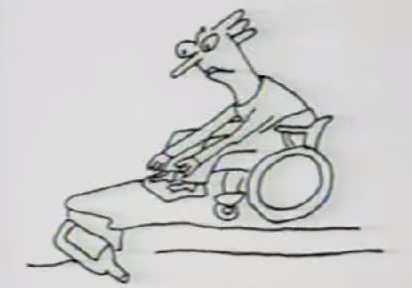
Every so often, a well-meaning soul of tremendous faith says to me, “You need not worry, there are no wheelchairs in Heaven.”

And, while I appreciate the deep, faith-based perspective of such individuals, I have to bite my tongue to keep from exclaiming, “What do you mean there are no wheelchairs in Heaven! How am I going to get around?”

I’m no theologian, but I understand the Judeo-Christian belief that there is no suffering in Heaven, and this is what individuals are truly getting at when they make such comments. And, I share the belief that there is no suffering in Heaven.

However, their words on this earth imply that I am suffering, that in Heaven, God will make the injustice of my life right. Yet, my faith says that they have it all misunderstood.

See, God made me right. Is my life in living with cerebral palsy a bit physically different than others? Of course. But, no one can justly declare it as suffering or needing to be resolved. Such beliefs are rooted in the unintentional ignorance of individuals, not in the intentionality of God. If we are to believe in an intentional God, then we must likewise believe that each of our lives was blessed with beautiful intention. My faith says that my cerebral palsy is part of exactly who I’m supposed to be, today, tomorrow, eternally – and I’m blessed with that. None of us need miracles, as we are already each a miracle.

In this way, if we are to have true faith, we must believe that each of our lives and circumstances has been created with an intention and purpose that some may not have the earthly insights to recognize. But, that’s OK. As long as we know our own value, intentionality and purpose, we know we’re blessed with being exactly who we are, perfect as-is – on earth as it is in Heaven. Just as houses of worship have accessible parking, wheelchair ramps and elevators, I’m positive that there’s an awesome custom-fit wheelchair awaiting me in Heaven.

The Science of Hope

emilybarn

(Beyond general admissions, my daughter is applying to an honors college program that includes research within the student’s field. In the applications process, a 750-word essay is required, explaining the desired area of research, why it’s of importance to the student, and its impact on humanity. It’s a lofty task that, ideally, begins students on an extraordinary academic journey, one that ultimately changes the lives of others. My daughter’s essay is in line with the inspired writing you read here week after week, and so it’s my privilege to share her essay with you this week.)

By Emily C. Smith

As I pursue my undergraduate studies in psychology, there is a much larger life mission at work for me. It’s a passion, a field of study, a research quest that ultimately effects each one of our lives: what’s the origin of hope within the human psyche?

It’s a very personal subject to me, and one that effects the life of every person on the planet. We either have hope or others have hope for us, and if hope is removed from our perspectives and lives, virtually all possibilities cease. Yet, with hope, potential dramatically expands our horizons, where a bleak prognosis becomes potential, where vying is a path for victory. However, the questions remain. What are the origins of hope? Why do some people have hope while others do not? And, how does hope, itself, impact the many circumstances throughout our lives?

I’ve learned about hope in my own life, and wish to extend the power of hope to others. I want to empower others with what I refer to as the “science of hope.”

As a very young child, my mother became addicted to prescription medication. I went through grade school, then junior high watching my mother drift away. I struggled with having hope. I remember being 11, and picking my unconscious mother off of the bedroom floor, tucking her in bed, my heading off to school. I remember sitting in class that morning thinking about all of the times I rushed to hospitals with my father because my mother had overdosed. I thought about all of the times I locked myself in my room as my mom crashed about the house. I remember all of the efforts my father made to put my mother through rehab, threatening to sue doctors who prescribed her more pills. Indeed, I remember sitting in class that morning, knowing my mother’s addiction was killing her – and there was no hope.

My father, though, knew something I didn’t. See, he was born with severe cerebral palsy. He wasn’t expected to live more than a few hours, and once he did, he was declared an absolute vegetable. His life ended up a lesson in never believing in a negative prognosis, but using hope as a guiding light, even in the bleakest of times – maintaining a high-profile career and giving me as much of his time as possible as my mother wasted away.

Soon, the inevitable occurred. My mother moved out, removing herself entirely from our lives. With bare walls because my mother took all of the pictures and very little experience running a house, especially at my young age, I wasn’t just void of hope, I was terrified. We were a 12-year-old and a suddenly-single father with severe cerebral palsy who used a power wheelchair in a bare-bones house – alone.

Yet, my father introduced the one component that would rescue me from my stifling fear and pain: the power of hope.

He hugged me and said, “It’s now just you and me. I don’t know how we’re going to do this, but we are. Soon these walls will be filled with pictures of our life, our dreams rebuilt.”

My father’s unshakable hope was my guide post. I held onto his hope as we learned together how to not just live, but to thrive, that guide post slowly becoming less of a need as it was replaced by my own intrinsic sense of hope.

Despite the tragedy of my family, hope has been the ultimate gift. We all face adversity, but when you have hope, you have the ability to not just survive, but excel. From my home life to my academics to my extracurricular activities, hope has led me to empowering heights. Give me a negative circumstance and I will show you the positives; show me limitations and I will show you possibilities; and show me a grim prognosis and I will show you hope.

I know where I got my hope – that is, from my father, from experiencing adversity and having him lead the way with hope. And, I want to further that legacy by not just portraying hope, but by scientifically defining it for humanity. See, I don’t want hope to merely be a mysterious state of mind that some have and some don’t. Rather, I want to research hope to a tangible level, where it’s a definable tool that doesn’t just elevate our individual lives, but all of humanity.

Kevin

2014100395201914

By Mark E. Smith

As he spun on the salon chair, his joy was contagious. No one else his age, 20s, would dare spin on the chair, hands thrust in the air, yelling, “Woohoo!” but he did. Most of us would be too self conscious, too restricted by social norms. But, his authenticity allowed him to do what we’d all love to do – that is, follow our unbridled enthusiasm. Yes, he was different from the rest of us, and we were all a little jealous.

He stopped spinning for a moment, looked at my 17-year-old daughter and waived, flashing a big grin.

“I’m Kevin,” he said.

“Hi, Kevin,” my daughter replied from her seat along the front window. “I’m Emily.”

“Emily, watch…,” he replied, spinning some more, hands in the air.

He spun, and he spun, and he spun until his mother and father pulled him from the chair.

“Bye, Emily – I’ll call you,” he said, putting his hand to his ear in a telephone gesture, and we all giggled at how adorably unabashed he was, moving toward the door.

As he left, I glanced at my daughter and soon there was a knock on the window behind us. We looked, and Keven blew Emily a big kiss, promptly dragged away, smiling, by his mom.

I was immediately struck with the thought that whoever defines intellectual disabilities has it all wrong. I realized that there were a lot of us with intellectual disabilities in the salon that eve, but Kevin wasn’t one. He followed his enthusiasm, lived with an uninhibited heart and wasn’t afraid to extend love to others. Few of us could say the same.

Me Being Me

1412359724784

By Mark E. Smith

At 43, I’ve had my challenges in life, but with a mix of hard work, the support of others and luck, I’ve been privileged to have accomplished a bit, from fatherhood to a pretty cool career. Nevertheless, someone asked me what my ultimate dream is from here? My answer could have been related to a next career challenge or maybe a materialistic goal like a lake house. However, none of that’s the case – its all too easy, too meaningless in ways. My answer from the depths of my heart was, “I just want to be me.”

Assuming that we’re healthy, productive, loving individuals, isn’t that our ultimate dream: to not only be free within to be ourselves, but to be truly embraced for who we are by others? How many of us have felt at times that for any number of reasons – a work environment, a relationship, family expectations – we couldn’t just be ourselves? Maybe it’s a seemingly huge issue like if your family knew you were gay, they’d disown you. Or maybe it’s a seemingly small issue like someone correcting your grammar. Or, somewhere in the middle, where your love interest wants to change something about you. All of these and countless other examples prevent you from being you, and it’s painful and it’s isolating – and I’ve been there.

I had a cute conversation with a buddy of mine. He shared with me that if he could find a woman who loved comic books as much as he does, she would be his soul mate. See, he’s had girlfriends in the past who’ve ridiculed him for collecting comics, so finding a woman who loves comics would be a dream come true. Yet, that’s not truly what he needs, is it? He doesn’t need a woman who loves comics; rather, he simply needs a woman who loves him for him, comics and all. It’s what we all want and deserve: to be loved as-is.

And, that is an epic battle of the heart for many of us, where we just want to be rightfully loved as-is, where we’re perfectly imperfect and nothing about us needs to change to fit in or be loved. We just need to be us and be loved on that merit alone.

Unfortunately, others may not get that concept and so it’s up to us to set the standard and set the boundaries. I genuinely love people, and there’s nothing I enjoy more than a great conversation. I don’t care who you are, what you look like, or how you live. Assuming you’re doing right by others, I don’t want to change anything about you. I just want to know the real you.

It’s this way of embracing others that I more and more expect in my own life. Regardless of the situation, I’m just going to be me as authentically as possible. I don’t need to prove anything or be anything – I just need to be me. And, when I’m not good enough for someone or criticized for just being me, I’ve developed the strength to put the onus back where it belongs – on the person doing the pointing.

I am me, you are you, and for anyone who wants to see flaws in us or seek to change us, well, we need to hand him or her a mirror and go about being just who we are: perfectly imperfect, as-is.

Really Skilled at Sucking

nike

By Mark E. Smith

Imagine spending years running alone. Per your pace, you’ve gone from a 30-minute walk of a mile to running a 15-minute mile. That’s quite an accomplishment.

But, then, you get a running partner, and that running partner runs a 6-minute mile. What would you realize in this process?

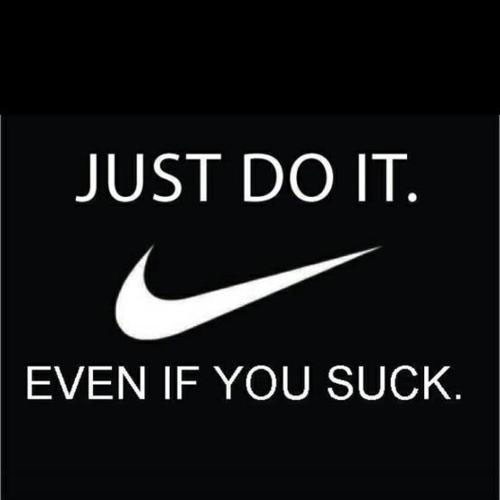
For me, I’ve realized that this is my life and I’m really good at being really bad at much of what I do. I suck, and I’m proud of that fact. You can’t suck at as much as me without a lot of hard work and determination.

See, for years now, it’s been just my daughter and me in our home, where I live as independently as possible with cerebral palsy – and I’m pretty good at it, moving along at my own pace. A lot of it takes time and tenacity, but so be it. I’ve always looked at my independent living skills as the result, not the effort. I don’t care what I have to do as long as I can accomplish the task.

However, now I have a running superstar by my side – my beautiful fiancee – and it’s made me realize that I’m really good at being really bad. A task that takes me, say, 10 minutes on my own, takes one minute with her helping. And, for the most part, I’m secure and appreciative of her helping because I equally contribute to her needs in other ways.

Nevertheless, we’ve had an ongoing dialogue about how beyond my neanderthal stubbornness, she’s raised good points that just because I can accomplish a task doesn’t mean I do it the easiest way, that I often make things harder than needed, that just because I’ve used a haphazard technique for 20 years doesn’t make it necessarily the best approach.

Beyond me, her point is one that’s strikingly universal: Questioning how we do what we do can help us find better solutions, from our careers to parenting to everyday life. But, I have my point, too: It’s taken me a lot of years to get this good at doing independent living tasks really badly – that’s hard to give up when you’re so talented at sucking as I am!

Who Really has the Power

report-card

By Mark E. Smith

I thrive on possessing power. But, not in the way you might think. In my business and family, I, in fact, practice the opposite, seeing my roles as humbly serving others. And, yet, when it comes to me, power is synonymous with personal accountability. I learned at an early age that in order to have power, you must be personally accountable; and, if you’re not personally accountable, you have no power. You can control life or life can control you. It’s initially circumstance, but ultimately choice.

It all started with my failing Biology in high school, namely because I wasn’t doing my homework. I wanted to do my homework, but my home life was a mess. My mother and stepfather made our home Hell. I came home from school each day to my mother in the most horrendous conditions – always drunk, but sometimes high, overdosed, manic, or suicidal – and then my stepfather came home drunk, where they fought and smashed up the house. My mother loved to break things and my stepfather loved to scream, and it made for long nights. On top of that, I was struggling to develop my independent living skills due to my cerebral palsy. How was I to somehow do homework with so much volatility in my life?

I lay in bed looking at my report card one night feeling ashamed because it was dotted with Fs and Ds. I’d worked really hard to be mainstreamed in an era when it wasn’t common practice, and I was watching it all slip away. I tossed the report card on the floor and decided my parents and cerebral palsy weren’t going to dictate my grades. I had the power, not them.

I went from a failing student to the honor roll the next report card period by literally locking my bedroom door in the evenings and letting my parents trash the house and there lives as I focused on my homework. I remember typing my homework while trembling and crying as my mom pounded on my door, screaming. Still, I wasn’t giving her power over my life. My grades were my responsibility – and I had the power to succeed over all.

Those years of finishing high school with A’s didn’t make me smarter, but they did make me wiser. I learned that our lives, in the long term, aren’t dictated by anyone or anything, but us. Circumstances may set us up as victims, but we can choose to be victors.

Zach And I Are In Love

Holly & Mark / Gillian & Zach

By Mark E. Smith

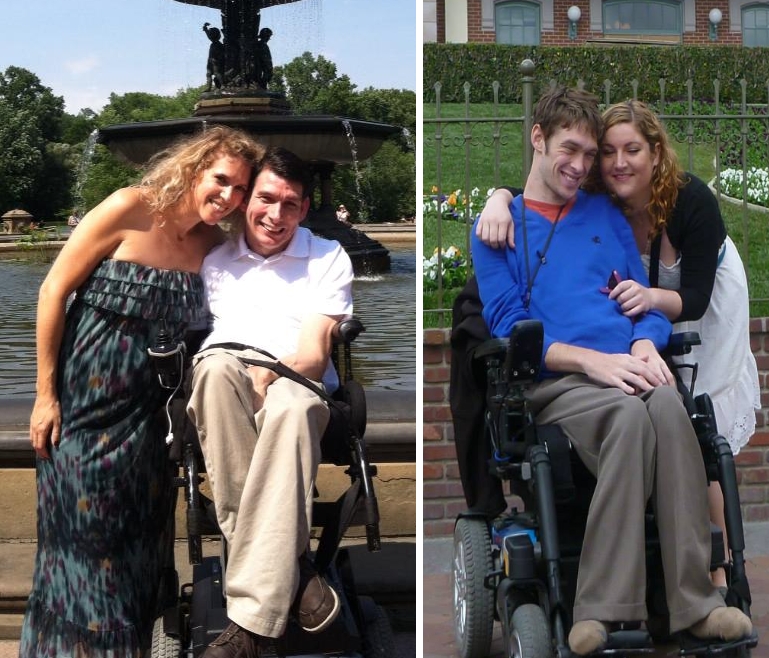
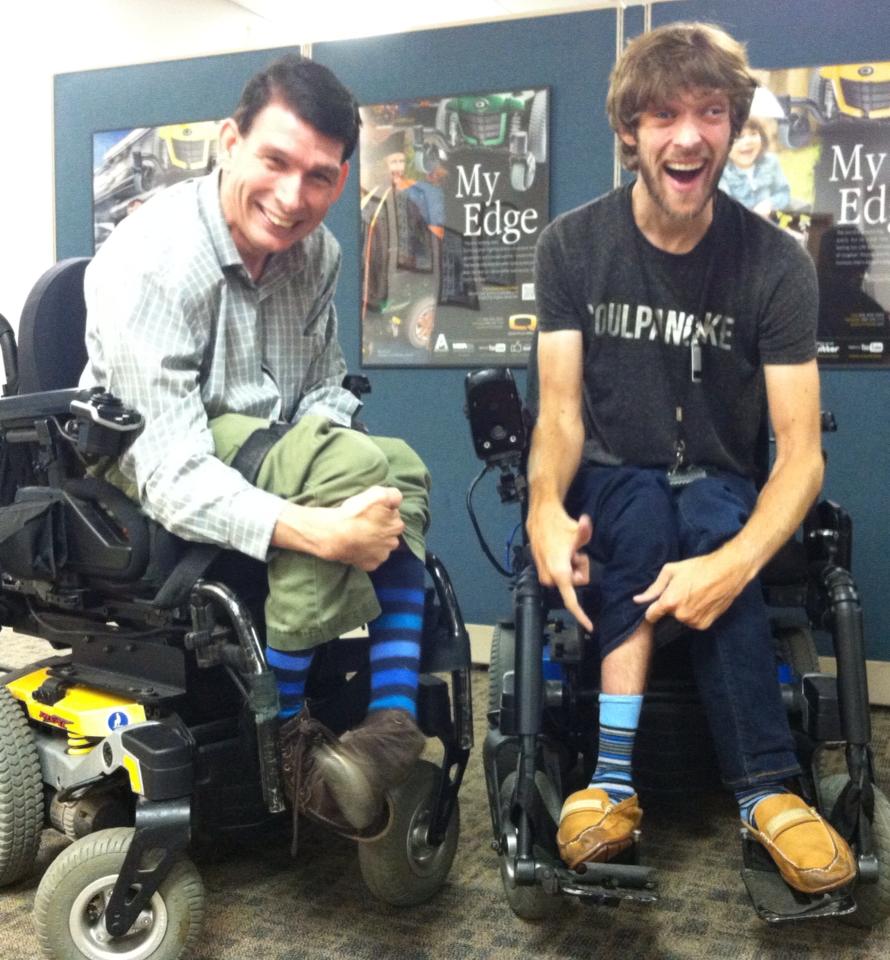
It’s official: Zach Anner and I – the two most eligible men with cerebral palsy in America – are in love.

Now, when I say that Zach and I have been the two most eligible men with cerebral palsy in America, what I really mean is, we couldn’t get dates if our lives depended on it. And, while we were tempted to date each other out of pure complacency, it turned out that waiting for the two most beautiful women in the world to sweep us off of our feet (which, let’s be honest, isn’t hard to do when we’re not on our feet to begin with), turned out to be a better idea. I should clarify that we weren’t both waiting for the two most beautiful women each, which would equal four women in total and would be really weird and a TLC reality show, but one amazing woman each. And, we scored!

In an uncanny twist, about 10 months ago, Zach and I started falling in love – with two separate women, not each other! – in Southern California. And, amazing women they were (they, of course, still are amazing, even more so, but I’m trying to keep my tense straight). Zach’s beloved Gillian is an internationally-known singer-song writer, and my beloved Holly is an artist. Both women are creative, witty, caring souls, who’s personalities truly radiate at a tangible level. Their depths of character range from funny to empathetic to being up for all that life has to offer. So, how did Zach and I ultimately get so blessed with such amazing women?

Cerebral Palsy. Fellas, trust me on this one. Forget the cheesy pick-up lines, fancy cars and medical degrees. All you need to attract a woman is cerebral palsy. Even if you don’t have cerebral palsy, say that you do. You can have a Ferrari and medical degree, but unless you tack cerebral palsy on the end, you don’t have a chance. Why? Because every woman knows cerebral palsy is where it’s at.

Of course, cerebral palsy has nothing to do with Zach and my finding love. The truth be told, we know the real secret to our finding the two most amazing women in the world: We’re just ourselves. What makes Zach and me who we are is just that – we’re happy as we are, cerebral palsy, poor posture, twisted senses of humor and all. And, with self-acceptance comes a confidence and comfort, where we have the ability to laugh and love and embrace life with an enthusiasm that’s contagious. We’re easy to love, but we equally love easily, where we know that vulnerability is a strength, empathy is a gift, and a true lover is also a best friend.

If you want to be loved for you… well… just be you.

Awesome socks don't hurt, either!
Awesome socks don’t hurt, either!

Confessions of a Bad Alcoholic

drunk

To John, February 5, 1951 – July 24, 2010

By Mark E. Smith

If you’ve read the research of recent years, then you probably already know about me: I’m an alcoholic.

Indeed, the medical establishment has concluded that alcoholism is hereditary – that is, if your family tree is lined with drunks, you’re a drunk, too. Or, you’re at tremendous risk of being a drunk. Walking past a bar or liquor store is like a metal shaving passing a magnet – it wants to suck you in!

For me, being an alcoholic is torturous because I think it’s the only thing I’ve failed at. I mean, I’m a bad alcoholic – really bad. My parents, grandparents, great grandparents and probably their parents were great at it. I mean, my mother and father had it down to a science – it’s not easy losing everything, including your life. But, me, I’m a terrible alcoholic. I’m so bad of a drinker that I haven’t drank today, nor did I drink yesterday or the day before or the day before or the day before or the day before….

But, my alcoholism even gets worse, pathetic, really. I’ve never hidden bottles, lost jobs, sobbed, Please take me back, ruined a wedding or child’s birthday party, bathed in cologne, slept on the front lawn in my clothes, wondered how my car keeps getting smashed up, vomited blood, feigned vertigo, passed out with a lit cigarette and burned my fingers, lied to everyone about everything, stole money from my child’s piggie bank, stood with belligerent narcissism before a judge, drank because of this or that, drank vodka from a water bottle at church, hugged a tree while the Earth spun at tremendous speed and I urinated on myself, or explained to a bank teller why my signature doesn’t match. Yes, I’m a terrible alcoholic.

However, here’s what I’m really good at: a little thing called personal accountability. Unlike the color of my hair, hereditary doesn’t dictate jack squat when it comes to my being an alcoholic or not. Life gives me free will to choose my path. And, while I understand the science, it’s 100 percent my choice to drink or not to drink. My mother did nine months in jail due to her third DUI, and upon being released, she stopped by a liquor store on the way home and downed a pint of vodka. Time and time again, I’ve watched people around me choose to re-elect life-destroying alcoholism, while others choose sobriety (and the science behind addiction recovery shows that the only time alcoholics maintain sobriety is when they literally choose to).

In this way, I’m among the worst alcoholics you’ll ever meet because I’ve turned my back on my own heredity.

One Morning in the Bathroom

bathrooom

By Mark E. Smith

Sometimes, vanity and modesty are voided by the realities of everyday life beyond our control, albeit disability, age or illness, and in those harrowing moments – wanting to stop time so that no one knows what we’re trying to hide from all others – we are forced out from our facades and have to ask for help, where our deepest vulnerability suddenly becomes our ultimate strength.


The Effort of Faith

faith

By Mark E. Smith

When I look at the three biggest challenges that have spanned my adulthood – writing, disability and romance – there’s a common denominator that forever keeps me pushing forward during both highs and lows: Faith.

Now, I don’t mean faith in religious terms – although, many people do, and that’s great. Rather, faith for me is belief, it’s an innate understanding that no matter what I face, I will pull through ultimately to my own betterment – that is, the light will be brighter at the end of each tunnel.

Faith for me, however, doesn’t function on its own. Faith directly correlates with effort. When I was in my early 20s as a young writer, my rejection ratio by magazine editors was around 20 to 1. For several years, my mail box was a literal daily dose of rejection, seemingly indisputable proof that I was failing as a writer. Yet, I simply had faith and I used all of that rejection as inspiration. I knew I wanted to write and I had faith that I could make it as a writer, so I put effort behind my faith and went to college to learn formalities and hone my craft. It’s taken over two decades, but my closet shelves are now lined with over 1,000 formal publications that I’ve been published in, plus all of my books and countless essays from the web. I went from spending my days seemingly writing for the sake of rejection to now editors offer me assignments. The factor of success has been having faith that I could be what I believed, and then applying the effort to become that success.

Disability and romance in my life have followed the same faith-based path. At many points individuals, situations and society have told me that I’m lesser, that I couldn’t achieve based on my disability. But, my faith has ultimately had the final vote. Dismiss me or count me out, but my faith assures that in the end, with effort, I will overcome. I may face challenges, but my faith dictates that I will succeed in the end in spite of them.

Of course, the struggle to find enduring love is a universal, epic one. Think about the canon of literature, art, music and movies that address our desire for enduring love. And, I’ve faced that struggle, too. Yet, I’ve had faith that as long as I live my best, with effort and awareness, enduring love will sustain itself in my life.

I put it this way: Life is a roller coaster – the highs are exhilarating and the lows are frightening. Yet, there’s a surefire way to even out the course. It’s called faith. With faith, and effort behind it, it’s impossible to get emotionally mired in even the bleakest situations because no matter what all signs may tell us, there’s only one truth: We will ultimately overcome. Have faith, put effort behind it, and believe that you are intrinsically capable of living the life of your dreams.