Pink Undies in the O.R.

photo (24)

By Mark E. Smith

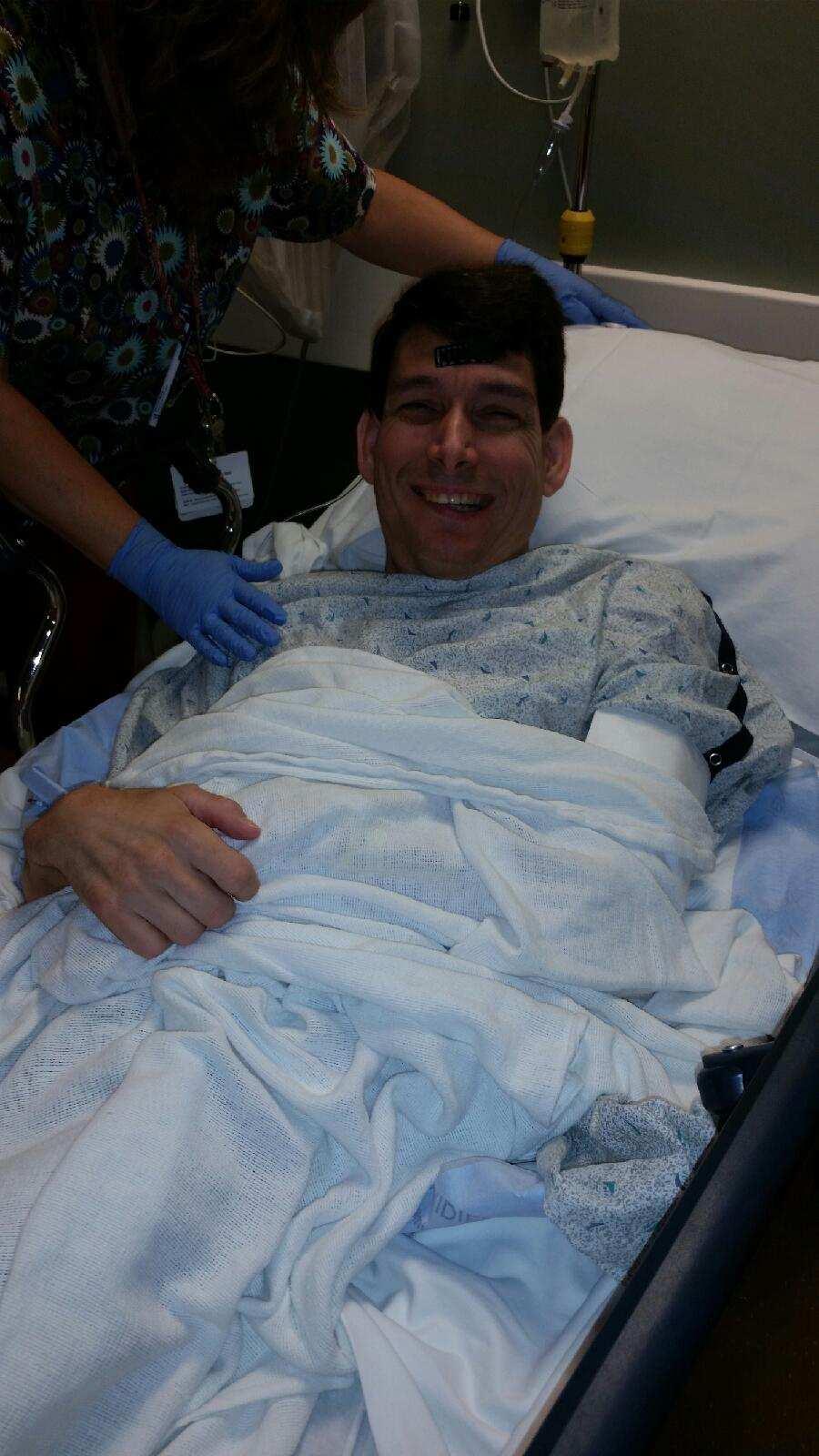
So, I’m laying stretched out on the surgical hospital bed in my neon-pink underwear and nothing else. And, I’m great with it. Muscular, with my trademark tattoo of the universal wheelchair symbol on my shoulder, I feel like a superhero. Cerebral Palsy Man here to save the day! But, the medical staff is here to save me – or at least figure out how to fix me up so they don’t have to literally save me. This is pre-surgery surgery, or as I like to call it, surgery.

My sister is with me because she’s had the worst luck of anyone I know – cancer, a critical automobile accident, over 20 surgeries. She knows the practice of medicine so well that I often have medical professionals ask if she’s one, herself. In this way, my sister is a double-edged sword: she’s great to have in the room as a medical advocate, but I don’t want her touching me out of fear her bad luck will rub off.

The nurse loves my pink undies, and I think she’s a bit charmed by my sense of humor around it all – my pink undies, flaunting my body regardless of disability, and my optimism toward the procedure itself.

Yet, I’m genuinely scared. I’m so scared that I’ve waited to do this far longer than I should have. It was my physician and friend who finally convinced me, knowing how potentially serious this could all be if I kept putting off surgery and treatment of anything else found in the process. Then once the specialists told me of the extreme risk my health was under, I knew I had to take responsibility, not just for myself, but for the sake of those who love me. And, I still have a lot of lovin’ to do.

The nurse asks me to put on the hospital gown, and I want to wear it as a cape. But, she insists I wear it the right way. My sister helps me put it on as I pout like her four-year-old. But, I want to wear it like a cape!

The anesthesiologist comes in and notes my “chronic” cerebral palsy. Is there non-chronic cerebral palsy, where you only have it on, say, Thursdays? She then stands at a computer and asks me questions from the screen, including, do I get short of breath walking up stairs?

My sister bursts out laughing and I point to my power chair parked against the wall, saying with absolute seriousness, “Only when I’m carrying that up stairs.”

Finally, the surgeon comes in to give me the rundown before we go into the O.R. He’s wearing the exact model watch I own and love, and for a moment I wonder if a man of such impeccable taste is wearing pink undies, too?

Now I’m getting even more scared, and the anesthesiologist isn’t helping. The initial shot that was supposed to put me in La-La Land still allows me to recite the first page of Chaucer’s Canterbury Tales – from the tenth grade. Still alert, I watch out of my peripheral vision as they roll me into the O.R. And, I see the size of the camera they’re going to slide down my esophagus and the table of tools they’ll ultimately use to take three biopsies. And, I watch as the anesthesiologist injects a new drug into my I.V.

Next thing I know, I awake. I think I’m still in the O.R., but as I open my eyes, a nurse tells me I’m in recovery. I’m still on my back, with the gown on, but I’m oddly now wearing pants, socks and shoes, with no recollection of the procedure or getting dressed.

“How are you feeling?” the nurse asks.

“…Like the morning after an awesome night in Vegas,” I reply. “How’d I end up here, and where’s my shirt?”
Zach And I Are In Love

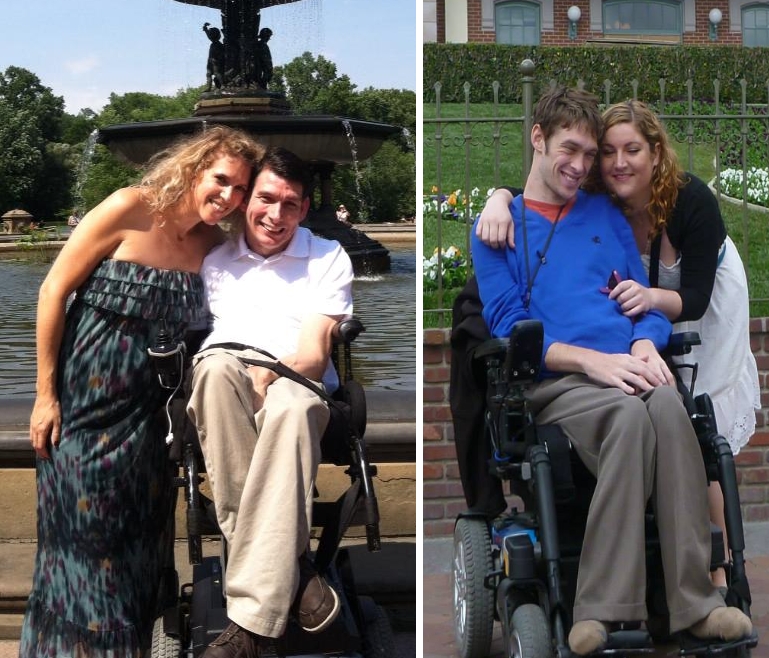
Holly & Mark / Gillian & Zach

By Mark E. Smith

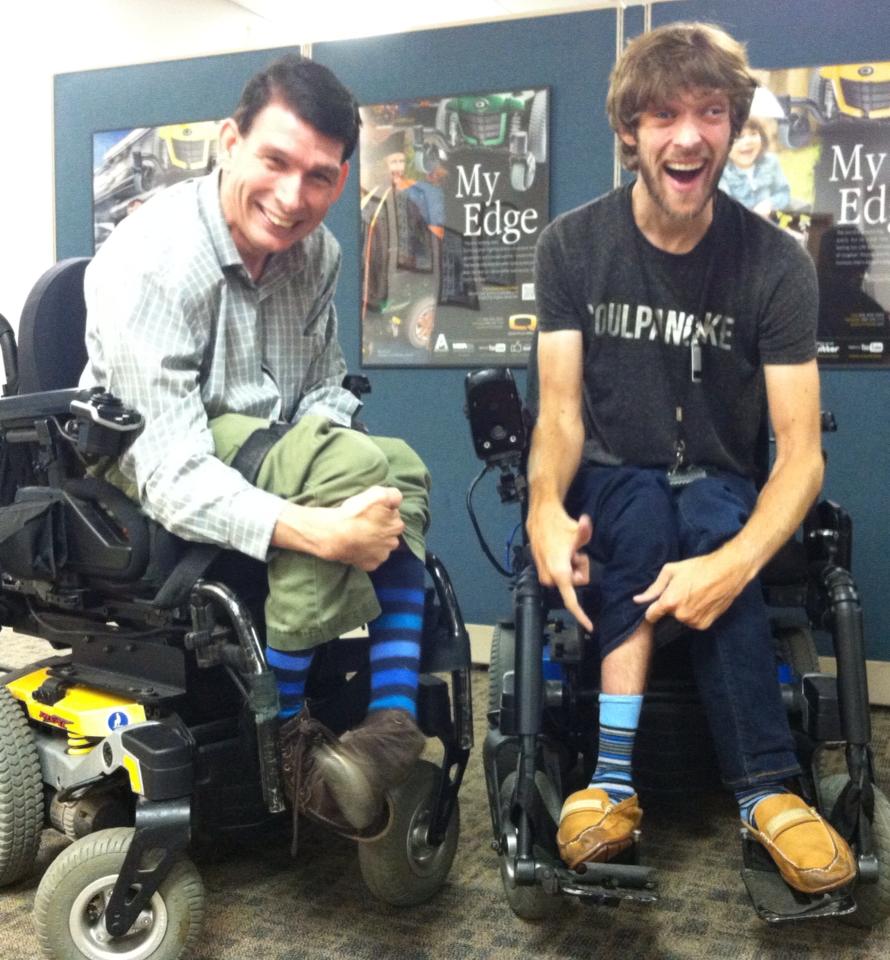
It’s official: Zach Anner and I – the two most eligible men with cerebral palsy in America – are in love.

Now, when I say that Zach and I have been the two most eligible men with cerebral palsy in America, what I really mean is, we couldn’t get dates if our lives depended on it. And, while we were tempted to date each other out of pure complacency, it turned out that waiting for the two most beautiful women in the world to sweep us off of our feet (which, let’s be honest, isn’t hard to do when we’re not on our feet to begin with), turned out to be a better idea. I should clarify that we weren’t both waiting for the two most beautiful women each, which would equal four women in total and would be really weird and a TLC reality show, but one amazing woman each. And, we scored!

In an uncanny twist, about 10 months ago, Zach and I started falling in love – with two separate women, not each other! – in Southern California. And, amazing women they were (they, of course, still are amazing, even more so, but I’m trying to keep my tense straight). Zach’s beloved Gillian is an internationally-known singer-song writer, and my beloved Holly is an artist. Both women are creative, witty, caring souls, who’s personalities truly radiate at a tangible level. Their depths of character range from funny to empathetic to being up for all that life has to offer. So, how did Zach and I ultimately get so blessed with such amazing women?

Cerebral Palsy. Fellas, trust me on this one. Forget the cheesy pick-up lines, fancy cars and medical degrees. All you need to attract a woman is cerebral palsy. Even if you don’t have cerebral palsy, say that you do. You can have a Ferrari and medical degree, but unless you tack cerebral palsy on the end, you don’t have a chance. Why? Because every woman knows cerebral palsy is where it’s at.

Of course, cerebral palsy has nothing to do with Zach and my finding love. The truth be told, we know the real secret to our finding the two most amazing women in the world: We’re just ourselves. What makes Zach and me who we are is just that – we’re happy as we are, cerebral palsy, poor posture, twisted senses of humor and all. And, with self-acceptance comes a confidence and comfort, where we have the ability to laugh and love and embrace life with an enthusiasm that’s contagious. We’re easy to love, but we equally love easily, where we know that vulnerability is a strength, empathy is a gift, and a true lover is also a best friend.

If you want to be loved for you… well… just be you.

Awesome socks don't hurt, either!
Awesome socks don’t hurt, either!

Kids Be Kids

specialneeds


By Mark E. Smith

As a classically-trained writer, I understand words – their efficacy or impotence, the way they twirl off of the tongue and echo in the ear. Words are powerful, captivating, emotive. And, sometimes, words are defining, both in the positive and negative.

For some time, as a writer, as a parent and as one with a disability – but, really, just as a person – I’ve been struggling with three words that we use to define what I’ve come to know as an ambiguous, possibly specious term: special needs child.

I, of course, understand our social definition of a special needs child, that of a child with a physical, emotional or intellectual disability. But, is it – special needs child – a logical term to use? I mean, I’m not questioning it from a political-correctness or ethical perspective. I simply question if the label is logical?

And, I don’t think it is. After all, have you ever met a child who didn’t have special needs? Of course not. If we truly acknowledge what each child in our life needs, every child is a special needs child. There are eight children in my close family, and they’re all so unique in character and at different stages from one another that each one has special needs. Why only project “special needs” onto children who have disabilities when every child clearly has special needs?

The label also represents a type of reverse discrimination that’s unfair to all children. If you’re with several children in public, and one has a disability, adults often fawn over the child who has a disability and ignore the other children. Yes, such adults mean well, but they’re doing more harm than good. Such situations inadvertently patronize disability and ignore others – everyone loses.

Instead, let’s see kids as kids. Each is special and unique and has needs, and should be recognized as such. Most importantly, let’s drop the labels altogether, and just let all kids be kids.

The Tortoise Mindset

hare-and-tortoise-694263

By Mark E. Smith

No matter how many times I’ve read Aesop’s fable, The Tortoise and the Hare, the tortoise always wins. Logically, at some point shouldn’t the hare win? After all, the hare is physically faster.

The answer is, no – not in the fable and not in life. Aesop, a slave in ancient Greece in the 5th century BC, was onto something: Dedication and perseverance always pay off in the end. Think about every aspect of your life, from health to career to relationships to finances – does taking the easy way ever work in the long run?

Never. The University of Wisconsin did a study (one example of many) on how long it takes to get in true physical shape. After six weeks of rigorous training, there were no results seen in the sample group; three months showed progress; but, it wasn’t till one year, then four years that there were significant physiological changes. Everyone wants a quick fix to shed those pounds and have six-pack abs, but there’s no such thing. However, you can absolutely do it if you have a tortoise mentality, where dedication and perseverance will pay off over years.

Want to be a millionaire? Maybe winning the lottery, flipping houses or playing the stock market is the ticket. No, the hare loses again. In the U.S., tortoises get rich. The average millionaire is 57, works over 50 hours per week, has a graduate degree, and is first-generation wealthy. What’s been their number one wealth-building tool? Saving 20% of their monthly take home pay over their career. Put simply, you get rich over decades, not overnight.

Of course, in relationships, the hare must win, right? Love at first sight rules all. Statistically, not so. See, your odds of staying married increase if you date for at least a year before tying the knot, and those who get married around age 30 are much more likely to stay married than those who get married younger. Want the healthiest marriage? Be a tortoise and take things slow and steady.

I live and work in the world of disability experience, where challenges abound for many of us. And, what I’ve learned is that rehabilitation doesn’t stop when released from the hospital; rather, it’s truly just beginning. There are no quick fixes, and some skill sets – from the physical to the emotional to the mental – can take decades to master. Heck, every morning I still work on the coordination needed to tie my shoes and button my pants– after over 30 years of trying. Yet, it’s the tortoise mindset that keeps us striving. If we simply stay dedicated and persevere, we will succeed in one way or form. It can take 20 or 30 years, but success will come.

The examples go on and on, but here’s the point: there’s literally no secret to success. Success isn’t luck of the draw or magic. We need only to look to Aesop’s fable of the tortoise and the hare – a slave’s philosophy from ancient Greece – to know that success is a marathon, not a sprint.

The Real Investment of Complex Rehab Technology

MarkESmith300

By Mark E. Smith

I strive not to overlap my print writing with my online writing because, really, there’s too much of my work floating around the literary world as it is. How much of me can any one reader take? However, I’m crossing my own boundaries and linking you to a very poignant piece in this month’s print edition of Mobility Management Magazine. You’ll learn a bit more about my life journey — and hopefully a bit more about others’ and your own. http://mobilitymgmt.com/Articles/2014/06/01/Complex-Rehab-Technology-Investment.aspx

The Effort of Faith

faith

By Mark E. Smith

When I look at the three biggest challenges that have spanned my adulthood – writing, disability and romance – there’s a common denominator that forever keeps me pushing forward during both highs and lows: Faith.

Now, I don’t mean faith in religious terms – although, many people do, and that’s great. Rather, faith for me is belief, it’s an innate understanding that no matter what I face, I will pull through ultimately to my own betterment – that is, the light will be brighter at the end of each tunnel.

Faith for me, however, doesn’t function on its own. Faith directly correlates with effort. When I was in my early 20s as a young writer, my rejection ratio by magazine editors was around 20 to 1. For several years, my mail box was a literal daily dose of rejection, seemingly indisputable proof that I was failing as a writer. Yet, I simply had faith and I used all of that rejection as inspiration. I knew I wanted to write and I had faith that I could make it as a writer, so I put effort behind my faith and went to college to learn formalities and hone my craft. It’s taken over two decades, but my closet shelves are now lined with over 1,000 formal publications that I’ve been published in, plus all of my books and countless essays from the web. I went from spending my days seemingly writing for the sake of rejection to now editors offer me assignments. The factor of success has been having faith that I could be what I believed, and then applying the effort to become that success.

Disability and romance in my life have followed the same faith-based path. At many points individuals, situations and society have told me that I’m lesser, that I couldn’t achieve based on my disability. But, my faith has ultimately had the final vote. Dismiss me or count me out, but my faith assures that in the end, with effort, I will overcome. I may face challenges, but my faith dictates that I will succeed in the end in spite of them.

Of course, the struggle to find enduring love is a universal, epic one. Think about the canon of literature, art, music and movies that address our desire for enduring love. And, I’ve faced that struggle, too. Yet, I’ve had faith that as long as I live my best, with effort and awareness, enduring love will sustain itself in my life.

I put it this way: Life is a roller coaster – the highs are exhilarating and the lows are frightening. Yet, there’s a surefire way to even out the course. It’s called faith. With faith, and effort behind it, it’s impossible to get emotionally mired in even the bleakest situations because no matter what all signs may tell us, there’s only one truth: We will ultimately overcome. Have faith, put effort behind it, and believe that you are intrinsically capable of living the life of your dreams.

Working Class Hero

scottbalkner

By Mark E. Smith

John Lennon coined it, and I’ve always believed in living it – as a father, as a bread winner and, yes, as one with a disability: A working class hero is something to be.

See, to me, a working class hero isn’t about a literal vocation or social class, but about drive and determination. Are you strong enough every morning, regardless of the challenges you face, to put your boots on and go into your day willing to do whatever it takes to get the job done, with little reward beyond knowing you’ve done right?

And, like I said, this purest form of heroism isn’t about vocation or social class. Yes, the roofer who’s on a roof in July, working 12 hours a day with 130-degrees radiating around him, all to support his family, is a literal working class hero. But, so is a full-time single parent. And, so is one sustaining sobriety. And, so is one thriving with a disability. Although each of these examples are very different – and you can insert any life path into the list that requires internal tenacity to succeed – they all demonstrate an extraordinary work ethic, they all demonstrate quiet, dignified heroics in everyday life.

And, there’s a certain rebellion to being a working class hero, where when life presents roadblocks that others don’t have the strength or courage to knock down, you utter a barely audible F-you, and fight your way through. Working class heroes punch adversity in the face and proceed on.

I want to introduce you to a working class hero of mine, Scott Belkner, who puts on his boots every day and just goes to work. There’s no one motivating Scott but Scott. He’s not someone you know, no fame or money. But, he demonstrates an internal work ethic that demands respect, that sets the bar for how so many of us should approach our lives.

Watch Scott’s story, and I bet he becomes a working class hero of yours, too.

More Than Enough

Mark and Emily001

By Mark E. Smith

I’ve spent my whole life not being enough. Truly, from my birth, onward, I’ve never been enough. The doctors declared me a vegetable who should be institutionalized. My father was so ashamed of my disability that he refused to push me in my wheelchair in public. Mrs. Robinson, my third-grade public school teacher, fought to keep me of her classroom because I wasn’t physically on par with the other students. My prom date wouldn’t dance with me because I used a wheelchair. Waitresses have refused to serve me, and even in 2014, I still occasionally face discrimination because in the eyes of some strangers, I am not enough.

And, it remains the case, that in so many situations and perceptions, I am not enough. However, I want to share with you a very fitting story about what it’s like to face such a struggle, what it means to be labeled, to go through life as never being enough. See, when I was around 13, I desperately pursued my physical independence, knowing that in a world that didn’t view me as enough, I was in a race for survival, avoiding the potential of ending up in a long-term care facility because I couldn’t care for myself. And, so as part of enhancing my physical strength toward independent living skills, I began going out every day after school and pushed my manual wheelchair along the street in front of my house. I was severely spastic, with terrible coordination, and used a power chair, so pushing a manual wheelchair was a tremendous struggle. I fought to get both hands on the push rims, and gave a single thrust of the wheelchair, throwing my body into spasms – then, as the wheelchair coasted to a stop, I started the process all over again. It took me over an hour to go down the block and back.

However, it wasn’t physically pushing the manual wheelchair that was the biggest challenge. Rather, it was the literal voices along the block. A few neighborhood boys of my age taunted me every day, calling me retard, mocking me with spastic gestures, telling me I was not enough, that I couldn’t even push a wheelchair correctly.

Nevertheless, every day for that school year, I put myself in the line of ridicule and humiliation and pushed that wheelchair up and down the block, literally being told I wasn’t enough with each challenging push of the wheels. It was a set schedule: at 3:30 every day, I pushed my manual wheelchair, and the other kids followed along humiliating me. It was painful and scary and enraging and embarrassing, but I had to endure it for my greater good.

That one year taught me a lot about not being enough. In pushing that manual wheelchair, all the while being mocked, I didn’t merely improve my physical abilities, I developed perseverance, determination and autonomy. I wasn’t pushing to be enough to the other kids or the rest of those who discounted me. Rather, I was pushing my own race to become more than enough.

The fact is, I’ll never be enough. Heck, my own father went to his grave unquestionably ashamed of me, I had a ex-girlfriend give me a written list of why I wasn’t worthy of her love, and I still face public discrimination and humiliation from time to time. I will never meet certain standards or be enough as a person in the eyes of some.

So, then, how are many aspects of my life explained? If I was not enough to my parents, how did I go on to successful careers in the mobility industry, writing and speaking? If I was not enough to my third-grade teacher, how was I able to go on to college and grad school? If I have not been enough of a man in the view of some strangers, how have I succeeded in raising a beautiful daughter as a full-time single father? The list goes on and on, but the point is, despite my never being enough in the eyes of so many, how have I, to the contrary, had so many successes?

The answer is universal. We should never strive to be enough in the eyes of others – it’s a low bar to measure ourselves. Instead, we should ignore the false ceilings that others place upon us and instead push to our own best abilities. And, in that process an amazing transformation occurs: we eclipse never being enough by actually becoming more than enough.

At the End of the Tunnel

lightendtunnel
By Mark E. Smith

In my roles within the mobility industry, I often encounter very difficult situations. No, I don’t mean broken wheelchairs or grumpy customers – those are typically easy to resolve. Rather, the difficult situations I face are families in emotional crises, where a husband is newly paralyzed or parents have lost a child to a progressive condition like muscular dystrophy. And, along that harrowing road over the past 15 years, I’ve seen such families turn tragedy into triumph, while others crumbled into ruins. What is it, then, that separates these two outcomes? What is it that allows couples to survive devastating circumstance while others dissolve?

I’m not a psychologist or a sociologist, nor have I done any scientific studies. But, I am a real, thinking, feeling person with empathy toward those facing adversity – I’ve been there and I know what it’s like. And, as I’ve been in the trenches with families in crises, I’ve observed two very distinct factors that allow couples to face and overcome life’s most profound tragedies, actually strengthening relationships, not destroying them.

The first is factor that successful couples have in the face of adversity is unyielding love and respect for each other. Now, all couples will say that they have unyielding love and respect for each other, and it seems obvious that couples would have this. But, we live in a culture where relationships are about as sacred as trip through a drive-thru, and there’s too often very little respect among partners. Think about couples around you, or maybe your own relationship, where each individual makes him or herself the priority, not the relationship or partner. Or, think about how moodiness, arguing and name calling are deemed acceptable by many. Those are traits of dishonor and disrespect, and when crisis hits, such couples are doomed. In crises, the blame-game ensues and rather than protecting each other’s hearts, they go for the jugular.

However, surviving couples are different. Mutual respect reigns over moodiness, arguing and name calling. Surviving couples run toward the safety and shelter of their relationship during crises, not away from it. There’s a sanctity to the relationship that’s upheld, serving as an unconditional safety net during crises.

Statistically, the average length of marriage prior to divorce is eight years. Why eight years? Money magazine recently reported that over any 10-year period, we have a 98% chance of facing a major life crisis, albeit financial, health-related, and so on. Therefore, if we’re in rocky relationships, and are all but certain to face a crisis, of course it’s just a matter of time before it’s game over, logically right around that 8-year mark.

Yet, truly loving, respectful couples ultimately find crises as opportunities to grow close together. So, at eight years, having faced crises and embraced each other, their commitment is stronger. A couple simply has to have unyielding love and respect to weather crises. I have yet to meet a couple who’s stayed together through a life-changing crisis who didn’t have a foundation of unyielding love and respect for each other.

The second trait that I’ve found couples must have in order to survive a life-changing crisis is a sense of a higher power. Now, I don’t mean formal religion – although it’s often the case – but a true belief in a guiding force that everything happens for a reason, with larger meaning and purpose. This is such a powerful tool toward coping and healing because it often explains the inexplicable.

I was born with severe cerebral palsy. If I looked at that as a random act, solely making me suffer, can you imagine how bleak my world view would be – there’d be no purpose for my life. However, if I truly believe that there’s a purpose to why I received cerebral palsy, I then naturally look for the positives, giving my life purpose and meaning. Couples who succeed through tragedy do exactly this – that is, they share a belief in a larger purpose and meaning to all. If one or both partners are bitter or resentful over a crisis, again, they’ll go for the jugular, not the heart – and the relationship won’t survive. Both partners must believe in a higher power of meaning and purpose.

What I know is that given enough time – statistically within a 10-year period – couples will face crises. And, having witnessed many families experience the most harrowing of circumstances, I can attest to this fact: As long as you and your partner have unyielding love and respect, and believe in a larger meaning and purpose to all, you’ll make it hand-in-hand to the light at the end of the tunnel.

Times of Need

timesofneed

By Mark E. Smith

For most of us, we’re far more comfortable giving than receiving. Yet, giving and receiving must be equally embraced if we are to truly have healthy, reciprocating relationships. Just as we strive to love and support others in their times of need, we must welcome their love and support in our times of need.

Now, I know it can be hard, where pride and ego can make it very emotionally difficult to receive in times of need. If you’ve been the bread-winner in your family, and your in-laws want to pay your mortgage because you’ve been out of work, that may be a difficult gift to receive. If you have a disability and your spouse wants to help with your daily care, that can be a difficult gift to receive. Or, if you’re a single parent and friends wish to watch your children to give you a break, that can be a difficult gift to receive. The examples go on and on, and I’m sure that you can think of examples from your own life where you’ve emotionally struggled with receiving from others on some level. However, here’s the heartfelt truth: when others offer to support us in our times of need, they do so out of love, and if we – again, out of falsities of pride, ego or embarrassment – reject their support, it will almost always be interpreted as some sort of rejection of their love. What’s more, in an intimate relationship, if we are always striving to be there for our partners, but won’t allow them to be there for us, it can be like slamming an emotional door in their face – and the inequity created will destroy the relationship. The fact is, love isn’t just about giving, but receiving.

One aspect of my life is that I can aspirate in my sleep, a very dangerous condition. Fortunately, due to preventative measures, I keep it under control, and when I do awake aspirating, I’m able to roll over and sit up, literally saving my life at times. Unfortunately, because my lungs fill with fluid, I become extraordinarily ill for 10 to 12 hours, with a 102-degree fever, till my lungs clear. As you might imagine, this can be really scary for my partner. Therefore, in wanting to protect her, I wouldn’t wake her up when it happened. In the morning, however, she’d become upset with me, knowing that I aspirated but didn’t wake her up. However, she wasn’t upset out of anger but love. When our partner is sick, we want to be there for him or her, and through my stubbornness, I wasn’t allowing her to be there for me. Not only was I wrong by robbing her of peace of mind – as she wanted to be immediately aware of the situation so she could help – but I also wasn’t fostering a reciprocating relationship. I wanted to give, give, give to her, but indirectly, I wasn’t fully allowing her to give back in among my times of need. That was painful for her to experience, and lousy on my part by thwarting reciprocation in our relationship. As a result, I became much more respectful of her concern for me, letting her know when I aspirated, allowing her to care for me. If we are to truly love someone, we must let him or her truly love us in our times of need, as well.

See, in loving, the one aspect we wish most is peace of mind. We want to know that those we love are healthy, safe and secure. The same goes for those who love us – that is, they want to know we’re healthy, safe and secure. And when we don’t allow others in, it causes them stress, anxiety and heartache. Letting others be there for us, as we wish to be there for them, offers peace of mind to those we love – and that’s one of the most humble yet powerful gifts we can give.

I discussed this overall subject with my sister, and she replied that it takes tremendous humility to allow others to be there for us in our most vulnerable times of need. And, she was right. We must let down our guard and inherently trust that those wishing to be there for us do so out of unconditional love and respect, and we should never interject insecurities into the dynamic. If someone wishes to assist you out of love and respect, allow him or her, as it’s a testament to your character, too.

Ultimately, no one gets through life alone. When we’re fortunate, we have the opportunity to love and support others in their times of need. However, let us not forget that love is reciprocation, and we must allow others to likewise love and support us if we are to have truly healthy relationships. Therefore, sometimes the greatest gift that we can give someone we love is the sincere opportunity for him or her to love and support us in return – especially in our times of need.