Talk About a Tragedy

pinscher

By Mark E. Smith

Never cry over spilled milk – or when your dog goes astray at the National Dog Show. It’s not the end of the world forever.

Or, is it?

Like millions of Americans, I spent part of my Thanksgiving watching the National Dog Show. I don’t know why Thanksgiving and the National Dog Show have become a combined tradition – other than many of the dogs would love to tackle a turkey and turn it into a chew toy – but the two now go together annually.

What I’ve concluded is that it should really be called the National People Show because the show dogs could care less. My English bulldog has some sort of award-winning pedigree, a name on her AKC registration so long that I truly don’t recall what it is. We just call her, Rosie the English Bulldog, and even then she rarely listens. My pedigree pup wants nothing to do with a show ring; rather, she wants to eat, sleep on “her” couch and poop in our hallway when no one’s looking. Basically, a $3,000 show dog is an arrogant, slovenly alien that dwells in your house. At least mine is.

Yet, people are compelled to romp pampered pooches around a show ring on Thanksgiving Day – and we watch by the millions. However, this year was worth the spectral because as a miniature pinscher did what dogs do – playfully making a mad dash untethered across the ring – its frantic handler ran after it, swooping it up, all to the delight of viewers. It may not have been that big of deal, but the fact that the handler cried inconsolably while carrying the dog back and uttered, “My world is over forever,” made a lot of us wonder if she wasn’t the most vapid, self-absorbed individual in the world – forever! I mean, I know people take dog shows seriously, but what kind of person cries and declares that her world is over forever (which is redundant), because her happy dog went for a self-appointed stroll?

All of this made me want to talk to the handler, literally. I had to know why she would take such a mundane – if not cute moment – and process it as a human tragedy? In all seriousness, I deal with individuals and families everyday who face devastating life circumstances – permanent disabilities, terminal illnesses, and the worst-of-the-worst, parents losing their children. And, so, in my world where children pass away at age 9 due to muscular dystrophy and mothers are paralyzed in their 40s due to ALS, how can anyone be so seemingly shallow, to be so clueless toward true human tragedy that she would sob and declare the end of her world over a happy dog trotting around a show ring? Yes, she lost a dog show, but the dog was happy, there was no consequence on anyone’s life whatsoever and, no, despite her declaration, the world didn’t end.

Unfortunately, I wasn’t able to track her down. Nevertheless, there’re only two possible causes for the handler’s completely inappropriate reaction. The first is that there are other emotional and psychological factors in the handler’s life that came out upon the unrelated catalyst of the canine’s impromptu jaunt. Emotions have to come out eventually, and they can come out at unexpected, unrelated times. Maybe the handler has real issues in her life and they all manifested on the punch-drunk little pinscher. I can’t help but empathize for anyone in such a situation, where flood gates of emotion open at an unexpected time – it’s scary, isolating and, unfortunately, can feel mortifying.

On the other hand, some people do live remarkably privileged, narcissistic lives, where the slightest hiccup – a lost dog show! – is the seeming end of their worlds forever. Maybe the handler truly is as shallow as she’s appeared.

I have no idea where the handler’s life experience resides. However, given the two possibilities, I sincerely hope that her sobbing over a cantankerous canine was emblematic of a vapid narcissist because that’s a far better fate than those who’ve known true tragedies.

Curveball King

The pitch

By Mark E. Smith

As a writer, I can tell you that life is a story that unfolds page-by-page as we live it. Some of it we can predict and when we get to those particular pages in life, those where our intuition is right. However, most aspects of life are totally unpredictable, and much like a novel that we can’t set down, each page brings twists and turns that leave us only wondering what will happen next?

As a person, much like a voracious reader, I learned to stop trying to predict life, to guess or try to control what comes next. Why? Because like a page-turner of a novel, we can rarely guess what comes next. Think about your own life. Go back 10 years. Could you have predicted the twists and turns – the unforeseen plots – that got you to where you are today? Certainly not.

Yet, it’s human nature to want to know how’s it all going to unfold? People may give you answers, from friends giving you comforting thoughts to medical professionals giving absolute diagnosis. However, no one truly knows. The couple who everyone proclaimed would be together forever ends up in a bitter divorce, while the individual with a grim medical prognosis goes on to a inexplicable cure. We’ve all seen these plot twists, the unpredictable nature of life. Therefore, if you try to predict life over the long term, you’re likely going to be both disheartened and surprised much of the time based on any given circumstance.

So, if it’s so difficult to predict life, how do we handle the twists and turns, the unknowns that are bound to come our way? To use a sports analogy that’s fitting, life throws us two pitches: a predictable fastball and an unpredictable curveball. But, here’s what’s astounding, in baseball and life: researches found that when batters hit a curveball, they’re more likely to hit a home run (it has to do with the spin of the ball, the way it deflects from the bat, and so on). Therefore, both our biggest disappointments and successes in life often come from the unforeseen, an unpredictable curveball that can either strike us out or bring us amazing opportunity. Yet, again, one can’t predict the outcome, but merely take each ball – life’s twists and turns, that is – as it comes.

What I’ve learned is to not try to predict or question the future, but to embrace whatever it brings. Whether life sends me a predictable fastball or unpredictable curveball, I accept them equally and take my best swing. Life is a novel – a baseball novel – and I’m forever excited to see how the plot unfolds as my protagonist strives to be the Curveball King.

Gala of the Messy and Miserable

20141118_175743-2

By Mark E. Smith

Facebook and disability – they’re both masters of illusion, where publicly you never see the whole picture of a person, just the best parts possible. But, what happens when you remove that curtain, where life isn’t glamorous postings or a guy in a power wheelchair, wearing a suit and tie, whizzing by you at work?

We really do live in a kaleidoscope culture, where people only want to see and present the pretty parts of life. The real and gritty parts are scary and painful – and yet all so real. None of our lives are pretty and perfect all of the time. In fact, they can often be messy and miserable. And, what I’ve learned is that the pretty and perfect parts don’t unite us; it’s the messy and the miserable that do – because they’re heartwrenchingly real. We can only relate to the pretty and the perfect to a limited degree. However, the messy and the miserable is often where life lands us – and we all can relate to that. In this way, there’s a reason in all of our lives to shatter the illusion and get real, where we have the courage to expose the messy and the miserable, and that’s when we truly connect with others.

My own Facebook and disability form an illusion. No, not intentionally, but by the nature of it all. My colleagues see me poised and polished in my career – perfect hair, whizzing by in a power wheelchair – and my Facebook shows an amazing life. So, if that’s the pretty and the perfect, where’s the messy and the miserable come in?

All over the place! I attended a gala recently and, if I say so myself, I looked GQ-hot rolling in. But, what no one saw was what it took me to get to that point. I’m no GQ model. Rather, I’m a guy with severe cerebral palsy whose life can be messy and miserable. Like many with complex disabilities, I had to build in my “bathroom regimen” in the process of getting ready, which takes time and is physically taxing. Then, the reason why I was polished and on time at the event was because my daughter and fiancee helped me get dressed. I can do it on my own, but it takes hours, so the more practical of the two options was accepting the gracious help of my daughter and fiancee to get me ready.

But, we never have these conversations, right? It’s not like someone says to me at a gala, “Mark, you look so handsome tonight.”

And, I reply, “Thanks. I struggled through a bathroom regimen this afternoon, then my fiancee buttoned my pants, tied my shoes and styled my hair….”

Yet, that’s the reality, and when I think about that gala, I know that many people there had messy, miserable aspects to their lives, too. After all, life isn’t easy for any of us. Maybe there were couples who argued like mad on the way, but walked in with smiles. Maybe they were couples who drove there in a car with the gas light on because they’re broke, but walked in like a million bucks. Maybe someone recently lost a family member and it took all of his or her strength to get dressed up and attend such a chipper gala. And, how many individuals there had disabilities or conditions unseen, from depression to epilepsy? I know that the beautiful lady on my arm – my fiancee, the one who helped me face my challenges to get to the gala – had her own challenges that eve, ones that no one knew, as she continues recovering from a recent cancer-related surgery.

The fact is, everyone’s life can look pretty and perfect on the outside. But, how many of our lives truly are? Life is often messy and miserable – and, as a result, absolutely beautiful. See, when we let down our facades, and with grace and dignity discuss the messy and the miserable in our lives, it makes those around us let down their guards, and that’s when we truly connect with others. And, when we connect, we’re not alone in the messy and miserable, and it makes all in our life – the messy and the miserable – dramatically easier to cope with.

And, so at that gala, I made my own silent toast to the messy and the miserable hidden beneath the facade of the pretty and the perfect – because we’re all in the trials of life together.

Gravitational Pulls of the Soul

past

By Mark E. Smith

Bishop T.D. Jakes says, “When you hold on to your history, you do so at the expense of your destiny.”

Have you ever lived those words or known someone who has? Many of us have seen the impact of such an emotional and mental paralysis that comes from holding on to a painful past – and some of us have lived it.

My history, which I’ve talked and written about extensively with the hopes that sharing my story will help others, is a bleak one. And, I literally had to let go of my history to get to my destiny, which has included sharing my story. However, it wasn’t easy, and when I spend time with those who are struggling to let go of their histories – those with acquired disabilities still longing for the ability to walk, those who were abused as children still harboring shame and self-doubt, those who’ve had their hearts broken, pining for that lost love – I know how hard it is to let go of that history to move on to one’s destiny. To make it even tougher, our histories sometimes have a way of holding on to us, where we continue encountering reminders of that which has caused us so much pain. So, how do we let go of our histories and move on to our destinies?

For me, it was a long process that allowed me to break free. It’s not like I don’t have memories or emotional scars. Those never go away. But, the pain of my past ceased effecting my daily life and allowed me to truly live my destiny when I found myself finally free of my painful history, where I had solitude within and could simply enjoy the life I’d striven to build. I’d liken it to the gravitational pull of the Earth from space – the force will always be there, but the farther we get from it, the less effect it has on us.

I remember being in the throws of my dysfunctional family in high school, knowing that simply graduating would move me a single step forward from my family history of a lack of education. Then, I knew that graduating college would move me a next step, the one from my family history of poverty. Then, I didn’t have a drink of alcohol until I was 33, knowing that I was healthy enough in my behavior to move beyond my family’s history of addiction. Yet, history can sneak up on us, and when I realized I was married to an addict and I didn’t want my daughter to have that history burden her – though it certainly did, has and will – I had the courage to end that marriage to again pull myself and my daughter farther from my history. At one point, I physically moved across the country, both for my career and to get farther away from my history – so I could live my destiny.

See, moving from our histories to our destinies is a lot of work – it’s being entrenched and digging our way out. It takes awareness, desire and patience. It takes knowing that where we were, isn’t where we belong. But, more than any other factor, it takes knowing that we have the power to move our lives wherever we wish, including far, far away from the gravitational pull of painful histories holding us back. We may not have controlled where we were, but we can control where we’re going. No, it’s not an immediate change, but through many individual, conscious decisions day-by-day, over months, years and even decades, we can let go of our painful histories and shift the tide, where our destinies become the gravitational force in our life.

As you read this, I don’t know what you’ve been through. Yet, I know that you are more than your history. We all are. You may long for the ability to walk again, but you have the power to set that pain aside and literally roll a wheelchair toward the life of your dreams. You may have had a horrific childhood, but you have the power to claim a life of solace surrounded by safety and love. You may have had your heart broken, but you have the power to entrust it with that special someone who proves as your true soul mate. You have the power to release your history – step by step, let it go! – and live to your destiny. None of it’s easy. However, destiny calls each of us to let go of our painful pasts and embrace our dreams. Once you allow yourself to be pulled by the gravitational force of your destiny… well… you’ll experience joys in life you never imagined.

The Most Human Experience

empathy

By Mark E. Smith

Much of my life is spent around those like myself who have physical disabilities. And, because I have faced adversity in my life, many have turned to me for understanding, reassurance and comfort. After all, if you look at me – body twisted, spastic in my power wheelchair – I personify adversity.

Yet, while I know of my adversities – and, yes, some components of adversity are universal – I can never fully understand someone else’s adversities. While two individuals may even have the exact same disability, condition or other life circumstance, what I’ve learned over decades of sharing stories of adversity with others is that no two experiences are the same.

This raises several intriguing questions. Firstly, if no two experiences are the same, how do we meet the innate need for connection with others in the face of adversity? And, secondly, how do we support others in their times of adversity when we haven’t had the exact same experience?

The answer to both these questions is a singular one: empathy. Empathy is an amazing human capacity because it allows us to connect with others on the most genuine levels, where it’s not about relating to an exact circumstance, but truly relating to the person who’s experiencing that circumstance in his or her own way. So, you may wonder, how have I done that in my own life? After all, I was born with cerebral palsy, so how can I relate with a mother who was able-bodied till age 36, then paralyzed from the chest, down? Yes, they’re both disability experiences – but vastly different.

The first interpersonal connection I make is to try to best understand the other individual’s perspective. I mean, can you imagine what it emotionally and psychologically feels like to be the nurturer and caregiver to your children and spouse, and now you’re physically unable to fulfill those roles in many ways? I know, we want to swoop in and rescue and say, “As a mother and spouse, you’re more than your body, and everyone views and loves you just the same.” And, it’s true – but that’s not empathizing with the person’s real, valid emotions. I’ve said in this exact situation, “I can imagine how difficult it is to have gone from the caregiver to needing caregivers. That’s a harrowing life transition. How are you dealing with that?” When we approach others’ adversities by letting them know we’re striving to see their situations from their perspectives, it creates true connection and validation – invaluable aspects of empathy.

This leads to the other aspect of empathy: being truly present in the other person’s time of adversity. No, I don’t know what that recently-paralyzed 36-year-old mother is literally going through – I’ve never experienced it and no one has ever been in her exact circumstance, either. However, I’ve made it through harrowing times in my life and there’s common humanity in that. And, so there’s the remarkable ability to quietly relate with someone, not on a circumstance level, but a human level. This is a scary place. I know scary places, so I’m just going to hold your hand as you move through it.

In these ways, through my decades around disability – both in my profession and in my personal life – I’ve learned a lot about being there for others. Empathy isn’t about having gone through an exact experience. Rather, empathy is about striving to understand another’s perspective and embracing him or her as-is, wherever he or she is in the midst of adversity. If we do that, we navigate toward the most uniting experience of them all: shared human experience.

Dust and Sweat and Blood

critics

By Mark E. Smith

Someone asked me what the hardest part of my career has been? I didn’t have to think twice: Learning to embrace criticism.

Whenever we put ourselves in the public eye, even on a small scale, criticism flies at us. I once read a scathing criticism about Mother Teresa. Why would anyone ever criticize Mother Teresa?

I would have never imagined 25 years ago when I published my first piece in Sports ‘N’ Spokes magazine about racing wheelchair technology that readers would send letters to the editor criticizing me. But, they did. I remember the next month’s issue where a Canadian racer lunched a personal attack on me in the Letters to the Editor section. It hurt and made me second guess myself, not as a writer, but as a person. Then I wrote a piece in New Mobility about the goal of equal rights for those with disabilities, and I again was shocked by the hate mail. By 1995, when my childhood autobiography was published – as wholesome as writing gets – I wasn’t surprised but disappointed at the strangers who didn’t attack the book, but me personally.

With my work becoming so visible online since the late 1990s, and my career and public persona growing exponentially ever since, public ridicule and criticism is something I’ve faced on a daily basis for two decades now. It’s weird turning on your computer each day, seeing complete strangers hating you. But, it goes with the territory of being in the public light.

What’s intriguing about criticism, however, is that it’s by no means limited to those of us in public roles. In fact, among the most painful forms of criticism can come from those closest to us, those who profess to care about us – spouses, parents, siblings. I know because I’ve been there, too.

I recently received an unsettling phone call from a 22-year-old college student with cerebral palsy. He’s striving to graduate college and build a life for himself, but his dad gives him no support, just criticism. I could relate on an eerie level because I was in almost his exact situation, where my estranged father went out of his way several times to lash out at me, mocking me for pursuing my education, criticizing me for “thinking I was better than everybody else because I was going to college.” Sure, it stung, but by that point I couldn’t put any credence in my father whose track record was a tenth-grade education, a walk-away father and an unemployed, life-long alcoholic.

And, that’s the pattern of critics: typically they’re the last people who should criticize anyone. From my public career to my personal life, I’ve never had anyone doing what I do criticize me. It’s always those not doing who criticize. Among the best quotes on this topic is President Theodore Roosevelt’s excerpt from a 1910 speech:

It is not the critic who counts; not the man who points out how the strong man stumbles, or where the doer of deeds could have done them better. The credit belongs to the man who is actually in the arena, whose face is marred by dust and sweat and blood; who strives valiantly; who errs, who comes short again and again, because there is no effort without error and shortcoming; but who does actually strive to do the deeds; who knows great enthusiasms, the great devotions; who spends himself in a worthy cause; who at the best knows in the end the triumph of high achievement, and who at the worst, if he fails, at least fails while daring greatly, so that his place shall never be with those cold and timid souls who neither know victory nor defeat.

Researcher and lecturer, Brene Brown, expands upon this, noting, “If you place yourself in the arena, you’re going to get your ass kicked. But, those not in the arena, who aren’t getting their asses kicked with us, have no right to judge. …Take your seats and be quiet.”

From Roosevelt to Brown, I wholeheartedly agree. We can’t put credence in armchair quarterbacks. If you’re on the field with me, taking blows, marred by dust and sweat and blood, I’ll give you due credibility. However, I can’t take beer-belly, armchair quarterbacks seriously – they invest nothing of themselves. If you criticize me, I will hear you out of decency, but I’ve learned that if I truly believe in what I’m doing – and I do – criticism may still feel lousy, but it doesn’t change my inspired path. Some are satisfied by watching and criticizing, but I’m busy doing.

Let us live boldly in the arena, and as the seated critics shout – too cowardly to be in the arena taking blows with us – use it as validation that we’re doing everything right and getting stronger all the time, thriving on being marred in dust and sweat and blood. It takes nothing to be a critic; it takes everything to strive to make a difference. See, the ultimate strength isn’t in ignoring your critics; rather, the ultimate strength is in having the courage to continue moving your life and career forward regardless of what they say.

Kevin

2014100395201914

By Mark E. Smith

As he spun on the salon chair, his joy was contagious. No one else his age, 20s, would dare spin on the chair, hands thrust in the air, yelling, “Woohoo!” but he did. Most of us would be too self conscious, too restricted by social norms. But, his authenticity allowed him to do what we’d all love to do – that is, follow our unbridled enthusiasm. Yes, he was different from the rest of us, and we were all a little jealous.

He stopped spinning for a moment, looked at my 17-year-old daughter and waived, flashing a big grin.

“I’m Kevin,” he said.

“Hi, Kevin,” my daughter replied from her seat along the front window. “I’m Emily.”

“Emily, watch…,” he replied, spinning some more, hands in the air.

He spun, and he spun, and he spun until his mother and father pulled him from the chair.

“Bye, Emily – I’ll call you,” he said, putting his hand to his ear in a telephone gesture, and we all giggled at how adorably unabashed he was, moving toward the door.

As he left, I glanced at my daughter and soon there was a knock on the window behind us. We looked, and Keven blew Emily a big kiss, promptly dragged away, smiling, by his mom.

I was immediately struck with the thought that whoever defines intellectual disabilities has it all wrong. I realized that there were a lot of us with intellectual disabilities in the salon that eve, but Kevin wasn’t one. He followed his enthusiasm, lived with an uninhibited heart and wasn’t afraid to extend love to others. Few of us could say the same.

Really Skilled at Sucking

nike

By Mark E. Smith

Imagine spending years running alone. Per your pace, you’ve gone from a 30-minute walk of a mile to running a 15-minute mile. That’s quite an accomplishment.

But, then, you get a running partner, and that running partner runs a 6-minute mile. What would you realize in this process?

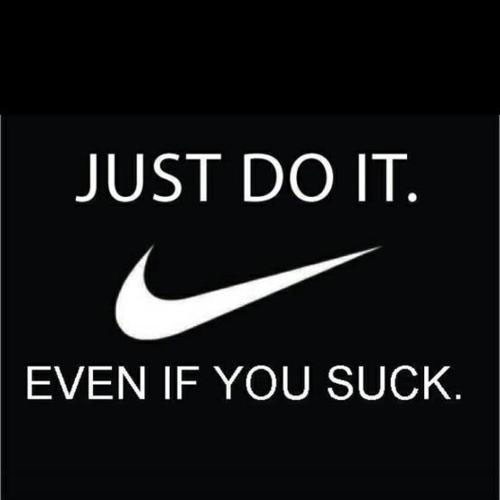
For me, I’ve realized that this is my life and I’m really good at being really bad at much of what I do. I suck, and I’m proud of that fact. You can’t suck at as much as me without a lot of hard work and determination.

See, for years now, it’s been just my daughter and me in our home, where I live as independently as possible with cerebral palsy – and I’m pretty good at it, moving along at my own pace. A lot of it takes time and tenacity, but so be it. I’ve always looked at my independent living skills as the result, not the effort. I don’t care what I have to do as long as I can accomplish the task.

However, now I have a running superstar by my side – my beautiful fiancee – and it’s made me realize that I’m really good at being really bad. A task that takes me, say, 10 minutes on my own, takes one minute with her helping. And, for the most part, I’m secure and appreciative of her helping because I equally contribute to her needs in other ways.

Nevertheless, we’ve had an ongoing dialogue about how beyond my neanderthal stubbornness, she’s raised good points that just because I can accomplish a task doesn’t mean I do it the easiest way, that I often make things harder than needed, that just because I’ve used a haphazard technique for 20 years doesn’t make it necessarily the best approach.

Beyond me, her point is one that’s strikingly universal: Questioning how we do what we do can help us find better solutions, from our careers to parenting to everyday life. But, I have my point, too: It’s taken me a lot of years to get this good at doing independent living tasks really badly – that’s hard to give up when you’re so talented at sucking as I am!

Not Different But Authentic

authentic

By Mark E. Smith

I had the privilege of being at a public venue with a five-year-old and his mother. The little boy uses a power chair due to a severe form of muscular dystrophy – and, man, he’s a go-getter! He’s happy, adorable, and a people magnet. And, everyone at the event saw what I saw: An adorable little boy with the world at his finger tips.

Yet, as he was literally surrounded by crowds who thought he was the cutest kid ever, there was a side that many didn’t know, nor wanted to know. Everyone wants to be inspired and delighted but a cute kid buzzing around in a power chair being… well… a kid. After all, it’s painful to think of any other possibilities, that maybe his life isn’t what it seems, that it might be disturbingly complex, something no child should experience.

And, so, as he charmed the crowds, I was with his mom, knowing the whole story. The seemingly care-free little boy averages one hospital stay per month, sleeps hooked up to a breathing machine, and he must be turned every few hours to keep his lungs clear at night. For his mom – single, with three children – this means around-the-clock care. And, get this, she works from 12:00am to 3:00am as a reservations clerk from home to help make ends meat. The carefree child and family that all assumed, in fact, has unfathomable challenges every day. I discussed the challenges with the mom and gave her a hug, and she got a bit teary-eyed.

How many of us can relate to this story? How many of us gloss over the challenges of others because they’re too painful to learn the realities? How many of us hide our own struggles because we don’t want others to see us as different, to know how difficult our lives really are?

But, we all have struggles. And, when we don’t recognize them in others or disclose our own at appropriate times, a facade goes up and we don’t make connections to the depths that our humanity allows. No, we shouldn’t then treat each other “differently,” but more authentically.

My point is, let us strive to recognize and embrace the entirety of others, and allow others to know the entirety of us, struggles and all, where adversity isn’t ignored but unites.

Who Really has the Power

report-card

By Mark E. Smith

I thrive on possessing power. But, not in the way you might think. In my business and family, I, in fact, practice the opposite, seeing my roles as humbly serving others. And, yet, when it comes to me, power is synonymous with personal accountability. I learned at an early age that in order to have power, you must be personally accountable; and, if you’re not personally accountable, you have no power. You can control life or life can control you. It’s initially circumstance, but ultimately choice.

It all started with my failing Biology in high school, namely because I wasn’t doing my homework. I wanted to do my homework, but my home life was a mess. My mother and stepfather made our home Hell. I came home from school each day to my mother in the most horrendous conditions – always drunk, but sometimes high, overdosed, manic, or suicidal – and then my stepfather came home drunk, where they fought and smashed up the house. My mother loved to break things and my stepfather loved to scream, and it made for long nights. On top of that, I was struggling to develop my independent living skills due to my cerebral palsy. How was I to somehow do homework with so much volatility in my life?

I lay in bed looking at my report card one night feeling ashamed because it was dotted with Fs and Ds. I’d worked really hard to be mainstreamed in an era when it wasn’t common practice, and I was watching it all slip away. I tossed the report card on the floor and decided my parents and cerebral palsy weren’t going to dictate my grades. I had the power, not them.

I went from a failing student to the honor roll the next report card period by literally locking my bedroom door in the evenings and letting my parents trash the house and there lives as I focused on my homework. I remember typing my homework while trembling and crying as my mom pounded on my door, screaming. Still, I wasn’t giving her power over my life. My grades were my responsibility – and I had the power to succeed over all.

Those years of finishing high school with A’s didn’t make me smarter, but they did make me wiser. I learned that our lives, in the long term, aren’t dictated by anyone or anything, but us. Circumstances may set us up as victims, but we can choose to be victors.