I’ve known and heard the most inspirational speakers in the world – from Nick Vujicic to W. Mitchell. However, when I heard one of my colleagues recently speak to a group of teens, it stopped me in my tracks and gave me goosebumps. How was it that I’d never heard such profound words come from the world’s best speakers?
“Some call what I have a disability,” he said to the students, noting his going totally blind in his 20s, but now in his 50s. ”However, I just call it a ‘problem,’ because problems have solutions.”
If we expand his philosophy beyond visual impairment or disability, think how liberating that is. So many of us see any form of adversity as a roadblock, end-of-the-line, full stop. I can’t do that because of… fill in the blank. We allow adversity to stop us because we don’t allow ourselves any alternatives.
Yet, what if we follow my colleague’s astounding wisdom, where adversity isn’t a full stop, but simply a problem that needs solving? OK, here I am – how do I solve this?
That single question changes everything, doesn’t it? It takes a situation that’s seemingly out of our control and puts us completely in control. It allows us to turn pessimism into perseverance. Most importantly, it allows us to turn adversity into opportunity.
As I learned in hearing my colleague speak to the teens that day, adversity is a great problem to have – because problems always have solutions.
Steve Aoki is among the most hated people in the world of social media. Every day there are tens of thousands of comments by his haters. Who’s Steve Aoki and why is he the object of such widespread vicious attacks?
He’s a music DJ and producer. In fact, he’s among the top musicians in the world, performing over 300 shows per year, headlining music festivals around the globe, where Guinness declared him the most traveled entertainer in the world. By all accounts, his work ethic is relentless. He doesn’t drink or smoke. He has a charitable foundation. He produces the top musical acts of our time. And, he brings joy to millions of his fans, a true superstar on stage at global venues. And, this remarkable success is why so many hate Steve Aoki.
Researchers have discovered that there’s a direct correlation between success and haters. The more successful one is, the more haters he or she will have. There’s some basic logic to it. In order to be hated, you must have merit, and the more merit you have, the more haters. On a Sunday at noon, millions are hating NFL quarterback, Ben Roethlisberger – and, it makes sense based on his success.
So, if success breeds haters, what is it about witnessing success that makes them hate? Firstly, psychologists have found that healthy, happy, successful people simply aren’t haters. If you’re satisfied with your life, you’re simply not preoccupied with others’. Rather, what they’ve found is that those who are dissatisfied with their own lives are exponentially more likely to hate those who are successful. As has been clinically put, hating the success of others is one’s own self-defined inadequacies manifesting themselves. Steve Aoki makes $23 million per year, jet-setting around the globe, filling arenas with adoring fans. That seems awesome if we’re content within ourselves. However, if we don’t feel we have the talent or drive to live a life of success, Steve Aoki proves a harsh mirror, where psychologists say that such expressed outer hatred is, in fact, self-hatred.
What’s more, many haters exhibit a defense mechanism – like an “armchair quarterback” – where they convince themselves that they know better than those who are successful, but never accomplish anything. Lots of passengers criticize a pilot, but none have invested what it takes to fly a plane. As Entrepreneur magazine put it, “…Hate is often a sign of weakness, envy and fear. Haters hate on you because you’re doing what they cannot, will not or are too afraid to attempt.”
In these ways, we know we’re rockin’ the world like Steve Aoki when we have two facets to our lives. Firstly, we feel content, passionate, and successful in our own lives. And, secondly, we observe the amount of haters growing in direct correlation with our success!
Sitting on the porch with among my best friends, George, I drifted the conversation to what I’ve been dwelling on: the tiny weeds in-between the hundred-year-old stones of the walkway.
Now, all anyone has noted is the beauty of the house and its serene surroundings. And, isn’t there charm to a real field-stone walkway, weeds in-between, leading to a house?
However, to me, they were just weeds, detracting from all – and I wanted them gone. I was admittedly oblivious to much – except for the tiny weeds in the walkway.
As I thought about getting rid of the weeds for several days – a distraction I couldn’t shake – I finally had to ask myself an introspective question. With all of the beauty of the house, property, family and friends not just surrounding me, but truly blessing me, why was I so focused on something entirely insignificant like the weeds between the stones of the walkway?
No, it wasn’t because I was ungrateful or unaware of all else. Rather, I was simply doing what so many of us do at times in our lives. Instead of seeing the 9,999 aspects of beauty around me, I was focused on the one annoyance.
How many times do we do this in our lives? A friend of mine, in a much more profound point in his life, shared with me once that three years after his paralysis from a diving accident, he realized that instead of focusing on the 9,999 things he could do, his life was stalled as he dwelt on the one thing he couldn’t do – walk. He went on to share that once he shifted his focus from that one aspect of his life, to the other 9,999 aspects, the world around him changed from dark to light, where joy and love and laughter and a success re-entered.
I go back to my question. How many of us choose to dwell on the one seeming negative in our lives – at least by our own definitions – instead of focusing on the 9,999 positives? We do it in our relationships, our careers, our self-images, and on and on. Why?
It’s innately human, that’s why – and it can counter-intuitively prove a profoundly life-affirming experience. See, we are all more blessed than we’ll truly ever know, even during times of extreme adversity, and our flawed capacity to not see the 9,999 positives in our lives at times, but to find a single negative, is life’s reality check. Yes, if we forever dwell on the one negative, it will defeat a beautiful relationship or great career, diminishing all the miraculous fortune that we have in our lives. Yet, if we are self-aware, those single negatives serve as an amazing compass that points us back to where our heads and hearts belong: cherishing the 9,999 positives in our lives.
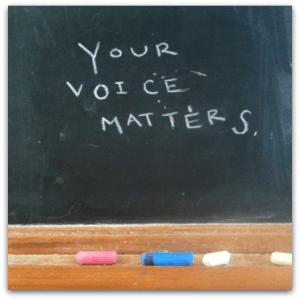
What is the difference between speech and voice? Speech is the articulation of sound, and when those sounds are put together in a normative way, the ability to communicate audibly with others occurs.
However, speech in our lives is very different than voice. Speech is descriptive, whereas voice is emotive. Speech says what’s obvious, voice expresses what’s not. Speech says, My parents passed away when I was in my 30s. Voice says, Although my relationship with both my parents was never healthy, and I long ago came to terms with that, it remains a surreal thought over a decade later that they’re not on this Earth any more – the phone will never ring with a long-overdue call from either of them. Indeed, it’s voice that gives us the ability to express ourselves far beyond the basics of speech.
Interestingly, in knowing peers with progressive conditions – ALS, MS, and such – who “lose their speech,” they’ve often shared after moving to a communication device that it wasn’t the literal loss of speech that was so devastating, but the loss of voice – that is, the loss of communicating emotion to others. It’s one level to lose the ability to ask for a glass of water; however, it’s a profoundly deeper level to lose the ability to spontaneously say I love you to a spouse, or tell a daughter how proud of her you are. That’s voice.
Regardless of our situations, using our voice can likewise be a struggle. The foremost reason we squelch our voice – albeit in the intimacy of a relationship or the public venue of a stage – is out of fear of rejection. Why don’t we tell our partners how we’re really feeling? Why don’t we speak up in that class, meeting or crowd? Why do we prevent ourselves from expressing our voice – what we really want to say – in any circumstance?
The answer is, we fear the rejection that may come with using our voice. However, here’s what’s amazing: we’re never rejected in the end when it comes to using our voice. It may take initial courage to use our voice – sometimes stomach-wrenching courage – but the result is empowerment.
Now, using our voice can seem dangerous. Do I really want to tell my spouse I’m unhappy in our relationship? However, nothing can change unless we change it, and our voice is the ultimate tool for that. Situations may be difficult, but squelching our voice hurts us more. There’s nothing more empowering and liberating in the end than expressing our voice.
The other miraculous effect of voice is that it unites. Shame, guilt, embarrassment, sadness can all squelch our voice. Yet, using our voice to openly share the origins of such emotions can not only, again, liberate us, but can help others. We all have a common humanity, and we’re not alone in our experiences – but we can feel alone. Voice can be the bridge that not only connects us through shared adversity, but leads us through it. Voice allows us to hear someone else’s story and realize that it’s our story, too – we’re not alone.
Voice is among the most powerful tools that we have. Like all powerful tools, voice can seem scary to use. Yet, when we have the courage to use our voice in sincere, constructive ways, it’s life-changing – both for us and others. After all, when we share our voice, we share our common humanity.
I don’t believe in self-confidence or ego. Those can waiver, be swayed or mislead us. What I believe in is self-comfort.
See, self-comfort is when we truly accept who we are, as we are, to the core – mind, body and soul. We’re comfortable with ourselves beyond all else. It doesn’t mean we’re full of ourselves or delusional. It simply means we know who we are, from the inside, out – and live as such.
And, it makes life so much easier and successful. Rather than wasting energy on trying to be what we’re not or invest in the opinions of others, we can simply thrive by being who we are. With self-comfort, we know our value, we know our favors and our faults, and we work with it all. Life need not be a struggle; it can be as easy and graceful as a leaf drifting in a breeze.
Being a teenager with cerebral palsy taught me this lesson young. I remember being a freshman starting high school, wanting to squelch every spasm, correct every slur in my speech – an overall fantasy of being someone I could never be. I had unbelievable anxiety on the first morning of school that year. The last person I wanted to be was “the kid with cerebral palsy” at my high school. I did an awesome job at covering up all my insecurities, though, by creating the most ridiculous smoke screen – literally. …I took up smoking.
At my high school, in those days, there was a smoking section, and as long as you could score cigarettes, you could smoke. So, as the initial weeks passed, I slowly merged in with the “tough crowd” in the smoking area After all, when it comes to insecurities, there’s strength in numbers. I bought a black leather jacket and biker boots out of the Sears catalog, stuffed my chest pocket with a Zippo lighter and a Marlboro Hard Pack, and my insecurities flipped into rock-solid confidence. Again, self-confidence and ego can fool even ourselves. In my insecure, skewed mind, however, I was a bad-boy in a power chair – right down to smoking Marlboros, no less.
However, as the school year went on, I realized that I didn’t need to be a so-called tough guy. As my classmates of all sorts embraced me, cerebral palsy and all, I didn’t need to hide behind a smoke screen or facade. I could just be me. I was a teenager with cerebral palsy, and if my peers accepted it, why shouldn’t I?
Ultimately, I gave up cigarettes, and fell in with the general crowd, focusing on my grades, girlfriends, and just being me, spasms, slurred speech and all. And, life was so much easier when I was comfortable truly being me. …But, I wore the leather jacket and motorcycle boots all the way through graduation because …well …they were awesome.
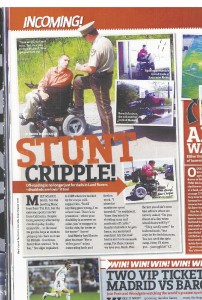
In my 20s, I achieved notoriety for jumping power wheelchairs off of ramps. To see a guy with cerebral palsy rev up a power wheelchair and jump it off of a ramp, a few feet in the air, was quite the spectacle. For me, it was a mix of misguided bravado, showmanship and stupidity. Unfortunately, though, it worked.
See, although I had overcome and was accomplishing a lot – I was a formal academic and writer at the time – people seemed mildly interested in any of that. But, the power wheelchair jumping, which I cringe to think now as a bit of a freak show, was an attention magnet. Before I knew it, I was featured in big-time magazines, and due to the advent of the Internet, I became widely known as “the guy who jumped power wheelchairs.” Soon, my reputation was bigger than I ever imagined, labeled by one men’s magazine as the “Stunt Cripple” – and my identity fractured.
There was no talent or point in jumping power wheelchairs. It, again, was a shameless spectacle. And, it surely wasn’t who I was. There was so much more to my life and accomplishments. Yet, a single aspect was defining me by reputation. I began to feel boxed in – and I wanted to be who I really was, instead of a one-dimensional caricature.
Many of us have found ourselves in such an identity crisis, haven’t we? We find ourselves in the situation of who others project us as isn’t who we are. In my case, it was admittedly of my own doing, but so often misconceptions, projections or circumstances by others can leave us feeling boxed in. No one should be defined by one dimension; rather, we should be seen in our entirety.
Now, my example of falling into an identity trap is a unique, ridiculous one – stupidity reigned – but it wasn’t the end of the world for my life and career. In far more serious examples, some of us have been boxed in to identities who we’re really not – and it’s been painful and extremely detrimental. How many of us have been in relationships where we felt obligated to act as someone we’re not? How many of us have been stereotyped based on our ethnicity, religion, sexual orientation, disability, and so on? How many of us have been labeled based on where we live, what we do for a living, or even how we dress? Indeed, most of us at some point have felt our entirety stripped down to a single trait that doesn’t just make us seem one-dimensional, but may not reflect us at all. The vital question is, how do we avoid that trap?
In some cases, we can’t. We may inevitably encounter stereotypes and ignorance that we can’t control. However, we can control our own behavior and teach people how to treat us. I recently did a big press conference in the New York City metro area. With a podium full of microphones, a row of TV cameras and a crowd of people, I don’t think a person in the room expected me to take the podium. After all, when’s the last time you saw a guy with severe cerebral palsy and a speech impairment command a press conference? But, I wasn’t going to let others’ perceptions or my disability define me. I made it clear that I’d take the podium – and I ended up on the NYC ABC affiliate’s 6 o’clock news that night holding the press conference.
We don’t have to be boxed in by ourselves or anyone else. With a little courage and a lot of introspection, we can most often avoid one-dimensional identities we misguidedly create or are thrust upon us by others. People call me a lot of titles nowadays – General Manager, writer, advocate, humanitarian, intellectual – but there’s one title that taking control of my own actions and identity buried a long time ago: Stunt Cripple.
I don’t know how it will all workout out. But, I know that it will.
See, what I’ve learned from living through adversity is that it shouldn’t be feared, but trusted. We may not see or understand it in the beginning, but there’s purpose and reason to it. Adversity enters our lives not to defeat, but to empower.
Now, adversity doesn’t work on its own. We must contribute perseverance, tenacity, optimism, introspection, and good ol’ sweat to reap its benefits. However, adversity particularly requires one attribute that we must contribute in order to allow it to elevate us: faith.
Adversity demands that in order to rise with it, we must place faith in it. We must know without a doubt that all happens for a reason. We must believe in a larger purpose. We must trust in ultimate outcomes, even when unknown or unseen. We must have faith in the awe-inspiring power of adversity to serve us, to uplift us, to empower us, to take our lives to heights we never dreamed.
I don’t know where you are in your life. But, from my experience in living through adversity, when you face adversity – and you will, as we all do – it has the power to enrich your life beyond your ultimate wishes. You just have to deliver what it requires – perseverance, tenacity, optimism, introspection, and good ol’ sweat – and a healthy dose of faith that ties it all together. To have faith in adversity is the power to not just survive, but to thrive.
Every night at 10:00 pm, I flip through the cable news channels. With redundant sound bites and flashing scenes – not to mention partisan political rhetoric – I’m told what a terrible world I live in. If I am to believe them, my life in every fathomable way is on the brink of disaster – and so is yours. If texting drivers and terrorists don’t kill us, our jobs will be downsized and exported, and our children will end up on heroin. But, then they go on to note that if we make one wrong vote, we will lose civil liberties and nuclear proliferation will usher in World War III. However, none of this matters because whatever the latest virus is, it’s likely to kill us before all else.
This is how the news media portrays our world night after night. Yet, day after day, my life – the world we share – couldn’t be more different. As one with a severe physical disability, the world of intolerance portrayed by the media that we live in should place me drowning in the bottom of a cruel socio-economic barrel. Yet, I’m not – and, in fact, my world, your world, our world couldn’t be more different than the distorted, sensationalism hyperbole spewed by make-up-strewn talking heads on cable news.
What 45 years of disability experience has proved to me is the truth of humanity. People are kind, accepting, embracing and tolerant. We know that we’re all in this together, and while my adversity is an obvious physical one, we all have known adversity, and it’s among the bonds that unites us. We all want to love and be loved, and as my career has taken me to countless cities and towns across this country, every where I’ve been has demonstrated one universal trait: kindness.
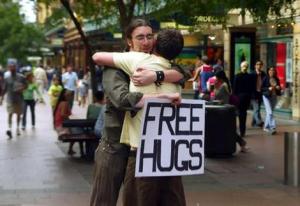
As one with a severe disability, who speaks and looks differently than others, who must turn to strangers for assistance in situations, who flies on planes and lands in cities, I see none of the harsh, cruel world portrayed by the media. I see the flight attendant offer to walk with me through the airport to ensure I find my shuttle van. I see the shuttle van driver insist on tying my shoe. I see hotel clerks ensure all I need is taken care of. I see waitresses intuitively move everything where I can reach it. I see individuals homeless say words of blessing to me. I see strangers in stores, restaurants, everywhere, share the kindest words and hug me.
I don’t know where the media gets its soundbites and images of the bleak world it portrays. But, if they followed me for an hour, in any city in this great country, they’d see the truth: the kindness of the world around us is awe-inspiring. Turn off the TV and get out into it.
It wasn’t her sharing being diagnosed at just 19 with multiple sclerosis that surprised me, nor was I surprised that now 20 years later, she’s effectively paralyzed from the neck, down. After all, I work in the wheelchair industry, and these are the stories I hear every day. No, I never get used to them, but such stories are the reality of those I serve.
However, what she said at the end of our conversation made my world stop: “Thank you for hearing me,” she said. “It’s been so long since I’ve felt heard.”
My heart paused to comprehend the profoundness of her words. With her disease progressed to the point of full body paralysis, having undergone so many life changes along the way, her biggest concern wasn’t any of that – it was simply wanting to be heard.
How many of us have felt that way – unheard? I have, and what I learned is that to be heard is to be acknowledged as a person, and when we’re not, it hurts. To not be heard is to not get our fundamental needs met. To not be heard is to not have our feelings validated. To not be heard is to not be valued. To not be heard is to not be seen. The pain behind being unheard haunts us to our core. When we don’t feel heard by our partners, by our families, by our communities, it’s really easy to feel as if we don’t exist.
Yet, we do exist – fully, completely, rightfully. And, it’s not that we’re unheard; rather it’s that others – wrongfully – aren’t listening. See, no one truly goes unheard. A heart beating makes the ultimate sound. Yet, many of us don’t listen, where insensitivity or ignorance or prejudice can make us deaf to those around us. The hearts of others are beating; we simply don’t listen to their breathtaking cadence.
When that woman expressed to me her gratitude toward my hearing her, it reminded me of an ultimate truth: To know what it’s like to be unheard teaches us what it’s like to truly listen.




 PowerchairDiaries