Learning to Love to Capacity

love

By Mark E. Smith

Currently, with tremendous strain, I can bench press 210 lbs. one rep. But, I don’t. Instead, three days per week, I bench press 120 lbs. 20 reps, then I drop to 100 lbs. and bench press another 20 reps. Guys all boast how much they can bench press one rep because it sounds impressive. However, it’s truly a specious exercise – they’re not building endurance or true fitness because they’re only doing it once, lifting beyond their real capacity. Me, I choose to lift less weight at higher reps because I want to build meaningful fitness to my genuine capacity.

It’s a lesson from the gym that’s even more important in our relationships. We should only represent ourselves to our truest capacities, as well as recognize the true capacities in our partners. Otherwise, relationships fail and people get hurt.

All of us mean well going into relationships. We put our best self forward and we see only the best in our love interest. Yet, it’s so easy to get caught up in that which we’re not. We want to be what the other person seeks, and we want him or her to be what we seek. And, it all works perfectly – that is, till we realize one or both of us are beyond our capacities. It’s like my bench pressing 210 lbs. I can do it once to impress, but I can’t sustain that level. If you want the real me, I bench press 120 lbs. really well.

In relationships it’s vital that we know our true capacities from the start, adhere to them, and truly recognize our love interest’s capacities. It’s just being honest, and when we do this, it dramatically reduces the odds of someone getting hurt.

Yet, it’s tough to do. It’s so hard because ideals don’t always align with reality. What we want in a relationship can be the antithesis of what we’re capable of. There are classic examples we all can relate with. Someone wants a relationship, but makes no time for it. Someone wants a relationship, but is emotionally still buried in a past one. Someone wants a relationship, but doesn’t have the emotional health to cultivate it. We’ve all done this, experienced this or witnessed this – and it only results in pain.

Bishop T.D. Jakes talks about the importance of realizing our capacities for love and how they vary based on who we are and what we’ve been through. He uses the metaphor that if we’re 10-gallon people looking to be filled with love, we’re never going to be filled by someone who only has an ounce to offer. By the same token, if we only have an ounce to offer, that’s fine, but let’s know that we can’t promise to give more than we have. There’s no right answer, just an honest one.

In this way, we must approach a relationship with accountability on our part, and clarity toward our partner’s capacities. We may want a certain type of relationship, but are we capable of it, and are we being honest and fair to our partner? And, are we able to view our partner with clarity, ensuring he or she is capable of the relationship?

The key to this is utter honesty and following our instincts. If we overextend our capacities in any way, it never feels right, and we have an obligation to stop it or, ideally, be authentic enough not to do it in the first place. Similarly, if our partner’s words are contradicted by actions or circumstances, don’t overlook that. Recognize each other’s true capacities and respect them because if you don’t, someone will get hurt.

Now, this isn’t psycho babble or new-age psychology, but common-sense life experience. I’ve been on both sides, as many of us have. I’ve tried to be someone who I wasn’t, and it didn’t work. And, I’ve overlooked signs in others that I shouldn’t have. There was no ill will in any of it, just intentions wishful beyond our capacities. What I learned in the process, though, is that there’s ultimate joy in being authentic in acknowledging both our own true capacities. Maybe the relationship will reveal itself as soul mates or prove unrealistic. It’s the variables of love. But, the beauty in being authentic in our capacities is that we have the honesty, authenticity and courage to just be us.

Who Really has the Power

report-card

By Mark E. Smith

I thrive on possessing power. But, not in the way you might think. In my business and family, I, in fact, practice the opposite, seeing my roles as humbly serving others. And, yet, when it comes to me, power is synonymous with personal accountability. I learned at an early age that in order to have power, you must be personally accountable; and, if you’re not personally accountable, you have no power. You can control life or life can control you. It’s initially circumstance, but ultimately choice.

It all started with my failing Biology in high school, namely because I wasn’t doing my homework. I wanted to do my homework, but my home life was a mess. My mother and stepfather made our home Hell. I came home from school each day to my mother in the most horrendous conditions – always drunk, but sometimes high, overdosed, manic, or suicidal – and then my stepfather came home drunk, where they fought and smashed up the house. My mother loved to break things and my stepfather loved to scream, and it made for long nights. On top of that, I was struggling to develop my independent living skills due to my cerebral palsy. How was I to somehow do homework with so much volatility in my life?

I lay in bed looking at my report card one night feeling ashamed because it was dotted with Fs and Ds. I’d worked really hard to be mainstreamed in an era when it wasn’t common practice, and I was watching it all slip away. I tossed the report card on the floor and decided my parents and cerebral palsy weren’t going to dictate my grades. I had the power, not them.

I went from a failing student to the honor roll the next report card period by literally locking my bedroom door in the evenings and letting my parents trash the house and there lives as I focused on my homework. I remember typing my homework while trembling and crying as my mom pounded on my door, screaming. Still, I wasn’t giving her power over my life. My grades were my responsibility – and I had the power to succeed over all.

Those years of finishing high school with A’s didn’t make me smarter, but they did make me wiser. I learned that our lives, in the long term, aren’t dictated by anyone or anything, but us. Circumstances may set us up as victims, but we can choose to be victors.

Righting Wrongs

choir

By Mark E. Smith

From the back of the concert hall, I see my daughter in the very front, standing on the choir risers. Even though the distance is far, we make eye contact and I smile big….

Often, it’s our obligation to make things right. If we don’t, then we, too, are perpetuating a wrong or injustice, further harming others. No, I don’t mean make things right because we’ve intentionally done wrong. Rather, I mean that if there’s a cycle of dysfunction, we must have the courage, wisdom, and tenacity to say, Enough! This destructive pattern not only stops with me, but actually changes with me. It’s a really powerful process where you, as a lone person, can change your life, your family tree, and the lives of many around you.

We unfortunately are cyclical creatures, following the pack. Although we have free will and astounding amounts of opportunity, we rarely use it. We know that our life paths are alarmingly dictated by those of most influence in our lives. The surest way to be a teen parent is if your parents were teen parents. The surest way to become an alcoholic is have parents who were alcoholics. And, the surest way to being a terrible boss is to be groomed by a terrible boss. These risk factors create systemic, generational wrongs – and they go on and on.

And, it’s up to us – and only us – to stop them. No rule book said that because my parents were uneducated, impoverished, alcoholic-addicts, I had to follow that path. Sure, statistics said I would. However, I’m not a statistic. I’m an individual. And, I’ve long known that I alone had the power to right the wrongs in my life – and I continue working at that every day. This is my life and no one dictates its potential but me.

Breaking the cycle isn’t easy. I’ve been there, and it’s a never-ending process. It’s a difficult journey because there’s no road map and usually no support. It’s like walking on ice for decades, where as long as you stay up, you’re fine, and the fear of losing footing keeps you laser focused on every move you make. Yet, the struggle is motivating, righting wrongs is empowering, and breaking cycles is liberating. You may have been born into it, but you can likewise grow out of it. Heritage, genetics, environment, upbringing – you can be more than all of it. Right the wrongs, break the cycles, and live to your potential.

…And, my daughter – born to me, where my examples of fatherhood were grim and bleak – smiles back as the choir begins to sing.

Pink Undies in the O.R.

photo (24)

By Mark E. Smith

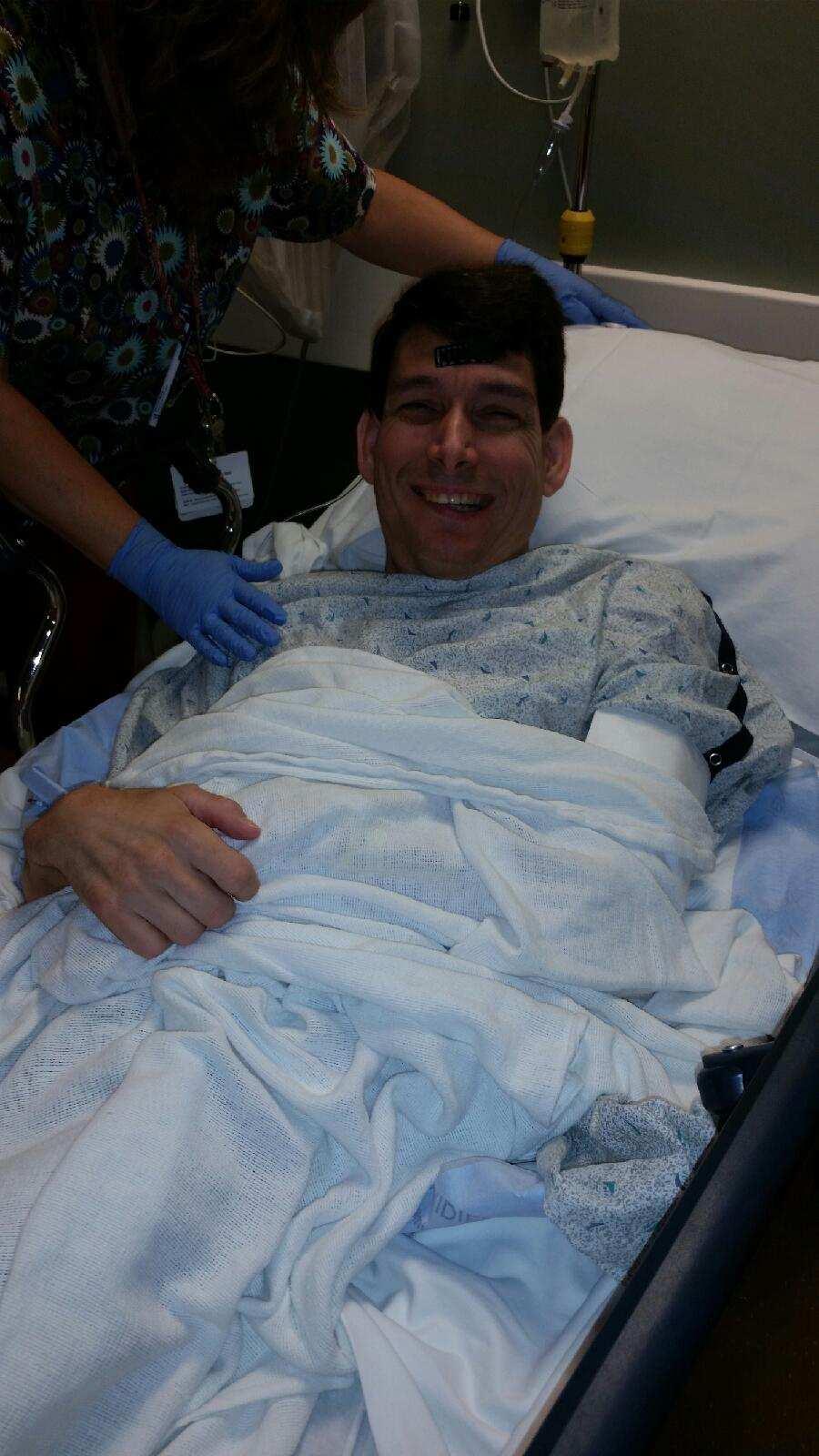
So, I’m laying stretched out on the surgical hospital bed in my neon-pink underwear and nothing else. And, I’m great with it. Muscular, with my trademark tattoo of the universal wheelchair symbol on my shoulder, I feel like a superhero. Cerebral Palsy Man here to save the day! But, the medical staff is here to save me – or at least figure out how to fix me up so they don’t have to literally save me. This is pre-surgery surgery, or as I like to call it, surgery.

My sister is with me because she’s had the worst luck of anyone I know – cancer, a critical automobile accident, over 20 surgeries. She knows the practice of medicine so well that I often have medical professionals ask if she’s one, herself. In this way, my sister is a double-edged sword: she’s great to have in the room as a medical advocate, but I don’t want her touching me out of fear her bad luck will rub off.

The nurse loves my pink undies, and I think she’s a bit charmed by my sense of humor around it all – my pink undies, flaunting my body regardless of disability, and my optimism toward the procedure itself.

Yet, I’m genuinely scared. I’m so scared that I’ve waited to do this far longer than I should have. It was my physician and friend who finally convinced me, knowing how potentially serious this could all be if I kept putting off surgery and treatment of anything else found in the process. Then once the specialists told me of the extreme risk my health was under, I knew I had to take responsibility, not just for myself, but for the sake of those who love me. And, I still have a lot of lovin’ to do.

The nurse asks me to put on the hospital gown, and I want to wear it as a cape. But, she insists I wear it the right way. My sister helps me put it on as I pout like her four-year-old. But, I want to wear it like a cape!

The anesthesiologist comes in and notes my “chronic” cerebral palsy. Is there non-chronic cerebral palsy, where you only have it on, say, Thursdays? She then stands at a computer and asks me questions from the screen, including, do I get short of breath walking up stairs?

My sister bursts out laughing and I point to my power chair parked against the wall, saying with absolute seriousness, “Only when I’m carrying that up stairs.”

Finally, the surgeon comes in to give me the rundown before we go into the O.R. He’s wearing the exact model watch I own and love, and for a moment I wonder if a man of such impeccable taste is wearing pink undies, too?

Now I’m getting even more scared, and the anesthesiologist isn’t helping. The initial shot that was supposed to put me in La-La Land still allows me to recite the first page of Chaucer’s Canterbury Tales – from the tenth grade. Still alert, I watch out of my peripheral vision as they roll me into the O.R. And, I see the size of the camera they’re going to slide down my esophagus and the table of tools they’ll ultimately use to take three biopsies. And, I watch as the anesthesiologist injects a new drug into my I.V.

Next thing I know, I awake. I think I’m still in the O.R., but as I open my eyes, a nurse tells me I’m in recovery. I’m still on my back, with the gown on, but I’m oddly now wearing pants, socks and shoes, with no recollection of the procedure or getting dressed.

“How are you feeling?” the nurse asks.

“…Like the morning after an awesome night in Vegas,” I reply. “How’d I end up here, and where’s my shirt?”

Zach And I Are In Love

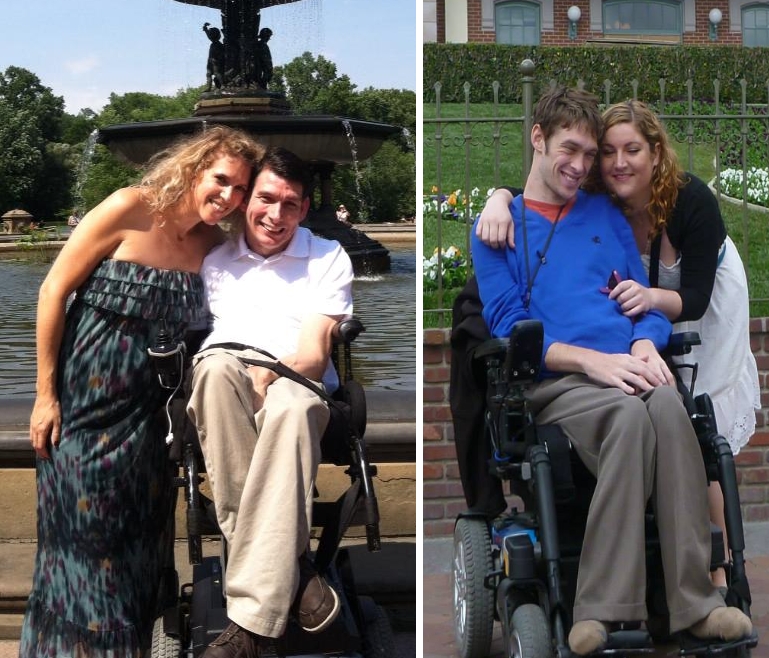
Holly & Mark / Gillian & Zach

By Mark E. Smith

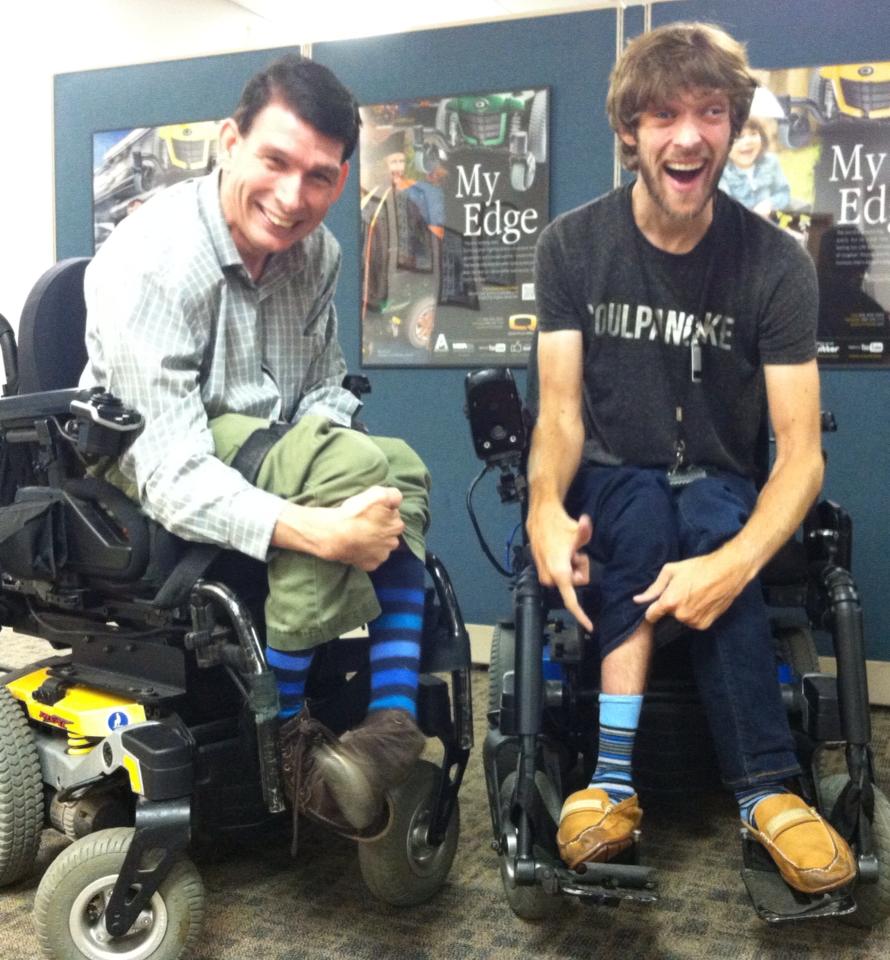
It’s official: Zach Anner and I – the two most eligible men with cerebral palsy in America – are in love.

Now, when I say that Zach and I have been the two most eligible men with cerebral palsy in America, what I really mean is, we couldn’t get dates if our lives depended on it. And, while we were tempted to date each other out of pure complacency, it turned out that waiting for the two most beautiful women in the world to sweep us off of our feet (which, let’s be honest, isn’t hard to do when we’re not on our feet to begin with), turned out to be a better idea. I should clarify that we weren’t both waiting for the two most beautiful women each, which would equal four women in total and would be really weird and a TLC reality show, but one amazing woman each. And, we scored!

In an uncanny twist, about 10 months ago, Zach and I started falling in love – with two separate women, not each other! – in Southern California. And, amazing women they were (they, of course, still are amazing, even more so, but I’m trying to keep my tense straight). Zach’s beloved Gillian is an internationally-known singer-song writer, and my beloved Holly is an artist. Both women are creative, witty, caring souls, who’s personalities truly radiate at a tangible level. Their depths of character range from funny to empathetic to being up for all that life has to offer. So, how did Zach and I ultimately get so blessed with such amazing women?

Cerebral Palsy. Fellas, trust me on this one. Forget the cheesy pick-up lines, fancy cars and medical degrees. All you need to attract a woman is cerebral palsy. Even if you don’t have cerebral palsy, say that you do. You can have a Ferrari and medical degree, but unless you tack cerebral palsy on the end, you don’t have a chance. Why? Because every woman knows cerebral palsy is where it’s at.

Of course, cerebral palsy has nothing to do with Zach and my finding love. The truth be told, we know the real secret to our finding the two most amazing women in the world: We’re just ourselves. What makes Zach and me who we are is just that – we’re happy as we are, cerebral palsy, poor posture, twisted senses of humor and all. And, with self-acceptance comes a confidence and comfort, where we have the ability to laugh and love and embrace life with an enthusiasm that’s contagious. We’re easy to love, but we equally love easily, where we know that vulnerability is a strength, empathy is a gift, and a true lover is also a best friend.

If you want to be loved for you… well… just be you.

Awesome socks don't hurt, either!
Awesome socks don’t hurt, either!

Confessions of a Bad Alcoholic

drunk

To John, February 5, 1951 – July 24, 2010

By Mark E. Smith

If you’ve read the research of recent years, then you probably already know about me: I’m an alcoholic.

Indeed, the medical establishment has concluded that alcoholism is hereditary – that is, if your family tree is lined with drunks, you’re a drunk, too. Or, you’re at tremendous risk of being a drunk. Walking past a bar or liquor store is like a metal shaving passing a magnet – it wants to suck you in!

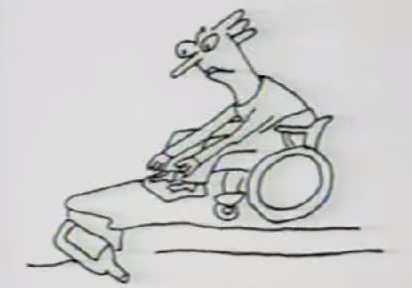
For me, being an alcoholic is torturous because I think it’s the only thing I’ve failed at. I mean, I’m a bad alcoholic – really bad. My parents, grandparents, great grandparents and probably their parents were great at it. I mean, my mother and father had it down to a science – it’s not easy losing everything, including your life. But, me, I’m a terrible alcoholic. I’m so bad of a drinker that I haven’t drank today, nor did I drink yesterday or the day before or the day before or the day before or the day before….

But, my alcoholism even gets worse, pathetic, really. I’ve never hidden bottles, lost jobs, sobbed, Please take me back, ruined a wedding or child’s birthday party, bathed in cologne, slept on the front lawn in my clothes, wondered how my car keeps getting smashed up, vomited blood, feigned vertigo, passed out with a lit cigarette and burned my fingers, lied to everyone about everything, stole money from my child’s piggie bank, stood with belligerent narcissism before a judge, drank because of this or that, drank vodka from a water bottle at church, hugged a tree while the Earth spun at tremendous speed and I urinated on myself, or explained to a bank teller why my signature doesn’t match. Yes, I’m a terrible alcoholic.

However, here’s what I’m really good at: a little thing called personal accountability. Unlike the color of my hair, hereditary doesn’t dictate jack squat when it comes to my being an alcoholic or not. Life gives me free will to choose my path. And, while I understand the science, it’s 100 percent my choice to drink or not to drink. My mother did nine months in jail due to her third DUI, and upon being released, she stopped by a liquor store on the way home and downed a pint of vodka. Time and time again, I’ve watched people around me choose to re-elect life-destroying alcoholism, while others choose sobriety (and the science behind addiction recovery shows that the only time alcoholics maintain sobriety is when they literally choose to).

In this way, I’m among the worst alcoholics you’ll ever meet because I’ve turned my back on my own heredity.

Kids Be Kids

specialneeds


By Mark E. Smith

As a classically-trained writer, I understand words – their efficacy or impotence, the way they twirl off of the tongue and echo in the ear. Words are powerful, captivating, emotive. And, sometimes, words are defining, both in the positive and negative.

For some time, as a writer, as a parent and as one with a disability – but, really, just as a person – I’ve been struggling with three words that we use to define what I’ve come to know as an ambiguous, possibly specious term: special needs child.

I, of course, understand our social definition of a special needs child, that of a child with a physical, emotional or intellectual disability. But, is it – special needs child – a logical term to use? I mean, I’m not questioning it from a political-correctness or ethical perspective. I simply question if the label is logical?

And, I don’t think it is. After all, have you ever met a child who didn’t have special needs? Of course not. If we truly acknowledge what each child in our life needs, every child is a special needs child. There are eight children in my close family, and they’re all so unique in character and at different stages from one another that each one has special needs. Why only project “special needs” onto children who have disabilities when every child clearly has special needs?

The label also represents a type of reverse discrimination that’s unfair to all children. If you’re with several children in public, and one has a disability, adults often fawn over the child who has a disability and ignore the other children. Yes, such adults mean well, but they’re doing more harm than good. Such situations inadvertently patronize disability and ignore others – everyone loses.

Instead, let’s see kids as kids. Each is special and unique and has needs, and should be recognized as such. Most importantly, let’s drop the labels altogether, and just let all kids be kids.

The Tortoise Mindset

hare-and-tortoise-694263

By Mark E. Smith

No matter how many times I’ve read Aesop’s fable, The Tortoise and the Hare, the tortoise always wins. Logically, at some point shouldn’t the hare win? After all, the hare is physically faster.

The answer is, no – not in the fable and not in life. Aesop, a slave in ancient Greece in the 5th century BC, was onto something: Dedication and perseverance always pay off in the end. Think about every aspect of your life, from health to career to relationships to finances – does taking the easy way ever work in the long run?

Never. The University of Wisconsin did a study (one example of many) on how long it takes to get in true physical shape. After six weeks of rigorous training, there were no results seen in the sample group; three months showed progress; but, it wasn’t till one year, then four years that there were significant physiological changes. Everyone wants a quick fix to shed those pounds and have six-pack abs, but there’s no such thing. However, you can absolutely do it if you have a tortoise mentality, where dedication and perseverance will pay off over years.

Want to be a millionaire? Maybe winning the lottery, flipping houses or playing the stock market is the ticket. No, the hare loses again. In the U.S., tortoises get rich. The average millionaire is 57, works over 50 hours per week, has a graduate degree, and is first-generation wealthy. What’s been their number one wealth-building tool? Saving 20% of their monthly take home pay over their career. Put simply, you get rich over decades, not overnight.

Of course, in relationships, the hare must win, right? Love at first sight rules all. Statistically, not so. See, your odds of staying married increase if you date for at least a year before tying the knot, and those who get married around age 30 are much more likely to stay married than those who get married younger. Want the healthiest marriage? Be a tortoise and take things slow and steady.

I live and work in the world of disability experience, where challenges abound for many of us. And, what I’ve learned is that rehabilitation doesn’t stop when released from the hospital; rather, it’s truly just beginning. There are no quick fixes, and some skill sets – from the physical to the emotional to the mental – can take decades to master. Heck, every morning I still work on the coordination needed to tie my shoes and button my pants– after over 30 years of trying. Yet, it’s the tortoise mindset that keeps us striving. If we simply stay dedicated and persevere, we will succeed in one way or form. It can take 20 or 30 years, but success will come.

The examples go on and on, but here’s the point: there’s literally no secret to success. Success isn’t luck of the draw or magic. We need only to look to Aesop’s fable of the tortoise and the hare – a slave’s philosophy from ancient Greece – to know that success is a marathon, not a sprint.

The Real Investment of Complex Rehab Technology

MarkESmith300

By Mark E. Smith

I strive not to overlap my print writing with my online writing because, really, there’s too much of my work floating around the literary world as it is. How much of me can any one reader take? However, I’m crossing my own boundaries and linking you to a very poignant piece in this month’s print edition of Mobility Management Magazine. You’ll learn a bit more about my life journey — and hopefully a bit more about others’ and your own. http://mobilitymgmt.com/Articles/2014/06/01/Complex-Rehab-Technology-Investment.aspx

The Effort of Faith

faith

By Mark E. Smith

When I look at the three biggest challenges that have spanned my adulthood – writing, disability and romance – there’s a common denominator that forever keeps me pushing forward during both highs and lows: Faith.

Now, I don’t mean faith in religious terms – although, many people do, and that’s great. Rather, faith for me is belief, it’s an innate understanding that no matter what I face, I will pull through ultimately to my own betterment – that is, the light will be brighter at the end of each tunnel.

Faith for me, however, doesn’t function on its own. Faith directly correlates with effort. When I was in my early 20s as a young writer, my rejection ratio by magazine editors was around 20 to 1. For several years, my mail box was a literal daily dose of rejection, seemingly indisputable proof that I was failing as a writer. Yet, I simply had faith and I used all of that rejection as inspiration. I knew I wanted to write and I had faith that I could make it as a writer, so I put effort behind my faith and went to college to learn formalities and hone my craft. It’s taken over two decades, but my closet shelves are now lined with over 1,000 formal publications that I’ve been published in, plus all of my books and countless essays from the web. I went from spending my days seemingly writing for the sake of rejection to now editors offer me assignments. The factor of success has been having faith that I could be what I believed, and then applying the effort to become that success.

Disability and romance in my life have followed the same faith-based path. At many points individuals, situations and society have told me that I’m lesser, that I couldn’t achieve based on my disability. But, my faith has ultimately had the final vote. Dismiss me or count me out, but my faith assures that in the end, with effort, I will overcome. I may face challenges, but my faith dictates that I will succeed in the end in spite of them.

Of course, the struggle to find enduring love is a universal, epic one. Think about the canon of literature, art, music and movies that address our desire for enduring love. And, I’ve faced that struggle, too. Yet, I’ve had faith that as long as I live my best, with effort and awareness, enduring love will sustain itself in my life.

I put it this way: Life is a roller coaster – the highs are exhilarating and the lows are frightening. Yet, there’s a surefire way to even out the course. It’s called faith. With faith, and effort behind it, it’s impossible to get emotionally mired in even the bleakest situations because no matter what all signs may tell us, there’s only one truth: We will ultimately overcome. Have faith, put effort behind it, and believe that you are intrinsically capable of living the life of your dreams.