It’s The One’s We Reach

By Mark E. Smith

No reputable drug and alcohol recovery program will publish its success rate, namely because industry wide, success rates are disturbingly low – in the 5% range. That is, approximately 95% of in-patients eventually relapse.

With such a low success rate, one might conclude that recovery programs don’t work. But, they do – for those who make an effort to change their own lives. Recovery programs are a tool for those who are dedicated to the process, where people who help themselves will succeed, and those who continue poor behaviors, fail.

One has to admire recovery counselors. I mean, imagine investing your heart and soul in striving to help many, where 95% of your efforts fail. At what point do you simply give up, noting that if people won’t help themselves, why should you strive to help them?

The answer is simple – if you can positively change the lives of only 5% of those you interact with, that’s a profound impact on others. However, accepting the realization that 95% of your efforts won’t succeed takes some understanding, the understanding that you can’t help everyone, but you can make an admirable attempt and help some. Your true success is in your making the effort, regardless of the outcome.

Most of us have friends, acquaintances, and family members who are living troubled lives on some level, where a simple change in behavior could dramatically improve their lives. And, when we’re at our best, we step in, striving to offer words of wisdom and encouragement. No, we don’t preach or lecture, but simply share that life doesn’t have to be so hard.

I had the privilege of sitting down with a young woman in her 20s, whose life is a mess – severe abandonment issues from a troubled family, engaging in promiscuity, alcoholic, and an overall emotional train wreck. But, as I explained to her, none of it has to be. By investing in herself, as with entering counseling and truly putting effort into addressing the negatives in her life, she could see real changes in real time.

I asked her if anyone had ever had such a conversation with her, and she said, no. And, I explained to her that I’ve overcome challenges in my own life, many with the help of others, and I’d be willing to assist in her getting her life on track if she felt that I could help in some way.

Unfortunately, not only didn’t she take me up on my offer to support her move toward positive efforts, but her life continues escalating in very troubling directions. She has every capacity to change – with effort, of course – but no seeming will to do so. In all fairness, though, when all one’s ever known is dysfunctional behavior, getting off of that path takes a monumental shift in mindset, often with a Herculean effort behind it. Yet, it is possible – and vital if one’s going to redirect one’s life.

In my several-hour conversation with her, I believe that she was extremely candid with me, but has no wish to get out of the rough waters she’s in – it’s the behavior she knows, her strikingly uncomfortable “comfort zone,” and she’s not changing it. So, considering her outlook, did I waste my time in reaching out to her?

Not at all. Again, when we strive to help others, our success is in the effort, not the outcome. We can be voices of reason and make sincere attempts to connect with others, but if they’re not receptive or willing to help themselves, at least we made the attempt.

In the disability realm, this subject constantly comes up, where family members ask, How can I help my loved one not be defeated by disability?

The fact is, some are defeated by disability, giving up on life, where their families want to help. Still, the process goes back to the adage that you can only help one who wishes to help oneself. You can offer all of the support in the world, but if one refuses change, there’s nothing you can do. This doesn’t mean that you shouldn’t make an attempt to help, but don’t feel like you’ve failed if the individual doesn’t respond. You can wish with all your might that your loved one with a disability gets his or her life on track; however, if he or she refuses to take the lead in the process, you should have a clear conscience, where your effort was commendable regardless of the outcome. If you want to enroll in community college, we’ll gladly pay the tuition. However, if you chose to spend the rest of your life uneducated, unemployed, and living in public housing, with a victim mentality toward your disability, we’ll be greatly disappointed, but your failure won’t be our responsibility in any way. …It’s this matter-of-fact approach that families must take.

Of course, reaching out to others is a risk, where the outcome most often isn’t what we wish – few people are willing to leave their comfort zones (again, as inherently dysfunctional as their “comfort zones” can be), and move their lives in healthier directions. And, for those of us who have striven to face challenges, and see the amazing potential in each individual’s life, it can be heart wrenching when we reach out to others in support, only to have them reject their own potentials. There’s a sense of loss when we know someone who could transform his or her life in a seeming instant – and is presented with the opportunity! – but he or she chooses to stay on a bleak course.

Still, we must recognize the 5% rule, that even if 95% of our efforts inspire no change in others, our consistent efforts to put ourselves on the line by reaching out to others will impact someone, somewhere, sometime – and that’s where the value resides in our efforts. Let us strive to reach out to everyone, don’t be discouraged when our efforts aren’t valued by others, and let us feel privileged to witness the positive changes and growth in the 5% of of sincere individuals bettering themselves.

Where It All Leads

By Mark E. Smith

With my 40th birthday here, I wished to note it with an act emblematic of the life I’ve lived – overcoming some personal challenge, and hoping to meet others and grow in the process.

Friends suggested skydiving, which is strikingly cliché, and actually void of any real risk. When it comes to tandem skydiving, your odds of dying I learned are 0.4 out of 100,000, whereas my riding my power wheelchair to work each day has my risk of dying many times higher, 2.5 out of every 100,000. Therefore, while most unknowingly see skydiving as a brave, risky feat, it’s actually a totally controlled, unrisky feat, far safer than simply crossing a street.

No, for my 40th birthday, I want real adventure, real risk on my own terms, so I’ve bought a plane ticket to Las Vegas, heading out by myself, cross country, to see where it all leads.

The first part of my journey is getting to Vegas. We’re in an odd time of post-ADA corporate disability rebellion it seems, where airlines, in particular, have been proving alarmingly disability-phobic. Over the past two years, we’ve heard discouraging stories of airlines refusing to fly single disabled passengers. In fact, two days before this writing, a young woman with muscular dystrophy, who uses a ventilator, was by all accounts illegally denied boarding a Delta flight home.

I fly often on business, but with colleagues, so this will be my first solo trip in quite some time (I always flew alone years ago based on necessity, never having an issue, but this recent trend toward disability discrimination by airlines has me curious as to my forthcoming solo flights). I know CFR 14, Part 382 that outlines federal guidelines for how airlines must treat passengers with disabilities, but gate agents, in their ignorance, don’t seem to follow federal regulations or acknowledge basic human dignity these days, so I’m curious to see what it’s like for a guy as severely disabled as me to fly alone during these times. Again, it’s easy for any of us to say it’s a piece of cake to fly with a companion. An acquaintance of mine is always boasting to others how easy it is to fly with a disability; yet, his wife or a caregiver is always with him – man-up and go it alone, and see how you’re treated, is what I always want to tell him. Therefore, that’s what I’m doing – manning-up and leaning into it – seeing what it’s truly like to travel alone with a severe disability in 2011. Do I think I’ll get kicked off of a flight like Johnie Tuitel, the motivational speaker with cerebral palsy similar to mine who made national headlines by being unjustly removed from a flight? I hope not – namely, because I’m extremely familiar with federal airline regulations and my airline’s policy, where I trust that I can cordially talk my way through any situation. However, I am curious to see what, if any, ignorance I encounter.

Of course, logistically, a lot else could go wrong during the trip. What if I get stranded at an airport based on weather? What if my power wheelchair gets damaged or breaks? What if any number of scenarios go wrong? Again, I fly all over the country with colleagues and there are no worries on such trips. But, now I’m a 40-year-old with severe cerebral palsy flying to Vegas alone – that’s an adventure, one where I’m placing myself in my sole confidence to get by no matter what.

Once I’m in Vegas, I’m pursuing an interesting tact – as a person first, and as a writer second. I’m meeting up with a lifelong friend, and the goal isn’t to know Vegas, but to get to know the people of Vegas, seeing where it all leads. We’ve both been to Vegas countless times – mostly on business – and the uniqueness of Vegas is that everyone is from somewhere else, all with an often amazing story – from the inspiring to the tragic. I’ve spent the last 22 years telling my story, and I want to hear others’ stories on a diverse, candid scale, the types of conversations you’ll typically only find in Vegas. Drinking, gambling, and strippers, don’t interest me – been there, done that, didn’t impress me. I want to know about the waitress working at the Denny’s on the Vegas Strip at 1:00am – what’s her story, what brought her to this point in her life?

The fact is, at 40, there’s absolutely nothing remarkable about me or my story – I’ve merely lived life potentials that everyone possesses – and I’m eager to hear how others have accessed their potential, or struggled to do so. I have no idea who we’ll meet, or where conversations will lead, but I hope realizations by all will be made in the process, that a common humanity runs among us regardless of who we are, where we come from, or the lives we live.

I’m getting on a plane headed for Vegas. Where it will lead is the mystery that is sure to create the adventure.

The Necessity of Challenge

By Mark E. Smith

Have you noticed how life has an uncanny way of placing lessons in front of us?

I was flipping through the channels, and came across a story about Kyle Maynard, born without arms or legs. Now in his mid-20s, Kyle not only was a high school championship wrestler, but went on to attend the University of Georgia, won ESPN’s Espy Award, appeared on every major talk show, authored a book, became among the top motivational speakers, modeled for Abercrombie & Fitch, opened his own CrossFit gym, and most recently fought in a sanctioned mixed martial arts fight.

So, I watched the quick story about Kyle, not thinking much about it because in the circle many of us travel, we’re all just doing what he’s doing – that is valuing what abilities we have, and making the most of them, consistently embracing new challenges.

However, here’s where the unexpected life lesson comes in: I changed the channel to NBC, where The Biggest Loser was on – a reality-type show about losing weight. And, I immediately encountered a 350 lb. woman crying that she couldn’t run on the treadmill. Meanwhile, the fitness coaches were screaming at her. Admittedly, in one of my most judgmental thoughts, I wished I could have been there screaming at her, too, as she should have been absolutely ashamed of herself. She was born with 100% of abilities – all four limbs, the ability to walk, and all – and she was crying over having to jog on a treadmill, all because she refused to rise to the simplest challenge. I went as far as to presume that the reason why she was obese was due to a lack of will toward facing any challenges, that eating was an escape to avoid any issues in her life – it’s psychology 101.

Now, before you judge me by stating that obesity is a disability that can’t be prevented, you need to know two facts: Firstly, according to U.S. and Canadian studies, “At an individual level, a combination of excessive caloric intake and a lack of physical activity is thought to explain most cases of obesity. A limited number of cases are due primarily to genetics, medical reasons, or psychiatric illness.” Therefore, obesity, primarily, is totally behavioral and preventable in most cases.

Secondly, The Biggest Loser only takes contestants who have behavioral obesity, so the woman crying about running on the treadmill wasn’t doing so for physical reasons, but out of an utter inability to tackle even the easiest challenge.

For me, the juxtaposition was profound: Kyle was born with no arms or legs and has taken full accountability for his life, filled with gratitude toward what he’s been given, gladly embracing ever-increasing challenges. On the other hand, the woman on The Biggest Loser was born with full physical abilities, ate herself to obesity, avoiding accountability, and took her life for such granted that she didn’t even have the willpower to run on a treadmill. What’s wrong with this picture?

Actually, the side-by-side comparison of Kyle and The Biggest Loser woman exemplifies a much larger picture of what’s going on today in America – that is, we’re seeing those with among the severest disabilities thrive to astounding success while much of the mainstream seems complacent in their lives. Biologically, it defies logic – that is a person with a sever disability shouldn’t excel over an able-bodied person, as the able-bodied person has every physical advantage, but we see it happening time and time again.

Yet, we know scientifically that our success at virtually any endeavor – even the most physical ones – has far more to do with the mind than the body. See, Kyle’s success is based on his lifelong mental skills of facing challenges, whereas The Biggest Loser contestant had no concept of facing challenges because she’d likely avoided them her whole life.

And, this is where we see the true reason of why those with severe disabilities can excel over the able-bodied mainstream – we know how to face challenges by nature of our everyday lives, and we’re not intimidated by whatever comes our way. See, challenges are like exercise – the more we face them, the stronger and more adept we become. And, when you’ve spent your life overcoming disability-related hurdles, you’re strikingly equipped to face virtually any challenges that come your way. Any limits in life can quickly disappear with such a highly-evolved skill set.

We had a snow and ice storm recently, and like every other day, I simply drove my power wheelchair to work – no big deal in my mind. Sure, I’ve been in some very bad conditions (even a State of Emergency once), but I truly don’t care what the weather is or how treacherous the conditions – I’m going to work because it’s simply what I do everyday, and no matter how bad the weather, it doesn’t phase me.

However, some people in my region don’t go to work in such storms because they somehow see it as too risky. In literal terms, I can drive my power wheelchair to work in the severest weather without a second thought, but others refuse to drive their heated 4-wheel drives. This fact goes back to the more challenges that we face, the more adept we become – and the less likely we are to see excuses in any circumstance. I know that I can survive the worst weather because I’ve done it. However, the person in the SUV who’s never moved beyond such a challenge has a far more limited view of what’s achievable. If much of life has been a physical cake walk, few develop the ability to face notable challenges, and it sets them at a disadvantage. However, if we’ve constantly faced – and embraced – challenges, we not only become proficient at persevering and facing challenges, but we also pursue opportunities that others pass upon.

While some of us have had little choice in whether we faced obstacles, we still at some point learned to embrace them, recognizing the empowerment that comes from the process. And, what’s vital – and personally inspiring – is to never stop seeking new challenges, ones that further broaden our potential, where the world around us becomes truly boundless. In my own life, I continue facing the challenges of my cerebral palsy – a never-ending life lesson on facing all-day adversity – but I’m likewise always placing additional challenges upon it, making my life seemingly much harder than it needs to be in the short term to ensure absolute empowerment in the long term. Unlike millions who think working 9 to 5 is enough, not doing much more in life, I know that I can push myself mentally, emotionally, physically, and intellectually much farther, where I simply don’t stop where others do. Driving my power wheelchair to work in the snow doesn’t phase me. I’m glad to stay up till 2:00 a.m. getting a writing job done. I’ll travel cross country by myself. I’ll go to work with a 102-degree fever. I’ll workout in my gym even after even the most exhausting day. I assume absolute financial accountability, living debt-free. I’ll throw myself off of my boat and work on my swimming, once thought impossible. And, I do all of this because it keeps me in the best overall shape possible, where I know that life is going to send more challenges my way, and when it does, I’ll simply say, Bring them on – I’m equipped to handle them.

For many, with and without disabilities, it’s tempting to make life as easy as possible. But, again, such a passive approach in life is counterproductive. If you want to truly get somewhere in life, make it as challenging as possible. For parents and caregivers, don’t be so quick to assist your loved ones with disabilities – if a task is just outside their abilities, let them struggle to accomplish it, rising to the challenge. As those with disabilities, ourselves, let us not ask for help, but struggle to accomplish a task, where we learn tenacity in facing challenges and breaking barriers. And, for all of us, challenges should rule our lives, where we’re primed to work two jobs, attend night school, hit the gym, go to work no matter what, and not ever use an excuse not to push ourselves beyond what others might perceive as illogical.

Every time that we face a challenge, we push the boundaries of our lives a little further. Why waste your life crying on a treadmill when by simply pursuing challenges, you can broaden your life on a limitless scale.

Sorry, Disability Ain’t the Issue

By Mark E. Smith

I was listening to the BBC disability-related talk show, OUCH!, a while back and they raised an interesting question: How often do you automatically attribute poor outcomes in your life to disability? For example, if you’ve ever been turned down for a date, did you automatically blame it on your disability?

Now, the OUCH! hosts, Liz and Matt, didn’t really explore the subject, but raised the question and moved on, per their fast-paced show. However, the subject remained with me because such thinking – …it was because of my disability – has been expressed to me by so many of my peers with disabilities when something doesn’t turn out the way they wish, and it’s always seemed like such an easy cop-out, hinged upon self-pity and shunning accountability.

An acquaintance with a disability recently requested my advice toward her job search. She was applying for jobs in a field requiring a minimum of a bachelor’s degree, with additional career certifications. She came to me frustrated that time after time, able-bodied individuals got the job, or she wasn’t called in for an interview at all – and she was convinced that it was all based on her having a disability, that she was being discriminated against by all. So, I asked to see her resume, as her story was quite compelling. To my surprise – based on how valid she expressed her concerns of discrimination – her resume told a totally different tale: She had an absolute lack of qualifications. She had no college education or certifications for the jobs she applied for, where if her resume came from anyone else, the human resources manager would just as quickly dismiss it. She blamed her inability to get a job on her disability, but the real problem was her resume – she was simply unqualified.

While injustice can occur based on disability, too often we use disability as a scapegoat in our lives, an easy pawn to shun accountability. Many of us know more than one guy who will swear that his wife or girlfriend left him because of his disability. In fact, if you ever run into a guy who uses a wheelchair who’s drinking alone in a bar, you’re almost guaranteed to hear such a sob story. And, in knowing couples who’ve gone through the process of disability, then divorce, such tales are true – the wife walked out on her husband with a disability (and, yes, men likewise leave women who become disabled). Yet, when you, as a third person, get a true glimpse into such failed relationships, virtually none failed directly due to disability, but due to extreme dysfunctions like addiction, emotional abuse, and a generally self-defeating attitude on the part of the person with a disability. In fact, a lot of times the disability factor causes the departing spouse to stick it out longer than she or he should have, not wanting to seemingly abandon the spouse “in a time of need,” whereas he or she would have left sooner if it was a non-disabled spouse who was such a mess. Yet, the person with the disability virtually never takes accountability, blaming it all on the disability, practically saying, Sure, I’m a pill-popping alcoholic, with no motivation, who hates the world, but she had no right to leave me just because I became paralyzed! Again, just asked the guy at the bar, he’ll tell you.

Of course, those who are single with disabilities can prove masters at blaming their disabilities for not finding love, conveniently overlooking every dysfunction in their lives. I have a buddy who I’ve known for ten years, and he calls me every few months with the same question: Why can’t women overlook my disability and love me for me?

And, on the surface it’s such a poignant, heartfelt question – but, my answer, not so much: You’re a 42-year-old, who’s never had a job, lives with your mom, plays video games all night, are 100 lbs. overweight, and your wardrobe consists of Twilight T-shirts and sweatpants. Disability maybe an issue for some women, but your overall lack of ambition is a problem for all women. If you have ten issues in your life and disability is one of them, address the other nine, and you’ll be 90% ahead of the game!

We know that discrimination occurs toward those with disabilities, and we likewise know that some are so uncomfortable around those with disabilities that they won’t accept us. However, those instances are few and far in-between. When we run into situations that don’t go the way we wish, we mustn’t blame disability by default, but analyze other areas of our lives with a possibly painful reality check. If I’m not getting jobs, is it because I’m not qualified? Did my spouse leave me because of my terrible behavior? Am I striking out in love because I have virtually nothing to offer someone? Then, when we answer such questions honestly, we know exactly what to work on to improve our lives and become better individuals. In many ways, taking disability out of the equation forces us to take responsibility – and that’s a life-bettering tool.

As for me, a harmless flirt, I get seemingly ignored by women all of the time. I suppose some could blame such rejection on my having cerebral palsy. However, in full accountability, I know the real answer: I’m just a creep. I need not worry about having cerebral palsy, but the creep in me certainly needs addressing. I really should work on that.

Spastic Half-Wit

By Mark E. Smith

I read that 92% of women and 56% of men struggle with some sort of low self-esteem, most commonly relating to “body image” or “feeling like one doesn’t measure up to others.”

In my experience, those statistics prove unfortunately true in everyday life, as I encounter many who confide in me – or indirectly suggest – such feelings of self-insufficiency. However, what’s striking is that it implies to me that I should be horrified by who I am: A spastic, half-witted guy with cerebral palsy, big ears, a goofy smile, and no talent, who doesn’t really fit in anywhere. I might as well put out a self-titled album, Rolling Disaster.

Really, I have attractive, intelligent, popular, able-bodied people tell me all of the time how insufficient they feel. Women who have model-like beauty and super intellects tell me that they’re disturbingly unattractive and unintelligent. Men who are brilliant tell me of their constant insecurities. And, it leaves me thinking that if all of these truly perfect people feel so horribly about themselves, I must really be a freakish wreck on wheels, where I truly do have many of the deficiencies that they wrongly project upon themselves. I mean, let’s be real – have you seen me? Again, I’m a spastic, half-witted guy with cerebral palsy, big ears, a goofy smile, and no talent, who doesn’t really fit in anywhere – who’s more of a literal mess than me? And, readers send me hate emails confirming those facts all of the time, so surely they’re true.

Of course, unlike the 92% of women and 56% of men with low self-esteem, I actually accept and embrace who I am. Indeed, I may be a rolling wreck, but I know that I can’t change aspects like having cerebral palsy, so rather than despising who I am, I make the most of who I am – much of which is based in gratitude for whatever I’ve been bestowed in life. Sure, I’m a spastic, half-witted guy with cerebral palsy, big ears, a goofy smile, and no talent, who doesn’t really fit in anywhere, but even those are traits not to be squandered. I say, why not be the best spastic, half-witted guy with cerebral palsy, big ears, a goofy smile, and no talent, who doesn’t really fit in anywhere, that I can be, right?

See, what I know is that our potential isn’t limited by what we lack; rather, our potential is maximized by what we have. And, too many of us count ourselves short, only seeing deficiencies – or, worst of all, buying into the criticisms of others – when we should be focused on our true potentials, our greatness within. We have this one body, mind, and life, and let’s make the most of them, where it’s not what we have, but what we do with what we have that makes all of the difference.

I could have looked at my life with spastic cerebral palsy and believed the pundits from birth, settling for an institutionalized life of physical dependency on others; but, instead, I sought to believe in developing whatever physical abilities that I could muster toward independence. I could have seen myself as having the cognitive deficiencies that doctors diagnosed me with when I was an infant; but, instead, I scored an I.Q. atop the charts, pursued a college education, going on to a successful career path serving others. I could have looked at myself in the mirror, seeing my cerebral palsied body – my undeniable “freakishness” – and never pursued relationships or a family; but, instead, I have a beautiful daughter, the center of my life. I could have presumed that I had no talent; but, instead, I write, give talks, and work in the wheelchair industry with great creativity. And, I could have looked at my power wheelchair as a device that prevented me from fitting in; but, instead, I combine my unique appearance with my personality to shine in crowds.

Indeed, every day I could write a thousand-line list as to how I’m not on par with everyone else, how I’m a spastic, half-witted guy with cerebral palsy, big ears, a goofy smile, and no talent, who doesn’t really fit in anywhere; but, instead, I recognize the positive attributes that I do have, and make the most of them, dedicating myself to family, career, and community.

Really, we’re a lot like old cars, where we may think of ourselves as clunkers, but with the right attitude, we truly shine as collector-quality classics. Take some time to look in the mirror, and see the shine in you – it’s there, you just have to open yourself to it. And, if it makes you feel better, you can say, At least I’m not a spastic, half-witted guy with cerebral palsy, big ears, a goofy smile, and no talent, who doesn’t really fit in anywhere, like Mark!

After all, if I’m doing great with all of my freakish flaws, you must be nothing short of a spectacular masterpiece of a person with your remarkable strengths, talents, and good-looks.

The Great Diaper Caper

My sister didn’t believe that I could actually go through with it. After all, we’re taught from an early age via potty training that peeing our pants – especially in public – is bad. So, as a guy pushing 40, how could I possibly just sit there and pee my pants at will in public, she wondered?

By Mark E. Smith

My sister didn’t believe that I could actually go through with it. After all, we’re taught from an early age via potty training that peeing our pants – especially in public – is bad. So, as a guy pushing 40, how could I possibly just sit there and pee my pants at will in public, she wondered?

This all began two decades ago when I flew from San Francisco to Lisbon, Portugal, and I went 21 hours without urinating. I’m sure that it was some sort of record at the time, but because the Guinness World Record officials weren’t there to document it, it didn’t count. Nevertheless, I didn’t go without urinating for 21 hours to set a record – though such recognition would have been nice – but I did it out of necessity, as my using unaccommodating restrooms, as with those on airplanes, was too difficult based on my disability.

In college, my long days similarly required me to refrain from using the restroom for 16-hour stretches, and while bladder infections and urinary tract inflammations ensued, I prided myself on having a bladder of steel – able to go entire days on a single sip of water.

Once established in my career and routinely flying, I returned to my old tricks, dehydrating myself for several days, able to fly cross-country without using the restroom – but not without the same, old toll on my body. I inevitably found myself with bladder infections and such once again, but I just did as I needed, keeping it all to myself. I was glad to be working, and any toll on my body was a small price to pay – I was a sort of binge-and-purge bladder expert, where it was part of my professional skill set.

Of course, along the way, some suggested solutions like catheters, but none seemed practical – at least not as practical as simply holding it for 21 hours (OK, holding it for 21 hours isn’t practical, either, but it is impressive, which is why I wish Guinness was there!). So, for two decades, I played bladder roulette, and as unhealthy as it was, it got me by. And, what always struck me was that in the grand physical scope of my disability, my bladder – that is, situations where I couldn’t use a restroom – was among the biggest issues. Forget walking – I just wanted to pee when I had to.

However, the last year brought dramatic changes to my life. I’ve been on a crazy fitness routine that requires a phenomenal high-protein diet, and at least 72 ounces of water per day to metabolize it all. The result is that I’m constantly hydrated and maintaining the best bladder health of my life. On top of that, I attended more pee-limiting events this past year than ever before, so the juxtaposition of being super-hydrated, with a bladder that doesn’t seem to be made of steel anymore, created some long days and flights when I couldn’t use a bathroom, all with a bursting bladder. I knew that with my career in high gear, and wishing to optimize my health, I had to find a solution to my decades-old bladder dilemma. And, that’s when it occurred to me, like a Freudian revelation mixed with a scene from the series, “Jackass”: Mark, you just need to man-up and pee your pants when in a pinch like everyone else these days!

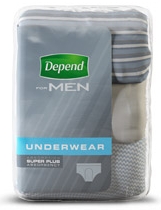
It turns out that a huge number of people in the U.S., out of medical necessity, rely on adult diapers – to the tune of a $4-billion per year industry. Even bad-ass ball player, Ken Griffey, Sr., is a spokesmen for the Depends brand of adult diapers – and without discounting his battle with prostate cancer, one has to admit that it’s pretty cool that he’s like, Yeah, I’ve rocked the Depends – and you should, too. And, the adult diaper industry has become marketing savvy, where they’re not calling the product “adult diapers,” but “maximum absorbency underwear.” Therefore, it occurred to me that if such a product was serving so many others so well, “maximum absorbency underwear” might solve my issue on cross-country flights and such, where, let’s be frank, I could simply pee my pants – just like bad-ass ball player, Ken Griffey, Sr.

Yet, I was still skeptical – I needed more research, more proof that “maximum absorbency underwear” really worked. Naturally, I turned to the most authoritative source online for such subjects: YouTube. I discovered that college kids are big reviewers of “maximum absorbency underwear,” where they put them on, get plastered drunk, and pee themselves, noting the results. And, overwhelmingly, they remark how much the product absorbs, how dry it keeps you, and how fresh you smell (namely due to pH-balancing qualities in the product). So, with bad-ass ball players like Ken Griffey, Sr., and binge-drinking college kids touting the merits, I figured that I couldn’t go wrong with sporting “maximum absorbency underwear.”

Coincidentally, around this time, I was at a home-medical trade show, and came across a giant booth of a particular adult diaper brand, with a hot, 40-ish woman working it. I was immediately drawn into the booth – admittedly to both perform further diaper research, and talk to the hot sales woman. As she gave me her sales pitch, she, in fact, explained, that she, herself, wore her company’s diapers – not out of medical necessity, but out of belief in the product. Of course, I couldn’t resist pushing the subject, morbidly intrigued that this woman, without real need, would put on “maximum absorbency underwear,” and just pee herself, and she went on to explain that she likes to wear them under her Spanx compression undergarments, so no one knows she’s wearing a diaper. I immediately realized that this woman could be the most shocking one-night-stand ever for an unsuspecting guy. Not only would she suddenly appear 20-pounds heavier upon removing her Spanx, but her further undressing would reveal her wearing a diaper for no apparent reason. I’ve never been the most discriminating guy toward getting lucky, but even that scene would have me peddling my wheelchair as fast as possible, like Fred Flintstones’ car, to get the heck out of that hotel room!

So, with my research done – Ken Griffey, Sr., binge-drinking college kids, and a bat-wit-crazy diaper saleswoman – I was ready to take the plunge into “maximum absorbency underwear” for my next flight. It turned out that Depends makes briefs, with patterns and all, that look close to actual designer underwear. No, they don’t actually pass for designer underwear – they are diapers, after all – but I reckoned that I’d look closer to Austin Powers on a water bed than Baby Huey in a giant crib. I say, if you’re going to rock a diaper, at least rock it well.

Now, I’m raising my teen daughter with a sense of awareness – and reluctant humor – so I dragged her to the pharmacy with me to buy my first 6-pack (a subliminal marketing ploy by Depends, associating manly diaper quantities with manly beer quantities), of designer Depends. And, my daughter, to her credit, was totally cool with it all – except when I showed her the woman’s version, noting that she would never have to leave class for a restroom break again if she wore them to school, that they were really a great study tool. Alas, I just got the stare, the one that says, Dad, I’m already putting up with your shenanigans – don’t push your luck.

Upon returning home with not just a 6-pack of Depends designer “maximum absorbency underwear,” but a 12-pack – because I’m a real 12-pack manly man – I called my sister, and she suggested that I put on a pair and test them out. However, I saw nothing practical or funny about peeing myself in the privacy of my own home for no good reason. I’m of the Generation X, where despite the necessity, I saw the real humor in peeing myself for the first time on an airplane, where the person sitting next to me would have no clue, where I might even be inclined to turn to him or her and say, Wanna know something awesome? I just pissed myself, and look, no one can even tell.

The next day, I drank an absurd amount during breakfast, saddled up in my diaper – read that, designer “maximum absorbency underwear” – and hopped a flight out of town. As cruel as life can be, the one time that I wanted to pee on a flight – the first time in my life! – I didn’t have to go. I was beginning to wonder if the magic to Depends was psychosomatic just as my sister suggested, that it’s tougher to voluntarily pee your pants than one might think.

Finally, with the plane’s engines humming, I looked out the window next to my seat, and realized that it was game on – I had to pee. So, I did – I just let it rip. And, everything that everyone said – Ken Griffey, Sr., binge-drinking college kids, and the bat-wit-crazy diaper saleswoman – was true. The pee seemingly disappears into a little pouch of technological marvel – no wetness, no leaking, no smell.

I turned to the guy next to me, but he was sound asleep, so I looked across the aisle to make eye contact with someone for an admittedly juvenile sense of amusement. And, an old lady leaned forward, smiling at me, just as if she was welcoming me to the club.

The Common Sense Cure

By Mark E. Smith

More than once, I’ve published an essay on how I’m not a man with a disability waiting for a cure, that I’m grateful for the life that I’ve been given, and I wouldn’t ask for a different life path. I was born with cerebral palsy, I live with cerebral palsy, and I’ll die with cerebral palsy – and I’m grateful for the life encompassed within, as-is. I’ve also written about how I don’t believe that it’s healthy for anyone to put his or her life on hold awaiting a cure – life is what we have in front of us at any given moment, so let us make the most of it.

Nevertheless, despite my own self-acceptance and encouraging all to live life to the fullest as-is, I’ve increasingly supported cure-based causes, not toward any specific condition, but toward the betterment of the human condition overall, where if we can treat and prevent a range of disabilities moving forward, we’re evolving humanity – and changing individual lives – in very meaningful ways. Spinal cord injury research toward a cure is a great example of one cause among many that I support, where I recently spoke at the national Unite 2 Fight Paralysis Science and Advocacy Symposium in Phoenix.

Now, you may be wondering, why I, as one with cerebral palsy, who’s not looking to cure myself, spoke at a cure-based conference geared toward paralysis? My appearance actually made perfect sense to me and the 150 people in the audience. See, the foremost area of research toward treating and curing spinal cord injuries is stem cells – and stem cell research potentially effects every person on the globe, likely treating and curing more than 80 illnesses, diseases, and disabilities. And, what’s amazing is that we’re already seeing results, where children’s own umbilical cord blood stem cells have been used in recent years to treat their illnesses and disabilities – including cerebral palsy. In fact, my sister, a cancer survivor, had her daughter’s “cord blood” banked, so that in the event that my sister has a recurrence of cancer, she has cord blood stem cells to dramatically aid in her treatment (and the same cord blood can likewise serve her daughter or husband toward illness and disability, if ever needed). Therefore, my talk wasn’t about curing any one condition, but about uniting our voices in support of research toward enhancing the human condition through research-driven cures as a whole.

Interestingly, my position of seeing tremendous humanitarian value in curing as many conditions as possible places me at philosophical odds with a radical fringe of the disability community – that is, a select few who believe that cure-based efforts do nothing but harm those living with disability by suggesting that we’re damaged goods, needing to be fixed, that we need to forget about cures and emphasize disability as a “natural part of human diversity.” However, here’s the problem with such fringe thinking: It contradicts science at best, and is inhumane at worst.

If we look at the origins of “disability” in an evolutionary context, it’s classified as three primary causations: A genetic or developmental anomaly; an injury; or, a disease or illness. To presume all of those as a “natural part of human diversity,” is scientifically invalid. We know that, barring modern medical intervention, genetic or developmental “variants” that are detrimental to survival weed themselves out, so they become extinct. We know that “injuries” are an anomaly that are totally avoidable beyond the given circumstance that caused injury – as in, there’s nothing “natural” about getting paralyzed in a car accident. And, we know that many diseases are preventable based on human behavior, diet, and environment. In these ways, it becomes impossible to argue that “disability,” as a scientific absolute, is a “natural part of human diversity.” Scientifically speaking, forms of cerebral palsy, paralysis, and HIV simply don’t occur unavoidably by nature in each of us – they result from extraneous factors – and many genetic variations would become extinct if modern medicine wasn’t able to preserve so many lives at birth. In this way, stating that we should “simply accept disability as a part of nature” truly goes against what we know from science, that very few disabilities are literally a “natural part of human diversity,” but occur via other causations – ones that are increasingly preventable and treatable. Using paralysis as a perfect example, we’ve used research in the automotive field – occupant restraints, headrests, and so on – to reduce injuries, and it only makes sense to use research in areas like stem cell therapy to treat any injuries. A cure for paralysis, therefore, isn’t altering a “natural part of human diversity”; rather, it’s using science to resolve an injury, restoring one’s full abilities.

Secondly, the belief that the quest for cures somehow detracts from those of us living with disabilities is a specious argument. Do some able-bodied individuals think that we live lesser lives without a cure? Of course they believe such. Do some individuals with disabilities feel that they, themselves, live lesser lives without a cure? Of course they believe such. However, they’re not emblematic of most of us, where we’re intellectually balanced enough to see both exceptional quality of life in living with disability while simultaneously supporting the quest for cures. Yet, the disability radicals will tell us that we can’t have acceptance and dignity while also supporting cure-based efforts. And, the radicals’ bitter, illogical perspective couldn’t be more distorted or inhumane.

I think back to my daughter’s birth, where due to my wife’s genetic condition, my daughter had a 50-percent chance of being born with a severe disability, where brain surgery would be needed to stop the progression of the condition for her to live. I had cerebral palsy, and my wife had genetic generalized dystonia, so we both knew how well we were living with disability, that we didn’t doubt our daughter could do just as well despite the projected health issues. We knew the risks and we were willing to love and raise our daughter, disability or not. However, as parents, of course we hoped that our daughter didn’t have the genetic condition. After all, given the choice, what rational parent wants his or her child living with disability? Although our daughter was born without the genetic condition, we were prepared to love her either way, but we were likewise relieved that she was born without disability. The question is, then, because I was relieved that my daughter wasn’t born with a disability, was I diminishing my own self-worth as one with a disability, did my mindset suggest that I didn’t want my daughter to be a lesser person like me, as the fringe’s thinking suggests?

Of course not. I was simply a father wanting the absolute best for my daughter – it’s how fatherly love works. Again, no rational parent would choose disability for his or her child, just as no rational person would wish unbridled disability as a fixture of human existence when we have potentials for prevention and cures.

From this perspective, we have to wonder why, by default, do those opposed to cure-based efforts seemingly want others to endure unbridled illness, disease, and disability, and suggest that if you support the quest for cures, you’re truly devaluing disability experience? Why do they stick to their position of, Disability is natural, and by seeking cures, we’re not accepting disability as valid way to live – we need acceptance of disability, not cures?

What they’re missing is a balance in their disability experience. They’re so wrapped up in themselves that they have no ability to consider the lives of others. Again, I can be totally accepting of my own disability while wanting absolute function and health for everyone else – it’s called having empathy and compassion. In very simple terms, I can’t walk, and I’m fine with that; but, I want everyone else to walk because it makes their lives easier on a fundamental level. What the radicals don’t understand is that you can have a disability and compassion toward others at once, where you can be completely comfortable in your skin, but still not wish hardships on others. And, most importantly, you can be totally accepting of disability while simultaneously striving to help others avoid its challenges through cure-based efforts.

See, I support the quest for cures not because of the promise that they show toward me, but because of the promise that they show toward all of humanity.

From Humble to the Humbling

By Mark E. Smith

Humble is an intriguing word, one that many can’t literally define, and when they do, “not arrogant” is a definition that often comes up. If you read corporate mantras these days, virtually all companies state wanting “humble” employees, ones who presumably aren’t arrogant, and recognize that they always have room for improvement – admirable traits, of course.

For those of us with disabilities, while being humble is a great trait to have, we have no choice but to endure the “humbling” – and there are profound differences in shifting from the adjective form, humble, to the verb, humbling, truly unveiling disability experience at a level that others rarely see.

In our public persona, whether we’re at work, on a date, or wherever, we, as those with disabilities, have the ability to appear just as humble or arrogant as anyone else. Yet, we are distinct from most others in a very striking way: We can’t escape living truly humbling lives, regardless of our persona.

What many don’t realize is that while the definition of humble is, “modest, or not arrogant,” the definition of humbling is, “to lower in condition, importance, or dignity.” And, as those living with severe disabilities, virtually all of us have struggled with the intrinsically humbling nature of disability experience at times, if not much of the time – that is, disability can make us feel very undignified and lesser than others at certain moments, no matter our acceptance or successes.

Grand Rapids-based author and speaker, Johnnie Tuitel, has flown over one-half million miles – all while having cerebral palsy and using a power wheelchair. Tuitel, poised and polished, was recently on his way from West Palm Beach to Kansas City, to speak at the National Self Advocacy Conference, and all was on schedule as he was transferred into his airline seat by U.S. Airways attendants. By all appearances, Tuitel was a successful businessman, on a typical business trip, where disability wasn’t an issue. However, all of that was about to change.

Soon, a U.S. Airways gate manager and flight attendant approached Tuitel, explaining to him that he would be removed from the plane immediately because he was “too disabled to fly alone.” According to U.S. Airway’s policy – and arguably in violation of the Americans with Disabilities Act – they do not allow those with severe disabilities to fly alone. And, the gate manager flagged Tuitel as too disabled to fly alone.

Imagine for a moment the reality of Tuitel’s situation, and how humbling it was to him, as it would be to any of us. Due solely to Tuitel’s disability, he was transposed in an instant by U.S. Airways from a man of common humanity, on the level of every other passenger, to being deemed a lesser human being, unfit to fly. In the immediate, it must have been shocking, angering, and humiliating to Tuitel; but, ultimately, it was humbling, where per the very definition, Tuitel was unjustly made of lower importance than others, with his dignity removed – simply a consequence beyond his control of living with a disability.

Indeed, many of us can relate with Tuitel’s experience of how humbling it can be dealing with the public when we have a disability, where common aspects like a waitress speaking to our companions instead of us, directly – as if our physical conditions effect our intelligence – can adversely effect our dignity. Tuitel’s experience may be shocking to some; however, for many of us with disabilities, it’s recognized as more common than we’d ever wish, where we know such humbling experiences all too well – and how they often appear out of nowhere, beyond our control, simply a consequence of living with a disability.

Of course, the humbling nature of disability isn’t only faced in public, but actually far more commonly in our personal, daily lives. As well as we cope, it’s still humbling to share the intimate details of living with disability with even those close to us. In fact, the first time that I had a girlfriend spend the night at my place was one of those times that stands out in my mind – humbling, to say the least. See, I wasn’t nervous about having intimacy with her. To the contrary, I was fired-up about that part, as most young men are. However, I was deeply self-conscious about the realities of having a woman literally spend the night in my bed with me, and to share some of the everyday realities surrounding my cerebral palsy.

Based on the fact that I couldn’t easily transfer out of bed in the middle of the night to use the restroom, I had to rely on using a urinal – in bed. So, there I was, wanting to be a handsome, romantic lover, but constrained by the realities that I was still a guy with cerebral palsy, who had to share among the most seemingly undignified parts of my life with my girlfriend if I was to take my relationship to the next level. The thought of using my urinal while sleeping in the same bed as my girlfriend mortified me, but I also recognized that it was a reality that I couldn’t avoid.

For several days before we were to spend the night together, I played the scenario in my mind: I was going to have the most romantic night ever, with me as the cerebral palsy version of Richard Gere. Yet, the reality was that I would be in bed with a beautiful young women, all cuddled up one moment, then likely having her see me use a urinal the next minute – that was a daunting, humbling realization to face.

I put off having to use my urinal as long as I could that night, till I couldn’t any longer. It must have been three- or four o’clock in the morning. And, I finally took my urinal from its hiding place in the nightstand drawer, held my breath out of mortification, and did what I needed to do to use it. As quietly as possible, I put it back in the night stand, and I lay back down, seeing her glance at me in the dawn light. She pulled the covers up, put her arm around me, and all without a mention. Somehow I had the courage to get past my extreme self-consciousness that night – but not without it being a very humbling experience, where my vulnerabilities where readily exposed.

As those with disabilities, we all go through exceptionally humbling experiences, some of which are public, and many of which we keep to ourselves, where only those closest to us know the true daily struggles that we face. Some humbling experiences are initially defeating, like Johnnie Tuitel being removed from the U.S. Airways flight. Other humbling experiences are inspiring, like my girlfriend being totally gracious and accepting of the realities of my disability upon our first night together. And, for most of our humbling experiences that we face due to disability, we eventually reach a point where we merely do what we must to get through each day, where the humbling is our commonplace, one that many never see or know of, but that we simply live – with a striking dignity to it all.

Wanna Watch Me Get Dressed?

By Mark E. Smith

Come on, someone’s said it to you. Maybe it was a friend, a colleague, or a love interest. And, admit it, you took it as a compliment.

Me, not so much. See, whenever anyone’s said it to me, I’ve struggled not to laugh, finding the sentiment genuinely funny, no matter how sincere the person has been when saying it: You know, Mark, I really don’t see you as disabled….

“Really, what part of this equation don’t you get?” I always want to retort, looking down at my body. ”…Never play the board game Clue because you’re the worst detective, ever!”

I’m a guy, with spastic cerebral palsy, who uses a power wheelchair – and, somehow one doesn’t see me as disabled. Really? It would be like me, at a “gentleman’s club,” saying to the dancer, You know, I really don’t see you as a stripper. …I mean, sure, you’re on stage, nude, accepting money from strange men; but, really, I don’t see you as a stripper – more like, say, a school teacher or an anthropologist.

Really, people don’t see me as disabled?

Look, I get the sentiment behind the statement – that the individual sees me as more than my exterior – but if that’s true, it should be self-evident in our interaction, not needing to be said. And, when someone says, You know, I really don’t see you as disabled, isn’t that really a paradoxical statement that says that they do see us as disabled? After all if one truly doesn’t see one’s disability, then the statement would never be made in the first place because the disability wouldn’t exist within one’s perception (call it a philosophical predication, if you wish).

Of course, I always want to turn the tables on the statement. Imagine if I was alone with a buddy, watching football on television, and I turned, looked my buddy in the eyes, and I said with a soft, sincere voice, You know, Frank, I really don’t see you as a man…. How long do you suppose it would take Frank to jump up from the sofa?

Or, how well do you suppose returning the sentiment to a love interest would fly? We’re cuddled up in bed, her supple hand on my cheek, and she whispers, “There’s something that I really want you to know – I really don’t see you as disabled….”

And, I begin kissing her neck passionately, and I reply in an breath-heavy voice, “And, there’s something that I really need you to know, I truly don’t see you as female….”

A lot of these Inspector Clouseaus are similarly – and, yet, completely contradictory – clueless as to how those of us with disabilities accomplish everyday tasks, as if it’s the Eighth Wonder of the World. Someone (who doesn’t really see me as disabled, of course), asked me how does one without arms or legs eat?

“With his or her mouth,” I answered.

“No, like how does he or she get the food to his or her mouth?” my friend asked.

“Levitation-based mind control,” I replied without blinking. “Floating freakin’ burritos – that’s what one eats when one has no arms or legs!”

Again, really? As adults, we’re somehow not smart enough to figure out that those who are quadruple amputees devise ways to eat – really? And, what gets me to no end is when those with disabilities, themselves, are the ones asking the most absurd questions. Logic tells me that because I’ve figured out how to live independently with a disability, so have many others with disabilities – therefore, there’s no mystery whatsoever in my mind how people get by in life, no matter one’s condition.

Yet, some with disabilities can’t seem to catch on to the concept that we all adapt and create pretty darn basic everyday living skills. One of the most common questions that I get asked by others with disabilities is, How do you get dressed? Really? Out of all of one’s problem solving skills, the one equation that’s unsolvable is how do I get dressed? …I always want to answer the question by asking, Well, how do you get dressed? Then, when they tell me the obvious – that they get dressed like everyone else! – I want to blow their minds with how I get dressed:

I had to rule out getting dressed standing up because I can’t stand up. So, because I can’t stand up in order to get dressed, I alternate between using high-class call girls (whom are strikingly reliable), and little people. Now, I know that using little people to get dressed may conjure up Santa’s elves stereotypes, but as long as I’m in a committed relationship with a woman of short stature – who so happens to be extremely attractive – it’s totally OK. However, when I can’t afford high-class call girls, or I’m not in a relationship with an extremely attractive woman of short stature, I have to opt for my last resort: I put on my pants, socks, and shoes while I’m on my bed, then I transfer into my wheelchair and put on my shirt. Does that answer your question, Detective Colombo?

OK, so maybe I’d better keep my retorts to myself. As absurd as the comments and questions are – You know, I really don’t see you as disabled or How does one with no arms or legs eat? – those uttering such words ultimately mean well. And, my giving any response besides, Thank you – that means a lot to me, or my seriously explaining how those of us with disabilities live independently, would almost certainly turn a well-intended moment into a creepy one really fast, sort of like sitting on the porch of a house in the country, on a warm moonlit night, and saying, You know, Malissa, I really don’t really see you as my cousin – wanna watch me get dressed?

Swallowing Swords: A Death-Defying Monologue

By Mark E. Smith

During my eighth-grade daughter’s summer vacation, she learned how to swallow a 20-inch stainless-steel sword. Now, that may sound a bit disturbing to you; but, don’t worry, she learned from two of the best sword swallowers around: Donny Vomit and Heather Holiday, headliners at Coney Island’s historical Circus Sideshow, where Mat Fraser, a noted international performer with a disability, also serves as Sealo the Sealboy each summer. And, in case you’re wondering, despite her pushed-up bosom, bull-ring nose piercing, tattoos, and sword swallowing, Heather Holiday is the type of sweet young woman who you could take home to meet Mother – if your mother is OK with sideshow performers, that is.

The story behind the story is that I took my daughter to the Sideshow, in fact, to see Mat Fraser – who has self-described flipper-like arms due to a birth defect – but we found studying sword swallowing via Donny Vomit and Heather Holiday to be a lot more interesting (those with disabilities are really just a dime a dozen these days, slowing down public transit and such as we make others wait for us to awkwardly maneuver our wheelchairs, as if we never get better at driving these things).

As it turned out, witnessing sword swallowing was a lesson that might serve my daughter well in life in more ways than simply working as a sideshow act – which, in my accountant’s opinion, would prove as a fiscally beneficial alternative to college, freeing up hundreds of thousands of dollars for me that I could then spend on a yacht or a 23-year-old girlfriend, or ideally both. See, as my daughter and I learned, there’s truly no trickery to sword swallowing. By tilting one’s head back, it creates a straight line from the throat, down the esophagus, right to the stomach – a nice human sheath for a sword to slip into. Of course, along the way, one has to be aware of the ever-so-minor detail of not tearing one’s heart or other vital organs by which the sword passes (27 sword swallowers have died in recent years by breaking this simple rule), but once the organs are cleared, it’s a straight shot down the hatch.

However, where the real challenge to sword swallowing comes in is in one’s mental capacity to block out one’s natural gag reflex, and then ignore the extreme discomfort of sliding a 20-inch sword down one’s esophagus – and make it appear pleasant and easy on stage. Sword swallowing, therefore, is less a physical skill, and more mind over matter.

Of course, my daughter never actually swallowed a sword, and expresses no interest in doing so – at least not until she’s 18 or when I’m not home. Yet, we both learned a valuable lesson toward mind over matter – that is, how we control our instinctive reflexes makes all of the difference when facing challenges in life.

I know all too well that in living life, not unlike sword swallowing, we need to move ourselves past any discomfort, and have the willpower to simply push through to the accomplishment, sometimes with a die-trying, sword-swallowing attitude. We need to be willing to go where others wouldn’t dare, where we’re willing to swallow our own metaphorical swords in pursuit of living to our fullest. Avoiding a challenge, giving up, or stopping short can’t be an option. It’s how we transcend from merely surviving to truly thriving. It’s how the sword goes from the tip of one’s tongue, to the pit of one’s stomach.

I’m celebrating my one-year anniversary of maintaining a rigorous diet and workout routine – a shift in lifestyle, really, from Twinkies and Southern Comfort, to nutrient bars and protein shakes. Despite my compulsions toward gluttony and binge drinking, I embarked on this path toward higher levels of physical fitness not because I was strikingly unhealthy or out of shape, but because I wanted to simply be a better me (though, I’ve long been remarkably stunning, as you may have noted by my perfectly deformed appearance), pushing myself physically and mentally farther, tackling swallowing yet another sword – and doing so without clipping an organ in the process, per se.

My biggest challenge – or should I say, nemesis? – has been my left arm. You’ll note that I do virtually everything with my right arm – no slight-of-hand or trickery involved – and I keep my left arm on my lap, hand between my knees, namely due to the effects of my cerebral palsy, but also because it’s cozy and warm. See, cerebral palsy is random in its physiological distribution – you might say, it has its own sick sense of humor – so it effects my left arm more than my right, limiting coordination. Fortunately, I’ve developed the larger motor skills in my left arm and hand over the decades for many independent living skills (except for that one favorite “skill” of us gentleman, if you know what I mean); but, overall, Lefty is an unwieldy fellow with a mind of his own.

In my workouts, however, I don’t allow my left arm any slack. If I do given sets and amounts of weight with my right arm, I hold my left arm to the exact same standard – Lefty has to literally pull his own weight, just like Righty. And, it proves little short of torturous much of the time, but, other times, just mocking. Ha ha, I’m Lefty, and you can’t control me – neener, neener, neener!

While my right arm has the coordination to blow through sets on my workout machine, it can be a workout in itself just trying to get my left hand to grip the darn bar (which is also why Lefty is of such little use for that gentlemanly compulsion, if you know what I mean), then I need to muster the coordination for my left arm to move through the workout rep as it spasms and contracts beyond my control. Then, once I fight through one rep, I have to do it all 49 more times, or however many more reps based on a given exercise. Inevitably, a set that takes three minutes with my right arm takes 15 minutes with my left arm – and it’s among the most frustrating, miserable processes ever. I crank up my iPod, shut my eyes, grit my teeth, and just fight through every spasm and contraction, pushing through the reps, no matter how agonizing – with a dose of angst toward Lefty that motivates me, of course. I refuse to let Lefty’s defiant behavior win, ever.

What’s intriguing, though, is a simple question: Why indefinitely torture myself with such a workout? Why not scale it back on my left arm? Or, why not just stop when my left arm seems impossible to control at times? After all, nothing in my life literally depends upon whether I do 30 reps or the full 60 with my left arm. No one’s watching, and there’s no consequence on my career, family, or health if I simply let my left arm have a little leeway. So, why not just do what’s reasonable and practical, and give myself some slack based on the very real limitations imposed by my cerebral palsy?

The answer is, reasonable and practical doesn’t get us ahead in life – a die-trying attitude does, where we’re not willing to give up, where we’re willing to ignore our gag reflex, and ease the sword down our throats, regardless of the discomfort. See, I figured out that my workouts serve as both a metaphor and precedent for other aspects of my life, that working out allows me to reinforce that I don’t care how difficult a challenge may be – I’m not quiting until I’m satisfied that I’ve met the goal, or die trying. It may be uncomfortable as the tip of the sword slides past my tongue, triggering my gag reflex, but I will move past it, till the sword’s tip touches my stomach, the handle against my lips, and my mind has won over matter.

Indeed, what I’ve learned from the principles of sword swallowing is that it’s not a physiological gag reflex that prevents 99.99% of people from swallowing swords, but our mental excuse reflex. Sword swallowers are simply willing to push themselves physically and mentally farther than others – they eliminate their excuse reflex, and just accomplish their goal, where they’re willing to die trying, so to speak.

No, I don’t suggest that anyone attempt sword swallowing – especially my daughter, and if she does attempt it, please don’t tell me (denial as a parenting skill works wonders). However, the mental techniques that sword swallowers use are ones that we should all apply to our lives, where we know that gag reflexes are really excuse reflexes, where we’re dedicated and bold enough to push beyond any hardships to reach the extremes of our potential, swallowing the swords of life, no matter how daunting they appear.