Pondering Wheelchair Prestige

Name almost any topic – politics, sports, religion, education, cars, pets – and people argue over it, talkin’ trash, as the hip kids say, about whose perspective is more valid.

But, who would think that such heated discussions would occur regarding wheelchairs? After all, the fact is, few items in mainstream culture are as seemingly sterile, void of any prestige to the masses, as a wheelchair, where able-bodied folks rarely note the exact model of wheelchair that you use, and none would ever challenge your personal taste in wheelchairs, as in, “Dude, what’s up with that hooptie – get a better chair, bro!”

Yet, people in the wheelchair community sometimes do just that – that is, challenge others on the validity of the types of wheelchairs that they use, or mock their brand loyalty, talking smack. And, such contention over wheelchairs is ridiculous, if not harmful to disability culture at large.

On Internet message boards, you’ll occasionally see claims where one person says that their wheelchair will out perform others, and the bantering gets going. And, in real life, you’ll hear users, providers, and reps dishing innuendos and spite toward other wheelchairs and brands to make their personal product preferences seem more valid. “Why’d you pick that chair – don’t you know that it’s just going to break?” is along the lines we sometimes hear.

But, among the worst I’ve encountered lately was at an event where I heard one user ask another user, “What, did you steal that piece of crap wheelchair from a nursing home?” diminishing the user’s lower-end wheelchair. As funny as that line seems, the guy who served it was serious and biting with its delivery, talking down to the other user, hassling him because he didn’t have the latest-greatest gig on wheels.

At some point there has to be a reality check that a wheelchair is ultimately a tool of necessity, not an item of bravado – that is, the one with the biggest, baddest wheelchair doesn’t win an award in the official I Can’t Walk Club.

What’s more, in the world at large, a particular type of wheelchair doesn’t socially distinguish one wheelchair user from another, either. Most folks in the mainstream aren’t judging us based on the brand and model of wheelchair we have – they don’t even know what makes one wheelchair different from the next. In fact, ask a guy in line at Walmart if he knows what a Quickie is, and he’ll give you an answer that will surely make his wife next to him blush, but it won’t have anything to do with wheelchairs!

Sure, a “cool looking” wheelchair will get comments from some – and that’s a great, inclusive sentiment. Yet, in whole, you have a disability, I have a disability, and others in the mainstream simply don’t see our actual wheelchairs as a distinguishing charachteristic among us. Put simply, those in the mainstream acknowledge that we use wheelchairs, but beyond occasionally noticing eye catching paint or upholstery, they make no distinctions between one wheelchair model and the next – the exact model of wheelchair we use is of virtually no significance to them.

But, some in our community do use their wheel chairs as bravado, a prestige symbol that they believe differentiates them from other wheelchair users. Why is that?

Well, we live in a materialistic society, where we often believe that what we have is what we represent, all of which supposedly defines who we are – from the cars we drive, to the clothes we wear, to the homes we live in. And, wheelchair users aren’t exempt from this cultural force, with some putting an overtly materialistic emphasis on their wheelchairs. And, within reason, that’s a healthy, empowered outlook, where one is proud of one’s wheelchair, just like pride in one’s other posessions.

Yet, the problem comes in when some with disabilities take “wheelchair prestige” too far, viewing one’s wheelchair as a true status symbol, believing that the quality of one’s wheelchair socially elevates them above others. I suspect that this outlook stems not from disability experience, but from personal values, where such individuals place an oversignifigance on all of their belongings, not just their wheelchairs – that is, you’ll hear them bragging about everything they own, not just their wheelchairs.

However, is it really rational to think that a cool wheelchair makes one person somehow better than others?

Of course not. Again, wheelchair use isn’t a choice, it’s a necessity, and anyone who skews it into a perceived status competition is missing the point entirely – of wheelchairs and life. We should ebrace our wheelchairs as a realistic part of our lives, and appreciate them for the liberation that they provide. But, we shouldn’t make them divisive objects of materialism between us – no one is better than another based on the type of wheelchair used. To the contrary, relying on wheelchairs for mobility should be a common experience that brings us together with shared understanding and camaraderie.

Esteem in one’s wheelchair is a positive force. Like crisp clothes, when we like what we see in the mirror, we feel better about ourselves – and, a cool wheelchair can make us feel better about ourselves, as it’s such an intimate extension of one’s body. But, let’s not be fooled into thinking that any caliber of wheelchair can truly define class distinctions among us – we’re all in the wheelchair world together. In this way, when we see other wheelchair users, we shouldn’t judge them by their wheelchairs’ characteristics, but by their true characters, where wheelchairs don’t distinguish us, but unite us.
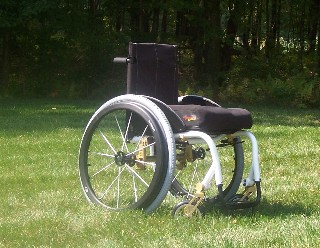
Propelling Change

The only constant in life is change. We’re born, we die, and in-between we age and we learn, we get jobs and we switch jobs, we find loves and lose loves, we succeed, we fail, and we grow. But, the foremost factor toward our successes in life, no matter who we are, is how well we accept, embrace, and foster change. Change is inevitable toward progress, and if we want to succeed, moving our lives forward, we must act upon change, not try to deny it.

I’m perplexed by those who avoid change in their mobility products, where in 2007, some still use wheelchairs from 1967 – not due to funding issues, but solely due to a personal reluctance to adopt modern mobility technology. After all, how is it logical that people choose to continue using 40-year-old wheelchairs when there have been such marked improvements in mobility technology over the decades?

I’ve recently ask several such users that very question, and they all had answers along the same lines: “It works for me, so why make a change?”

If one applied that logic to all other areas of life, one would never achieve any progress. A high school diploma works, but pursuing an advanced college degree certainly provides more career options and greater income. A marriage of convenience works, but one of passion and shared interests certainly inspires one’s life. Put simply, just because something works doesn’t make it the best alternative, and pursuing change is part of improving our lives.

And, that’s my answer to the question of, “Why change my old wheelchair if it works for me?” — that is, just because a decades-old wheelchair works doesn’t mean that it’s the best mobility solution.

In fact, in many cases, using an outdated wheelchair is the worst mobility solution, detracting from one’s life, just as potentially stifling as avoiding changes in our careers and relationships. It’s entirely possible that an outdated, 50-pound, steel manual wheelchair literally holds one back, where moving to a modern, 30-pound, aluminum wheelchair could literally moves one’s life forward through enhanced propulsion efficiency and increased transportability.

Another argument people make about not wanting a modern wheelchair is that a new one won’t fit as well as one of twenty-something years. And, to a point, they are correct – after all new shoes never fit like old ones. However, a skilled wheelchair specialist and manufacturer can replicate almost any seating and positioning needs, where even if one doesn’t want any changes to positioning, newer, more liberating wheelchair technology can still be worked in conjunction with existing preferences.

On this topic, I had the pleasure of meeting a gentleman at MedTrade this year. He explained to me that he’d always used E&J’s circa 1970 one-arm-drive manual wheelchair because it better met his needs than newer wheelchairs, that they didn’t steer or fold as well as his old, trusty E&J model.

Still, he eventually recognized that he was almost certainly missing out on modern technology, that a lighter, more efficient manual wheelchair would likely allow him greater mobility. From that realization, rather than holding on to what he new simply worked for him – the old, steel E&J – he had a current manufacturer custom integrate his existing E&J one-arm-drive mechanism into a new titanium wheelchair model. The result, he shared with me, has been profound, where his mobility is so enhanced by an ultralight wheelchair that he wished that he’d made the switch in the 1980s, rather than in the 21st century – that is, he wished he’d pursued change sooner.

Nevertheless, despite the countless examples of lives that I’ve seen positively changed by consumers who moved from decades-old wheelchairs to modern technology, some might say that it’s none of my concern if one prefers a trusty, old wheelchair over a newer one.

And, they’re right. We live in a fabulously free country, and just as no one has the right to tell another how to live life, no one has a right to dictate what type of mobility one uses.

But, as an individual with a disability, and in my consumer-focused roles, I recognize the remarkable liberator that enhanced mobility plays in our lives, where I know that, for example, a decades-old, 50-pound manual wheelchair can be replaced with 30-pound modern wheelchair, and dramatically change one’s life for the better. One can’t fault another for simply wishing everyone to have utmost mobility, especially when the advantages of modern mobility technology as a whole are indisputable.

Surely, comfort with the wheelchairs that we know and use offers utmost security – and, there’s merit to the notion of not fixing what isn’t broken. However, just because a product works for someone doesn’t mean that it’s the best solution, namely when dramatic advancements in technology have occurred. The fact is, wheelchair technology has improved dramatically over the decades, especially in the past twenty-five years, and it’s improved many of our lives.

What I ask is, the next time that you encounter someone stubbornly using a decades-old wheelchair, take a moment to find out why, maybe let them know how a modern wheelchair has improved your life, and how it could likely improve his or hers. No, we don’t want to drag anyone toward change against his or her will; however, getting them at least rolling in the right direction is a meaningful attempt toward fostering the mobility of others.

Monotubing Me

markmono1.jpg

The saying that everything old becomes new again has never been truer than when it comes to today’s ultralight manual wheelchair market, where Rainer Kuschall’s decades-old monotube design is all the rage, with virtually all manual wheelchair manufacturers now offering monotube models. To use another cliché, one might say that the bandwagon is better late then never.

Nevertheless, even though it took 22 years for the monotube to catch on in the U.S., it’s done so for good reason: A monotube makes for a responsive but forgiving ride, in a lightweight, compact package, with a sleek, minimalistic aesthetic.

I’ve used a rigid frame style manual chair for the past two decades, with my most recent built 7 years ago. I’m no jock or super-para by any stretch. In fact, I’m a complete spazzo on wheels – which is all the more reason for me to use a rigid frame, as in for utmost durability and propulsion efficiencies, compensating for my spastic, tone-driven push strokes. So, with my company increasing its presence in the manual chair market, and my needing a new rigid, I was fortunate to be able to put together a frame set of my own this year – a monotube, no less – in time for flying to MedTrade and other upcoming travel.

My frame set aside, the choices that I made toward components – such as rear wheels and casters – are the most applicable topics of discussion, using aftermarket components that are widely available, ones that you might use on your own chair.

Weight is critical toward wheelchair propulsion, especially at the rear wheels. A heavier wheel simply requires more energy to accelerate and propel than a lighter wheel, so the lighter the rear wheels, the easier a manual wheelchair is to push. With this principal, I began with a Spinergy Spox LX rim, which is among the lightest rims available.

If I wished the absolute most efficient, lightest wheel configuration, I would have finished the Spinergy LX rim with an aluminum handrim and a 100psi clincher tire. However, being that I’m using the chair for travel in everyday enviroments, I chose to run a slightly heavier but more practical set-up.

For tires, I went with a 65 psi, 1-3/8” everyday tire. Everyday tires offer better terrain handling, hold optimally with brakes, offer increased puncture resistance, and better maintain air pressure than 100 psi clinchers. Unquestionably, 100 psi clincher tires are far more efficient on ideal, hard surfaces than 1-3/8” everyday tires; but for everyday use on unpredictable terrain, 1-3/8” everyday tires are a sound choice.

The handrims were another choice made out of practicality. I went with ergonomic handrims for better grip over standard tubular handrims. And, indeed, the ergonomic handrims allow a notably comfortable, efficient grip – even on my one hand that doesn’t have a much coordination – and they are tremendously more effective toward uphill pushing and downhill braking. As such, from an ergonomic viewpoint, they are fantastic. However, ergonomic handrims are much heavier than a standard aluminum handrim – about 1 lb. Per side – to the point where the wheel feels heavier. What’s more, because the weight of a handrim is spinning at the outermost portion of the wheel – the most consequential place to add weight to a manual wheelchair – the heavier rotational weight of the handrim surely detracts from performance. However, the question becomes, do the benefits of ergonomic handrims outweigh the drawbacks of extra weight?

In my use, absolutely – the increased propulsion efficiencies that I get from using ergonomic handrims is well worth the trade-off in weight. The ergonomic handrims simply allow me to propel the chair dramatically better (or, at least keep the darn thing rolling in a straight line, which is the best that I can hope for!).

On the front casters, I went big for a monotube with an 80-degree front frame bend, squeezing in 6”, soft-roll front casters. Again, on ideal, flat, hard, smooth surfaces, an 80mm or 4” caster would prove most responsive. However, in everyday use, on unpredictable surfaces, a big, 6” soft-roll makes for an easier, safer ride. And, they are totally smooth, void of chatter on rough surfaces, which is a nice difference from small, hard casters – the chair all but glides. Plus, the aluminum rims are always a classic cool look.

Another practical touch are my quick-release stroller handles, set behind the backrest. On the one hand, I need a low back height for self-propulsion, but then the push handles are too low for others to push me when needed. To address this, I added height-adjustable, quick-release stroller handles that are placed at the right location for a companion, without interferring with my my positioning.

Of course, even though we built my own chair, I wasn’t without fitting issues like many users, where my posture doesn’t like to conform to typical seating and angles – I’m not a sit-and-go kind of fit. As has always been the case, I build my seating as close to my needs as possible, then a lot of tweaking still has to occur with adjustments to angles, cushions, and straps. While I understand this involved process, my ever-teasing daughter viewed it a tad mored bluntly. While fitting myself at home in my new chair one evening, I explained to her that we had to take the chair back to my office for some changes to the backrest, as it wasn’t fitting my angles and posture quite right.

“So, the back is wrong?” she asked

“Yep – I need to make it fit my crazy posture better,” I said, transferring onto the couch, my daughter holding the chair.

“But, you’re the one who made it, right?” she asked.

“Yep,” I replied.

“If you made the back, and it’s wrong…” she said with a smile, “…then that means that you made you’re own chair wrong.”

“Exactly,” my wife chimed in from the kitchen, making my daughter laugh.

“Come here, shorty – let’s see how well you fit!” I said, grabbing my daughter, pulling her onto the couch, tickling her.

“I take it back, I tack it back! You are the WheelchairJunkie!” she exclaimed, laughing hysterically.

Indeed, monotube wheelchairs and kids are fun – and even more fun together.

When Wheelchairs Can’t Buy Happiness

You’ve likely heard the expression, “Money can’t buy happiness.”  However, have you ever heard the expression, “Wheelchairs can’t buy happiness?”


Surely, you’ve never heard the expression related to wheelchairs, but such an expression is increasingly true among those of us with disabilities, which can prove both inspiring and defeating all at once.

Undoubtedly, wheelchair culture continues culminating, where wheelchair design aesthetics play an ever-increasing role in consumers’ lives, where having the latest-greatest wheelchair model has utmost importance for a growing number of those with disabilities. 

Toward the positive, where wheelchairs were once a sole device of necessity, something dreaded by many, wheelchairs have now assumed aspects that are objects of desire, where cool colors and cutting-edge components are enthusiastically sought – a transformation that undoubtedly changes lives for the better.  And, this trend transcends wheelchairs, liberating many other aspects of disability in that when we feel better about our wheelchairs, we feel better about other aspects of our lives.

However, in this era where wheelchairs are increasingly seen as objects of some prestige, I’ve also witnessed a downside:  The emotional drain of “chasing the next best thing.”

There’s no question that products are finding their way to market in an increasing number, at a faster pace than ever before.  Twenty-five years ago, there were around 5 powerchair models readily available on the U.S. market.  Today, there are close to 100, with countless configurations and options.  And, the models keep advancing, resulting in better and better products.

In today’s market, when one buys a wheelchair, there’s certain to be a newer model or enhanced features shortly to come tomorrow.  For most users, this market reality is of no consequence, as they are happy with the wheelchairs that they have, knowing that as time passes, new products will come and go, and they’re enjoying the liberation that their existing wheelchairs provide.

Yet, some wheelchair users, like other mainstream consumers, are emotionally captured by the thought of not possessing the latest-greatest wheelchair, especially when they see others getting one – that is, they are suddenly disappointed by their existing wheelchairs, dwelling on wanting the new, latest-greatest one.

And, here’s where the troubling aspect of “wheelchair prestige” truly shows itself in this trend:  Dwelling on having the latest-greatest wheelchair is as self-defeating as dwelling on possessing the latest-greatest of any product – it’s an emotional chase that ultimately proves pointless.

Now, I’ll be the first to say that few aspects in our lives are more important than our wheelchairs — and innovations in wheelchairs have changed our lives.  However, wanting a new wheelchair simply to have the latest-greatest version rarely proves life changing.  Will moving up to newer electronics or a newer frame style offer slightly better performance, convenience, or function over one’s current wheelchair that’s, say, seven months old?  Maybe.  But, will it truly change one’s life?

Usually not.  Surely, tilt seating for pressure sores or upgrading from one class of wheelchair to another, for example, can change one’s life.  But, that’s not what we’re discussing.  Rather, what we’re discussing is wanting the latest-greatest model or features simply to have the latest-greatest – not out of necessity, but desire.  And, in that way, one’s life won’t change.  After all, chasing the latest-greatest of any product does not bring sustained happiness or liberation.  The latest-greatest car, computer, or wheelchair may distract one’s attention away from other aspects of life for a while, creating a false sense of happiness in its obtainment, but once the latest-greatest model or feature is topped by another, the quest starts all over – one can’t find sustained contentment by always seeking external sources of promised contentment.

Still, the reasons why some wheelchair consumers get caught in this cycle, however, can’t be dismissed as flawed consumerism or dysfunctional emotional pacification through buying – it’s a much deeper issue. 

Wheelchairs are intrinsically a foremost tool of promise and liberation – they literally mobilize our lives.  At the same time, they can also prove a focus of limitations, where they can’t always take us everywhere we wish, physically or emotionally.  The cumulative result is that one can view a wheelchair from a very seductive perspective:  If only my wheelchair was a little better, my life would be better – I could go farther, faster, easier, looking cooler.

At some point, though, that outlook becomes defeating, unable to deliver its promise.  Yes, it’s great to have esteem and passion about one’s wheelchair, and even want the coolest one ever.  However, we can’t hinge all of our hopes and frustrations on our wheelchairs, thinking that if we somehow just obtain the latest-greatest one, we will somehow find sustained fulfillment and liberation in life.  Unfortunately, contentment over disability isn’t so easily obtained. 

Great wheelchairs liberate and inspire us, captivating us with their coolness, proving a positive force in our lives.  However, dwelling on having the latest-greatest wheelchair – believing that if we can only obtain the newest model or features, our lives will change – proves an ultimately unfulfilling quest.  In this way, successful mobility doesn’t come from dwelling on possessing the latest-greatest products in hopes that they will fill a void.  Rather, successful mobility comes from allowing our current wheelchairs to assuredly foster the quality of our lives day after day.

Count On Composure

I’m raising my daughter with a foremost principle that I trust will serve her well: Always treat others with respect, kindness, understanding, and composure – even when others don’t treat her with the same accord – and she’ll go far in life. No, it won’t always be easy, but it will prove successful.

As one with a disability and in my public roles, my striving to live that principle by example has proved a key component to my own successes. From rude airline agents to angry customers to people publicly criticizing me, I approach all others with respect, kindness, and understanding, believing that no matter how others behave, it’s no reason for me to respond poorly, that under all circumstances I should offer others the levels of respect and kindness that I wish. As my mother said when I was growing up, two wrongs don’t make a right, you attract more bees with honey than with vinegar, and an eye for an eye only results in two blind men.

Unfortunately, we don’t live in such a consistently forgiving world. Many people do believe in an eye for an eye, where you reap what you sow, where they’re glad to throw the ball back at you even harder than you threw it at them, not calming situations, but exacerbating them. And, that goes for the wheelchair world, as well.

It amazes me how many wheelchair consumers believe that screaming at their providers will help resolve their wheelchair issues. Are wheelchair issues frustrating? Sure. Can providers act like uncaring, unprofessional jerks? Absolutely. Yet, the fact is, treating others rudely – even people who seemingly deserve it based on their own attitudes – makes situations worse, not better, including when it comes to wheelchair service.

Sure, when you’re frustrated – your chair’s in the shop, and your provider’s not returning your calls – complaining, threatening, and yelling seems like a natural reaction. After all, doesn’t complaining, threatening, and yelling get a provider’s attention? Of course it does. But, does it get results?

Usually not. If the provider is ethical and inspired, he’s likely doing the best he can in working with your chair, and treating him with complaints, threats, and yelling isn’t going to speed up the process. In fact, such antagonism will likely slow down the repair, as the time that could be spent fixing your chair may be directed toward having to address your upsetting phone calls and emails.

Likewise, complaining, threatening, and yelling at an inattentive, jerk provider can also do nothing more than make the situation worse. Even jerks don’t like jerks, and just like angering a rogue airline agent can result in your luggage being rerouted to Timbuktu when you’re flying to Orlando, antagonizing an already less-than-ideal provider might cause your wheelchair to end up at the end of the repair line. No, it’s not ethical, but neither is raising heck with your provider – and when two poor attitudes collide, an eye for an eye can ensue.

Fortunately, composure proves beneficial in almost all circumstances – that is, the principal that I strive to live and instill in my daughter, that addressing others with respect will bring positive results. Just as jerks will prove vindictive to other jerks, jerks will almost always respond positively, at least in small ways, to respect and kindness extended to them. No, being nice in a frustrating, combative situation isn’t easy, but it is fruitful – and it’s the surest way to positive results.

Now, some might say, “Mark, my provider is already an unconcerned jerk, and I have nothing to lose by treating him as poorly as he treats me – I’m going to show that jerk what it’s like to deal with a real jerk, me!”

Again, there’s no value in that position – there’s no opportunity for progress. The opportunity for progress is in getting your provider on your side, where he helps you because it’s the ethical, professional, understanding role to serve. And, sometimes, like it or not, it’s up to you to set the example, to set the standard – it’s up to you to demonstrate that respect deserves respect.

Certainly, treating everyone, including providers, with respect, kindness, dignity, and composure isn’t always easy, and doesn’t always guarantee the positive relations that we seek. However, as a whole, composure will succeed over complaining, especially when it comes to wheelchair service. The next time you find yourself ready to blow steam at your provider, remember that while anger is easy to vent, it’s not so easy to live with, where it can harm your mobility. Save yourself some grief in dealing with your provider by maintaining composure, and see if respect, kindness, and understanding foster progress in the situation.

Conversation With A Crazy Kid

We know that kids are classic when it to asking questions about disability. Yet, when it comes to wheelchair use, I’ve observed that children are less inquisitive and less concerned these days toward those who use wheelchairs than they used to be – namely, I suppose, because if you watch the Disney Channel, Nickelodeon, or Sesame Street, or read grade-school text books, children with disabilities are prevalent as a trend toward overall diversity representation.

Nevertheless, the other evening, I came across one of the few kids in America who’s apparently never seen a wheelchair – ironically, just a few blocks from the company that I work for manufacturing wheelchairs, a fixture in our town.

“What’s that?” the chubby 10-year-old, or so, boy with round, wire-rim glasses asked, pointing at my wheelchair as we both waited at the corner to cross the street.

“A wheelchair,” I said, looking at the red lit don’t-cross sign.

“What’s it for?” he asked.

“I can’t walk, so I use this,” I said, looking him in the eyes, smiling.

“Why can’t you walk?” he asked, motionless, simply staring back at me in the eyes.

“My legs don’t work right,” I said, giving a simple, quick answer, waiting for the light to change, knowing not to get into a complex discussion with the Twenty-Question Kid about cerebral palsy.

“Are they made out of rubber?” he asked, arms at his side, his eyes still locked on mine.

“What?” I asked, unsure if I had heard him correctly, unsure we were still on the same subject.

“Your legs,” he said, “are they made out of rubber?”

I’ve heard a lot of crazy sentiments come out of the mouths of children, but none have ever asked if my legs are made from rubber. I’m a fairly quick wit, but his question was so unexpected and imaginative, I was speechless, impressed by his originality. This crazy kid was raising the bar on our street-corner conversation, to where he had me stumped. I smirked, looked at the light to see if it was still red, then I composed myself, forming my comeback.

“Not rubber,” I said. “They’re made out of polyvinyl chloride.”

“Oh,” he said, still staring me in the eyes. “What’s that?”

“PVC plumbing pipe,” I replied.

“Oh,” he said.

I looked at the light, noting it was now green.

“Time to cross,” I said, rolling into the crosswalk, looking over my shoulder, seeing him just standing there on the corner, motionless, watching me leave.

The Color Of Mobility

In the selection of a new wheelchair, there are dozens of choices, ranging from the model wished, all the way down to the type of footplates, with a myriad of choices in-between. But, there’s one choice that consumers overwhelmingly see as especially important: Color.

One would think that comfort and functionality would prove key decisions in wheelchair selection, aspects that certainly are important to one’s mobility. However, color selection is an aspect that many users debate the most – sometimes for weeks – before ordering a new wheelchair. In fact, I’ve known users who selected one model over another simply based on a particular color offered. Surely, some might view placing such importance on color as trivial. But, in my experience, placing utmost importance on color makes entire sense, and literally enhances one’s mobility.

If you think about it, color is one of the few true choices that we have toward our wheelchairs. Sure, we pick the model, seat size, armrest style, and such, but those really aren’t choices – they’re just variations of must-have items that are dictated by using a wheelchair.

However, color is completely at our whim. When it comes to color, no one needs an Octane Orange ultralight wheelchair, or Purple Passion powerchair – but, it’s what one wants. After all, the colors we choose broadcasts who we are, how we feel, what we wish to project. From brilliant black to lime green, the color of our wheelchairs is the taste, texture, and tone of our lives, expressed through our wheelchairs. And, it’s in this context that the importance of color – the vibrancy it adds to our lives – begins to prove itself.

Imagine for a moment that you’re newly disabled – or, maybe you can think back to such a time in your life. You’re in a rehab facility, getting fitted for your first wheelchair, and it’s all foreign and frightening. You’ve gone from relying solely on your body, to seeming confinement to a wheelchair, with virtually no time to emotionally adjust. And, now the clinician is running you through a litany of wheelchair specifications – to which you can’t relate.

But, then there’s selecting the color of your new wheelchair. Maybe you’re into sports, so you go for silver and black because the Raiders are your favorite team. Or, maybe you’re a hip young lady who has the pink Motorola Razor cell phone, so you pick pink to match. Or, maybe you’re a motocross fan, so you pick orange, KTM’s signature color. Or, maybe you want your wheelchair stealth, so you go with a black-on-black color scheme like seen on choppers and SUVs nowadays. Color, in this way, is a connection, from you to your wheelchair – it’s of you and for you, the opportunity to apply your personality to your wheelchair and express it to the world. 

The fact is, the moment that you feel better about your wheelchair, you feel better about your life.  And, that’s the color – the power –  of mobility.

How Onset Of Disability Influences One’s Wheelchair

At onset of disability, if you want the best wheelchair that money can buy, make sure that you get run over by a bus.

As ridiculous as that advice sounds, it’s seemingly true. What my extreme example eludes to is that not only does the type of health insurance one has determine the quality of the wheelchair one receives, but so does how one incurs disability in the first place.

As discussed by Dr. Fabrisia Ambrosio of the University of Pittsburgh in a recent article, those who experience disability due to sudden trauma, such as spinal cord injury, receive higher-end wheelchairs from the start than those with non-traumatic injury disabilities, including multiple sclerosis or muscular dystrophy, to name a few. And, in my professional experience, this assertion absolutely proves true, with ramifications not only toward one’s initial wheelchair, but also potentially affecting every subsequent wheelchair one ever receives throughout life.

The fact is, a traumatic injury is a hot-rush, non-stop ticket to the heart of our healthcare system. A spinal cord injury, for example, dictates a linear path from a trauma unit through advanced rehab, where, along the way, most patients go through state-of-the-art rehabilitation programs like those of Kessler, Shepherd, Craig, and Casa Colina rehab centers. And, it’s during rehabilitation that the best-of-the-best clinicians fit patients with cream-of-the-crop wheelchair technology, with newly-injured individuals leaving in among the most advanced manual and power wheelchairs.

However, those with progressive disabilities, such as multiple sclerosis, are far less likely to go through such an intensive rehabilitation program, never receiving such focused, all-encompassed healthcare, such as that geared toward traumatic injury. As a result, wheelchairs for those with progressive disabilities are fitted and prescribe on a more throttled scale, by local therapists and providers who may not have the cumulative resources and experience of advanced rehab centers. Further, toward progressive disabilities, therapists and providers, as required by most insurers, often only assess one’s needs in the immediate, prescribing and funding wheelchairs that aren’t of the most advanced technology, even though one’s condition may become more involved, where in several months or years, a much higher-end wheelchair may be needed.

In this way, during the fitting and funding of first wheelchairs, traumatic injury patients typically have access to higher-end mobility technology over those with progressive disabilities. However, such inequities don’t stop at the issuance of one’s first wheelchair.

Many insurers use the level of one’s current wheelchair as historic precedent for one’s next wheelchair, meaning that what you have is what you get, unless there’s a dramatic change in condition that warrants higher-end technology. The consequence is that if one is initially issued a lower-end wheelchair, one is likely to receive the same type of wheelchair at the time of replacement if there’s no change in condition, keeping one in a funding cycle of low-end mobility products.

Surely, hindsight is 20/20, and there’s nothing that any of us, as wheelchair users, can do to change our own first wheelchairs. However, as members of the disabled community, it’s vital that we look to help others new to disability. If you encounter someone about to get fitted for his or her first wheelchair, take a few minutes to point him or her in the right directions, toward consumer sites on the web, toward an outpatient seating clinic at a rehab center, toward the knowledge that everyone should ideally have when selecting a first wheelchair. In fact, your timely advice could affect the quality of wheelchair that he or she receives for decades to come.

Equality At The Strip Club

If anyone would end up having a profound conversation about disability in a strip club, it would be me.

This all started with a conspiracy the other day. See, if my friends and I told our wives that we were having a guys’ night out at the strip club, it would never fly – we’d be lectured, then resigned to staying home to watch the Lifetime network with our wives. However, if we said that we were invited to a “bachelor party,” we were free to go – after all, who wants to be known as the only wife out of the bunch who wouldn’t let her husband go to the bachelor party?

And, our pact to blatantly lie to our wives worked perfectly.

So, there we were at the strip club, and it was everything you could imagine – gold poles, multicolored lights, drifting smoke, and 4-inch heals everywhere. And, as is the case at strip clubs, there was a steady stream of women offering lap dances to us, at least one every two minutes, trying to drain our dollars in real time.

“Dude, check that out,” my buddy said, pointing to an extremely tall, slender, brunette woman in a skin-tight, silver-sequined halter top and matching hot paints.

I watched her for a moment, two tables or so from us in the foggy, seemingly dizzying club. She had a card in her hand that she showed the customer at the table, then tucked the card in her top, picked up a pen and pad off the table, and wrote on it, showing it to the gentleman. I looked to her lips to see what she was saying, but she wasn’t saying a word, just pointing at the note pad, as if wanting the guy to read it.

“She’s a deaf-mute,” my buddy said, looking at me, then back to her.

I watched her gesturing to the guy with her pad again, having written down something else she wanted him to read. “I think you’re right,” I replied.

“That’s weird,” my buddy said.

“This whole scene is weird,” I said. “A deaf-mute stripper isn’t any weirder than a stripper, in general.”

My buddy looked at me, raising an eyebrow.

“Really, if you think about it, there’s equality to it,” I added. “Why shouldn’t a deaf-mute woman strip?”

“I don’t know?” he replied. “It’s just weird.”

“Look at it this way, she’s putting herself out there with a disability well beyond what most would do,” I said. “I know it sounds crazy, but there’s some courage in that. Hustling guys for lap dances takes some gumption, so imagine doing it when you’re deaf and can’t speak.”

“Then, think what she could do if she put that fortitude toward other things in life,” he said.

“But, that goes for every dancer in here,” I said. “That’s where there’s equality in a warped kind of way – there’s no reason why one with a disability shouldn’t pursue any path, functional or dysfunctional.”

“So, is stripping going to be your new career path?” my buddy asked, smiling, picking up his beer.

“My wife begs me to put my pants back on, let alone a club full of strange men paying me to take them off,” I said, reaching in my pocket for more money for the next lap dance. “When you’re smokin’ hot like her with a disability, you make money. When you’re a weathered yahoo like me with a disability, you lose money.”

“That’s how strip clubs work,” my buddy replied, slapping me on the back. “And, aren’t they great!”

They Shouldn’t Trust A Guy Like Me

Consumer survey companies hate me – they just don’t know it.

I just received another consumer survey to fill out. I receive quite a few these days, having bought a new van within the last year, which immediately put me on ten different automobile surveys, with a computer purchase, catalog ordering, and a subscription to Consumer Reports all adding another dozen surveys to my mailbox.

But, as a guy with a disability, I know that I completely skew the ultimate accuracy of their target marketing toward me, where my on-paper demographic doesn’t account for my true wants and needs. To the survey data collectors, I’m a 36-year-old married home owner, with one child, white-collar income, with interests in “outdoor recreation” and “family activities” – characteristics that, based on the junk mail I receive, paint me as the type of guy captivated by SUVs, lawn tractors, and treadmills. I even receive a bi-weekly flier from the high-end outdoor retailer, REI, listing specials on bicycles and kayaks.

The fact is, as a result of my having cerebral palsy and using a wheelchair, the consumer survey demographic generated about me goes out the window, where unless they show me a powerchair on a lawn tractor or tread mill, they’re wasting their advertising dollars.

Nevertheless, I confess that when filling out the surveys, I purposely check the box that states that I have an interest in “fitness,” which explains the REI bicycle and kayak fliers – and, more importantly, the Victoria’s Secret bikini catalogs that I happily receive in the mail, too.