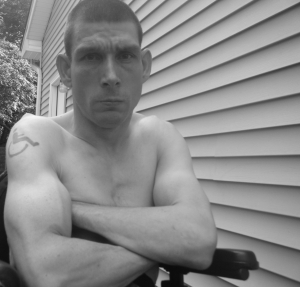
I’m Going to Eat Your Heart

By Mark E. Smith

One couldn’t say that I have an anger management problem by any stretch. In fact, I’m among the easiest-going, happy-go-lucky guys around – very little ruffles my feathers. But, that doesn’t mean that I’m not fearless – arguably to an absurd point – where I won’t grab a guy by the shirt who’s being a jerk in public, welcoming a little scrap with another dude when called for.

I’m sure that my brother helped instill fearless bravado in me when we were growing up. After all, it makes no intrinsic sense for me, as a guy with cerebral palsy, using a power wheelchair, to be the one guy in a scene to grab a jerk by the collar, pull him into my spit-firing, vein-bulging face, and tell him in words that I can’t use here that if he doesn’t settle down, I’m going to rip off his limbs and eat his heart while it’s still beating. See, my brother and I are six days less than a year apart, and we were raised very much like twins, right down to always having the same clothes and toys. In a psychoanalytic way looking back, I think that we were both always trying to distinguish ourselves from each other – and that included via never-ending brotherly brawls.

For better or for worse, it never seemed to matter that I had cerebral palsy and my brother didn’t – when we fought, we really fought. In no mixing terms, we beat the heck out of each other, both playing on our strengths, as well as the other’s vulnerabilities. He knew that he could punch me and run, and as long as I couldn’t catch him, he would win, leaving me with a black eye, busted lip, or such. Yet, I knew that if I got my hands on him, he wasn’t getting away – I’d throw my good, strong right arm around his neck, and try to choke the life out of him. I know that child psychologists frown upon sibling rivalries nowadays – and I don’t tolerate such violence among the kids in my own family, where I’m always reprimanding my two nephews for antagonizing each other – but, when my brother and I were kids, duking it out seemed par for the course.

As adults, my brother and I laugh about it all now, and joke about how inherently bold it made both of us. After all, in my brother’s case, if he’s beat-up a kid with cerebral palsy, that’s probably not a guy scared of punching just about anyone. And, in my case, as a kid with cerebral palsy raised to give and take punches, an absurd fearless toward fist-to-cuffs has stuck with me, as well. In fact, my buddy, Jeff, and I inadvertently ended up in the front row of a concert not too long ago, and when the drunk idiots around us started going nuts, bumping into me, I started swinging. Jeff seemed a bit concerned at first, but once I grabbed and punched a few people – and the crowd figured out to stay away from this guy in a power wheelchair – Jeff seemed a bit reassured that I wasn’t going to get us killed. I suppose people figured that if I was crazy enough to be in a mosh pit in a wheelchair, swinging on people, they should probably just stay away from me.

Now, my brother and I are both successful in our careers, with kids of our own – living as wholesome, law-abiding, God-fearing citizens – and neither one of us are the types hanging out at country-n-western bars looking for fist fights (beyond my inadvertently ending up in a mosh pit, that is). However, my one short fuse relates to jerks in public, especially those disrespecting women – and I’ve become bolder in my reactions since raising my daughter. I have zero tolerance for guys disrespecting women in public – guys gawking, making inappropriate comments, or such – and I have no qualms about straightening out the situation in real time.

Word must have gotten around about my short fuse because I was out with a female friend, and she commented to me that a creepy guy was staring her down. However, before I could turn around and see who it was – and impulsively roll over and pick him up by his shirt – she asked me not to do anything, not wanting a scene. I did as she wished, didn’t move, and continued with our conversation. However, I wondered how she knew that I was the kind of guy who would create such an over-the-top scene, that I wouldn’t have any hesitation about grabbing a guy by the shirt and explaining to him in four-letter words how to act around ladies in public?

A few days later, I asked my friend how she knew that I was immediately ready to roll over and grab the guy by his shirt? She said that she recognized me as the protective type, and when she saw me intuitively go for my power wheelchair’s joystick, ready to spring into action, she knew to talk me down quickly.

I’ve always wondered what has gone through the minds of those few individuals over the years who I’ve confronted regarding their poor behavior? When a well-dressed guy with cerebral palsy, using a power wheelchair, rolls up to you, and says things into your ear that could never be said in a PG-rated movie – adding up to, If you don’t leave right now, I’m going to rip your heart out and eat it as an appetizer – what really goes through your mind? Or, on the few occasions when my words weren’t convincing enough, when I’ve literally picked them up by their shirts, what were they thinking as the weight came off of their feet, as I pulled them over my armrest, into my contorting face?

The real question is, how have I not been beat-up by now? (Heck, I would have beaten myself up by now!) I reckon that the answer is a combination of factors. Firstly, every guy I’ve dealt with was either really drunk, or a slender creep – both of which have been surprisingly easily manhandled. Secondly, I think there’s some shock to having a cartoon-looking guy in a power wheelchair, with cerebral palsy, grab you by your shirt and threaten to eat your heart – why take the chance of second-guessing a guy like me who’s seemingly crazy enough to confront you? Thirdly, my strength and appearance has to freak them out, where I’m strong to begin with, and when I spasm, it’s then unbridled strength (I broke the arm off of a 250 lb. chest press machine, when the weights were maxed-out, simply by spasming), so it has to be unsettling to be tossed around, seemingly uncontrollably, by a guy in a wheelchair going spastic with such force, where I’m breathing like an angry bull, trying to control the both of us. (As cerebral palsy comedian, Josh Blue, puts it, if a guy with cerebral palsy gets mad, someone’s going to get hurt by the palsy punch, and no one’s sure where it comes from or where it’s going, especially the guy with cerebral palsy!)

Nevertheless, there’s always a chance that a guy could start swinging on me – and I’d be fine with that. In my adult life with cerebral palsy, I’ve taken some hard falls, with bell-ringers to the head, so I don’t doubt that I could withstand a close-quarters punch to the head or two. I might even be flattered by the equality of it – at least until the third punch sent me snoozing into Lala Land. But, the goal, much like with my brother when I was a kid, has to be for me to never let it get to the third punch. Again, in theory, like a boxer holding his opponent close, as long as I’ve got my hands on him he’s not going anywhere. And, if he wanted to take me to the ground, a 400 lb. power wheelchair is going with us, and since I’m strapped in, I’m likely not the one it would land on.

Ultimately, though, my absurd, in-your-face antics toward jerks in public are arguably foolproof: No matter how jaded our society, if people see an able-bodied guy trying to fight a guy in a wheelchair in public, some bigger dude is going to knock his lights out for picking on a guy in a wheelchair – there’s still that stigma that you shouldn’t punch a guy in a wheelchair. So, no matter what creeps do in public to tick me off, they’re going to have a tough time winning in the end – which is why I’m always courteous enough to offer them the opportunity to leave before I tear their pulsating, blood-dripping hearts from their chests and eat them (or before they’re torn apart by an angry mob for beating the daylights out of me, a poor, defenseless guy in a wheelchair).

Following Fran

By Mark E. Smith

I recently participated in a San Francisco Chronicle newspaper debate over legalizing marijuana in California, and I quickly topped the debate as holder of the least popular position:

….As one with a severe disability, I’m constantly embarrassed that disability is used as a justification for pot use. The fact is, there’s no link between having a disability and using pot – and anyone who makes such a connection is simply using disability as an excuse to get high (and, arguably, avoid accountability in living with disability). No, living with disability isn’t always comfortable or ideal; however, it in no way warrants or justifies drug use. I assure you that many of us with disabilities have the self-acceptance and fortitude to live healthy, clear-minded lives, where we look at our peers with disabilities who use pot and call them what they really are: Drug addicts.

My “blunt” position was ranked by readers as the most disliked out of 40 or so arguments for or against legalizing pot – who knew there were so many angry, stoned people with disabilities reading the San Francisco Chronicle? …Based on their angry comments toward my position on the subject, you’d think that I was personally taking away their hash pipes.

However, all was not lost on me in the debate, as one pro-pot reader’s comment addressed to me particularly captured my attention:

Cannabis is used for pain relief, why should people suffer in pain unnecessarily? Do you think that suffering in pain is good for character development?

My answer is a no-nonsense one: Absolutely pain and suffering is good for character development – it’s among the foremost ways that we evolve for the positive as individuals. The fact is, adversity, pain, and suffering are intrinsic parts of human experience, and facing them in healthy ways is not only good for character development, but also strengthens the capacities of our humanity. After all, the only way that we truly develop resilience and fortitude is by facing adversities, not avoiding them. Adversity is like exercise: The more positive effort that we put into facing it, the more developed we become.

Even on seemingly superficial levels, it’s undeniable that adversity, pain, and suffering can serve us in positive ways. When we’re willing to study harder than our peers, we excel in school. When we’re willing to work harder than our colleagues, we excel in our careers. When we’re willing to push our bodies to the limit with exercise, we excel in health. And, all of these are character-building efforts, developing our tenacity and perseverance in spite of the discomfort that they require. In this way, there’s no question that one who avoids any discomfort has a less-developed character than those who expose themselves to hardships in order to live to their fullest potentials.

In a more literal way, there’s no question that embracing any physical pain of disability or illness – not masking or avoiding it – is a key to character development, an evolved skill set that will never fail us. One of my closest friend’s brother, Fran, has been going through among the most intensive cancer treatments, with massive doses of chemo therapy. However, to all of our amazement, he has barely slowed down his activity level, merely working his cancer treatment into his schedule rather than allowing it to dramatically effect his life. In fact, while most people are laid-up in bed, too ill to function at his level of treatment, Fran is out doing most of the activities that he’s always done, including helping others in any ways that he can. Sure, he told me that he feels like hell much of the time; but, he won’t let that get in his way. So, how does Fran defy conventional reaction to cancer treatment, not slowing down when others must, to where he possesses pain management skills that seem to contradict modern medicine’s understanding of it?

The answer is elementary: Some 48 years ago, Fran began building life skills by enduring a level of pain and suffering that very few humans have ever known. See, when Fran was 13, in 1961, working at a gas station, there was an explosion, setting him ablaze. Rather than stopping, dropping, and rolling – the technique that we all know today to extinguish flames – he ran in panic, further spreading the fire, burning his whole upper body, including his face, beyond recognition. A witness finally tackled him, putting out the flames; yet, Fran’s challenges had just begun.

Back in the early 1960s, the treatment methods for severe burn victims weren’t nearly as evolved as they are today. In fact, the post-burn treatment, such as soaked wound dressings, were said to be more painful than the burns, themselves – a striking contrast to such modern practices today as hydrotherapy. So, Fran not only went through the initial trauma of the explosion, but also endured the treatment of burns over his entire upper body, multiple surgeries, permanent disfigurement, and blindness in one eye. Yet, the experience ultimately made him all but unstoppable, going on to have a family and a dedicated career over the past 48 years, overcoming any adversities that he encountered, where he’s also been the go-to guy when anyone needs assistance or a helping hand – everyone just calls Fran.

As Fran proves, and as I’ve personally lived and witnessed time and time again, when we face pain and suffering head on – and when we’re even willing to pursue it when needed – we absolutely develop our character and strengthen our capacity to succeed in life, foundations of tenacity that serve no matter what comes our way. Indeed, we have the capacity to not just endure pain and suffering, but also to embrace it for our betterment.

I’ve never known anyone succeed in life from running from adversities. However, I can show you countless individuals, like Fran, who’ve succeeded by embracing the harshest circumstances with fortitude and perseverance – and true character, of course – where they’ve only become stronger and more successful. The way I see it, those pot-smokers with disabilities can keep at it in California – it’s their own lives they’re wasting. But, for me, I’m following Fran, where I’m glad to reap the life-long rewards of building character through embracing adversity, pain, and suffering. After all, the more we’re willing to endure, the more we’re willing to evolve as individuals.

People Talking as People

By Mark E. Smith

A friend recently had me send him a replacement thumb screw to optimally secure a shroud piece on his power wheelchair. It was held on by a remaining screw on one side, but, absent the second screw, it sat crooked, ajar. “I just want to shut people up about it,” he said, noting the non-stop comments from his family and friends, constantly asking, Aren’t you ever going to fix that thing?

It really is amazing how bold people are toward commenting on our wheelchairs – and, when I say bold, what I really mean is unoriginal, idiotic, and even disability-phobic. After all, when was the last time a stranger made a creative, intelligent comment about your wheelchair? Chances are, rarely, if ever. …It’s always an unoriginal, idiotic comment like the greeter at Wal-Mart saying, Now, no burning rubber in here!; or your uncle, Harry, who says, We should soup that up with a gas engine!; or the nurse who asks, You’re not going to run me over with that, are you?; as you follow her down the hall at the doctor’s office.

My personal favorite – and, when I note favorite, I mean the most unoriginal, idiotic, never-ceasing comment of them all – is during every winter, when all I hear for six months is, Do you have snow chains for your wheelchair? And, undoubtedly, each person who asks me that wise-crack question thinks that he or she is the funniest, most original comedian out there – except that he or she really isn’t, merely stating the unoriginal and idiotic. Sixteen people made that comment to me on a single snowy day – I counted! – and I simply started replying, No, but I have duct tape… and I’m going to put it over the mouth of the next person who asks me that idiotic question! But, people kept asking, no less – there apparently isn’t enough duct tape to stifle the unoriginal and idiotic.

The other one that I love – to hate! – is when people ask me why I don’t clean my power wheelchair, when they know that it’s been raining or snowing for a week. I always want to reply, If you drive your car to work in the rain or snow, it gets dirty, just like when I drive my power wheelchair to work in the rain or snow, it gets dirty. What part of this equation don’t you comprehend, Einstein?

Most recently, I’ve inadvertently brought the unoriginal, idiotic comments toward my power wheelchair to whole new level, where they’re strikingly consistent, no matter the weather or occasion. I’ve had my “everyday” power wheelchair for about four years, and it’s gone through hell and back – driven thousands of miles, through countless thunderstorms and winter snow, caked in road salt for months at a time. And, so after such abuse, I understandably needed to replace my rear caster beam. In today’s limited funding climate, where many struggle to get basic mobility, it would have been unethical and immoral of me to simply order up a new caster beam for my wheelchair through my own company’s inventory system – there are too many people in need for me to be patching up my own wheelchair with new parts when such parts should go to others in need. Instead, I waited till our Service department had a used caster beam in reasonably good shape, and I had them recycle it onto my own wheelchair in need. The beam, as it turned out, was a different color than my frame; yet, that was of no concern to me – my goal was to have optimal mobility without impacting others with disabilities, so I was merely thrilled to have a good, used caster beam, regardless of color.

However, I didn’t consider the single, unoriginal, idiotic question that my mismatched-colored wheelchair would forever invite: How come your hood doesn’t match the fenders? As if I’m stuck in a never-ending episode of Seinfeld, every unoriginal, idiotic Neanderthal asks me that exact question, thinking that he or she is freakin’ hilarious: How come your hood doesn’t match the fenders? I suppose that I could take the time to explain the socially-responsible reason why my caster beam doesn’t match the rest of my wheelchair, but it would be like trying to explain the moral dilemmas of Dostoevsky’s Crime and Punishment to a three-year-old.

The larger issue is, however, why are people so quick to make unoriginal, unintelligent comments about our wheelchairs? After all, as those with disabilities, we don’t make unoriginal, idiotic, stereotypical comments to strangers about their appearances, nor do those who are able-bodied make such comments to each other. For example, a Wal-Mart greeter is allowed to say to a wheelchair user, Now, no burning rubber in the store!, but would be fired if he or she said to every overweight person, Now, no eating everything in the store! Both comments, at their core, are offensive; yet, culturally, one is allowed to call attention to a stranger’s wheelchair, but not allowed to make a wisecrack regarding, say, a stranger’s weight – what’s the basis for such a discrepancy of socially-acceptable behavior?

The answer resides in remaining disability phobia, where some people just don’t know how to act around those with disabilities, so they try making small talk centered around one’s wheelchair – and much of it ends up sounding really, really stupid, if not downright offensive to some.

I know a guy who works on the motor end of the power wheelchair industry, and based on my understanding of his background, prior to his entering the industry six years ago, he knew nothing of disability – and possibly still doesn’t. See, he knows me – and those around me – very well, but treats me very differently from others. When he sees everyone else, he greets them by name; however, whenever he encounters me, he simply says the same thing every time: Man, those motors are quiet!, referring only to my wheelchair. He’s said it to me hundreds of times, in every sort of setting. He could be talking to a group of people, and as I roll by, he’ll shout it at me – Man, those motors are quiet! It’s never, Hi, Mark, how are you?, just the same old, annoying comment: Man, those motors are quiet!

Why, though, does he insist on shouting that singular phrase at me year after year, rather than simply greeting me like everyone else? The first possibility is that he has a clinical fetish for wheelchair motors, and can’t control his “urges” when I roll by. Of course, a more likely possibility is that he lacks the capacity and comfort level to interact with those who have disabilities, and instinctively focuses on that which he’s comfortable with – motors. Therefore, saying, Hey, Mark, how are you?, to me, the guy with the disability, is so far outside of his comfort zone that the best that he can squeeze out is, Man, those motors are quiet!

Indeed, it’s a striving toward comfort level that ultimately motivates most of the unoriginal, idiotic comments that we receive toward our wheelchairs. People truly aren’t trying to be stupid and annoying, but actually gracious. Many without disability experience want to reach out to us as people, but aren’t sure how, so they stumble over themselves, using the obvious – our wheelchairs – as a conversational ice-breaker. And, that’s an effort on their parts that we should appreciate. Rather than avoiding those with disabilities as an unknown, others are taking the chance to start a dialogue with us – albeit, awkward, with unoriginal, idiotic comments – and it’s our role to then seize the opportunity, where we have a chance to engage with them in dialogue, where they then can see us as just people, after all.

The next time that someone makes an unoriginal, idiotic, comment about your wheelchair – Do you need a license to drive that thing? – try not to be annoyed or dismissive, but use it as an opportunity to open an immediate dialog, where the conversation quickly moves from your wheelchair to you as a complete person. You’ll likewise be amazed at how quickly you, too, will see the individual in front of you transform from an unoriginal moron to a sincere person, where everyone’s initial assumptions breakdown, and you just become people talking as people.

Learning the High Road

By Mark E. Smith

Most are lucky to have one influential figure in their life, and I’ve been fortunate to have several. Arguably my closest mentor today is Poppop, who everyone in New York City and West Palm Beach knows as my grandfather.

Poppop isn’t my biological grandfather. See, I married into a traditional, patriarchal, New York Jewish family – a stretch for me coming from the wrong side of the tracks, of divorced parents, where I was raised borderline catholic at best. Yet, almost 20 years ago, Poppop welcomed me into his family, not just as his grandson-in-law, but over the years, closer to his literal grandson or son.

Poppop is the real deal, a pull-yourself-up-by-your-bootstraps-and-make-something-of-yourself Jewish immigrant. He came to the U.S. as a child, and began selling leather wallets on New York City street corners during the 1920s. By the 1930s, he lugged a bag full of leather goods, selling door-to-door, experiencing tremendous discrimination as a Jew. By the 1940s, he was the top salesman of a leading leather goods company. And, by the 1950s, he was president of the company where he was once a salesman. Then, his business accomplishments really skyrocketed. In the 1960s and 1970s, Poppop owned the largest percentage of the U.S. leather market, where if you bought any leather goods, from purses at Macy’s to the leather interiors of Cadillacs, it was from Poppop’s company. As he reached retirement age in the late 1980s, Poppop sold off the various components of his company, heading off to follow his passions of golf, travel, and charity, till this day dashing between West Palm Beach and New York City.

As I went from academics into the mobility industry years ago, Poppop became my foremost mentor – my business school of sorts, teaching me much of what he’d learned about customer service, quality products, and, above all else, extraordinary ethics. What’s more, in recent years, Poppop has brought me into his circle of friends, where I’ll spend Saturday afternoons outside the kosher deli near his home during the summer, listening to stories by some of the greatest businessmen of all time, who founded mega companies that we all know today, who have over-the-top accomplishments like winning the America’s Cup in sailing. I admit that I don’t contribute much to the conversations – as I can’t hold a candle next to these guys – but I use every opportunity to ask questions and listen, learning all that I can from these amazing men in their sunset years.

You’re only as good as your product, and your product is only as good as you.

If your product or service isn’t self-evident, then you don’t have one.

The only way to make money in the longterm is to put people before profit.

Never, ever speak ill of a competitor or product, as it does nothing more than reflect poorly upon you.

The only opinion that counts is the customer’s.

These are just a few of the creeds that I’ve learned from Poppop and his peers, and they are tenets that I’ve striven to apply without compromise within my roles in the mobility industry, where my goal isn’t to be a titan of business, but to merely do what’s right by my peers with disabilities. In this way, you’ll always see me practice what I’ve learned and believe, and noting my now trademark consumer-centric phrases like, The question isn’t what’s the best wheelchair; rather, the question is, what’s the best wheelchair for you? and, If you think it’s the best wheelchair on the market, then you’re right – your opinion is truly the only one that matters. And, as I trust you’ve witnessed, I live by those mottoes. Sure, I work for a specific manufacturer, but like a doctor who’s taken the oath, my moral, ethical obligation is to put a consumer’s mobility above all else – after all, that’s what the mobility business requires.

I’ve been inspired that many others in the mobility industry share my ethics, where many recognize that no single product is right for everyone, that we must have equal respect for all products that liberate consumers. Yes, there’s business competition, but there’s also an unspoken, ethical agreement that you don’t engage in any practices intended to deceive or harm consumers’ interests to simply sell your product over another. And, all have followed that business ethic in our industry to a remarkable degree – that is, till now.

I’ve been disheartened in recent weeks as I’ve witnessed the mobility industry become fractured by a sole manufacturer who has violated our code of conduct by distributing a video that ultimately bashes many of us competitors in the industry. Even worse is that the video intentionally strives to mislead consumers, a ploy to put money before mobility, profit before people. For the sake of integrity and standards, I’m not going to mention the manufacturer or link to the video, but in no uncertain terms, they use trickery and video editing to make virtually all leading power mobility products look really, really bad – to the point that if their efforts weren’t so shameful and unconscionable, it would be comical. To give an analogy of how rigged the video is, it would be like a boat company showing how their competitors’ boats will sink, while they’ve clearly drilled holes in the bottoms.

Of course, mobility products aren’t luxury items like boats, but are profound, life-sustaining devices that we rely on for our independence – and that’s why I find the manufacturer’s tactics and video so disturbing. For a manufacturer to spitefully disregard the value of our lives as those with disabilities by putting out a deceptive, misleading video of trickery, designed to scare consumers away from all mobility products that compete against theirs, crosses a line of basic human integrity.

The question, however, that I have is, Why did the manufacturer – and ultimately its individual employees – go as far as to make a video bashing among the mobility industry’s most-proven products and strive to deceive consumers?

To answer the question, I have to go back to sage advice from Poppop and his peers: Nothing clouds business judgment like desperation.

If the manufacturer is losing the battle in the mobility market bit by bit, I suppose they figure that they’re down to their last option: Play dirty.

Undoubtedly, some will fall for their skewed, deceptive, heavily-edited video, so they’ll get some results. And, maybe they’re even glad to have gotten under my skin, high-fiving each other in their cubicles, saying, See, we even got Mark E. Smith talking about us! However, any scant results from the video can’t make up for the loss of respect that they’ve invited by offending virtually everyone associated with mobility products.

Indeed, their video makes me angry, and even a bit ashamed to know that a manufacturer in my industry would stoop to such low levels. However, I ultimately have to cut them some slack, knowing that they haven’t been as fortunate in life as me, where I’ve had Poppop to not only teach me the right ways to succeed in business, but, most importantly, how to live with true integrity.

When Disability is the Story

By Mark E. Smith

I’m all for remarkable stories about remarkable people, from the historical and the famous to heroes next door. In fact, much of my free time is spent studying great people, where I’ve learned that we can discover much of our own potentials through the examples of others.

Yet, what’s discouraging is all of the mainstream-distorted disability fribble that we must wade through to get to great stories that involve disability. Sure, there are lots of so-called “inspiring” stories about disability on the newswire and television every day; but, very few are actually newsworthy when you take out the disability aspect.

For example, there’s nothing newsworthy about a 17-year-old kid with a great smile and lots of friends. But, if we give that young person a disability, then you have a feel-good cover story for your local paper, where, …Jimmy may not have all of his limbs, but he still has a smile that lights up the neighborhood. Or, there’s nothing remarkable about two parents with four kids who live on a farm. But, if those two parents have a disability – dwarfism – now it becomes a sensational reality TV show, Little People, Big World. Why is that? Why do we, as a 21st-century, westernized culture still see disability, in itself, as newsworthy and sensational, without requiring any real substance?

Unfortunately, the answer is, because our culture still doesn’t recognize the fact that many with disabilities live strikingly “normal” lives, where we work and raise families like most others. People still buy into the myth that disability, in itself, somehow makes every day “different” – and it’s captivating and mysterious to those readers and viewers who don’t know any better. It’s really tying into stereotyping and ignorance in the name of newsworthy.

Nevertheless, some with disabilities argue that such news stories and television shows about strikingly average people who happen to have disabilities are positive and educational, showing them in a “normal” light. However, that doesn’t prove true, as if that was the case, those with disabilities wouldn’t be profiled in the first place. The network, TLC, would never produce a show about an “average” family on a farm – that is, because no one would watch such a mundane subject. Yet, once disability is brought into it, then there’s sensationalism that sells. The X-factor is disability, and it reflects poorly upon everyone involved, including those of us with disabilities at large. The consequence is this: When people see those with disabilities applauded for living ordinary lives, it actually diminishes our equality, where if the ordinary is seen as our peak, then our true potential is lost in the message.

Interestingly, those of us with disabilities can likewise be falsely drawn into seeing the disability experience of others as inspirational, when it’s truly not inspirational at all. We can look at a story on television, just like everyone else, and say, Wow, isn’t it inspiring that a guy who’s a quadriplegic can play rugby, get tattooed, and pick up chicks? Yet, if you remove the disability, there’s no inspiration in that story – it’s every jock at your local bar. What we should do is remove the disability from the story, and see if true inspiration remains? For example, a 27-year-old preacher who travels the world speaking to millions is an amazing story, especially when you realize that he’s done it on his own, starting when he was 19, where religion is only part of his message, where he is also dedicated to speaking to youth about staying on positive paths, no matter the temptations or challenges that one faces. The fact that this amazing individual, Nick Vujicic, was born with no arms or legs simply adds to the story. The inspiration to look for, then, isn’t in the fact that one simply has a disability, but that he or she is truly impacting others in extraordinary ways.

Of course, worst of all is when the media portrays those with disabilities as inspirational when, in fact, the individuals’ lives are absolute train wrecks. TLC recently debuted a documentary on “Kenny,” the gentleman known from the Jerry Springer Show, who has no legs and walks on his hands. As the documentary showed, Kenny, a high school drop-out, caught the attention of some in show business, landing a decade-long career on the Jerry Springer Show, where he would sneak-up on guests and “freak them out” as “the man with half of body.” However, as the documentary chronicled, Kenny left the Jerry Springer show, and was living in a transient motel with his fiancée and her two children, one of whom Kenny thought might be his biological child because he had slept with his fiancée seven years earlier when she was still married to her husband, the legal father of the two children. Kenny and his fiancée’s goal was to have a paternity test, but Kenny insisted that no matter what, he would be there for the two children – and they even called him ”Dad.” Well, the paternity test came back negative – Kenny was not the father – and the documentary ends with an update that Kenny left his fiancée and the two children, and is now living with his parents.

Now, where the documentary crossed the line was in perpetually stating what a remarkable, inspiring individual Kenny is, seemingly oblivious that his life and choices are horrendous at best, devastating to others at worst – after all, how does a man of any moral fiber whatsoever vow to raise two children, have them living in poverty in a transient motel, then split? That may be a Jerry Springer episode, but it certainly isn’t inspirational, as TLC insisted.

Surely some reading this might argue that disability defines my own life story, asking the question of, Mark, if you remove disability from your own story, is there anything left to your merit beyond a guy with cerebral palsy?

It’s a valid question, and I believe that the answer is, absolutely there’s more to my life story than cerebral palsy. See, my roles – through the mobility industry, writing, speaking, and charity – aren’t centered so much around my own disability, but are ultimately centered around serving others. Yes, my disability adds to the story, but it’s ultimately my larger efforts in life that create what I hope is a legacy of positively effecting the lives of others in many different ways. And, that’s how we should all assess the merits of our own lives if we end up in the public light in any way, where we candidly ask ourselves, Am I being acknowledged solely based on disability, or because of the larger merits and accomplishments in my life? Again, individuals like Nick Vujicic are great examples, where disability, by nature, may be part of the story, but it’s not the whole story – and I strive to follow their leads by making my own life less about disability and more about making a difference in the world around me.

Indeed, I applaud mainstream media stories about those with disabilities, but only when they’re warranted. I don’t want to read about how 17-year-old Jimmy’s smile cheers up the neighborhood as one with a disability – it patronizes and reduces Jimmy to less than his potential, as it ultimately does everyone else with a disability. Nor do I want to see absolute train wrecks with disabilities presented as inspirational, making the inexcusable, excusable based solely on disability.

However, what I do enjoy seeing are stories like when 17-year-old Jimmy, who happens to have a disability, gets a summer internship on Capitol Hill – that’s a great news story, as it would be about any 17-year-old with such accomplishment. Put simply, let us find inspiration in stories about the sum of one’s humanity and accomplishments, not the singularity of disability, where stories don’t patronize but honor.

Man Vs. Life

By Mark E. Smith

If there’s one common criticism of my writings, it’s that I’m an idealist. However, such critics couldn’t be more wrong. In fact, I’m the most cynical, paranoid person I know. See, I recognize that it’s Man versus Life, and when we’re not living to our absolute best, Life will take us out – it’s itching to drop us to the canvas like a soft-jaw boxer, never to get up again.

I figured out as a young kid that I could never give in to Life – I could never let it win. Sure, it’s tried every day since I was born to tear me apart, but I strive to stay one move ahead of it, a chess game of real consequence. It’s thrown adversity after adversity my way, landing a few blows; but, for the most part, I’ve bobbed, weaved, and ducked, telling it, Is that all you’ve got?

And, yes, it always has more – Life’s a worthy opponent, never ceasing. I give Life credit for being especially proactive with my cerebral palsy, where it thought that it could slow me down, placing an anchor around my neck right out of the womb. But, Life made a strategical error, lacking foresight, not planning on my simply choosing to grow bigger and stronger than that anchor, not dragging it as a burden, but carrying it as an honor.

Then, once life saw that physical limitation weren’t something that would slow me down, it decided to toss in mental and emotional turmoil – dysfunctional parents sure to defeat me. But, like watching old tapes of a boxing opponent, I learned Life’s most devastating tactics by seeing what it did to those around me, where it used addiction and poverty to defeat them. I knew it would send those my way, so I got my fists up as soon as the bell rang, ready to rumble.

Alcohol destroyed the lives of many around me, so I simply had to avoid that slippery slope of indulgence, not routinely drinking. Poverty kept those around me destitute, so I simply had to get a formal education, follow a strict work ethic, and live debt-free. And, irresponsible living took the health of those around me, so I knew that I had to maximize my health. Life lured those around me into easy defeats, placing them on the ropes – but, I wasn’t falling for its tricks.

Pushing 40 now, and having found security against many of Life’s blindsides, I might be inclined to relax a little, let down my guard, not be so cynical or paranoid. No way. To the contrary, I know that Life’s still waiting to tear me apart and rip me to shreds – as quick as we rise, Life will try to make us fall even faster. Life shadows me, where if I have one slip, I know it will kick all of the legs out from under my table, crumbling me like house of cards. But, I won’t let it. I sleep with my eyes open. I keep sobriety on my breath, and money in the bank. I work till I collapse on the keyboard, and I workout till my arms feel raw, ready to tear from my torso.

Life may be pacing me, but I’m pacing it, where when I take my last breath, I will know that I’ve likewise left Life bloodied, gasping on the canvas, with nothing left, from among the most epic battles it’s ever faced.

Confining Ourselves: Where’s the Outrage?

By Mark E. Smith

Many of us involved in disability advocacy dream of a day when those with disabilities in the U.S. unite and form a serious, influential constituency – one much like the NAACP or AARP.

See, as those with disabilities, if we simply united as a body of millions, solidifying our collective voice on a national level, issues like detrimentally-low mobility and in-home care funding would be resolved in an instant – our influence on elected officials would be so great that they’d address our needs to no end. It really would be that simple – no rocket science or mountain climbing involved.

Yet, let’s be blunt about our current state: As those with disabilities, we remain a fragmented population of uninvolved individuals across the nation. What we are, is non-vocal as constituents, and what we aren’t is recognized by our elected officials and the mainstream at large. Even the so-called disability groups – as much as they boast efficacy – remain tiny, unknown, and off of the map on Capitol Hill, with arguably no political power. Everyone knows the NAACP, AARP, and even the NRA. No one in the mainstream can name a national disability rights organization, nor can most individuals with disabilities. Why is that?

Further, with the power of the Internet – linking those with disabilities across this nation from their own homes, with the click of a mouse – how is it that the top disability websites remain minuscule in visitors compared to even niche mainstream communities on line, where a single car or video game forum gets many times more posts each day than all of the disability-related forums combined? Why is that?

Why is it that everyone from gun owners to video gamers are dramatically more unified than those with disabilities, especially when those of us with disabilities have so much at stake – from health care to socio-economic equality?

Indeed, Why is that? is the question that we, as those with disabilities losing the national battle to be heard, should be asking ourselves today. Why is it that after four decades of advocacy, those with disabilities remain fragmented from the mainstream, vacant from the political process, and isolated from each other?

Our ongoing overall fragmentation as a community comes down to one fundamental answer: As individuals with disabilities, we’re so consumed with our own personal self-interests that we don’t summons the will or energy to consider the needs of our peers or the value of a “collective disability community.” Put simply, as those with disabilities, we’re so self-centered with our individual lives that we don’t care what’s happening to others with disabilities around us.

Now, that sounds like a critical statement, but it’s not; rather, it’s an insightful one. See, most of those of us with disabilities aren’t self-centered by nature, but by necessity – and that fact has contributed to our lacking collective power as a community.

As we sit here today, those of us with disabilities continue facing bleak realities in the U.S.:

• Those with disabilities are 1/2 as likely to have completed high school, and only 1/3 as likely to have a bachelor’s degree, as those without disabilities

• Adults with disabilities are almost 3 times as likely to live in poverty as people without disabilities

• 62% of those with disabilities are unemployed

• Only 7% of those with disabilities own their own home, compared to 69% of the general population

Those are strikingly grim statistics, and what they point to is the fact that many with disabilities – arguably, 2/3 – are in a daily struggle for individual survival. And, as much as we’d like to tout a one-for-all ideology that unites those of us with disabilities in our struggles, it simply doesn’t happen. The fact is, many with disabilities are so consumed by their own individual struggles that they can’t summons the capacity to unite and fight in others’ interests. In very real terms, when one has ALS, and is struggling for attendant care and equipment funding – not to mention facing the emotions of the circumstance – it’s unreasonable for anyone to expect him or her to be on the front lines of disability advocacy for others.

And, this is where many overlook the critical difference between a powerhouse lobby like the AARP versus those with disabilities failing to unite. The average AARP member has attended college, has a household income over $50,000, owns one’s home, and is married with children, in good health. Such a constituency demographic as those belonging to AARP truly have the time, energy, and resources to dedicate toward supporting their community at large. Again, this is a striking contrast to those with disabilities who struggle for basic necessities on a daily basis. You can’t save others when you’re trying not to drown.

Yet, no matter the valid reasons of why those with disabilities fail to unite, the truth is undeniable: If those of us with disabilities are to ever gain an influential voice in the U.S., we have to unite. We have to put community before ourselves, and recognize that efforts toward a collective voice and goals will ultimately serve us better than simply caring for our own individual needs in the immediate.

I’ve witnessed a striking example over the last decade in my roles in the mobility industry of how those with disabilities unknowingly invest in their own individual self-interests, ignoring the needs of others with disabilities, to the detriment of all involved. Everyday, I work with individuals struggling for wheelchair funding. And, what’s telling is that while those in need of wheelchairs are frustrated during the funding process, once they have their own new wheelchairs, they disappear into the sunset, exhibiting seemingly zero concern toward their peers’ similar struggles. That is, most wheelchair users demonstrate no regard for addressing the system at large that’s harming those with disabilities. I got my wheelchair – that’s all that matters, is the message that many with disabilities indirectly convey, and the same short-sighted attitude is applied to attendant care funding, access to health care, and so on.

As a result, those with disabilities continue losing vital resources. For example, since 2005, power wheelchair funding has been cut by 39.78% – and only covers models for in-home use. While these facts are clearly unacceptable, many individuals with disabilities truly don’t seem to care, remaining silent on such issues. Of course, those with disabilities who were simply glad to get their own power wheelchair in previous years are now finding the funding climate even more challenging as they struggle to get a new one – and apparently accepting less and less is fine in their minds. Inaction speaks louder than words.

However, for our community as a whole, such I-got-mine thinking is leading to a doomsday climate: An overall lack of accountability by those of us with disabilities to advocate for our needs is eroding access to even basic services. Currently, there’s proposed legislation to further devastate mobility funding via a tax, but few with disabilities have spoken against it. Similarly, positive legislation like the Community Choice Act for increased in-home care funding is vital to those with disabilities, but few with disabilities have spoken to support it. Our lack of voice tells legislators that we’re passive at best, and willing targets at worst. Capitol Hill can do what it wishes, knowing that we don’t advocate for our own interests.

But, imagine if, in 2005, those individuals with disabilities didn’t just say, I got my wheelchair – that’s all that matters, but they had actually said, the system’s failing us – let’s collectively fix it. …Imagine if 10,000 wheelchair users had gathered on Capitol Hill – like the NAACP, AARP, or NRA would do – and brought awareness to the issue of mobility funding. The power of our collective voice wouldn’t have been ignored, and we would have better mobility and in-home care funding today than ever before in U.S. history.

At this writing, a national issue is currently that the U.S. Preventative Services Task Force recommended changing the schedule for routine mammography screening for women, raising the starting age from 40 to 50, and changing the frequency from annually to every 2 years. Upon this news, within minutes, women’s advocacy groups blanketed the media and their elected officials with voices of outrage, that while the recommended guidelines may save toward health care costs, they’d likewise risk the health of millions of women. Within hours, women’s outrage made every news outlet, where one couldn’t pick up a newspaper, turn on television, or log onto the Internet without being aware of it. The story of how the task force’s recommendations would jeopardize women’s lives became a national issue within 24 hours – and it all started with women voicing their outrage. At this point, it’s unlikely that the recommended new guidelines will go any further than a mere proposal, namely because women simply aren’t allowing it.

By stark contrast, the overwhelming majority of those with disabilities – dare I say, 99% – remained totally silent and disengage in collective change when a 3.27% mobility funding cut was proposed in 2005, then a 27% cut in 2006, then a 9.5% cut in 2009. As those with disabilities, we did nothing to stop the proposed cuts, and all were enacted – and, make no mistake, every individual who relies on insurer funding for mobility products has, is, or will suffer because of our refusal to protect our own interests. It’s disheartening to admit, but when one looks at the cuts in services – from mobility funding to in-home care – we’ve truly done this to ourselves. Inaction is a form of consent.

Now, you may be thinking, Mark, in several paragraphs, you’ve gone from excusing those with disabilities because the socio-economics are so grim, to faulting them for inaction and a lack of accountability – which is it?

My answer – read that, the disability community’s answer – is that it’s both. Yes, as individuals and as a community we face valid hardships, but we can’t continue using them as reasons not to address the larger importance: We have no collective voice in the 21st century. And, until we, as those with disabilities, learn to look beyond our own individual self-interests, and pursue a collective voice, our socio-economic and political status will never improve. We, based on our own daily complacency, will indefinitely hold ourselves hostage as a fragmented, rarely-heard community, where we allow ourselves to be stripped of services, one by one.

The vital call for action is clear: Get involved as an individual. When you encounter an issue that needs addressing, don’t simply skirt around it for yourself; rather, sound the alarm bell for the greater good of all with disabilities. Going back to my example of reduced mobility funding because those with disabilities have ignored the issue at large, if every individual who struggled with Medicare and insurer funding of wheelchairs simply wrote to his or her congressman, thousands of letters would pile up in a matter of days, forming a collective voice that couldn’t be ignored. If your elected representative in your sole congressional district received 100 letters from constituents next week sharing their mobility funding horror stories, he or she would take exceptional notice – the collective voice would inform and alarm everyone from the representative to the national media that change is needed in real time. And, change would occur.

You may have overcome the hurdles to get your own new wheelchair and in-home care, to name two necessities; but, now your obligation is to help your peers get theirs, and to ensure that the next time that you’re needing vital resources, they’re easier to get, not harder.

As an individual with a disability, you need to move beyond your own hard-luck story, and join others to address issues at large – become part of a rallying of the troops. Write to your elected officials regarding the struggles of obtaining vital resources like funding for mobility and in-home care, be an engaged member in on-line disability communities for change, and encourage others with disabilities to get involved with you. You need to stay informed of the pressing issues of today – the Community Choice Act toward in-home care, Medicare cuts in catheter coverage, and the proposed further cuts and taxing of wheelchairs, to name just three issues – and get involved as a voice of advocacy. That is, live up to your obligation to be a contributing member to the disability community at large.

No one likes to hear the discouraging facts, but, as individuals with disabilities, we’re statistically failing ourselves in the U.S. today. Let us stop viewing our community’s grim socio-economic realities as valid exemptions, and see them as imperative reasons to rise up – as individuals, as peers, as a community, as a collective voice of millions – and usher in the political and social change that we’ve neglected for four decades, but are unquestionably capable of achieving in all but an instant.

Schooling Senator McCaskill

claire

By Mark E. Smith

It’s always striking to me when people try to politicize wheelchairs and scooters – mobility aids, that is. After all, disability doesn’t discriminate – republican, democrat, or other, when you need a mobility aid, you simply need it. A mobility aid stems from a medical necessity, not a political preference – and ideology doesn’t get a vote in the process when you’ve lost the ability to walk independently.

For this reasons, it stunned me when I saw Missouri’s junior Senator, Claire McCaskill, say to Fox News’ Chris Wallace last week that “hundreds of billions of dollars” can be saved by simply not “giving free scooters to Medicare beneficiaries who don’t really need them.”

Her statements went beyond a political gaffe, and into the realm of spiteful, where Senator McCaskill went on national television and did nothing more than make outlandish, prejudice claims, politicizing mobility aids and scapegoating those with disabilities out of pure ignorance.

This wasn’t the first time, however, that Senator McCaskill went on the attack of mobility aids – and those of us who use them. See, in a May 27, 2009, town hall meeting, she noted that mobility aids and citizens with diabetes are taxing our health care system:

…This is the example I love to give. I did it on Charlie Thompson’s radio show this morning. Many of you heard it. And that is, how many of you have seen the ads for scooters? The ads for scooters. You can get a free scooter. Now think about that. It’s not a free scooter. Guess who’s paying for it? We’re paying for it. Now why do we have a system that is marketing and foisting upon many people that may not want ’em a scooter, ’cause it’s free? Well, it’s because we pay to get people scooters. Now, which is healthier? …Walking. So what are we doing? We’re paying for the scooters. …We’ve got to get back to rewarding good outcomes, we’ve got to get back to, and we can do this. We can lower these costs. Diabetes alone is an incredible drain on our tax dollars….

So, what Senator McCaskill directly suggests is that if you’re unable to walk due to disability like me, you’re a senior like my family member who barely gets by with a walker, or you have diabetes like my 12-year-old neighbor, you’re a lazy, “incredible drain” on the system.

As one with a disability, how do her words make you feel?

I’ll tell you in no uncertain terms how I feel about Senator McCaskill’s views: They make me feel like I’m hearing an elected official who’s so out of touch, and lacks such empathy for many of her own constituents – like adults with cerebral palsy, seniors with mobility impairments, and children with diabetes – that she’s not just from Capitol Hill, but void of reality.

All of this leads me to one critical question: What have those with severe disabilities, the elderly, and even children with diabetes done to cause Senator McCaskill to make us her scapegoat for the country’s fiscal crises and health care debate?

The answer is, those with disabilities have done absolutely nothing to be made Senator McCaskill’s target – and the statistics prove that point.

In 2007, Medicare spent approximately $1.2-billion on “power mobility aids,” out of total Medicare spending of $430-billion. Therefore, if Senator McCaskill had her wish and eliminated Medicare coverage of all power mobility aids, it would only save Medicare $1.2-billion out of its $430-billion expenses. Although, $1.2-billion is a lot of money, it’s actually only 0.28% of Medicare’s expenses – proving that Senator McCaskill’s claim that mobility products are taxing the system by “hundreds of billions of dollars” isn’t just exaggerated, it’s ludicrous.

Where the statistics become even more compelling is when one realizes that 67% of Medicare-funded power mobility aids go to the severely disabled, non-elderly – those with paralysis, muscular dystrophy, cerebral palsy, and multiple sclerosis, to name a few. Therefore, Senator McCaskill’s fiscal argument that eliminating scooter funding will save “hundreds of billions of dollars” becomes even more strikingly absurd, where scooters for the elderly are less than 1/3 of the $1.2-billion of power mobility funding. Scooters for the elderly, then, are “budget dust,” as Washington insiders call such small amounts, not a “hundreds of billions of dollars” end-all to health care funding as Senator McCaskill outrageously claims.

It’s also imperative to address Senator McCaskill’s statements that the elderly – and, anyone with a disability, really – get “free scooters” handed to them. Her statement demonstrates her absolute ignorance toward the diagnosis, prescription, and funding process. Scooters and power wheelchairs are FDA-regulated medical devices that must be prescribed, then authorized based on proven medical necessity, before Medicare will fund a mobility aid. Furthermore, in this era – where mobility funding has already been decreased by over 35% in the past five years, and the qualifications have become extremely stringent, including the in-home-use-only provision – it’s tougher than ever before for those with even the most clear-cut needs to obtain a mobility aid. In very simple terms, if you rely on a mobility aid, then you know that the process of getting one involves adjectives like frustrating, time-consuming, disheartening, unjust, and bureaucratic – and Senator McCaskill’s flip use of free isn’t in the equation, insulting those not only struggling to obtain a mobility aid, but also living with disability.

Now, since I’ve dispelled Senator McCaskill’s fiscal absurdities by simply presenting the facts, let me directly address her social concern that the elderly population is exploiting scooter use.

The social reality is, the elderly population isn’t racing out to get scooters as Senator McCaskill states. In fact, seniors who use scooters do so out of medical necessity – that is, they are limited in their ability to walk and require a mobility aid, accordingly. However, where the reality of scooter use among the elderly becomes especially poignant is that many elderly use scooters as a “last resort” due to declines in health, and some refuse to use a scooter even when unquestionably medically needed, as they see it as “giving in.” The elderly in America are a persevering, independent population, and they don’t turn to mobility aids until absolutely necessary.

In my own family, I have a 99-year-old relative who still lives in his own home, going shopping and such with assistance, and uses a walker. I’ve spent a great deal of time with him this summer, and it pains me to see him struggle with basic mobility, barely able to move about with his walker. Not only is he an ideal candidate for a scooter, but I actually got him one. Yet, he refuses to use the scooter, feeling as though it would be “giving up” – an understandable emotion for a man of lifelong physical strength and independence. As positive slants as I’ve put on scooter use in speaking with him – that it will make him more mobile and safer in everyday life – he refuses to use any device beyond his own legs, no matter how weak and limiting they are.

As my own relative demonstrates, contrary to Senator McCaskill’s ignorance, not only isn’t the elderly population exploiting scooter usage, many of age aren’t using mobility aids when they truly need them, so it’s entirely debatable that the elderly population is, in fact, under-served by mobility aids. Further, it can be argued that the under-served elderly population is actually a fiscal liability by not having mobility aids, a risk toward Medicare hospitalization costs. Again, I look at my elderly relative teetering while using a walker, and wonder what one fall – one trip to the emergency room, not to mention a hospital stay or surgery – would cost Medicare? We know that such a hospital visit would cost far more than a preventative $1,200 scooter. In these ways, not only aren’t scooters over-utilized by the elderly, but Senator McCaskill’s wish to restrict their funding even more could most likely increase Medicare costs by not preventing falls and injuries by those who need mobility aids to sustain health and safety.

Lastly, I’d be amiss if I didn’t address Senator McCaskill’s belief that television commercials that advertise scooters and power wheelchairs promote fraudulent use, that such ads encourage those not in need to get a mobility aid through Medicare. Again, people without medical conditions don’t pursue mobility aids. After all, there’s not one argument why a sane, healthy person would see a scooter commercial and decide to pursue a diagnosis and prescription, and try to go through the approval process to get a mobility aid that they don’t need. People without disabilities don’t want to be disabled. By literal comparison, McCaskill’s concern would also suggest that Lipitor commercials encourage those in perfect health to try to convince their doctors to prescribe them the cholesterol-lowering medication even though they don’t need it. The rational fact is that people respond to mobility and medication commercials for the same reason: Existing medical need. If you’re totally healthy, a commercial for a mobility aid or condition-specific medication won’t convince you otherwise. On the other hand, if you have a condition, and you respond to a commercial that advertises a solution, that simply makes you a consumer, not a “fraud” as McCaskill labels beneficiaries who rely on mobility aids.

When one looks at the simple facts – that power mobility aids cost Medicare $1.2-billion annually, not “hundreds of billions” as Senator McCaskill claims; that mobility aids are merely a tiny fraction of Medicare’s annual $430-billion expenditures, not Medicare’s foremost cost as Senator McCaskill suggests; and that the elderly population is reserved toward using mobility aids, not seeking them fraudulently as Senator McCaskill asserts – one truth is evident: Senator McCaskill, of the great state of Missouri, is out of touch, misinformed, and a voice of degradation toward those with disabilities.

Let us hope that the great constituency of Missouri uses its collective voice to reel their junior Senator, Claire McCaskill, back down to Earth, where those with disabilities are respected, not scapegoated for one misguided politician’s hoped personal gain.

Road to Danger


By Mark E. Smith

I’ve been reading posts on the WheelchairJunkie message board by users asserting their rights to use their wheelchairs along the shoulders of roadways, as “pedestrians” – and it reads to me as a troubling argument, where based on pedestrian accident statistics and remaining social barriers of inaccessible sidewalks and transit systems, we should advocate getting wheelchair users off of roads, not on them.

Technically, throughout the U.S., a wheelchair user is a pedestrian, able to travel where pedestrians travel. For some, this includes traveling down the shoulders of roadways when sidewalks aren’t available. Of course, as experienced by some posters on the message board, ignorance remains toward disability and wheelchair use, where some with disabilities have expressed being stopped by the police for using their wheelchairs “in the street,” provoking the wish of some to seek legal protection so that they can continue using their wheelchairs along roadways when needed.

What’s occurred to me in reading the discussions is that while many wheelchair users are quick to tout their rights as pedestrians on roadways, none mention personal safety and responsibility, where just because one can or needs to use a wheelchair along roadways doesn’t mean that the activity is prudent.

The fact is, automobiles occupy the road, and the minute that a pedestrian ventures into the proximity of vehicular traffic, extreme awareness and caution must be taken. While a pedestrian may have every right of way, it still doesn’t discount the fact that pedestrians who use wheelchairs are regularly struck and killed by automobiles in this country, frequently reported in news stories.

According to the National Center for Statistics and Analysis, whenever pedestrians interact with roadways, there’s potential danger, to the toll of 1 pedestrian death every 108 minutes in the U.S. Additionally, the facts show that placing oneself outside of normal pedestrian patterns – such as outside of crosswalks – skyrockets the risk of an accident, with 75% of pedestrian-vehicle accidents occurring at non-intersections.

Interestingly, I’ve read wheelchair users stating that they travel on the shoulders of roadways even when there are accessible sidewalks because it’s safer, that the bumps and slopes of sidewalks can be dangerous. Statistically, nothing is farther from the truth. In 2001, while 4,461 pedestrians were killed on roadways, none were killed on sidewalks by roadway vehicles according to statistics. Sure, some who use wheelchairs say that a rough sidewalk could cause a wheelchair to tip, resulting in injury; however, such odds are so small that they’re a non-statistic, especially for a wheelchair-sidewalk related death. Put simply, pedestrians using wheelchairs on roadways are unquestionably at risk, but not so on sidewalks – that is, the safest place for a pedestrian, wheelchair or not, is on a sidewalk.  (And, it’s illegal in most states for a pedestrian to travel along a roadway when a sidewalk is available.)

Similarly to using sidewalks, pedestrians dramatically increase safety by simply obeying intersection laws, crossing in crosswalks, namely when the light gives the pedestrian the right of way (again, 75% of all pedestrian fatalities occur at non-intersections, so crossing at controlled intersections dramatically increases safety). And, traveling during daylight hours also reduces the risk of pedestrian accidents, where 66% of pedestrian fatalities occur at night, between 6 pm and 6 am.

Still, some pedestrians who use wheelchairs have no choice but to travel down the shoulder of a road or cross at non-intersections, as there are no sidewalks or crossings, a disconcerting reality. Advocates blame this dangerous fact on poor infrastructure, with not enough governmental attention to sidewalks or accessible transportation. Yet, with 4 million miles of paved roads in the U.S., we will never have coast-to-coast sidewalks or transportation, where pedestrians will always have to interact with roadways at some point. In this way, it’s vital that, no matter the right of way, pedestrians who use wheelchairs lookout for themselves to the best of their abilities when interacting with roadways.

When one finds oneself in a situation where there’s no sidewalk, one should be smart about it, taking all necessary precautions to travel as safely as possible. One should stay as far as possible outside of the flow of traffic; one should wear blaze-colored safety clothing to dramatically call drivers’ attention; one should fly an orange flag to increase the wheelchair’s visibility; and, one should avoid inherently dangerous roads and situations altogether. Yes, a pedestrian may have the right of way; however, one should still take whatever steps possible to ensure one’s own safety above all else.

I write on this topic from great personal experience, having spent 31 years as a pedestrian using a wheelchair, including using my wheelchair to get back and forth to work till this very day – and I know the pitfalls and hazards, from no sidewalks to drivers running red lights. However, I’ve dedicated myself to not becoming a statistic, where I strive to take every precaution possible to stay safe. If there’s a sidewalk, I’m on it; and, if there’s a crosswalk, I use it. I wear a blaze-orange safety coat, and I fly a safety flag. And, I never assume for a second that being on the road is in my favor, even when I have the right of way. I know that the law does not ultimately prevent pedestrian accidents, it merely assigns liability, and I have no interest in being on the winning side of the law after being hit by a car; rather, my goal is to not get struck in th first place.

From these perspectives, fighting to allow pedestrians who use wheelchairs increased access to roadways truly defeats safety and accessibility. I agree that it’s unrealistic to assume that no one with a disability ever has to travel down the shoulder of a road out of necessity – the reality is that some have to, where there are no sidewalks, and they shouldn’t be hassled by the police if traveling with prudence. However, one’s recognizing necessity is a lot different than literally advocating wheelchair use on roadways for the sake of “personal liberty,” as suggested by some. As a result, what we really need to do is fight to keep wheelchair users off of roadways by advocating increased access to sidewalks and transportation, encouraging our peers to stay safe through logical channels, to not become the latest tragic news story.

Indeed, when there’s no sidewalk or accessible transportation on our local routes, let us not pursue the right to use our wheelchairs on dangerous roadways; but, instead, let us assert ourselves with City Hall that there needs to be more sidewalks and transit services to keep us safe and independent in our local communities. That is, as pedestrians who use wheelchairs, let us fight for safety through accessible sidewalks and transportation, not seek the skewed right to become roadway fatality statistics in the name of personal liberty.

Disability Rights or Child Welfare?

motherchild.jpg 

By Mark E. Smith


They say that there’s always two sides to every story, but aren’t the facts still the facts? This is one of those cases – surrounding a parent with a disability, no less.


“A disabled mother fights again for right to raise her child,” is the headline of a circulating news story this week, And, if you’re a parent with a disability like I am, that headline is sure to capture your attention, conjuring natural thoughts of, “You mean someone, presumably a court, isn’t allowing a mother to raise her child because the mother has a disability?”


Then, the opening of the article confirms such a thought:


The first time Sabreena Westphal went to court to try to keep her children, she became a celebrity. Suffering from cerebral palsy and unable to walk or fully use her arms, she was still determined to care for her two young sons. Disabled parents and advocates rallied behind the young woman with the pixie haircut and impish smile who, at the time nearly 20 years ago, went by the name Tiffany Callo. She was the subject of a book, “A Mother’s Touch: The Tiffany Callo Story.” She rode in a limousine to an appearance on “Donahue.”

But the book didn’t come with a happy ending. Her little boys were adopted and taken far from her San Jose home.

Five years ago, she became pregnant again. And now she’s back in court.This time, Westphal, 40, is trying to prevent her 5-year-old daughter from being adopted by a couple in San Joaquin County. This time, she has the Americans with Disabilities Act of 1990 on her side and a political landscape that has changed substantially for disabled Americans.

As if those details aren’t alarming enough, it turns out the Westphal and the father of the 5-year-old have had an additional streak of bad luck, with Westphal having been hit by a car in her power wheelchair, and her child’s father being hospitalized for lupus.Surely, Westphal sounds like a mother with the world against her.

However, as one learns more of the story, another side comes out, one generated more by facts from social workers, courts, and family members than by a heavily-spun disability rights story: Westphal’s disability clearly isn’t the reason why her kids have been taken away. In fact, as reported, Westphal has a 20-year history dating back to drug use, relationship volatilities, a lack of developing a healthy support system, accusations of child abuse, passing her children off to neighbors and family members, and habitually failing to comply with the standards that social workers put in place to care for her children.

Line up Westphal, the disability-rights activists, and the media spinning the story, and it becomes obvious that they’re all overlooking the most important part of the issue: The 5-year-old child’s welfare.In fact, this story isn’t about disability or the ADA at all; rather, this is a story about a child whose needs were reportedly neglected by her parents, including a mother who failed to provide adequate support for all three of her children at different times.

I appreciate that Westphal wants her child back, using disability rights as a soapbox; however, is that really what’s best for the child?

Based on what I’ve read, of course not. The 5-year-old needs a stable, safe, functional, caring home, and, disability or not, Westphal has reportedly failed to meet those obligations, arguably through making poor decisions over and over again.

Beyond my own fatherhood, I’ve known many couples with disabilities raising children, where social workers have never entered the picture. And, there’s no secret to the success of these parents – they simply provide stable, safe, nurturing, responsible homes, where the child’s needs come before their own. These are principals that all appropriate parents follow, regardless of disability.

There’s no doubt that the Westphal story is ultimately sad all the way around, where everyone in the story seems on the razor’s edge of life. However, the real tragedy is the experience of the child. Westphal, by all accounts, has been given chance after chance to turn her life around, and has failed to do so. Yet, the child never had a chance, born into a reported unfit home, shuffled to neighbors and family, neglected by her parents, never to know the parental bonding, trust, and stability that every child requires.

And, that’s where I, as a parent, believe that this case comes into a clear, concise perspective: It’s not about disability rights in the least. Instead, it’s a case exclusively about responsible parties – family, social workers, and the courts – determining what’s best for a child.