Ridding Weeds

2016-09-21_20-56-19

By Mark E. Smith

Sitting on the porch with among my best friends, George, I drifted the conversation to what I’ve been dwelling on: the tiny weeds in-between the hundred-year-old stones of the walkway.

Now, all anyone has noted is the beauty of the house and its serene surroundings. And, isn’t there charm to a real field-stone walkway, weeds in-between, leading to a house?

However, to me, they were just weeds, detracting from all – and I wanted them gone. I was admittedly oblivious to much – except for the tiny weeds in the walkway.

As I thought about getting rid of the weeds for several days – a distraction I couldn’t shake – I finally had to ask myself an introspective question. With all of the beauty of the house, property, family and friends not just surrounding me, but truly blessing me, why was I so focused on something entirely insignificant like the weeds between the stones of the walkway?

No, it wasn’t because I was ungrateful or unaware of all else. Rather, I was simply doing what so many of us do at times in our lives. Instead of seeing the 9,999 aspects of beauty around me, I was focused on the one annoyance.

How many times do we do this in our lives? A friend of mine, in a much more profound point in his life, shared with me once that three years after his paralysis from a diving accident, he realized that instead of focusing on the 9,999 things he could do, his life was stalled as he dwelt on the one thing he couldn’t do – walk. He went on to share that once he shifted his focus from that one aspect of his life, to the other 9,999 aspects, the world around him changed from dark to light, where joy and love and laughter and a success re-entered.

I go back to my question. How many of us choose to dwell on the one seeming negative in our lives – at least by our own definitions – instead of focusing on the 9,999 positives? We do it in our relationships, our careers, our self-images, and on and on. Why?

It’s innately human, that’s why – and it can counter-intuitively prove a profoundly life-affirming experience. See, we are all more blessed than we’ll truly ever know, even during times of extreme adversity, and our flawed capacity to not see the 9,999 positives in our lives at times, but to find a single negative, is life’s reality check. Yes, if we forever dwell on the one negative, it will defeat a beautiful relationship or great career, diminishing all the miraculous fortune that we have in our lives. Yet, if we are self-aware, those single negatives serve as an amazing compass that points us back to where our heads and hearts belong: cherishing the 9,999 positives in our lives.
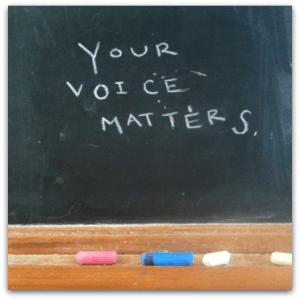
The Power of Voice

voice

By Mark E. Smith

What is the difference between speech and voice? Speech is the articulation of sound, and when those sounds are put together in a normative way, the ability to communicate audibly with others occurs.

However, speech in our lives is very different than voice. Speech is descriptive, whereas voice is emotive. Speech says what’s obvious, voice expresses what’s not. Speech says, My parents passed away when I was in my 30s. Voice says, Although my relationship with both my parents was never healthy, and I long ago came to terms with that, it remains a surreal thought over a decade later that they’re not on this Earth any more – the phone will never ring with a long-overdue call from either of them. Indeed, it’s voice that gives us the ability to express ourselves far beyond the basics of speech.

Interestingly, in knowing peers with progressive conditions – ALS, MS, and such – who “lose their speech,” they’ve often shared after moving to a communication device that it wasn’t the literal loss of speech that was so devastating, but the loss of voice – that is, the loss of communicating emotion to others. It’s one level to lose the ability to ask for a glass of water; however, it’s a profoundly deeper level to lose the ability to spontaneously say I love you to a spouse, or tell a daughter how proud of her you are. That’s voice.

Regardless of our situations, using our voice can likewise be a struggle. The foremost reason we squelch our voice – albeit in the intimacy of a relationship or the public venue of a stage – is out of fear of rejection. Why don’t we tell our partners how we’re really feeling? Why don’t we speak up in that class, meeting or crowd? Why do we prevent ourselves from expressing our voice – what we really want to say – in any circumstance?

The answer is, we fear the rejection that may come with using our voice. However, here’s what’s amazing: we’re never rejected in the end when it comes to using our voice. It may take initial courage to use our voice – sometimes stomach-wrenching courage – but the result is empowerment.

Now, using our voice can seem dangerous. Do I really want to tell my spouse I’m unhappy in our relationship? However, nothing can change unless we change it, and our voice is the ultimate tool for that. Situations may be difficult, but squelching our voice hurts us more. There’s nothing more empowering and liberating in the end than expressing our voice.

The other miraculous effect of voice is that it unites. Shame, guilt, embarrassment, sadness can all squelch our voice. Yet, using our voice to openly share the origins of such emotions can not only, again, liberate us, but can help others. We all have a common humanity, and we’re not alone in our experiences – but we can feel alone. Voice can be the bridge that not only connects us through shared adversity, but leads us through it. Voice allows us to hear someone else’s story and realize that it’s our story, too – we’re not alone.

Voice is among the most powerful tools that we have. Like all powerful tools, voice can seem scary to use. Yet, when we have the courage to use our voice in sincere, constructive ways, it’s life-changing – both for us and others. After all, when we share our voice, we share our common humanity.

Cerebral Palsy and Cigarettes

cigarettes

By Mark E. Smith

I don’t believe in self-confidence or ego. Those can waiver, be swayed or mislead us. What I believe in is self-comfort.

See, self-comfort is when we truly accept who we are, as we are, to the core – mind, body and soul. We’re comfortable with ourselves beyond all else. It doesn’t mean we’re full of ourselves or delusional. It simply means we know who we are, from the inside, out – and live as such.

And, it makes life so much easier and successful. Rather than wasting energy on trying to be what we’re not or invest in the opinions of others, we can simply thrive by being who we are. With self-comfort, we know our value, we know our favors and our faults, and we work with it all. Life need not be a struggle; it can be as easy and graceful as a leaf drifting in a breeze.

Being a teenager with cerebral palsy taught me this lesson young. I remember being a freshman starting high school, wanting to squelch every spasm, correct every slur in my speech – an overall fantasy of being someone I could never be. I had unbelievable anxiety on the first morning of school that year. The last person I wanted to be was “the kid with cerebral palsy” at my high school. I did an awesome job at covering up all my insecurities, though, by creating the most ridiculous smoke screen – literally. …I took up smoking.

At my high school, in those days, there was a smoking section, and as long as you could score cigarettes, you could smoke. So, as the initial weeks passed, I slowly merged in with the “tough crowd” in the smoking area After all, when it comes to insecurities, there’s strength in numbers. I bought a black leather jacket and biker boots out of the Sears catalog, stuffed my chest pocket with a Zippo lighter and a Marlboro Hard Pack, and my insecurities flipped into rock-solid confidence. Again, self-confidence and ego can fool even ourselves. In my insecure, skewed mind, however, I was a bad-boy in a power chair – right down to smoking Marlboros, no less.

However, as the school year went on, I realized that I didn’t need to be a so-called tough guy. As my classmates of all sorts embraced me, cerebral palsy and all, I didn’t need to hide behind a smoke screen or facade. I could just be me. I was a teenager with cerebral palsy, and if my peers accepted it, why shouldn’t I?

Ultimately, I gave up cigarettes, and fell in with the general crowd, focusing on my grades, girlfriends, and just being me, spasms, slurred speech and all. And, life was so much easier when I was comfortable truly being me. …But, I wore the leather jacket and motorcycle boots all the way through graduation because …well …they were awesome.