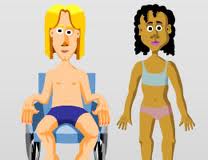
Wanna Watch Me Get Dressed?

By Mark E. Smith

Come on, someone’s said it to you. Maybe it was a friend, a colleague, or a love interest. And, admit it, you took it as a compliment.

Me, not so much. See, whenever anyone’s said it to me, I’ve struggled not to laugh, finding the sentiment genuinely funny, no matter how sincere the person has been when saying it: You know, Mark, I really don’t see you as disabled….

“Really, what part of this equation don’t you get?” I always want to retort, looking down at my body. ”…Never play the board game Clue because you’re the worst detective, ever!”

I’m a guy, with spastic cerebral palsy, who uses a power wheelchair – and, somehow one doesn’t see me as disabled. Really? It would be like me, at a “gentleman’s club,” saying to the dancer, You know, I really don’t see you as a stripper. …I mean, sure, you’re on stage, nude, accepting money from strange men; but, really, I don’t see you as a stripper – more like, say, a school teacher or an anthropologist.

Really, people don’t see me as disabled?

Look, I get the sentiment behind the statement – that the individual sees me as more than my exterior – but if that’s true, it should be self-evident in our interaction, not needing to be said. And, when someone says, You know, I really don’t see you as disabled, isn’t that really a paradoxical statement that says that they do see us as disabled? After all if one truly doesn’t see one’s disability, then the statement would never be made in the first place because the disability wouldn’t exist within one’s perception (call it a philosophical predication, if you wish).

Of course, I always want to turn the tables on the statement. Imagine if I was alone with a buddy, watching football on television, and I turned, looked my buddy in the eyes, and I said with a soft, sincere voice, You know, Frank, I really don’t see you as a man…. How long do you suppose it would take Frank to jump up from the sofa?

Or, how well do you suppose returning the sentiment to a love interest would fly? We’re cuddled up in bed, her supple hand on my cheek, and she whispers, “There’s something that I really want you to know – I really don’t see you as disabled….”

And, I begin kissing her neck passionately, and I reply in an breath-heavy voice, “And, there’s something that I really need you to know, I truly don’t see you as female….”

A lot of these Inspector Clouseaus are similarly – and, yet, completely contradictory – clueless as to how those of us with disabilities accomplish everyday tasks, as if it’s the Eighth Wonder of the World. Someone (who doesn’t really see me as disabled, of course), asked me how does one without arms or legs eat?

“With his or her mouth,” I answered.

“No, like how does he or she get the food to his or her mouth?” my friend asked.

“Levitation-based mind control,” I replied without blinking. “Floating freakin’ burritos – that’s what one eats when one has no arms or legs!”

Again, really? As adults, we’re somehow not smart enough to figure out that those who are quadruple amputees devise ways to eat – really? And, what gets me to no end is when those with disabilities, themselves, are the ones asking the most absurd questions. Logic tells me that because I’ve figured out how to live independently with a disability, so have many others with disabilities – therefore, there’s no mystery whatsoever in my mind how people get by in life, no matter one’s condition.

Yet, some with disabilities can’t seem to catch on to the concept that we all adapt and create pretty darn basic everyday living skills. One of the most common questions that I get asked by others with disabilities is, How do you get dressed? Really? Out of all of one’s problem solving skills, the one equation that’s unsolvable is how do I get dressed? …I always want to answer the question by asking, Well, how do you get dressed? Then, when they tell me the obvious – that they get dressed like everyone else! – I want to blow their minds with how I get dressed:

I had to rule out getting dressed standing up because I can’t stand up. So, because I can’t stand up in order to get dressed, I alternate between using high-class call girls (whom are strikingly reliable), and little people. Now, I know that using little people to get dressed may conjure up Santa’s elves stereotypes, but as long as I’m in a committed relationship with a woman of short stature – who so happens to be extremely attractive – it’s totally OK. However, when I can’t afford high-class call girls, or I’m not in a relationship with an extremely attractive woman of short stature, I have to opt for my last resort: I put on my pants, socks, and shoes while I’m on my bed, then I transfer into my wheelchair and put on my shirt. Does that answer your question, Detective Colombo?

OK, so maybe I’d better keep my retorts to myself. As absurd as the comments and questions are – You know, I really don’t see you as disabled or How does one with no arms or legs eat? – those uttering such words ultimately mean well. And, my giving any response besides, Thank you – that means a lot to me, or my seriously explaining how those of us with disabilities live independently, would almost certainly turn a well-intended moment into a creepy one really fast, sort of like sitting on the porch of a house in the country, on a warm moonlit night, and saying, You know, Malissa, I really don’t really see you as my cousin – wanna watch me get dressed?

Swallowing Swords: A Death-Defying Monologue

By Mark E. Smith

During my eighth-grade daughter’s summer vacation, she learned how to swallow a 20-inch stainless-steel sword. Now, that may sound a bit disturbing to you; but, don’t worry, she learned from two of the best sword swallowers around: Donny Vomit and Heather Holiday, headliners at Coney Island’s historical Circus Sideshow, where Mat Fraser, a noted international performer with a disability, also serves as Sealo the Sealboy each summer. And, in case you’re wondering, despite her pushed-up bosom, bull-ring nose piercing, tattoos, and sword swallowing, Heather Holiday is the type of sweet young woman who you could take home to meet Mother – if your mother is OK with sideshow performers, that is.

The story behind the story is that I took my daughter to the Sideshow, in fact, to see Mat Fraser – who has self-described flipper-like arms due to a birth defect – but we found studying sword swallowing via Donny Vomit and Heather Holiday to be a lot more interesting (those with disabilities are really just a dime a dozen these days, slowing down public transit and such as we make others wait for us to awkwardly maneuver our wheelchairs, as if we never get better at driving these things).

As it turned out, witnessing sword swallowing was a lesson that might serve my daughter well in life in more ways than simply working as a sideshow act – which, in my accountant’s opinion, would prove as a fiscally beneficial alternative to college, freeing up hundreds of thousands of dollars for me that I could then spend on a yacht or a 23-year-old girlfriend, or ideally both. See, as my daughter and I learned, there’s truly no trickery to sword swallowing. By tilting one’s head back, it creates a straight line from the throat, down the esophagus, right to the stomach – a nice human sheath for a sword to slip into. Of course, along the way, one has to be aware of the ever-so-minor detail of not tearing one’s heart or other vital organs by which the sword passes (27 sword swallowers have died in recent years by breaking this simple rule), but once the organs are cleared, it’s a straight shot down the hatch.

However, where the real challenge to sword swallowing comes in is in one’s mental capacity to block out one’s natural gag reflex, and then ignore the extreme discomfort of sliding a 20-inch sword down one’s esophagus – and make it appear pleasant and easy on stage. Sword swallowing, therefore, is less a physical skill, and more mind over matter.

Of course, my daughter never actually swallowed a sword, and expresses no interest in doing so – at least not until she’s 18 or when I’m not home. Yet, we both learned a valuable lesson toward mind over matter – that is, how we control our instinctive reflexes makes all of the difference when facing challenges in life.

I know all too well that in living life, not unlike sword swallowing, we need to move ourselves past any discomfort, and have the willpower to simply push through to the accomplishment, sometimes with a die-trying, sword-swallowing attitude. We need to be willing to go where others wouldn’t dare, where we’re willing to swallow our own metaphorical swords in pursuit of living to our fullest. Avoiding a challenge, giving up, or stopping short can’t be an option. It’s how we transcend from merely surviving to truly thriving. It’s how the sword goes from the tip of one’s tongue, to the pit of one’s stomach.

I’m celebrating my one-year anniversary of maintaining a rigorous diet and workout routine – a shift in lifestyle, really, from Twinkies and Southern Comfort, to nutrient bars and protein shakes. Despite my compulsions toward gluttony and binge drinking, I embarked on this path toward higher levels of physical fitness not because I was strikingly unhealthy or out of shape, but because I wanted to simply be a better me (though, I’ve long been remarkably stunning, as you may have noted by my perfectly deformed appearance), pushing myself physically and mentally farther, tackling swallowing yet another sword – and doing so without clipping an organ in the process, per se.

My biggest challenge – or should I say, nemesis? – has been my left arm. You’ll note that I do virtually everything with my right arm – no slight-of-hand or trickery involved – and I keep my left arm on my lap, hand between my knees, namely due to the effects of my cerebral palsy, but also because it’s cozy and warm. See, cerebral palsy is random in its physiological distribution – you might say, it has its own sick sense of humor – so it effects my left arm more than my right, limiting coordination. Fortunately, I’ve developed the larger motor skills in my left arm and hand over the decades for many independent living skills (except for that one favorite “skill” of us gentleman, if you know what I mean); but, overall, Lefty is an unwieldy fellow with a mind of his own.

In my workouts, however, I don’t allow my left arm any slack. If I do given sets and amounts of weight with my right arm, I hold my left arm to the exact same standard – Lefty has to literally pull his own weight, just like Righty. And, it proves little short of torturous much of the time, but, other times, just mocking. Ha ha, I’m Lefty, and you can’t control me – neener, neener, neener!

While my right arm has the coordination to blow through sets on my workout machine, it can be a workout in itself just trying to get my left hand to grip the darn bar (which is also why Lefty is of such little use for that gentlemanly compulsion, if you know what I mean), then I need to muster the coordination for my left arm to move through the workout rep as it spasms and contracts beyond my control. Then, once I fight through one rep, I have to do it all 49 more times, or however many more reps based on a given exercise. Inevitably, a set that takes three minutes with my right arm takes 15 minutes with my left arm – and it’s among the most frustrating, miserable processes ever. I crank up my iPod, shut my eyes, grit my teeth, and just fight through every spasm and contraction, pushing through the reps, no matter how agonizing – with a dose of angst toward Lefty that motivates me, of course. I refuse to let Lefty’s defiant behavior win, ever.

What’s intriguing, though, is a simple question: Why indefinitely torture myself with such a workout? Why not scale it back on my left arm? Or, why not just stop when my left arm seems impossible to control at times? After all, nothing in my life literally depends upon whether I do 30 reps or the full 60 with my left arm. No one’s watching, and there’s no consequence on my career, family, or health if I simply let my left arm have a little leeway. So, why not just do what’s reasonable and practical, and give myself some slack based on the very real limitations imposed by my cerebral palsy?

The answer is, reasonable and practical doesn’t get us ahead in life – a die-trying attitude does, where we’re not willing to give up, where we’re willing to ignore our gag reflex, and ease the sword down our throats, regardless of the discomfort. See, I figured out that my workouts serve as both a metaphor and precedent for other aspects of my life, that working out allows me to reinforce that I don’t care how difficult a challenge may be – I’m not quiting until I’m satisfied that I’ve met the goal, or die trying. It may be uncomfortable as the tip of the sword slides past my tongue, triggering my gag reflex, but I will move past it, till the sword’s tip touches my stomach, the handle against my lips, and my mind has won over matter.

Indeed, what I’ve learned from the principles of sword swallowing is that it’s not a physiological gag reflex that prevents 99.99% of people from swallowing swords, but our mental excuse reflex. Sword swallowers are simply willing to push themselves physically and mentally farther than others – they eliminate their excuse reflex, and just accomplish their goal, where they’re willing to die trying, so to speak.

No, I don’t suggest that anyone attempt sword swallowing – especially my daughter, and if she does attempt it, please don’t tell me (denial as a parenting skill works wonders). However, the mental techniques that sword swallowers use are ones that we should all apply to our lives, where we know that gag reflexes are really excuse reflexes, where we’re dedicated and bold enough to push beyond any hardships to reach the extremes of our potential, swallowing the swords of life, no matter how daunting they appear.