The Hidden Nature of Icebergs

By Mark E. Smith

The average iceberg is 90% under water – that is, only 10% of it is visible above the surface. When we know this fact, it becomes obvious why icebergs are so dangerous to ships: What’s unseen below the surface causes catastrophes like that of the Titanic.

Most people are a lot like icebergs, where we only see a very small glimpse of who they really are, where we never know what’s truly going on in their lives beneath the surface. Maybe they’re strangers among us in line at the grocery store, colleagues who we pass in the hall at work, or even friends and family members. Sure, we see their outer appearances, smiling and cordial, but we truly don’t know much past that superficial persona.

Interestingly, some of the most harrowing stories that I’ve ever encountered involved among the most poised people, where at a glance, their smiles and demeanor would never hint at the challenges that they faced. People have said to me, Wouldn’t it be great to have his or her life? And, I’ve thought, If you only knew the struggles that he or she faces beneath the surface….

I met one young lady in her early 20s who appeared to not have a care in the world – stunningly attractive and on the fast-track in her career – and everyone was envious of her at a glance. Yet, as she was gracious enough to share with me, her home life as a child was an abuse-filled nightmare, and now in her 20s, she’s raising her two little sisters because her step-father shot her mother, then shot himself. And, she lives with that reality 90% below the surface every day, moving forward the best that she can, with poise and a smile. How that 90% hasn’t pulled her under in life defies logic, and as I spoke with her, the best advice that I could offer was that I hoped that she’d slowly bring her 90% to the surface, where the appropriate people close to her could know of her struggles and thereby help, where she realizes that she’s not alone in facing life’s challenges.

In ways, we’re fortunate when among our foremost challenges is a physical disability, where it’s so in the open that we can’t hide it – an iceberg well above the surface for all to see. Of course, many with physical disabilities would gladly hide their disabilities if they could, but what’s not realized is that, again, it’s usually burdening when we hide much of ourselves from others. Truly, we’re fortunate that physical disability requires us to live bold lives, where as long as we’re interacting with others, they at least know part of our struggles in life – and there’s a refreshing candor and honesty to that, one to which many can relate. When others see our obvious struggles, it can often let them know that they’re not alone in facing life’s challenges, whatever they may be.

I’ve also witnessed how disability can put us more in tune with others, where we can often sense others’ struggles, where while we may only literally see 10% of the iceberg like everyone else, we still intuitively recognize something much deeper beneath the surface that needs embracing – a kinship of sorts.

I was in a tiny restaurant in rural Virginia, having dinner late one night with several volunteers who were working the disability awareness program with me at the National Boy Scout Jamboree. We had a lot to talk about, so it was a long dinner. Throughout the evening, the waitress who served us was polite and courteous, but I learned nothing about her except for her name, Tiffany. Yet, there was something about Tiffany that made an impression on me, something that I couldn’t define.

By the time we were ready to leave the restaurant, my group was the only one left, and my colleagues finally made their way out the door, leaving me behind fiddling with my wallet and phone, finishing my soda. As I spun my wheelchair around to head out of the door to catch up with my group, Tiffany came up to thank me for being a customer, and she put out her hand to shake mine.

“Everyone hugs Mark,” I said, smiling, a line that I always use, opening myself up for a hug.

Tiffany, without hesitation, stepped forward and hugged me. And, what caught my attention was that she didn’t just hug me and step back; rather, she hugged me for several moments, and when she finally stepped back, she was sobbing to the point that she grabbed a napkin off of the table, and wiped her eyes.

“I’m sorry,” she said with an awkward laugh. “…Typical woman.”

“Don’t be,” I said, putting my hand on her forearm. “If I told you everything is going to be OK, would you believe me?”

“I know,” she said, wiping her tears. “You know, it’s just hard sometimes.”

“And, we get through it,” I said. “Been there, done that – we get through it.”

I backed my wheelchair into the door, and pushed it open, rolling in reverse. “You’re going to get through this, Tiffany, I know you will! …We all do,” I said, rolling out the door as she just smiled and waved, watching me leave.

I had no idea who Tiffany was beyond her waitress role, or what issues she was facing in her life. However, clearly there was some sort of vying in her life, and what touched me was that, for a brief moment, we both acknowledged that challenges that are intrinsic to all of our lives – the icebergs just below the surface. Was it my disability, or my offering a hug that suddenly brought her iceberg to the surface? Probably a little of both, along with her presumably having a really bad day, where, again, for reasons I’ll never know, she was particularly emotional. No matter, I’m thankful that I extended a hug at the right place, at the right time, and made a very authentic connection, letting a seeming total stranger know that she wasn’t alone, as it likewise reminded me that I’m not alone in my struggles.

People are so darn scared to be authentic, to show any more than 10% of themselves. Likewise, we’re scared to look beyond the 10% of others, where when we say, Hi, how are you?, to colleagues in the hall, we truly aren’t seeking a sincere answer – but, we should be. Now, I’m not saying pour your heart out to your boss or to strangers in line at Wal-Mart – there’s a right and wrong time for everything. However, at some point, on a larger scale, we need to be willing to open up ourselves more to those around us, where we’re not afraid to expose or recognize more than 10% in each other. In hip talk, take chances and be real with others – you’ll be amazed at the way it changes your interactions for the better.

During your day, you likely cross paths with a lot of people, where your only initial glimpse of them is of that superficial 10%. Make an effort to look a little deeper – in others and yourself – to where you’re bold and brave enough to truly connect with others, where you’re reminded that we’re all in this often cold sea of life together. Indeed, when we’re open enough to share the 90% of each other that really counts, our perceptions of each other most often change for the better, not unlike witnessing the stunning depth and beauty of icebergs hidden beneath the surface. All you have to do is look for them – they’re there.
I’m Going to Eat Your Heart

By Mark E. Smith

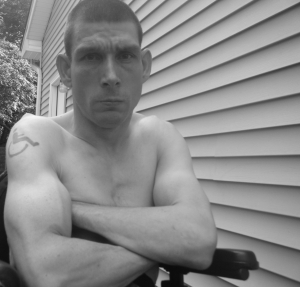
One couldn’t say that I have an anger management problem by any stretch. In fact, I’m among the easiest-going, happy-go-lucky guys around – very little ruffles my feathers. But, that doesn’t mean that I’m not fearless – arguably to an absurd point – where I won’t grab a guy by the shirt who’s being a jerk in public, welcoming a little scrap with another dude when called for.

I’m sure that my brother helped instill fearless bravado in me when we were growing up. After all, it makes no intrinsic sense for me, as a guy with cerebral palsy, using a power wheelchair, to be the one guy in a scene to grab a jerk by the collar, pull him into my spit-firing, vein-bulging face, and tell him in words that I can’t use here that if he doesn’t settle down, I’m going to rip off his limbs and eat his heart while it’s still beating. See, my brother and I are six days less than a year apart, and we were raised very much like twins, right down to always having the same clothes and toys. In a psychoanalytic way looking back, I think that we were both always trying to distinguish ourselves from each other – and that included via never-ending brotherly brawls.

For better or for worse, it never seemed to matter that I had cerebral palsy and my brother didn’t – when we fought, we really fought. In no mixing terms, we beat the heck out of each other, both playing on our strengths, as well as the other’s vulnerabilities. He knew that he could punch me and run, and as long as I couldn’t catch him, he would win, leaving me with a black eye, busted lip, or such. Yet, I knew that if I got my hands on him, he wasn’t getting away – I’d throw my good, strong right arm around his neck, and try to choke the life out of him. I know that child psychologists frown upon sibling rivalries nowadays – and I don’t tolerate such violence among the kids in my own family, where I’m always reprimanding my two nephews for antagonizing each other – but, when my brother and I were kids, duking it out seemed par for the course.

As adults, my brother and I laugh about it all now, and joke about how inherently bold it made both of us. After all, in my brother’s case, if he’s beat-up a kid with cerebral palsy, that’s probably not a guy scared of punching just about anyone. And, in my case, as a kid with cerebral palsy raised to give and take punches, an absurd fearless toward fist-to-cuffs has stuck with me, as well. In fact, my buddy, Jeff, and I inadvertently ended up in the front row of a concert not too long ago, and when the drunk idiots around us started going nuts, bumping into me, I started swinging. Jeff seemed a bit concerned at first, but once I grabbed and punched a few people – and the crowd figured out to stay away from this guy in a power wheelchair – Jeff seemed a bit reassured that I wasn’t going to get us killed. I suppose people figured that if I was crazy enough to be in a mosh pit in a wheelchair, swinging on people, they should probably just stay away from me.

Now, my brother and I are both successful in our careers, with kids of our own – living as wholesome, law-abiding, God-fearing citizens – and neither one of us are the types hanging out at country-n-western bars looking for fist fights (beyond my inadvertently ending up in a mosh pit, that is). However, my one short fuse relates to jerks in public, especially those disrespecting women – and I’ve become bolder in my reactions since raising my daughter. I have zero tolerance for guys disrespecting women in public – guys gawking, making inappropriate comments, or such – and I have no qualms about straightening out the situation in real time.

Word must have gotten around about my short fuse because I was out with a female friend, and she commented to me that a creepy guy was staring her down. However, before I could turn around and see who it was – and impulsively roll over and pick him up by his shirt – she asked me not to do anything, not wanting a scene. I did as she wished, didn’t move, and continued with our conversation. However, I wondered how she knew that I was the kind of guy who would create such an over-the-top scene, that I wouldn’t have any hesitation about grabbing a guy by the shirt and explaining to him in four-letter words how to act around ladies in public?

A few days later, I asked my friend how she knew that I was immediately ready to roll over and grab the guy by his shirt? She said that she recognized me as the protective type, and when she saw me intuitively go for my power wheelchair’s joystick, ready to spring into action, she knew to talk me down quickly.

I’ve always wondered what has gone through the minds of those few individuals over the years who I’ve confronted regarding their poor behavior? When a well-dressed guy with cerebral palsy, using a power wheelchair, rolls up to you, and says things into your ear that could never be said in a PG-rated movie – adding up to, If you don’t leave right now, I’m going to rip your heart out and eat it as an appetizer – what really goes through your mind? Or, on the few occasions when my words weren’t convincing enough, when I’ve literally picked them up by their shirts, what were they thinking as the weight came off of their feet, as I pulled them over my armrest, into my contorting face?

The real question is, how have I not been beat-up by now? (Heck, I would have beaten myself up by now!) I reckon that the answer is a combination of factors. Firstly, every guy I’ve dealt with was either really drunk, or a slender creep – both of which have been surprisingly easily manhandled. Secondly, I think there’s some shock to having a cartoon-looking guy in a power wheelchair, with cerebral palsy, grab you by your shirt and threaten to eat your heart – why take the chance of second-guessing a guy like me who’s seemingly crazy enough to confront you? Thirdly, my strength and appearance has to freak them out, where I’m strong to begin with, and when I spasm, it’s then unbridled strength (I broke the arm off of a 250 lb. chest press machine, when the weights were maxed-out, simply by spasming), so it has to be unsettling to be tossed around, seemingly uncontrollably, by a guy in a wheelchair going spastic with such force, where I’m breathing like an angry bull, trying to control the both of us. (As cerebral palsy comedian, Josh Blue, puts it, if a guy with cerebral palsy gets mad, someone’s going to get hurt by the palsy punch, and no one’s sure where it comes from or where it’s going, especially the guy with cerebral palsy!)

Nevertheless, there’s always a chance that a guy could start swinging on me – and I’d be fine with that. In my adult life with cerebral palsy, I’ve taken some hard falls, with bell-ringers to the head, so I don’t doubt that I could withstand a close-quarters punch to the head or two. I might even be flattered by the equality of it – at least until the third punch sent me snoozing into Lala Land. But, the goal, much like with my brother when I was a kid, has to be for me to never let it get to the third punch. Again, in theory, like a boxer holding his opponent close, as long as I’ve got my hands on him he’s not going anywhere. And, if he wanted to take me to the ground, a 400 lb. power wheelchair is going with us, and since I’m strapped in, I’m likely not the one it would land on.

Ultimately, though, my absurd, in-your-face antics toward jerks in public are arguably foolproof: No matter how jaded our society, if people see an able-bodied guy trying to fight a guy in a wheelchair in public, some bigger dude is going to knock his lights out for picking on a guy in a wheelchair – there’s still that stigma that you shouldn’t punch a guy in a wheelchair. So, no matter what creeps do in public to tick me off, they’re going to have a tough time winning in the end – which is why I’m always courteous enough to offer them the opportunity to leave before I tear their pulsating, blood-dripping hearts from their chests and eat them (or before they’re torn apart by an angry mob for beating the daylights out of me, a poor, defenseless guy in a wheelchair).